
How can an RIA get clients from ChatGPT and AI search?
An RIA cannot make ChatGPT recommend it on demand. Start with verifiable firm facts, useful answers, indexable pages and a way to measure qualified inquiries.


An RIA cannot make ChatGPT recommend its firm on demand. It can make its public facts easier to check, answer questions its ideal clients actually ask, and measure whether those steps lead to qualified inquiries. That is a better plan than chasing a supposed AI ranking trick. It also works when a prospective client finds you through a person, a directory, or a conventional search result.
Key takeaways
- You cannot force an AI recommendation; you can make your public facts verifiable and answer the questions your ideal clients actually ask.
- An AI mention is not a lead - your site, your proof, and your contact route still have to convert the visit.
- Fix verifiable facts first: who you serve, what you do, where, credentials, fees, and how to reach you.
On this page
- What must a prospective client be able to verify?
- How do you find out what an AI answer says about your firm?
- What should you publish for a real client question?
- Does a technically sound page guarantee an AI citation?
- Should you seek outside mentions and directory profiles?
- What does published research say about why some firms get named?
- How do you measure whether the work brought clients?
- What can you test in 30 days?
- What if you are not named after a month?
- Where this plan has limits
- Where Valora fits
- The bottom line
- The bottom line
- Frequently asked questions
Start with the distinction that matters: an AI mention is an observation in one answer. It is not an inquiry, a meeting, or a client. A firm should improve its public evidence and contact route even if its name never appears in the prompt you tested.
What must a prospective client be able to verify?
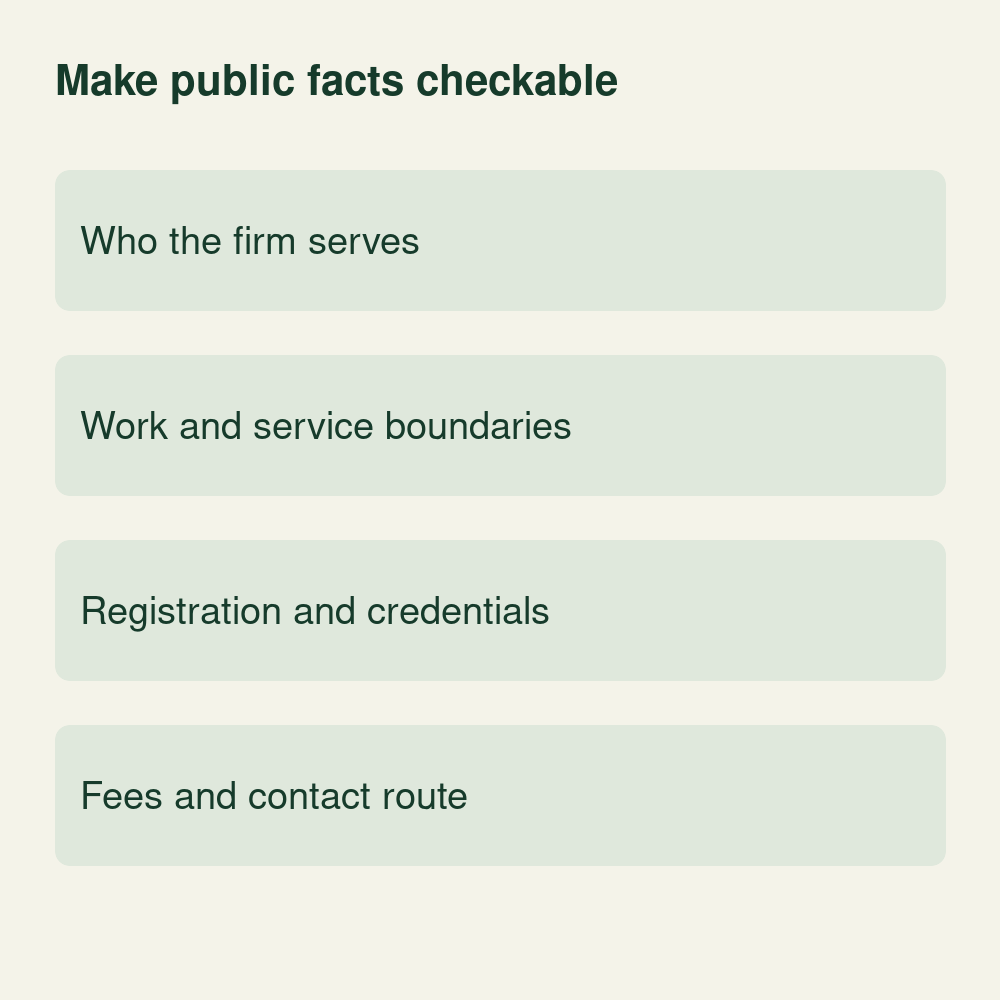
Write down who you serve, the work you do, where you can serve clients, your registration and credentials, your fees or fee approach, and how a person can reach you. Put that information on the firm site in ordinary language. Compare it with public records and any profiles you control. The Investor.gov guide to IAPD shows how a person can check investment advisers and their filings. Your marketing copy should not describe a credential, location, or service more broadly than the underlying facts allow.
For example, “comprehensive planning for everyone” tells a reader little about fit. An actual firm that works with federal employees approaching retirement might explain which retirement decisions it handles, what it does not handle, and whether it serves people outside its home state. This is an illustrative description, not a real firm or a claim that the wording will trigger an AI recommendation. Your own specialty must be one you can substantiate.
How do you find out what an AI answer says about your firm?
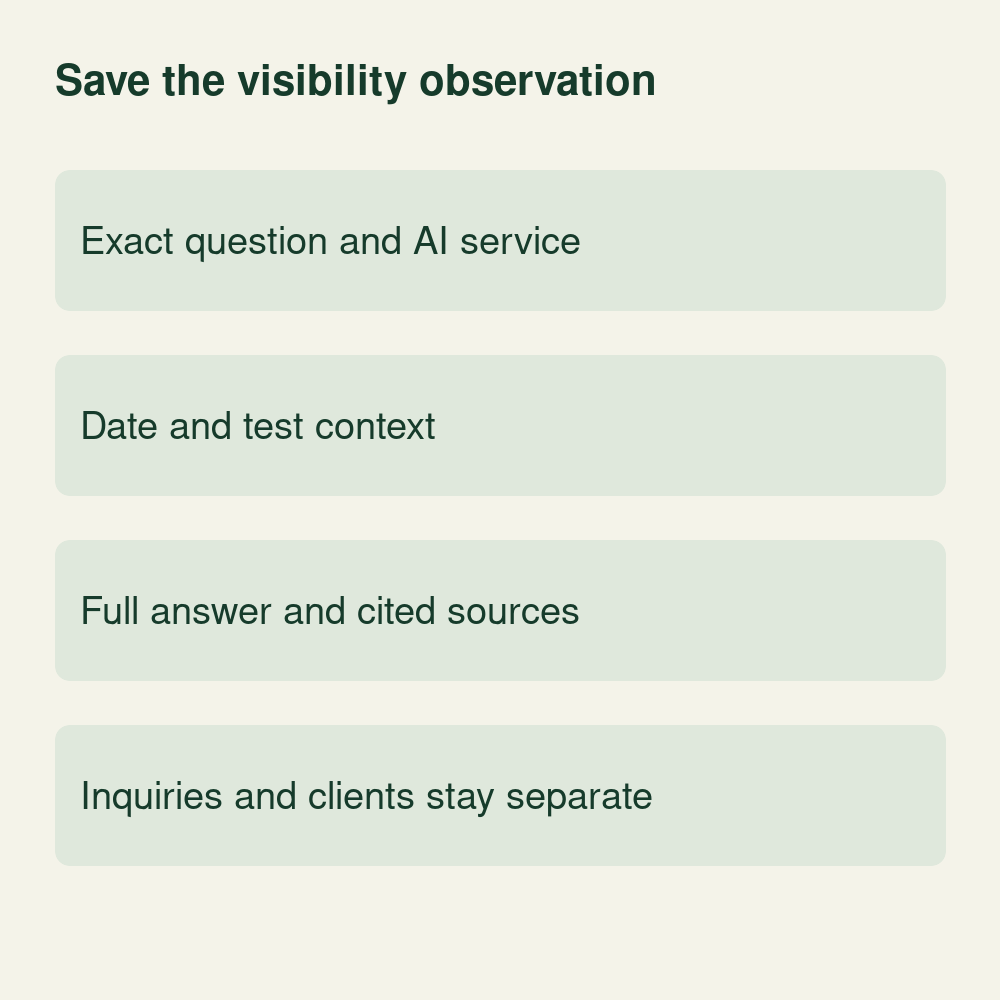
Choose a small, fixed set of questions your ideal client might ask. Include an adviser-selection question and a question about the planning problem you solve. Record the exact wording, AI service and model if shown, date, location or account context, the full answer, cited sources, and any firms named. Repeat the same questions later under comparable conditions. A screenshot or full saved answer is stronger evidence than a link to a temporary chat that may expire.
Read the result as a diagnostic. If the answer gets your firm's address or services wrong, first check your own site and the public profiles you can correct. If it does not name your firm, ask whether the prompt even describes a client you serve. Do not infer a precise ranking from one test. Responses can differ across prompts, systems, places, and times. Our guide to correcting wrong firm facts starts with the source of a mistake rather than a guess about the model.
What should you publish for a real client question?
Choose a question you heard in an actual client or professional conversation, remove identifying details, and answer it directly. Explain what changes the answer, link to the relevant primary sources, and make clear when a person needs advice about their own facts. Review regulated claims with the right person at your firm. A service page explains what you offer; an article answers a question. Do not publish near-identical city or occupation pages just to increase your page count.
Google's guidance on AI-generated content focuses on accuracy, quality, and value to readers; scaled pages that add no value can violate spam policies. That guidance is about Google Search, not a secret recipe for ChatGPT. Kitces' advisor AI-search analysis also argues for specific, useful expertise and clear positioning. Treat that as practitioner analysis, not a measured conversion promise.
Checking your own visibility? Run the free readiness check - it shows whether AI search can find and recommend your firm today: Can ChatGPT find your firm?
Does a technically sound page guarantee an AI citation?
No. A page can be live and still be hard for search systems to discover. Check that the intended page is accessible, has a self-consistent canonical, is not blocked or marked noindex, and appears in an appropriate sitemap. Link to it from a relevant page on your site. If you use Search Console, inspect the exact URL and separate “discovered,” “indexed,” and “shown in an answer.” Those are different states.
Google's documentation for AI features says a supporting link in its AI features must meet normal Search requirements, including indexing and snippet eligibility. It also says no special AI file or markup is required for those features. That does not establish how ChatGPT chooses a source. Google Search and ChatGPT are different products; do not turn documentation for one into a claim about the other.
Should you seek outside mentions and directory profiles?
It can help a person find and check your firm when an association, publication, or directory accurately describes your work. Choose places your client group actually uses. Check each directory's eligibility and cost before joining, and keep its information current. Contribute an article or answer only when you know the subject. Never buy reviews, manufacture independent coverage, or promise that a mention will cause an AI system to name you.
The point of outside context is trust for a human reader. It may also appear as a cited source in some AI answers, but whether it does is an observation to test, not an outcome to sell. The difference matters when you decide how much time to spend.
What does published research say about why some firms get named?
Ahrefs' May 2025 analysis of 75,000 brands found a Spearman correlation of 0.664 between web mentions and Google AI Overview visibility in its selected sample. Its December 2025 follow-up found YouTube mentions had the strongest measured correlation, about 0.737, across ChatGPT, AI Mode and AI Overviews. These are observational associations, not causal levers, recommendations or client-acquisition results. Sources: Ahrefs May study; December follow-up.
The GEO research presented at KDD 2024 tested content changes on its GEO-bench query benchmark. It reported source-visibility gains of up to 40% under its metrics, with results varying by domain. This does not establish an advisory-firm client-acquisition effect or reveal the algorithm of a commercial AI tool. Sources: GEO paper.
Ahrefs' May 2025 dataset contained about 55.8 million AI Overviews observed in desktop results across 590 million keywords in its index. Those are keyword-result observations, not 590 million individual consumer searches, and do not establish lost clicks or advisor hiring behavior. Sources: Ahrefs desktop-keyword analysis.
LumenGEO, a vendor, reported a July 2, 2026 snapshot using 130 matched queries and 3,292 citations across Perplexity and ChatGPT's web-search-enabled Responses API. The observed source sets differed. This is not a consumer-UI study, proof of how either product's algorithm works, or a forecast for an advisory firm. Sources: LumenGEO vendor snapshot.
For a research-first walkthrough of the same playbook, see our companion article: How to get your firm recommended by ChatGPT and Perplexity.
How do you measure whether the work brought clients?
Keep a simple chain: page drafted, page live, indexed if verified, AI mention if captured, inquiry received, fit confirmed, meeting attended, and client signed. Give each stage a date and a source. Ask actual inquirers how they found you, and avoid counting the same person twice. Our inquiry guide explains why a form submission alone is not a qualified prospect.
Do not label all search traffic as AI traffic. Google says visits from its AI features are included in the overall Web search type in Search Console; that view does not by itself isolate AI Overview clicks. Referral data from another service can be incomplete too. The strongest evidence that this work helped is a real, source-attributed conversation with someone your firm can serve.
Done researching? The free readiness check shows whether AI search can find and recommend your firm, and you can reach the team straight from it: Can ChatGPT find your firm?
What can you test in 30 days?
- Week 1: Write your actual client-fit sentence. Compare your site with your registration and controlled profiles. Save a baseline set of exact prompts and full answers.
- Week 2: Correct inaccurate facts and broken contact paths. Check the canonical, access, and indexability of your important pages.
- Week 3: Publish one reviewed answer to a question your client group asks, and link it from the relevant service or resource page.
- Week 4: Re-run the same prompts, then review real inquiries. Keep AI mentions, page traffic, qualified meetings, and signed clients in separate columns.
For SEC-registered advisers, the SEC marketing rule guide explains limits on misleading statements, testimonials, endorsements, and related records. Compensation for an endorsement can be non-cash. State-registered firms should have their reviewer check applicable state rules. This article is a marketing test, not legal advice.
What if you are not named after a month?
Do not buy a promise of placement. Check whether your public facts are accurate, your answer page helps a real person, your prompt matches the clients you serve, and your site lets a visitor take the next step. Keep the baseline and test again after a real change. A firm that is clear and checkable has improved something useful even before any model names it.
If you run an advisory firm and want a bounded review of what your public website says about you, request Valora's free AI-search readiness check. It reports what it found and could not verify; it does not promise an AI mention, referral, or client.
Where this plan has limits
This is the slow plan, not a trick: public facts and useful answers compound over months, and no honest person can promise a timeline. A firm that needs clients this quarter should run this alongside the channels that already produce conversations, not instead of them.
Where Valora fits
We run this playbook for advisory firms - verifiable facts, answer-first content, monthly visibility measurement. The free readiness check is the first measurement: Can ChatGPT find your firm?
The bottom line
You cannot make ChatGPT recommend your firm. Verifiable facts, useful answers and a clear contact route are work to test, not a promise of appearing over time. Re-run the same questions and keep mentions, inquiries, suitable meetings and signed clients separate.
Frequently asked questions
1. Can an RIA make ChatGPT recommend it?
Not on demand. What you can do is make your public facts easy to verify, answer the questions your ideal clients actually ask, and measure whether those steps produce qualified inquiries.
2. Is an AI mention the same as a lead?
No. A mention is an observation in one answer on one day. It becomes a lead only when a person acts on it, so your site, your proof, and your contact route have to convert the visit when it happens.
3. What should an RIA fix first for AI visibility?
Verifiable facts: who you serve, what you do, where you can serve clients, registration and credentials, fees or fee approach, and how to reach you - in ordinary language, consistent with public records like your IAPD filing.
Want to see whether AI search can find and recommend your firm? Run the free readiness check - and if you want to talk it through, you can reach us straight from the results: Can ChatGPT find your firm?



