
How should an RIA choose which public documents belong in an answer engine?
Review public disclosures and educational PDFs by purpose, version and access. Use a checklist without mistaking a public document for a citation or advice.


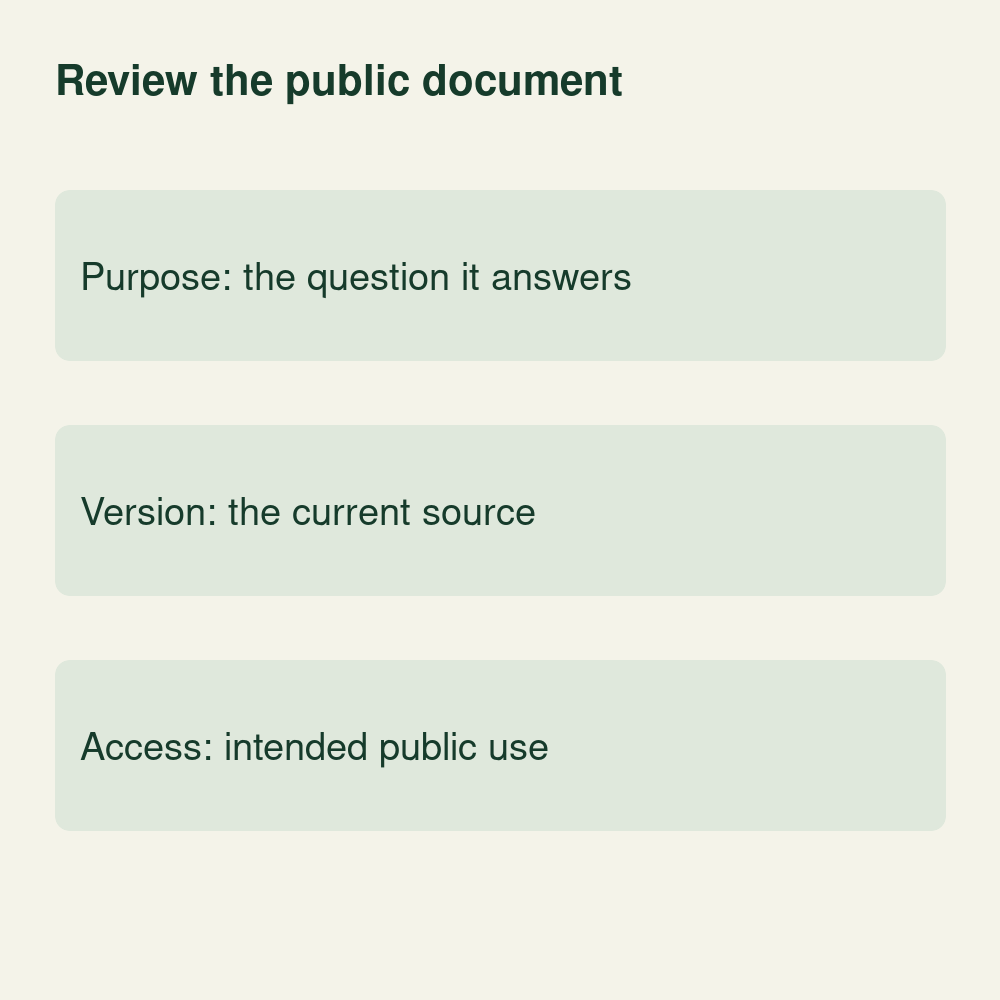
An RIA should put a document into its public answer set only after checking its purpose, current version, public-access status and connection to a real reader question. A public filing, an educational PDF and a client-only record are different kinds of material. The useful document is one a reader can understand and verify without confusing an example with advice or a disclosure with a recommendation.
This is a publication-review framework, not a legal conclusion about any firm's disclosure duties. The official sources below were checked on October 3, 2026. Qualified reviewers should assess the firm's actual documents and obligations before publication.
What job should the document do?
Start with the question the reader needs answered. Then decide whether the document supplies evidence, explains a process or gives a worked educational example.
A firm might have a plain-language service explanation, a public disclosure and a general planning checklist. Each can be useful, but their roles differ. The checklist is not a substitute for a disclosure. The disclosure is not a promise that the firm is suitable for every reader.
Write one sentence describing the document's purpose. If that sentence needs several unrelated decisions, a short web explanation may be more useful than asking the reader to interpret a large file. Keep the original source available where appropriate rather than replacing its meaning with a convenient excerpt.
Do not publish a document solely because an answer engine might find it. The reader needs a useful reason to open it. A file added without context can make the site's information harder to reconcile.
How should a public disclosure be handled?
Treat the disclosure as a source with a defined purpose, version and scope. Do not turn public availability into an endorsement or a personalized recommendation.
Investor.gov's Form ADV brochure bulletin describes narrative disclosures about advisory business practices, fees, conflicts and disciplinary information. Its explanation is a starting point for understanding the document, not a certification that a particular firm's copy is complete or applicable to a reader.
The IAPD investor bulletin describes the public disclosure database and access to a firm's current filings. Use the actual current filing when a factual explanation depends on it. A saved copy or an old page title is not proof of the current version.
Keep the context visible if you point to a filing from an educational page. Explain what the reader can check there without claiming that registration means the regulator recommends the firm. The SEC's endorsement investor alert makes clear that the agency does not endorse firms or services. Have the responsible reviewer reconcile public descriptions with the actual source.
This article does not list delivery deadlines, filing thresholds or every required disclosure. Those are separate questions for qualified review. The publication worksheet only helps identify which source and version are being used.
Does a PDF automatically belong in an answer engine?
No. A file format can be supported without a particular document being indexed, selected or useful to quote. Do not collapse those stages.
Google's supported-file documentation lists PDF among the formats it can index. That is a capability statement, not proof that the firm's PDF is indexed. Google also describes how content type and file handling affect its interpretation.
Google's AI-feature guidance connects supporting-link eligibility to Search indexing and snippet eligibility. It does not say every eligible document will be chosen. Nor does it establish how every other answer engine will use the same file.
Give the technical reviewer the exact URL and intended public document. Check that an unauthenticated reader receives the correct file, that the text is readable and that the page linking to it explains its purpose. A successful download is only one part of the evidence.
What context should sit beside the download?
Tell the reader what the file is, who produced it, which version it is and what question it can answer. Keep the limits close to the explanation.
A fictional educational worksheet can say that it illustrates a general planning process and does not select a transaction. A public service document can identify the reviewed scope without inventing an available appointment. A disclosure link can tell the reader what information is found in the filing.
Do not rely on a vague footer to undo a confident claim near the download. If an example uses assumptions, make them visible where the example appears. If a source is dated, say so rather than presenting the title as a current conclusion.
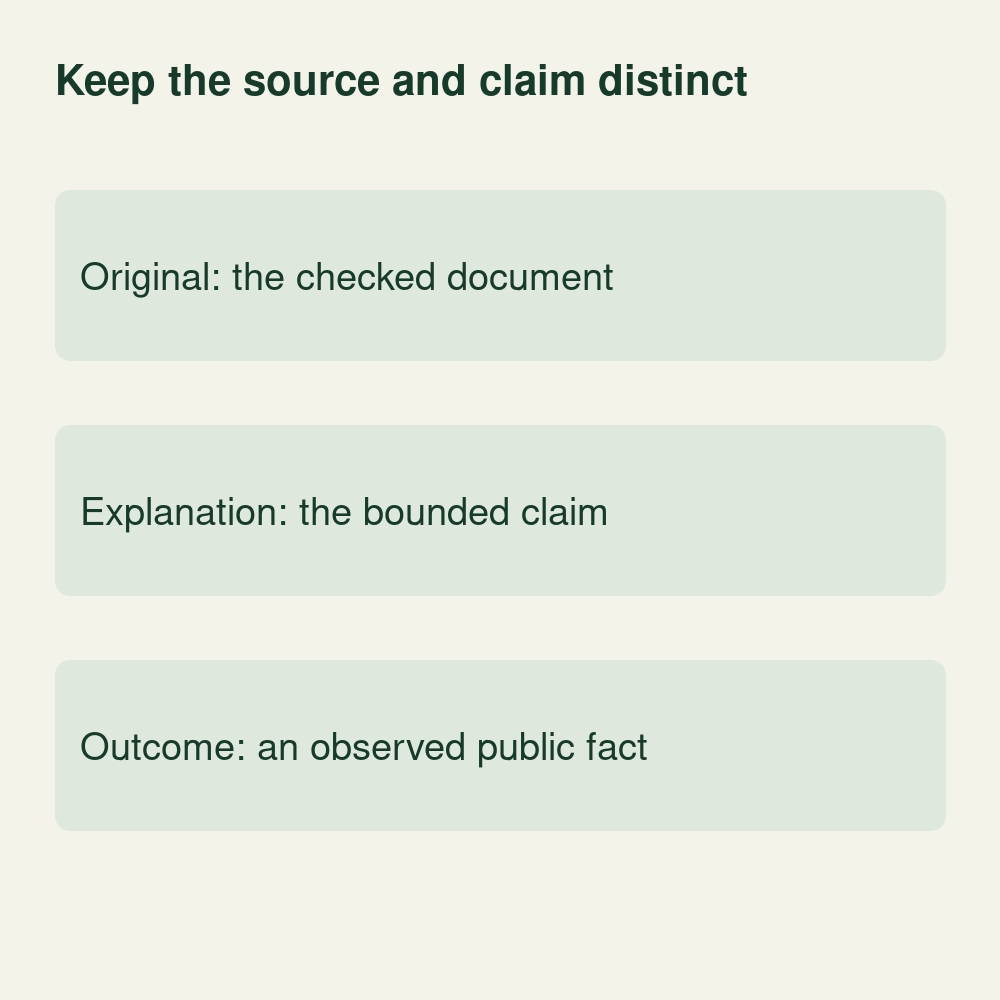
Preserve the distinction between the original document and the site's explanation. A reviewer should be able to compare them. A shortened passage that removes an important condition can mislead even when its remaining words came from a real source.
What belongs in the public-document checklist?
Use one row per candidate document. Keep the owner decision separate from the access and source checks.
The public-document answer checklist
| Document and purpose | Source and version | Access and context check | Decision and limit |
|---|---|---|---|
| A public filing used to explain firm facts. | The current authoritative filing and its date. | The exact public source link and a clear explanation of what it contains. | Qualified review reconciles the claim; public filing is not an endorsement. |
| A general educational PDF. | The named author, checked sources and version. | Readable text, intended public URL and visible assumptions. | Publish only reviewed general content; do not present it as personalized advice. |
| A service explanation. | The firm's verified current scope and responsible reviewer. | The explanation agrees with the relevant public sources. | Do not turn an old brochure into a current availability claim. |
| A worked example or checklist. | The stated assumptions and source basis. | The limit sits with the example, not only elsewhere on the site. | Keep the example fictional and the unresolved decisions visible. |
| A saved or duplicate copy. | The authoritative original and whether this copy still matches. | The reader can identify the current version and source. | Flag stale copies for review; this worksheet does not authorize a redirect or deletion. |
| A client-only or confidential record. | The appropriate private record and access owner. | Reviewed authentication and authorization, not a public download. | Exclude it from the public answer set; do not expose real client details to test access. |
This is an original editorial organizing aid. It does not certify compliance or approve the release of any real document. Keep the publish decision pending when source currency, authority or public access remains unclear.
Why should private records stay outside the set?
Public answer collections are the wrong destination for confidential client material. A crawler preference is not a security boundary.
Google's robots.txt introduction explains that crawler rules do not enforce behavior for every crawler and that a disallowed URL can still appear in Search. It describes password protection and other controls for different purposes. Do not treat a robots entry as permission to place client records at a public URL.
Use synthetic files for a technical access test. Have the appropriate security owner review authentication and authorization. This article does not choose a storage service, audience or disclosure method for the firm.
If the document's public status is uncertain, stop the publication decision. Do not resolve uncertainty by assuming that an email attachment, shared folder or publicly reachable link was meant for every reader.
How should the collection be reviewed after publication?
Recheck the exact public link and the explanation together. A source change can leave an otherwise working download misleading.
Record the version and check date so another reviewer can recover what was used. If the document or source changes, flag the affected explanation for an in-place review. A publication routine should not assume that a still-working URL has unchanged meaning.
Use the indexability guide for the broader page-access and indexing checks. Use the crawler-purpose comparison for search, training and user-retrieval controls. The claim-review ledger helps track the statement built from the document.
Keep the outcome record modest. A public document, an indexed document, a cited document and an inquiry are separate observations. A useful collection gives the reader a current source and an honest explanation, not a pile of files presented as visibility proof.
Frequently asked questions
Does a supported PDF format guarantee an AI citation?
No. A supported format, successful download, indexing and an observed citation are different stages.
Can a public filing replace a clear service explanation?
A filing and a service explanation have different jobs. Reconcile the explanation with current authoritative sources and keep the filing context visible.
Should old copies be redirected or deleted immediately?
No. Identify the authoritative version and flag stale copies for review. This checklist does not authorize a merge, redirect or deletion.
Can robots.txt protect a client-only PDF?
Do not treat a crawler preference as access control. Private records need reviewed authentication and authorization.
Does this checklist certify disclosure compliance?
No. It is an editorial organizing aid. Qualified reviewers assess the actual documents and obligations separately.



