
How should an RIA write a value proposition a prospect can test?
An RIA value proposition should name the people, problem, service and first step a prospect can verify.


An RIA's value proposition should let a prospective client answer four questions before booking a call: Who do you serve? Which problem do you help with? What does the work look like? How can I check whether your firm is credible and a fit? A sentence that says "personalized financial planning for every stage of life" answers none of them. A useful statement makes the work visible, without promising a financial result that the firm cannot substantiate.
Key takeaways
- Name a real client situation and a specific service, then show what the first step involves.
- Make fit testable with scope, fees, credentials, process and the kinds of questions you can answer. Do not invent client outcomes or imply that every person with a profession needs the same advice.
- Review the proposition against actual client work and compliance records. A narrow but false claim is worse than an honest broad one.
Why does a generic promise fail before the first call?
Financial advice is hard to inspect in advance. A prospect cannot pick up a financial plan the way they can inspect a physical product. Kitces has described this as a core marketing problem for advisers: their service is intangible, and a website often gives a prospect little basis for comparison. [1] Another Kitces discussion separates the prospect's early search for general trust from the later decision that a particular adviser can solve their problem. [2]
Imagine a physician who changes jobs and has compensation, retirement-plan, and insurance questions. "Comprehensive wealth management" does not tell that physician which questions your firm handles, whether you work with physicians, or what a meeting would produce. "We help employed physicians organize the financial decisions around a job change, including retirement-plan choices and insurance coverage; our first meeting is a fit conversation, not a plan" is more informative, but only if that describes your actual practice. It promises a conversation and names topics, not an investment return.
This is not a recommendation to choose physicians as a niche. The example illustrates how a prospect can tell whether to read on. If the firm works across several client situations, state the shared decision that joins them rather than pretending to have a specialty.
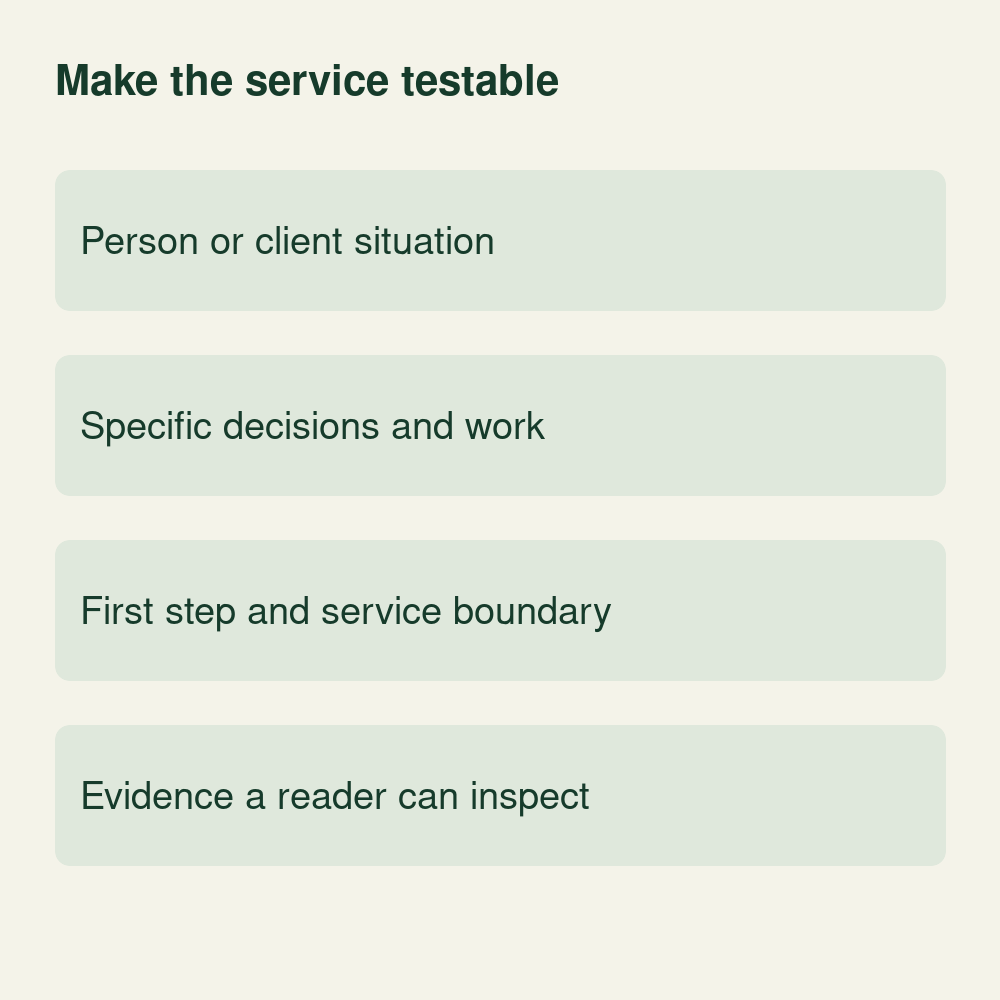
What four parts should the statement contain?
Start with the person or situation. A job change, business sale, inherited assets, or a new retirement date is more actionable than "families and individuals." If your practice serves a defined profession, say so only when the firm's experience and services support it. A profession is not a substitute for a problem. Two people with the same job can need very different advice.
Then name the work in plain terms. "We compare the options for an old workplace retirement plan and map how the choice interacts with your broader plan" says more than "holistic solutions." Do not imply legal or tax advice if your firm does not provide it. State where coordination with the client's lawyer or tax adviser begins.
Third, explain the first step and the service boundary. Is the first meeting a fit call? Is a written plan a separate paid engagement? Do you manage investments, provide one-time planning, or work on an ongoing basis? A prospect should not need a sales call to discover that a service is not available. Fees and minimums should be easy to find where applicable; if a fee varies by scope, explain how it is determined rather than inventing a single price in the headline.
Finally provide evidence a reader can inspect: names and credentials the firm is entitled to use, a clear service page, accurate firm and professional registration details, a sample of the process that does not expose clients, and consistent facts across the website and public profiles. The SEC's IAPD resources can help a prospect research an investment adviser, but a registration lookup is not an endorsement or a guarantee of quality. [3]
How can you draft the sentence without a slogan?
Use a working pattern, not a template to publish unchanged:
We work with [client situation] on [specific financial decisions]. Our [defined service] starts with [real first step], so you can decide whether [scope and fit criterion] makes sense for you.
For example: "We work with owners preparing for a business transition on decisions about cash flow, investment policy and what happens after a sale. We start by mapping the decisions and identifying which questions need a tax or legal specialist, then agree on the scope of any planning engagement." This is hypothetical copy, not a description of Valora or any specific firm. An actual RIA should rewrite it around services it truly delivers, review it under its compliance process, and avoid implying that it orchestrates outside professionals unless it does.
A firm with no narrow client niche can still be clear: "We offer ongoing financial planning and investment management to households navigating retirement decisions. A fit call covers your questions, our service scope and our fees before either side decides to work together." The statement becomes stronger when the linked page explains how planning and ongoing service actually work.
What should a skeptical prospect be able to verify?
Test the proposition as a reader. After seeing the homepage and one service page, can you answer these questions?
- What kind of situation does the firm understand, and what does it not claim to handle?
- Who does the work? Are their names, roles, credentials and registration details accurate?
- What happens in the first conversation, and when would a paid relationship begin?
- What is included in the service, what is excluded, and how are fees explained?
- Does the public bio or service page support the headline, rather than contradict it?
This is a clarity test, not a checklist that proves conversion. A reader might still choose another adviser. Kitces' discussion of the prospect's decision process suggests that referrals and other initial trust signals often need a credible website to reinforce them; it does not establish that changing one headline will cause a measurable client gain. [2]
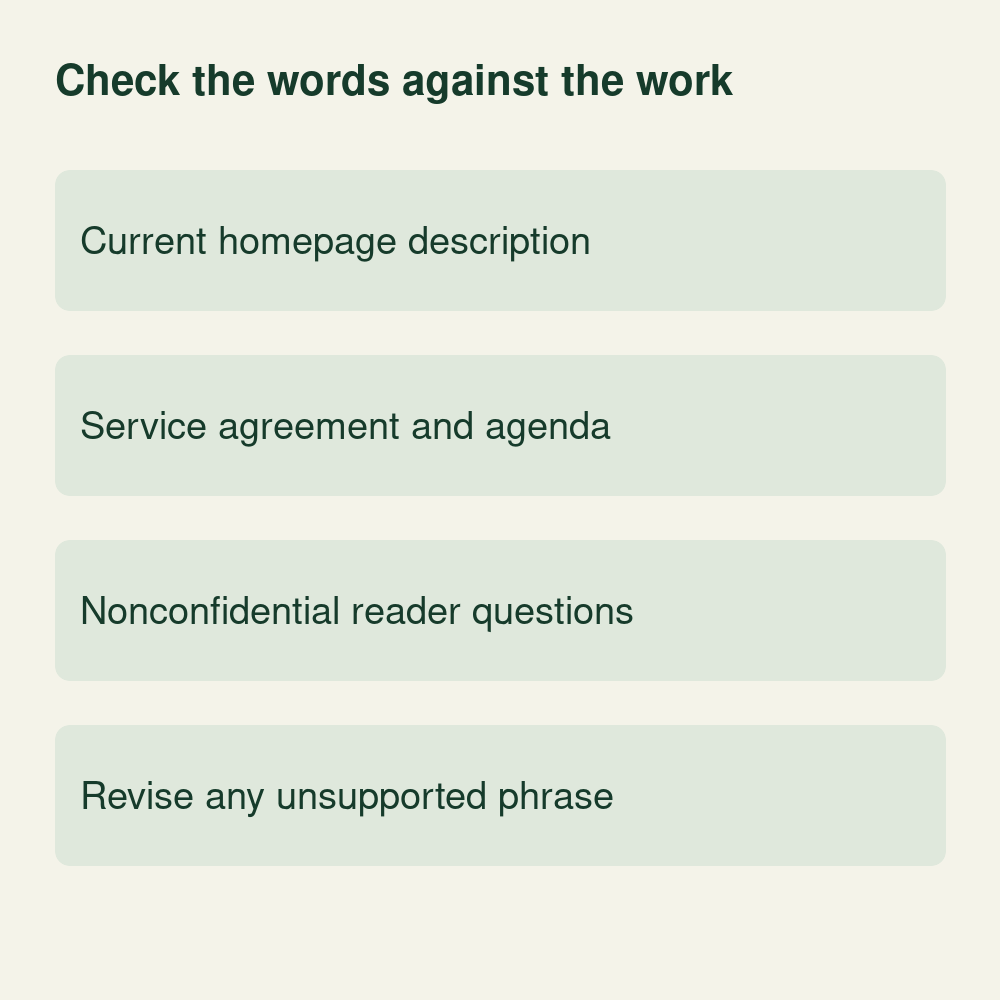
One useful exercise is to put the current homepage sentence next to the service agreement, the client meeting agenda, and recent nonconfidential client questions. Mark every phrase that would surprise a current client. If "integrated tax strategy" is not in the agreement and the adviser only refers tax work out, revise the phrase to show coordination, if that is what really happens.
Should the proposition name a niche?
Only when it changes the service in a meaningful way. Serving a profession may affect compensation, benefits, timing, and the other professionals involved. The value is not the label "we serve doctors." It is the firm's ability to describe the decisions those clients actually face and the work it offers around them. Kristen Luke's Kitces article argues that a niche can narrow the audience and make marketing more targeted; that is an argument for fit, not proof every narrow niche is commercially viable. [1]
For a related check, see our guide to testing a niche against the planning work.
A firm can test a focused service page before rebuilding its entire brand. Start from observed questions and real capacity. Publish a page that explains the work; ask relevant prospects whether it answers their first questions; record where people still need clarification. Do not fabricate experience, credentials, or prior results to make the page sound mature. If there is not enough real experience to make the claim, choose a broader truthful statement and build the specialty through actual work.
Where should the claim appear on the site?
Place a short version near the top of the homepage and a fuller explanation on the relevant service page. The About page should identify the people and explain how they work; it need not repeat a homepage slogan. The contact form should ask only what is needed to assess fit and should not imply a client relationship has begun. For one reader, the path may be homepage to service page to About page; another may arrive directly on a question-led article. Use consistent words for the service and avoid a different identity on every page.
For a related check, see our guide to choosing what belongs on the About page.
If the statement relies on a credential, testimonial or endorsement, check that it meets applicable rules and firm policies. The SEC marketing rule addresses, among other things, misleading statements, testimonials and endorsements, substantiation and required disclosures. [4] This article is an editorial framework, not legal advice. An RIA's compliance team should review its exact copy, records and distribution context.
How should you measure whether it helps?
Define a small, inspectable funnel. Record which page or source brought an inquiry, whether the person described a problem the firm can address, whether a meeting was held, and whether a client relationship eventually began. Keep those stages separate. A rise in page views does not prove better-fit inquiries; a booked meeting is not a client. With a handful of inquiries, a one-month comparison can be noise.
Read the actual questions people send. If prospects repeatedly ask whether the firm offers one-time planning, the site probably has a clarity problem even if traffic is steady. If unsuitable inquiries continue, ask whether the headline, service page, form and directory profiles disagree. Treat these as hypotheses to check, not a claim that any particular rewrite will lift conversion.
A practical review takes one page at a time: capture the current copy and date, change a specific ambiguity, keep the service description accurate, and revisit the inquiry log after enough time to learn something. Do not replace the whole site every time a week is quiet.
Where does Valora fit?
Valora is working on ways for advisers to make their firms easier to find and understand. A truthful proposition is a prerequisite: discovery does not help if the description is vague or overstates the service. Valora is testing an advisor acquisition program; it has not established that a rewritten page yields qualified introductions, meetings or signed clients.
If you want to check how your firm currently appears in AI answers, request an AI-search readiness check. A point-in-time review may show examples of what an assistant says. It is not a forecast of leads or clients.
The bottom line
A value proposition is a testable description of a firm's fit and work, not a superlative. Name the client situation, the decision, the service and the first step. Back every claim with something real on the site and in the firm. A prospect who is not a fit should be able to learn that early; one who is a fit should know what to ask next.
Frequently asked questions
Is "fiduciary" enough to differentiate my RIA?
No. It may matter to a prospect, but it does not explain the work, the service scope or why your firm fits a particular problem. Explain what the firm will do and let readers verify registration and disclosures. Do not use a legal label as a substitute for details.
Can I use a testimonial as proof?
Possibly, but not casually. Testimonials and endorsements can trigger conditions under the SEC marketing rule, including disclosure, oversight, disqualification and recordkeeping requirements depending on the circumstances. Have the firm's compliance process review the exact use and context. [4]
What if I serve more than one type of client?
Describe the shared decision or service, then give accurate examples for the distinct situations you actually handle. You can use separate service pages when the work genuinely differs. Do not create doorway pages that swap profession names while saying the same thing.
Should I promise a result in the headline?
Only if a claim is truthful, appropriately qualified and substantiated. A process description is usually more useful than an unsupported outcome promise. Do not imply investment performance, a tax result, or client acquisition certainty that you cannot establish.
How often should I revisit the statement?
When the service, team, fee model or clients change, and when real prospect questions show a gap. Keep a dated copy and review the entire page, not just the first sentence. Repeatedly changing a headline without a hypothesis makes it hard to learn anything.
Sources
[1] Kristen Luke, Kitces.com, "How To Conquer The 3 B's Of Marketing Differentiation" (2022): https://www.kitces.com/blog/unique-value-proposition-choose-niche-financial-advisor-marketing-strategy-attract-clients/
[2] Sydney Squires, Kitces.com, "How Prospects Choose A Financial Advisor: 3 Ways To Show Value" (2026): https://www.kitces.com/blog/prospects-information-seek-financial-advisor-marketing-value-proposition-decision-making-social-media-seo-newsletters/
[3] SEC, Investor.gov, "Investment Adviser Public Disclosure" (IAPD): https://adviserinfo.sec.gov/.
[4] SEC, Investment Adviser Marketing compliance guide: https://www.sec.gov/resources-small-businesses/small-business-compliance-guides/investment-adviser-marketing



