
How to evaluate a marketing firm for your advisory firm: 5 questions that separate qualified prospects from vanity metrics
An advisor evaluating six marketing firms asked the right questions - and most firms can't answer them. The five questions that separate qualified prospects from vanity metrics, and what a good answer sounds like.


Evaluate an advisor marketing firm on its defined output, total cost, evidence of results, the work required from your team, and the fit with your service. Define a qualified prospect in writing before comparing offers. Ask for references and inspect the agreement rather than treating views, contact details or a provider's claims as proof of new clients.
Those five questions are the whole evaluation. A marketing firm that survives them is worth a proposal call. A firm that gets vague on any of them has told you what you needed to know. Here is each question, what a good answer sounds like, and the math that decides the last one.
Key takeaways
- Judge marketing firms on qualified prospects, clients, and AUM - never on views, leads, or engagement. The first set is pipeline, the second is applause.
- Kitces reported a $3,119 average acquisition cost in its historical 2020 advisor sample; 83% was imputed adviser time. Include your own hours when comparing a quote.
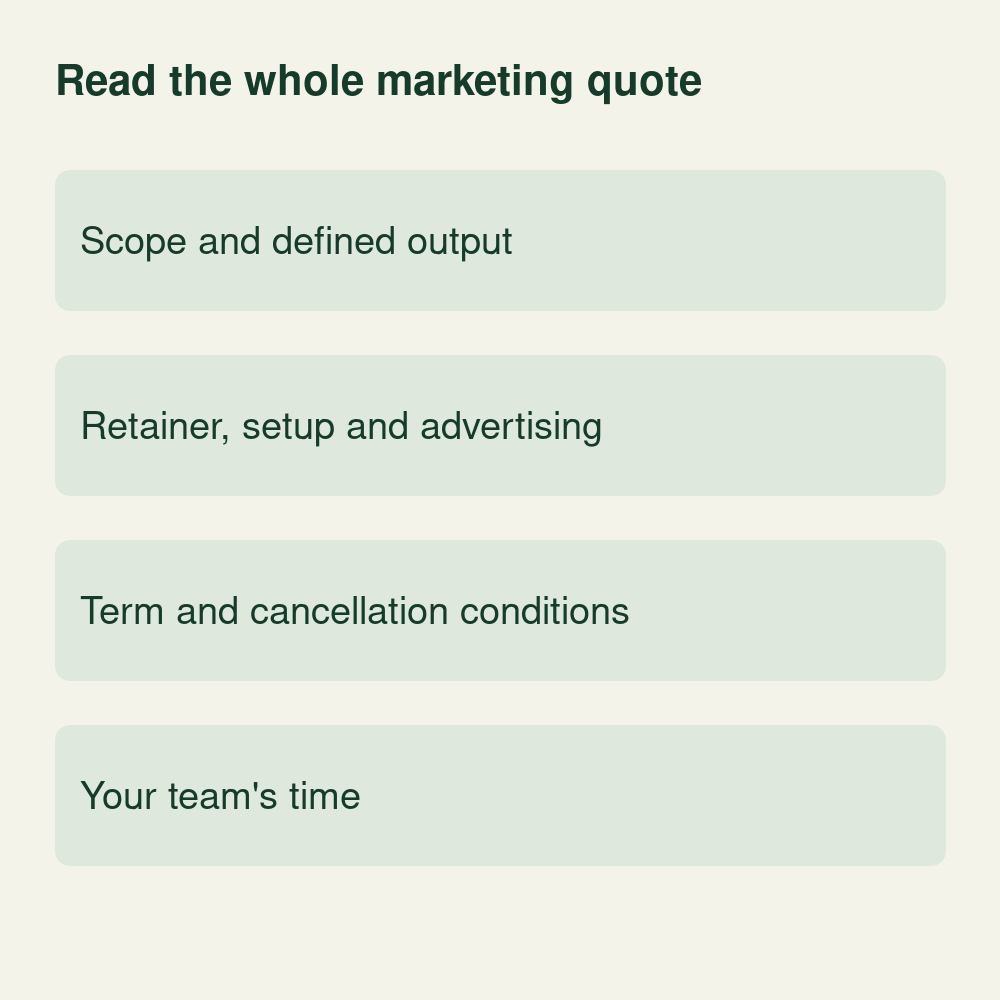
- Request a current written quote with retainer, setup, ad spend, required hours and cancellation terms. A promised client count is not evidence of a future result.
- Compare all-in acquisition cost with both gross revenue and profit. At an assumed annual 1% fee on $2 million, gross revenue is $20,000 a year. A $3,119 acquisition cost equals about 1.87 months of that gross revenue; profit payback cannot be calculated without the margin.
On this page
- Will they deliver qualified prospects, or mostly views, leads, and engagement?
- What should you expect to spend, including ad spend?
- What results should you demand - appointments, clients, or new AUM?
- How much work should the firm require from you?
- How do you decide whether it was worth it?
- What changes when you target $2M+ households?
- Where this framework has limits
- Where Valora fits
- The bottom line
- The bottom line
- Frequently asked questions
Will they deliver qualified prospects, or mostly views, leads, and engagement?
This is the question that ends most evaluations early, because the industry runs on vocabulary. A "lead" can mean a person who downloaded a PDF in 2022. "Engagement" can mean your own employees liked the post. Neither one pays a bill.
Define qualified before the sales call, in writing: the prospect's needs fit your work, they can receive your services (right state, right fee model, any asset minimum), and they have agreed to a real next step. Our guide to what counts as a qualified inquiry walks through building that definition. Then ask the firm, in these words: "How many qualified prospects, by my definition, did you deliver to your last three advisor clients, and can I talk to one of them?"
A good firm answers with numbers and references. A weak one answers with case-study screenshots full of impressions.
What should you expect to spend, including ad spend?
Compare current written quotes by scope rather than treating a broad monthly range as representative of the market. Include setup, advertising, term, cancellation conditions and your team's hours. Our lead-generation comparison is a starting list to verify, not a price-population study.
Kitces reported an average acquisition cost of $3,119 in its historical 2020 sample of more than 800 advisers: $519 in hard-dollar spending and $2,600 in imputed adviser time, about 83% of the total. Compare the invoice plus your hours; do not assume the sample split is your own.
What results should you demand - appointments, clients, or new AUM?
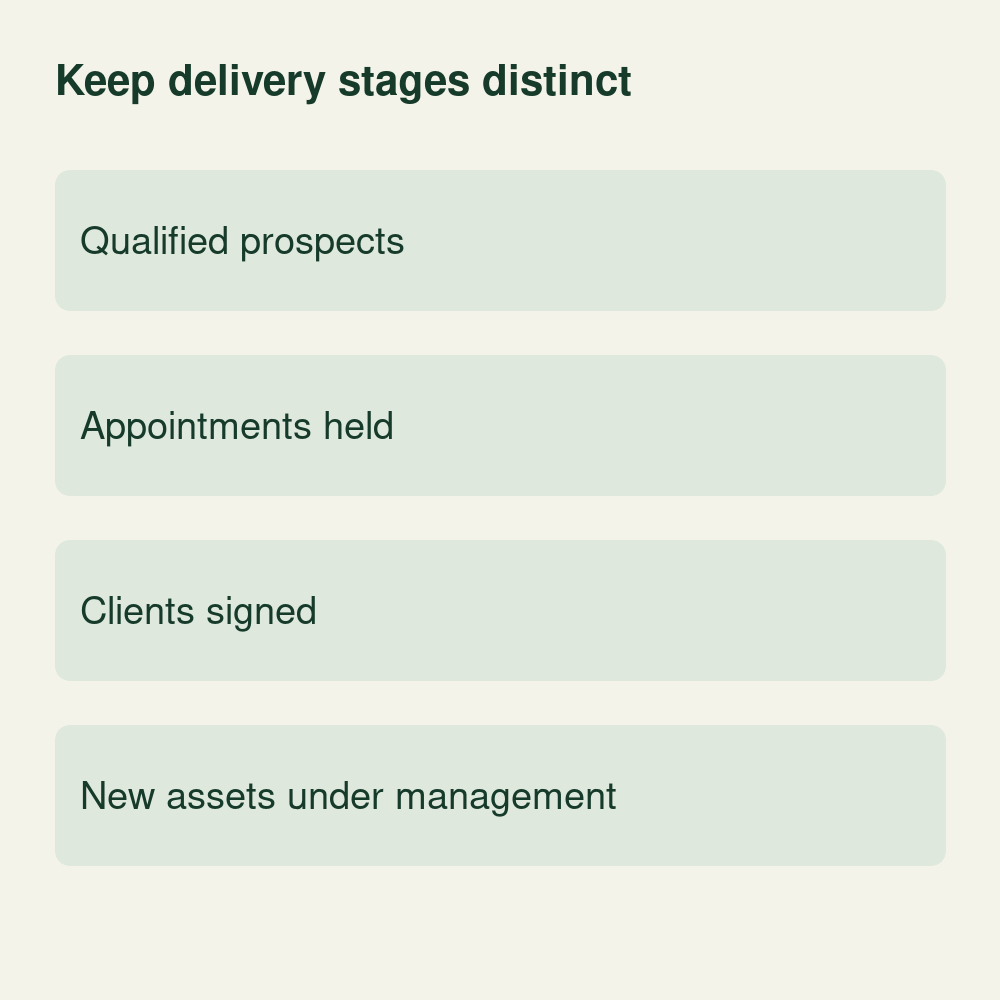
Report results in a ladder, and insist the firm reports the same way: qualified prospects at the bottom, appointments held above that, clients signed above that, new AUM at the top. A firm can move the bottom rung quickly and honestly believe it is winning while nothing reaches the top.
In the historical 2020 Kitces sample, third-party marketing consultants averaged $25,403 per acquired client and social media on its own averaged $11,937. These channel averages are not a forecast for a provider or your firm. Ask for evidence linking activity, qualified inquiries and signed clients.
Doing this math for your own firm? Request the free readiness check. A completed readiness review can show examples of how your firm appears in AI answers at the time of the check. Request a review: Can ChatGPT find your firm?
How much work should the firm require from you?
Adviser time accounted for 83% of acquisition cost in the historical 2020 Kitces sample. Ask how much weekly work a provider requires from your team and include its value in the comparison. A done-for-you label does not establish the total cost or the time it will save.
Ask for the time budget in writing: hours per week for recording, reviewing, approving, and meeting. Then multiply by your honest hourly value and add it to the fee before comparing firms. The cheapest retainer on paper is often the most expensive one on your calendar.
How do you decide whether it was worth it?
Use a review window that fits the actual sales cycle and available records, not a universal six-month minimum. Add fees, ad spend and the value of your hours, then divide by attributable signed clients. If there are no signed clients, report the cost and open pipeline separately rather than calculating a finite cost per client.
For an illustrative annual 1% fee, $2 million produces $20,000 in gross annual revenue and $250,000 produces $2,500. A $3,119 acquisition cost equals about 1.87 months of the first amount or 1.25 years of the second. A $10,000 acquisition cost equals six months of $20,000 gross annual revenue. These are gross-revenue coverage calculations, not profit payback: servicing costs, margin, timing and retention are not specified. The $3,119 figure is a historical Kitces survey average reported February 10, 2020, not the cost your firm should expect.
What changes when you target $2M+ households?
In Ficomm Partners and Absolute Engagement's early-2026 survey of 1,000 investors who currently work with a financial advisor, 8.7% reported using an AI tool to help find their advisor. That share was 25.3% among respondents under 45 and about 15% among those with $5 million or more in investable assets. In Wealthtender's 2025 survey of 500 U.S. adults with household incomes over $100,000 who plan to hire an advisor within five years, 96% said they would still research an advisor online even if the advisor came highly recommended. This measured stated plans, not observed behavior or a before-contact timeline.
For a $2M+ practice, weight the channels that survive a careful prospect: verifiable public facts, content that demonstrates how you think, presence in the places AI engines read, and warm introductions. A firm pitching you volume - thousands of leads, mass ad campaigns - is pitching the wrong physics for this market. Ten qualified conversations with the right households beat a thousand form fills from the wrong ones.
Where this framework has limits
Five questions cannot see inside a firm's delivery team, and references are chosen, not random: every vendor's happiest client sounds great. Treat this as a filter that gets you to a shortlist, then run a small paid pilot with its own measurement before signing anything long. And the CAC figures above are averages from one research program - your market, niche, and sales skill will move your real numbers in both directions.
Where Valora fits
Valora is testing a way for financial advisors to build a more measurable client-acquisition system across LinkedIn outreach and AI-search visibility. Request the free readiness check. A completed review can show examples of how your firm appears in AI answers at the time of the check. We are still validating the path from visibility and outreach to qualified introductions; ask us how the founding advisor program is structured. Request examples from a completed review: Can ChatGPT find your firm?
The bottom line
Evaluate marketing firms the way the advisor in that community did: qualified prospects, real spend, real results, your hours, and the worth-it math. Any firm that answers all five with numbers earns a pilot. Any firm that answers with adjectives earns a pass.
Source and method: Kitces' February 10, 2020 article describes a survey of more than 800 financial advisors. Acquisition cost includes hard-dollar marketing spend and the imputed value of adviser time. These historical sample averages are not current prices or forecasts for a firm. Read the Kitces 2020 analysis.
Frequently asked questions
1. How much do advisor marketing firms cost?
Compare the actual quoted retainer, setup, ad spend and your own hours. The historical 2020 Kitces sample attributed 83% of its $3,119 average acquisition cost to adviser time; that is a reason to include time, not an estimate of your current total.
2. What is a good cost per client for a financial advisor?
In the historical advisor sample reported by Kitces in 2020, the reported average was $3,119 per client. At an illustrative annual 1% fee on $2 million, gross annual revenue is $20,000; $3,119 equals about 1.87 months of that gross revenue. On $250,000, gross revenue is $2,500 a year and coverage takes about 1.25 years. Profit payback needs a margin and servicing-cost assumptions.
3. How do I know if a marketing firm's leads are qualified?
Define qualified in writing before you buy: the prospect's needs fit your work, they can receive your services, and they agreed to a real next step. Then ask the firm for qualified-prospect counts against that definition from their last three advisor clients, plus a reference you can call.
4. Should an RIA hire a marketing firm or do marketing in-house?
Compare the provider fee plus your time with the cost of doing the same work internally. Kitces attributed 83% of acquisition cost to adviser time in its historical 2020 sample, but your split may differ. Judge payback using profit from actual signed clients and the required service, duration and retention assumptions.
Want examples of how your firm appears in AI answers? Request the free readiness check. A completed readiness review can show examples of how your firm appears in AI answers at the time of the check. Request a review: Can ChatGPT find your firm?



