
How to Find High-Intent Leads Before Your Competitors
Timing beats volume. How to find high-intent leads at the moment they are ready, before your competitors see them.


Use relevant public signals to decide which potential clients deserve a closer fit check, not to assume someone is ready to buy. A change in role, business circumstances or engagement can provide context for a relevant message. Verify the context, respect contact preferences and measure actual conversations separately from the signal that prompted them.
Key takeaways
- Public changes and engagement provide context to verify, not proof of readiness to buy.
- Check fit and contact preferences before outreach.
- Measure signals, replies, meetings and signed clients separately.
On this page
- 1. LinkedIn Engagement Signals
- 2. Website Visitor Intent Signals
- 3. Company Growth and Hiring Signals
- 4. Funding and Business Expansion Signals
- 5. Competitor and Industry Engagement Signals
- Step 1: Understand the Signal
- Step 2: Personalize Around the Trigger
- Step 3: Follow Up Based on Engagement
- Where signal-based selling has limits
- Where Valora fits
- The bottom line
- The bottom line
- Frequently asked questions
Hiring, funding, repeated visits or public questions can suggest a topic worth checking. None establishes that a person has a buying need, controls a budget or wants contact.
A small team can begin with a short list of relevant public changes and record what it could verify.
Use a signal as context for a fit check, not evidence of permission or a reason to assume an outreach message is welcome.
The workflow below is a way to test relevance and timing; it does not establish a higher conversion rate.
What Are Buying Signals?
Buying signals are actions or changes that indicate a prospect may have a current need, interest, or business challenge related to your product or service.
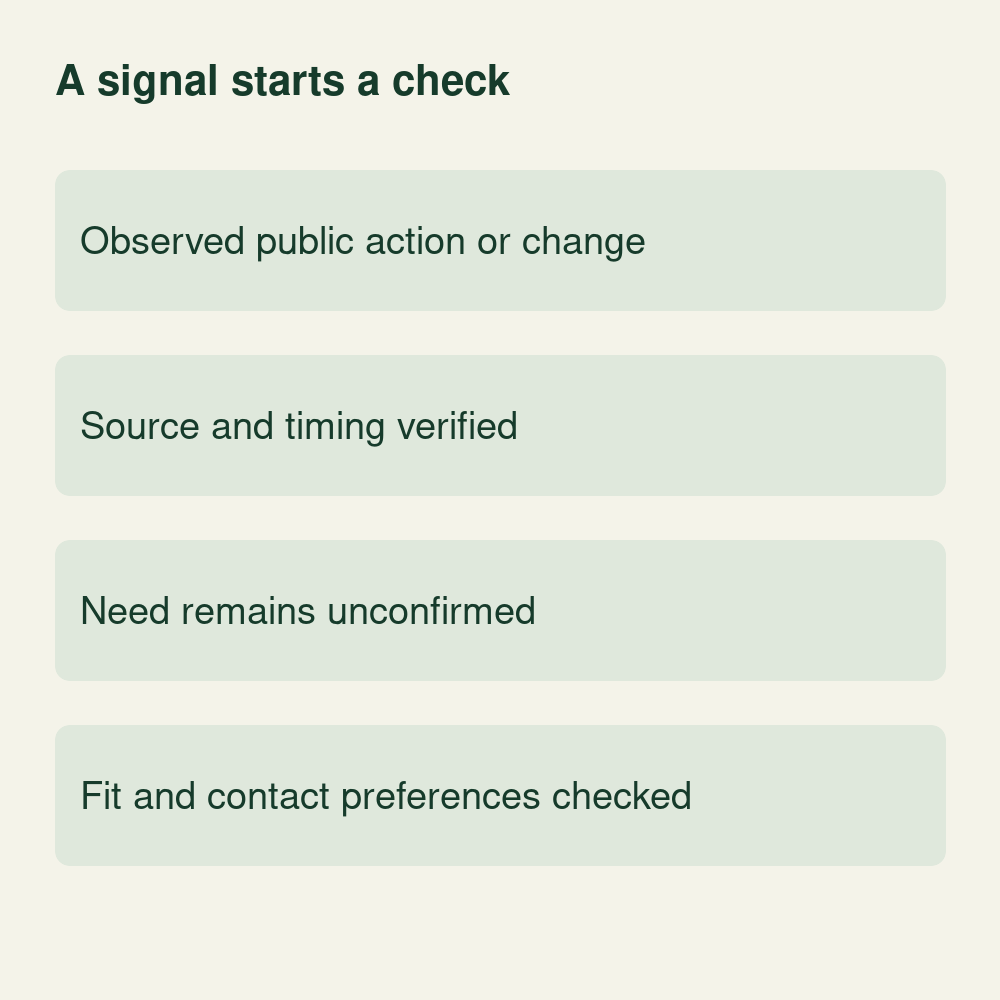
Use each signal to ask what is known and what remains uncertain:
- What topic the observed activity concerns
- What need remains unverified
- What source and timing you can confirm
- Whether a relevant contact would be welcome
Examples of buying signals include:
- Engaging with relevant LinkedIn content
- Visiting your website multiple times
- Hiring for roles related to your solution
- Announcing company growth or funding
- Changing technology providers
- Mentioning a problem your product solves
- Interacting with competitors
The goal is simple: reach out when the timing makes sense.
The Most Valuable Buying Signals to Track
1. LinkedIn Engagement Signals
LinkedIn activity can provide public context about a topic someone chose to discuss. It does not establish buying intent or rank as the strongest intent source without supporting evidence.
Signals worth monitoring include:
- Commenting on industry discussions
- Engaging with your company's posts
- Following your employees or executives
- Sharing content related to your solution
- Posting about business challenges
For example, someone commenting on posts about improving outbound sales processes may be actively looking for ways to improve their sales pipeline.
The key is context.
A relevant interaction can suggest a question to ask, but it does not prove that the person is shopping for your service.
What to do:
Prioritize prospects who engage with topics related to your product. Start conversations by referencing the specific discussion rather than immediately pitching.
Example:
"Saw your comment about outbound teams struggling with personalization at scale. Curious if that's something your team is currently exploring?"
The example references a public discussion; whether it leads to a conversation is an outcome to measure.
2. Website Visitor Intent Signals
Your website visitors are another valuable source of buying signals.
Someone researching your product pages, pricing page, integrations, or case studies may already be evaluating solutions.
Important website signals include:
- Visiting pricing pages
- Returning multiple times
- Viewing product pages
- Downloading resources
- Spending significant time on key pages
Instead of treating every visitor equally, prioritize visitors who match your ideal customer profile and show repeated interest.
Repeated pricing-page visits and a single article visit are different observations, but neither identifies a need or permission to contact by itself.
3. Company Growth and Hiring Signals
A business change may create a question worth checking.
Check what changed and whether it relates to work your firm actually offers.
Examples:
- Hiring multiple sales representatives
- Expanding into new markets
- Building a new department
- Opening new locations
- Growing headcount rapidly
For example, a company hiring several SDRs may be more likely to need sales automation, prospecting tools, or better outbound processes.
Growth does not itself establish a problem your service can solve or an available buying budget.
Checking your own visibility? Request the free readiness check. A completed readiness review can show examples of how your firm appears in AI answers at the time of the check. Request a review: Can ChatGPT find your firm?
4. Funding and Business Expansion Signals
Funding and expansion announcements can supply context. They do not prove increased discretionary budget or a need for your service.
Track companies that:
- Recently raised funding
- Entered a new market
- Announced aggressive growth plans
- Expanded their leadership team
A company that just raised capital may be actively investing in tools, hiring, and systems required to scale.
Verify the announcement and relevance before deciding whether a message would help.
5. Competitor and Industry Engagement Signals
Public competitor research may show a topic of interest, but it does not establish readiness to buy.
Signals include:
- Engaging with competitor content
- Comparing solutions publicly
- Asking product-related questions
- Participating in industry discussions
Treat a competitor-related interaction as context to verify, not a qualified prospect.
How to Turn Signals Into Conversations
Finding a signal is only the first step.
The mistake many sales teams make is treating every signal as an opportunity to immediately pitch.
A better approach:
Step 1: Understand the Signal
Ask:
- What action did the prospect take?
- Why might this matter?
- What problem could they be experiencing?
Use verified context to make the question specific; measure whether the person finds it relevant.
Step 2: Personalize Around the Trigger
Avoid generic messages.
Instead of:
"Hey, we help companies improve sales."
Try:
"Saw your team is expanding the outbound function. Many companies at that stage struggle with keeping prospect research and personalization consistent. Curious if that's something you're focused on right now?"
The example ties a question to a reported event. It is not evidence that this wording improves replies.
Step 3: Follow Up Based on Engagement
Not every prospect is ready immediately.
Continue building familiarity through:
- Helpful content
- Relevant insights
- Follow-up messages
- Social engagement
The goal is to create conversations, not force meetings.
Building a Signal-Based Sales System
The challenge with buying signals is volume.
A sales team may have thousands of prospects showing different activities across LinkedIn, websites, company updates, and industry platforms.
Limit the watch list to signals you can check and act on responsibly.
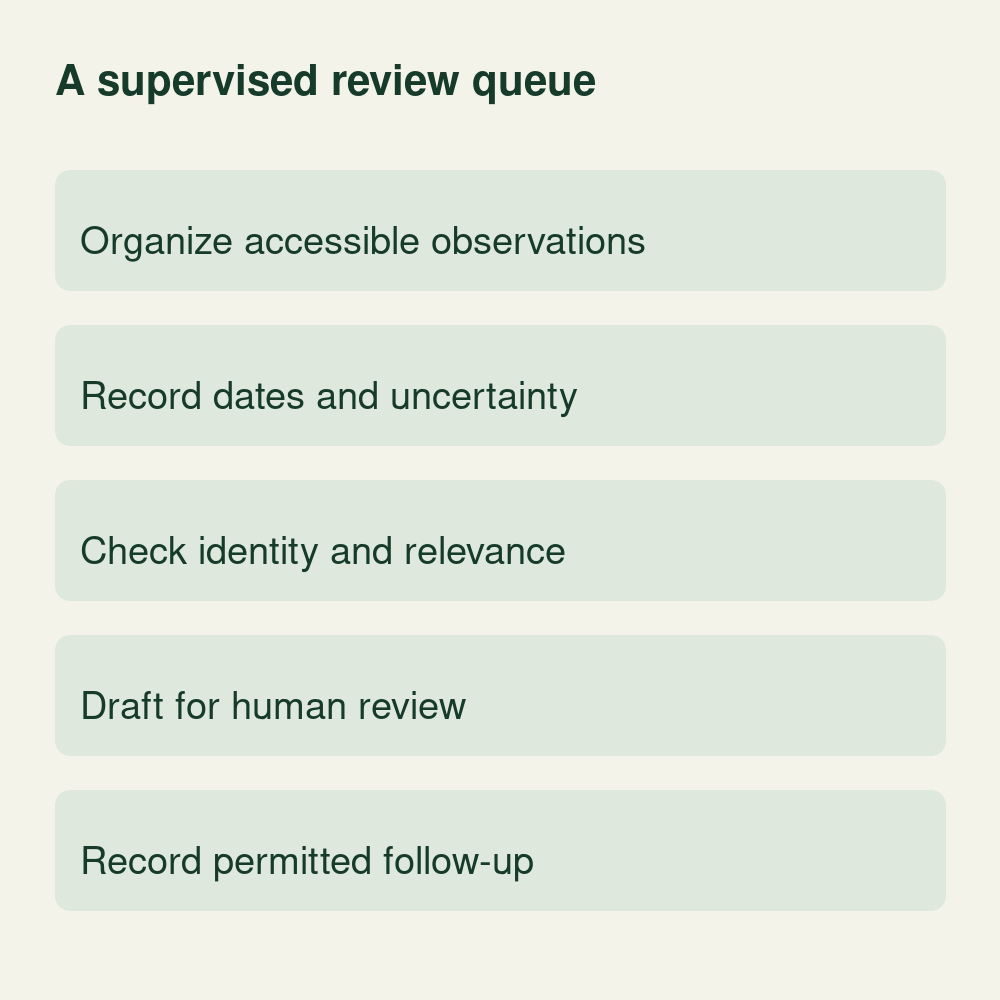
A supervised system might support a bounded workflow such as:
- Organize accessible public observations
- Record source dates and uncertainty
- Create a review queue
- Check identity and relevance
- Draft a question for human review
- Record permitted follow-up decisions
Test accuracy, permission, duplicate handling and time saved before expanding a workflow.
How Might Valora Help Advisors Study Buying Signals?
Valora is testing how publicly available signals might help advisers research suitable prospects. It is not monitoring an established stream of prospective clients.
Before using a signal for outreach, an adviser can ask:
- Who is showing interest
- Which prospects match your ICP
- What triggered the opportunity
- When to reach out
- How to personalize the conversation
Prospect research, relevant outreach, and later conversations can be tracked separately. Valora is developing support for this workflow, but no pipeline result is established yet.
Done researching? Request the free readiness check. A completed readiness review can show examples of how your firm appears in AI answers at the time of the check. Request a review: Can ChatGPT find your firm?
Where signal-based selling has limits
A signal is a reason to check context, not proof of need, permission, qualification or timing. Record its source and limits before using it in an outreach decision.
Where Valora fits
Valora is testing ways to help financial advisers understand how their firms appear in AI search and build a more measurable client-acquisition process. We have not established a live service delivering exclusive prospects from AI answers. If you serve advisory clients, request the free readiness check: Can ChatGPT find your firm?
The bottom line
Check public context, verify fit and contact preferences, and measure actual replies, meetings and signed clients separately. Being first to notice a signal does not ensure a conversation.
Frequently Asked Questions
1. What are buying signals in sales?
Buying signals are actions or events that indicate a prospect may have interest or a current need for your product. Examples include website visits, LinkedIn engagement, hiring activity, funding announcements, and product research.
2. Why are buying signals important?
They can organize a review queue around relevant context. Test whether that review improves your own decisions; a signal alone does not establish intent or efficiency.
3. How do you find buying signals?
Buying signals can be found through LinkedIn activity, website behavior, company news, hiring changes, funding announcements, technology changes, and engagement with competitors.
4. Can AI help identify buying signals?
AI may help organize accessible information for human review. Check source accuracy, permissions and false matches before using a result. No tool can infer a person's buying intent with certainty.
Test Signals Before You Reach Out
A prospect's circumstances require a fit check.
Look for a verified question or change relevant to the service, not an assumed need.
Signals can prompt that check; measure whether a suitable conversation follows.
Instead of increasing outreach volume, focus on improving outreach timing.
Valora is developing support for advisers to research outreach and measure whether suitable conversations result. That path is being tested; qualified pipeline is not a current delivered result.
Want examples of how your firm appears in AI answers? Request the free readiness check. A completed readiness review can show examples of how your firm appears in AI answers at the time of the check. Request a review: Can ChatGPT find your firm?



