
Lead generation strategies for financial advisors: what each one really costs
Compare the full cost of advisor lead generation: cash, staff time, source, consent, fit, meetings and signed clients. Historical benchmarks are not a promise for your firm.


Choose lead-generation work by client fit, total cost and the evidence you can collect from inquiries through signed clients. Educational content, referrals and paid channels do different work; none guarantees suitable inquiries. Kitces reported a $3,119 average acquisition cost in its historical 2020 sample, not a current price for your firm. This guide explains how to compare options and measure the result.
Key takeaways
- Kitces reported a $3,119 average acquisition cost in its historical 2020 adviser sample; 83% was imputed adviser time rather than hard-dollar marketing spend.
- Referrals are the most cost-efficient strategy that exists, but they are passive. A firm that only waits for referrals has a ceiling set by its current client base.
- Channel rankings depend on the metric, sample and period. Compare current options using your own costs and attributable signed-client results rather than assuming a historical ranking applies.
- Bought leads and paid listings work when you measure cost per qualified lead, not cost per name.
- The firms that grow predictably treat lead generation as a measured system: one niche, two or three channels, tracked cost per client, and a follow-up process that responds within hours.
What this guide covers
- How much does it really cost to get one client?
- Why do referrals still dominate advisor growth?
- Which lead generation strategies have the best economics?
- Should advisors buy leads?
- How do you turn tactics into a lead generation system?
- What are the real limitations of each strategy?
- Where Valora fits
- The bottom line
- FAQs
How much does it really cost to get one client?
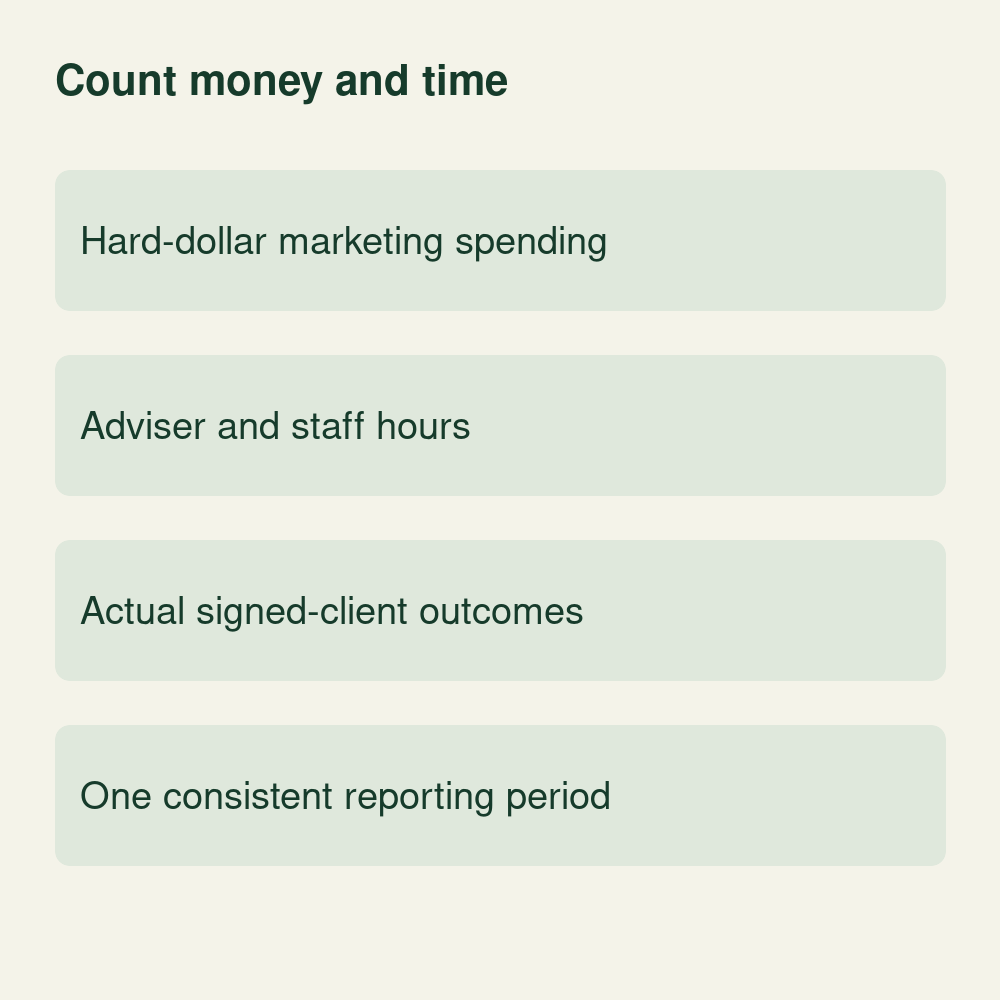
In its historical 2020 survey of more than 800 advisers, Kitces reported an average $3,119 acquisition cost: $519 in hard-dollar spending and $2,600, about 83%, in imputed adviser time. Include time in your own calculation and distinguish these sample findings from current prices.
Two implications follow. First, early on, trading your time for clients is rational. When the firm is young, hours are cheap and dollars are scarce. Second, that trade stops working as you grow. The advisor's hour is the most expensive hour in the firm, and a growth engine built entirely on the founder's calendar cannot scale past the founder's calendar.
The same research found the spread between strategies is enormous: from as little as $338 per client at the efficient end to more than $25,000 at the extreme end (a niche marketing-consultant tactic, not a typical advisor channel). Choosing channels is not a branding decision. It is a unit economics decision.
Check how visible your firm is to the prospects already searching for an advisor like you.
Why do referrals still dominate advisor growth?
Kitces' April 18, 2022 discussion describes historical referral adoption and says its marketing-efficiency ratios use median results. Top-efficiency subgroup results are not universal expected returns. A referral does not establish that a person is pre-sold or that their sales cycle will be short.
Referral volume depends on the relationships, service and people involved. Do not treat a fixed monthly count or doubling target as a benchmark. Record consented introductions, fit and actual next steps.
The practical answer is not to abandon referrals but to systematize them and then add channels that scale independently. Ask at moments of delivered value. Make introductions easy with a clear description of who you help. Track referral sources so you know which clients and COIs actually produce. Then build the second engine.
Which lead generation strategies have the best economics?
The Kitces data upends the conventional wisdom. The strategies advisors use most are often the worst performers on cost:
- Networking: $4,494 average cost per client acquired.
- Client appreciation events: $4,933 per client.
- Centers of influence (attorneys, CPAs): $9,144 per client, because the relationship takes years of the advisor's time to cultivate.
- Social media posting on its own: Social media on its own averaged $11,937 per acquired client in the historical 2020 Kitces sample. That result does not establish what an integrated campaign or your firm will cost.
Kitces' April 18, 2022 discussion compares historical results for the top quartile of marketing-efficient firms using median revenue-to-cost ratios. Those subgroup observations are not typical expected returns, causal rankings or a measure of acquisition speed for your firm.
Compare dollar spending and adviser time under your own service economics. Historical subgroup results do not establish that dollar-scaled tactics universally outperform time-based work.
Should advisors buy leads?
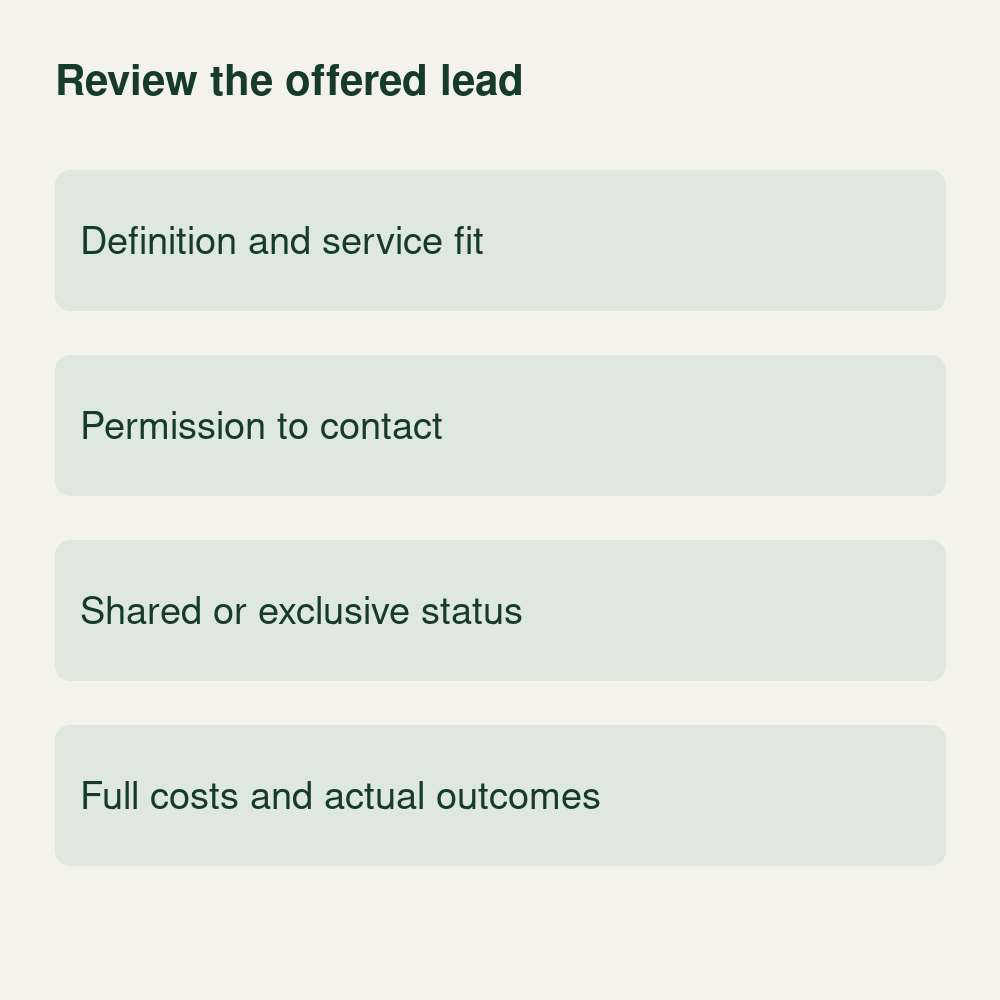
Check how the vendor defines a lead, whether contact is permitted, whether the lead is shared and what costs apply. Shared or exclusive status alone does not establish suitability or payoff.
Kitces' April 18, 2022 discussion gives a 7.2x marketing-list example for standout firms in its historical top-quartile framework. The article says efficiency ratios use medians. This is not a current expected return; compare your actual costs with attributable client revenue and profit.
Three questions separate good paid lead sources from bad ones: Are the leads exclusive to you? Did the prospect ask to talk to an advisor, or did they just fill out a form? And can you see the qualification criteria? If the vendor cannot answer all three clearly, the leads are not cheap. They are just priced low.
See where your firm stands before you spend another dollar on leads.
How do you turn tactics into a lead generation system?
A predictable lead generation system tends to share a structure, whatever channels you pick:
- One defined niche. Every efficient strategy in the data works better when the message is specific. "Advisor for tech employees with equity comp" outperforms "advisor for everyone" in content, SEO, referrals, and paid channels alike.
- Two or three channels, run properly. One relationship channel (referrals, COIs), one compounding channel (SEO, content, a book or podcast), and optionally one speed channel (paid leads or listings) once the economics are proven.
- Fast follow-up. Speed matters here: treat fast, thoughtful follow-up as part of the channel itself, not an afterthought. Whatever generates the lead, slow follow-up is where many firms leak the value.
- Measure fees, advertising and adviser time per source, then compare actual suitable inquiries and signed clients. No current universal 2%-of-revenue or 20%-of-time budget rule is established here.
What are the real limitations of each strategy?
Honesty about failure modes is what separates a plan from a wish:
- Referrals: unscalable alone, unpredictable month to month, and they dry up the moment service slips.
- SEO and content: often many months before meaningful traffic, and the rise of AI answers means the content has to be structured for machines to cite, not just humans to read.
- Seminars and events: strong attendance economics can still hide a brutal cost per actual client.
- Social media: among the worst measured CACs in the Kitces data when done as posting for posting's sake; it works as an amplifier of a niche message, not as a strategy by itself.
- Bought leads: quality varies wildly by vendor, shared leads poison the well, and compliance review of how the leads were generated is on you.
Where Valora fits
Valora is testing a way for financial advisors to build a more measurable client-acquisition system across LinkedIn outreach and AI-search visibility. Request the free readiness check. A completed review can show examples of how your firm appears in AI answers at the time of the check. We are still validating the path from visibility and outreach to qualified introductions; ask us how the founding advisor program is structured.
Check whether AI can find your firm.
The bottom line
Track the path from each source to a qualified inquiry, meeting and signed client. Include spending and adviser time, compare a realistic sample, and review what changed. The $3,119 average reported by Kitces in 2020 is historical context; your own costs and client economics determine whether a channel is worth continuing.
Source and method: Kitces' February 10, 2020 article describes a survey of more than 800 financial advisors. Acquisition cost includes hard-dollar marketing spend and the imputed value of adviser time. These historical sample averages are not current prices or forecasts for a firm. Read the Kitces 2020 analysis.
Frequently asked questions
1. How much should a financial advisor spend on lead generation?
Budget hard-dollar marketing spend and adviser time separately. Kitces reported that time represented about 83% of its $3,119 acquisition-cost average in the historical 2020 sample. Use your own hours, costs and client economics rather than treating that split as a current budget rule.
2. What is the fastest way to get leads as a new advisor?
There is no universally fastest source established by this guide. Test channels that fit your service and permitted audience, then record the time from inquiry to signed client. Historical revenue-to-cost ratios do not measure acquisition speed.
3. Are bought leads worth it for financial advisors?
Assess the actual lead definition, exclusivity, permission to contact, total cost and signed-client results. Compare cost per client and expected profit with your own data. The historical $3,119 average reported by Kitces in 2020 does not prove that a particular lead offer is good value.
4. How do I calculate my client acquisition cost?
Add your hard marketing spend for a period to the value of the hours you spent on business development at your effective hourly rate, then divide by the number of new clients gained. Do it per channel: the blended number hides the fact that one of your channels is probably subsidizing another.
Sources: Kitces Research on advisor marketing and client acquisition costs (Client Acquisition Costs For Financial Advisor Marketing Strategies; Kitces Research On The Best Advisor Marketing Strategies).
Source scope: Kitces' April 18, 2022 article explains the historical median marketing-efficiency metric and the top-quartile subgroup; these differ from a current expected return or acquisition-speed forecast. Read the historical efficiency analysis.



