
What should an RIA verify before putting LocalBusiness markup on its website?
Compare proposed LocalBusiness data with visible website facts and checked sources. Use a parity worksheet without treating markup as a result guarantee.


Before adding LocalBusiness markup, an RIA should compare each proposed fact with what a reader can see and what the firm has checked. Start with the business type, name, address, telephone, hours and page URL. A technically valid label does not establish that the underlying fact is true. Keep a fact out of the proposed markup when its meaning, source or public wording remains unsettled.
This article is a fact-parity review, not an indexability guide or a promise about search results. It does not decide whether a firm qualifies for a particular feature. The official vocabulary and Google documentation cited below were checked on October 4, 2026. A site owner should review the actual implementation against the current requirements before making a change.
What does the label describe?
Schema.org describes LocalBusiness as a particular physical business or branch of an organization. Its page lists a broad vocabulary of properties. That vocabulary is not a certificate that every property fits every firm, or that a particular search feature will use it.
Ask what the proposed object represents before asking which fields the template can accept. Is it a particular office, a business entity, or a page describing a service? Those are different descriptions. If the proposal changes between them halfway through the form, the problem is the meaning, not the syntax.
The person preparing the markup should be able to explain that meaning in one plain sentence. For example, a generic review note might say, "This object describes the firm's public office page." That sentence is only a proposed description. It does not settle whether the chosen type or its fields are right for the real office.
Do not select a more specific type because it sounds better. Ask the implementer to show why the type describes the actual subject. If the answer relies on a feature the firm does not provide, hold the proposal. This review concerns accurate description, not how to make a business seem more established.
Do the marked facts match the visible page?
Google's general structured-data guidelines say the data should be a true representation of the page content. They also warn against marking up content that is not visible to readers and against irrelevant or misleading content. These are Google's published rules for its features, not a general statement about every AI system.
Put the visible sentence and proposed property beside each other. If the page says meetings are arranged separately, a field describing regular walk-in hours needs an explanation. If the page names an organization but the object names a different branch, ask which subject the page actually describes. Do not let a template conceal those differences.
Exact spelling is only one part of parity. Meaning matters too. "Contact us to arrange a meeting" does not say that someone can arrive without arranging one. An office address does not, by itself, explain which services happen there. Review what a reader would reasonably understand, then compare it with the proposed field.
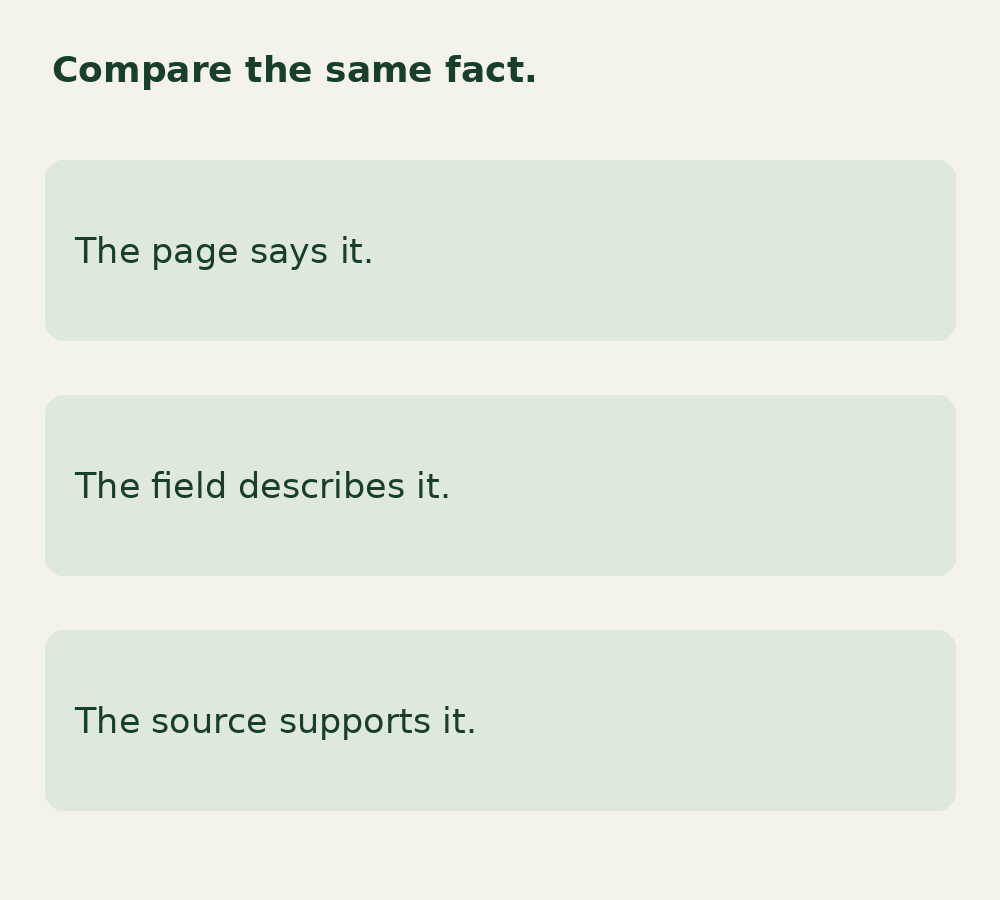
Which source settles each fact?
A source column keeps the discussion concrete. It might point to a reviewed business record, an approved public contact page or a responsible person's confirmation. This public worksheet does not need the contents of a private record. It needs enough information for the reviewer to find the appropriate evidence through the firm's own process.
Write down what was checked, not merely who touched the document. "Copied from last year's template" explains where the text came from; it does not show whether it is current. "Address checked by the site owner against the approved public contact page" is a different kind of note.
A missing source is an open item. It is not an invitation to infer hours from a map listing or a phone number from an old brochure. Public copies can disagree. When they do, identify the disagreement and ask the person responsible for the fact to settle it before the implementation is approved.
Keep the public page and the evidence record separate. A reviewer may need a private confirmation, while the page should contain only wording cleared for the intended public audience. Accurate markup is not a reason to publish a private address or internal contact detail.
How can you compare the fields without losing the context?
The worksheet below is an original editorial aid. It does not generate production markup or certify compliance. Use one row for each proposed field, and add rows when a field contains several claims. A single "all checked" cell hides the parts most likely to need a decision.
| Review item | Visible page statement | Proposed data | Evidence and decision |
|---|---|---|---|
| Subject and type | What does this page describe? | What object and type are proposed? | Confirm that both describe the same subject. |
| Name | Which public name does the reader see? | Which name appears in the field? | Check the approved wording; flag an unexplained variation. |
| Address | What does the page say about this address? | What address and role are proposed? | Check accuracy, intended publication and meaning. |
| Telephone | Which public contact route is shown? | Which number is proposed? | Check the real route; do not substitute a private number. |
| Hours or appointments | What arrangement does the page explain? | What availability does the field describe? | Hold any unsupported interpretation. |
| URL and image | Which public page and illustration are relevant? | Which destinations are proposed? | Open the exact destinations and compare their content. |
Use generic examples while planning the review. For instance, a proposed row can say "the reviewed public number" rather than displaying a real person's mobile number. The final implementation still needs the actual approved value. The example is a way to organize work, not a substitute for checking it.
Does a template settle the implementation?
No. A template can organize fields, but it cannot know whether the facts fit this firm. Google's LocalBusiness documentation has feature-specific instructions and examples. Read it alongside the general policies, not instead of them.
Keep two questions separate: "Does this implementation meet the current technical requirements?" and "Does it accurately describe this page and business?" A validator can help with the first question. The second needs evidence and human review. A green test result cannot settle a disputed address or an unsupported service description.
Do not turn a code example into a claim about your own results. This worksheet contains no forecast of rankings, citations, clicks or inquiries. A proposed implementation, an approved implementation and an observed public result belong in different parts of the work record.
What should the reviewer receive?
Send the exact proposed version through the firm's review process: the visible page wording, the structured-data object, the field comparison and the unresolved items. A summary saying "the schema is fixed" is not enough to inspect. The reviewer needs the values and the page they describe.
Make changes visible. If the address row changed after the first review, identify that row and why it changed. If the markup now describes a different subject, do not present it as a harmless formatting correction. Return the affected version for review.
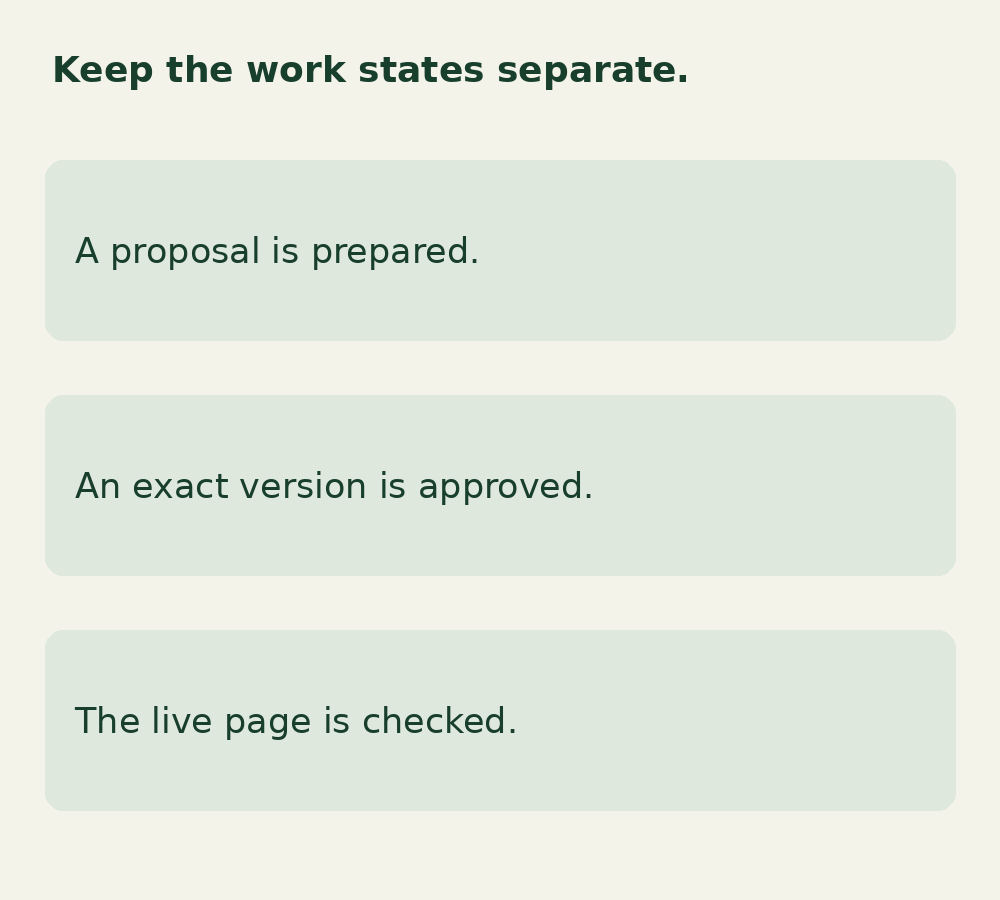
What remains after the change goes live?
Open the intended public page and compare it with the approved version. Check its visible wording and the actual structured data, not only the editor's saved state. Record the exact URL and the version inspected. If the public page differs, keep the item open for the person responsible for the implementation.
This is separate from the check of whether a page is indexable. That guide covers access and page-status signals. This worksheet asks whether the marked facts faithfully describe what the reader sees. Fixing one does not prove the other.
Give ongoing facts an owner. A changed contact route or appointment arrangement can make a once-accurate field stale. The useful record ends with who will check the affected page when that fact changes, rather than with a claim that the work can never need attention again.
Frequently asked questions
Does a valid template prove the facts are right?
No. Syntax and factual accuracy are separate checks. Compare the actual values with the visible page and checked evidence.
Should every listed property be filled?
No. A vocabulary lists possible properties; this worksheet does not establish which ones fit the real business or implementation.
Can markup describe a fact absent from the visible page?
Google's general guidelines warn against marking up content that is not visible to readers. Review the actual page and applicable feature guidance together.
Does this worksheet guarantee a search result?
No. It is a fact-parity review, not an indexability guide or a ranking, citation or inquiry forecast.
What happens when a fact is disputed?
Record the disagreement and hold the affected proposal until the responsible person settles the evidence and wording.



