
What should a solo RIA automate first?
A solo RIA should automate a small, supervised handoff before automating advice or outreach.


A solo RIA should automate a repeatable, low-judgment process before automating advice or outreach. For a firm trying to grow, the first practical candidate is often a CRM workflow that records a consented inquiry, assigns a follow-up, and documents what happened. For a lifestyle practice with a small, stable client base, the first candidate might instead be a recurring client-service checklist. Start from the work that is being missed, not from a vendor's feature list. Keep a human responsible for deciding what to say to a client and for reviewing the records.
Key takeaways
- Map one real workflow, including trigger, owner, decision points, record and exception, before buying software.
- A CRM can be the operational hub of a growing advisory firm, but only if the data and tasks are maintained. A reminder is not a relationship or compliance system by itself. [1]
- Automate scheduling, task creation and review prompts before client-specific recommendations, claims or unsupervised messages. Privacy, recordkeeping and supervision still apply.
Why is "automate prospecting" too broad a starting point?
Prospecting is not one task. It includes collecting a contact, establishing whether the person wants a reply, checking fit, deciding who follows up, answering the question, documenting the conversation and knowing when not to pursue it. A tool that sends messages faster can amplify a vague offer, a stale contact record, or a missed opt-out. The first automation should help the adviser keep a promise already made to someone, not make more promises before the operation can support them.
Suppose a prospective client completes a website form. Today the adviser receives an email, leaves it unread during meetings, then remembers two days later. A modest workflow could log the inquiry in a secure CRM, create an assigned task to review it, and flag it if no human has handled it within a defined window. It should not automatically assert that the person qualifies, that the firm accepts them, or that a financial recommendation is appropriate.
Michael Kitces' discussion of the first technology for a solo adviser distinguishes a growth-oriented business from a lifestyle practice. For the growing firm, he makes the case that a CRM is central for tracking tasks and activities, not merely storing contacts. For a smaller practice, the first tool can depend more on its specific staffing and work. [1] That article was published in 2018, so treat the operating principle as a framework, not a current ranking of vendors or prices.
How do you pick the first workflow?
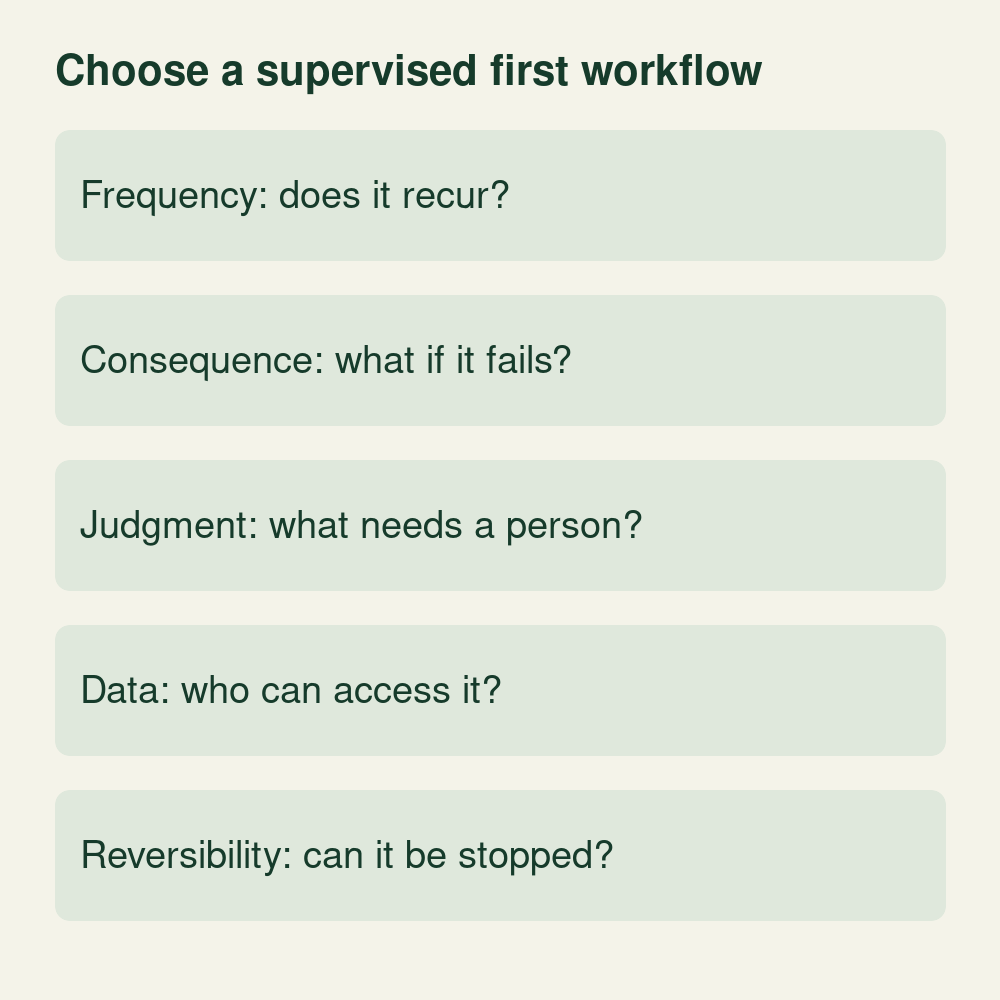
Write down recent tasks that caused delay, rework or client confusion. Then score each candidate on five dimensions:
- Frequency. Does it recur enough that a checklist will pay for itself?
- Consequence. What happens if the task is missed or completed incorrectly?
- Judgment. Does it require tailored advice or an exercise of professional discretion?
- Data sensitivity. What personal information is handled, and who can access it?
- Reversibility. Can an erroneous trigger be caught before an external message or irreversible action?
For a related check, see our guide to planning a publishing rhythm the firm can maintain.
A recurring appointment reminder or internal task assignment may score well if it is accurate and supervised. An automated recommendation based on a client's account balances scores poorly on judgment and consequence. An old spreadsheet can be the first fix; buying an AI tool is not a prerequisite.
Make the boundary explicit: software may create a task when a consented form arrives; the adviser decides whether and how to respond. Software may remind the team to review a client service item; the responsible professional decides what the client's circumstances require. A default email sequence should not run simply because a record was imported.
What would a basic inquiry workflow look like?
Trigger: A person submits the firm's own contact form and agrees to the stated follow-up. The form displays a privacy notice and collects only the information needed for routing. Do not assume that a scraped contact or a social-media profile has the same permission.
Record: The system stores the submission timestamp, stated question, source URL or campaign where available, consent context, and responsible staff member. Avoid placing account numbers, health details or documents in an ordinary marketing CRM unless its controls and firm policy explicitly support them.
Task: Create a human review task with a due window appropriate to the firm's actual capacity. The system can warn when the task is overdue. An acknowledgement, if used, should say only that the request was received and explain the next step; it should not promise a meeting, service or outcome.
Decision: The adviser or trained staff checks whether the firm serves the stated need, whether the person already has a relationship with the firm, and whether the request should go to a licensed professional or specialist. A question that suggests urgent financial or legal consequences should not be answered by an unreviewed canned reply.
Closeout: Mark the outcome precisely: no response needed, replied, meeting offered, meeting held, client onboarded, or not a fit. Record reasons at the right level of detail and respect retention and privacy rules. A completed follow-up task is not a qualified inquiry, and a qualified inquiry is not a signed client.
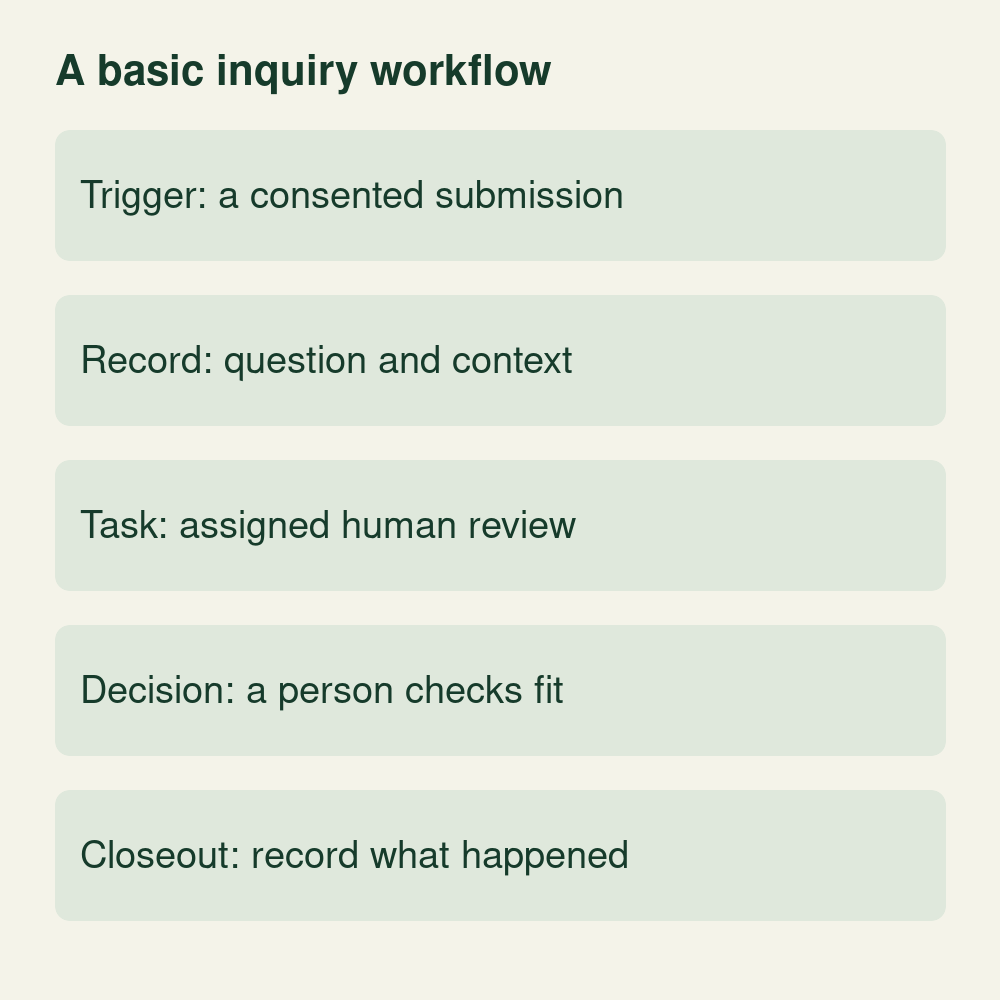
This is an example architecture, not a claim that Valora currently supplies these steps or that it has a live qualified-introduction service. Any product used should be checked against the firm's security, supervision, records and integration requirements before adoption.
When does client-service automation come first?
If the bottleneck is missed annual reviews, incomplete meeting preparation, or inconsistent follow-through, map that service path before generating more inquiries. A simple service calendar might identify which clients need an upcoming review, create preparation tasks, and flag unresolved follow-ups. The adviser should still decide which topics matter for each client, whether to change a plan, and what to communicate.
Kitces has described how a standardized service system can create reliable recurring work without making every client's advice identical. [2] The point is to systematize reminders and handoffs, not to mass-produce the same recommendation. An RIA with a different service model should adapt the workflow rather than borrow someone else's calendar wholesale.
A client-service checklist might include when a review was due, whether the client was contacted under the firm's preferred channel rules, whether meeting materials were prepared, who owns open items, and when those items were closed. It should have exceptions: a client on a different service schedule, a contact preference, or a planning event that changes priorities. Without exceptions, automation quietly turns into a source of errors.
What controls should exist before you switch it on?
Test the trigger with dummy data. Confirm that it creates one task, not duplicate tasks, and that the right person can see it. Check what happens when the form is incomplete, when the same person submits twice, when a task is overdue, and when an opt-out or deletion request arrives. If a tool sends a message, read the exact outgoing version and verify who receives it. Run a small pilot and inspect the log before broadening it.
Protect data access. Choose which information truly needs to cross from a form into a CRM, restrict access by role, check whether the vendor exports data and logs actions, and establish who can fix a bad record. A convenient connection is not automatically an approved one. The SEC has updated Regulation S-P requirements around safeguarding and incident-response programs for covered institutions; exact deadlines and applicability depend on the firm's status and size, so the compliance team should determine what applies. [3]
For marketing communications, check the firm's approval and recordkeeping process. The SEC's investment adviser marketing rule addresses misleading claims, substantiation, testimonials and endorsements. [4] A workflow that automatically republishes a testimonial or generates an outcome claim deserves review before it goes live. The tool cannot confer permission to use a client's words or data.
How can you tell whether the automation helped?
Capture a baseline before the pilot: how many inquiries arrived, how many received a timely human review, where tasks stalled, and how many required corrections. For client service, measure on-time reviews and open follow-ups, not merely the number of reminders sent. After a short pilot, inspect missed triggers, duplicate records, accidental messages, staff time and client confusion alongside any saved time.
For a related check, see our guide to separating referral stages before comparing results.
Do not claim a conversion lift from a few cases. If one meeting came from the workflow, that is one observed meeting, not proof of incremental revenue. If the system reveals that nobody owns the replies, the correct change may be staffing or prioritization rather than another automation. A clean process can make problems visible; it does not solve every bottleneck by itself.
Keep a manual stop switch and a way to correct records. Review task rules when the firm's service model, staff or policies change. The cost of maintaining the automation belongs in the decision, even when the software is already licensed.
Where does Valora fit?
Valora is testing an adviser acquisition program and related ways to make the path from visibility and outreach more measurable. It has not established a current service that delivers exclusive, qualified introductions or a proven path from an automated workflow to signed clients. Before considering another source of inquiries, an adviser should know who will review, respond to and record them.
For the AI-discovery part of that picture, request an AI-search readiness check. It may provide a point-in-time view of how a firm appears in AI answers; it does not measure workflow performance, qualified leads or client acquisition.
The bottom line
The first automation is a small, supervised workflow that prevents a real missed handoff. For a growth-oriented solo RIA, that may mean CRM tasks around consented inquiries. For a service-heavy practice, it may mean review preparation and follow-up. Define the trigger and exception, keep the professional judgment with a person, and measure actual reliability before adding more tools.
Frequently asked questions
Should I automate outreach before I set up a CRM?
Usually not if you cannot reliably track permission, ownership, replies and opt-outs. Automating volume before the response workflow works can create more missed conversations and compliance risk. Start with the records and human handoff.
Can AI qualify a prospect automatically?
It can help organize information, but a label based on a short form should not be treated as a professional determination or a promise to the prospect. Keep the person who decides fit and the reason for the decision identifiable in the record.
Does every solo firm need the same CRM?
No. Firm size, service model, staff, current tools and supervisory requirements differ. The first decision is what workflow the firm needs and what records it must keep; compare current vendors only after writing those requirements.
What is a safe first client-service automation?
An internal reminder to prepare for a scheduled review or to check an open action item is a reasonable candidate. Test it, include exceptions and keep the adviser responsible for advice and client communication.
How long should I test one workflow?
Long enough to see the normal cases and the exceptions that matter, such as duplicates, missing data, opt-outs and an overdue task. Set a review date and criteria before the pilot. A few quiet days are not proof that it is reliable.
Sources
[1] Michael Kitces, "The Best Technology To Adopt First As A Solo Financial Advisor" (2018): https://www.kitces.com/blog/best-technology-for-solo-financial-advisor-to-adopt-first-crm/
[2] Kitces.com, "How A Client Service System Personalizes Advice Efficiently": https://www.kitces.com/blog/create-standardized-client-service-system-model-automate-deliver-personalized-advice-efficiency/
[3] SEC, "SEC Adopts Rule Amendments to Regulation S-P" (2024): https://www.sec.gov/newsroom/press-releases/2024-58
[4] SEC, "Investment Adviser Marketing" compliance guide: https://www.sec.gov/resources-small-businesses/small-business-compliance-guides/investment-adviser-marketing



