
What should a solo RIA publish each week to build trust?
A solo RIA can build trust with accurate answers to real prospect questions, at a cadence it can sustain.


A solo RIA should publish on a cadence it can sustain and review accurately, not on a universal quota. Start with one real prospect question, answer it completely on a durable page, and use a short email or social post to point readers to that page if the firm already uses those channels. A weekly article is an example of a manageable test, not a rule or a promise of new clients. A solo adviser who cannot give that page the necessary research and compliance attention may be better served by one useful article every two or four weeks.
Key takeaways
- Start from questions your actual prospects ask, not a calendar of generic awareness days.
- Separate the durable answer from its distribution. One good page can support several short, accurate pointers without manufacturing several new claims.
- Set a review and measurement routine that records sources, approvals, publication dates, reader behavior and fit inquiries separately.
What is the smallest useful content plan?
Pick one audience, one recurring decision, and one place where the answer will live. For example, a firm that works with people nearing retirement may hear, "What should I bring to a first planning meeting?" A page can explain the meeting's purpose, the documents that may be useful, what should not be sent over ordinary email, and when a paid engagement begins. It does not need to advise a reader to move assets or make a withdrawal.
The next week, the firm might answer a different question raised in those conversations. If there was no meaningful new question, update the existing page or skip a cycle. The aim is a library that helps people decide whether the firm fits, not a streak of posts. Kitces recommends capturing ideas as they arise in client and prospect conversations and using an editorial calendar and repeatable template to make the work sustainable. [1] That is a workflow suggestion, not evidence that any fixed cadence increases conversion.
Write down the question in the reader's language. Record what the adviser actually knows, which part requires an external source, and who reviews it. If a client asked it privately, generalize the situation and remove identifying details before publishing. Consent to receive advice is not consent to be used as a case study.
How do you choose a question worth its own page?
A stand-alone page earns its place when the question has a distinct answer and would help a reader even without a sales call. Compare three candidate topics:
| Candidate | Editorial choice | Why |
|---|---|---|
| "What happens in our first meeting?" | Service or About page section | It is about the firm's process and needs a stable home. |
| "Should I roll over my old workplace retirement account?" | Educational article, carefully scoped | The answer depends on account rules, costs, investments, tax effects and the person's situation. Explain a decision framework, not a universal instruction. |
| "Why are we the best retirement adviser?" | Do not publish as written | It is a claim about superiority, not a reader question, and may be unsupported. |
For a related check, see our guide to making the service promise testable.
Before assigning a new URL, search the firm's own site. If an existing canonical already answers the question, improve that page. Several near-identical URLs make maintenance harder and can confuse readers. A service page and a blog article may coexist when they do different work: the service page says what the firm offers; the article answers a broader question a reader might ask before comparing firms. Link them where the relationship helps.
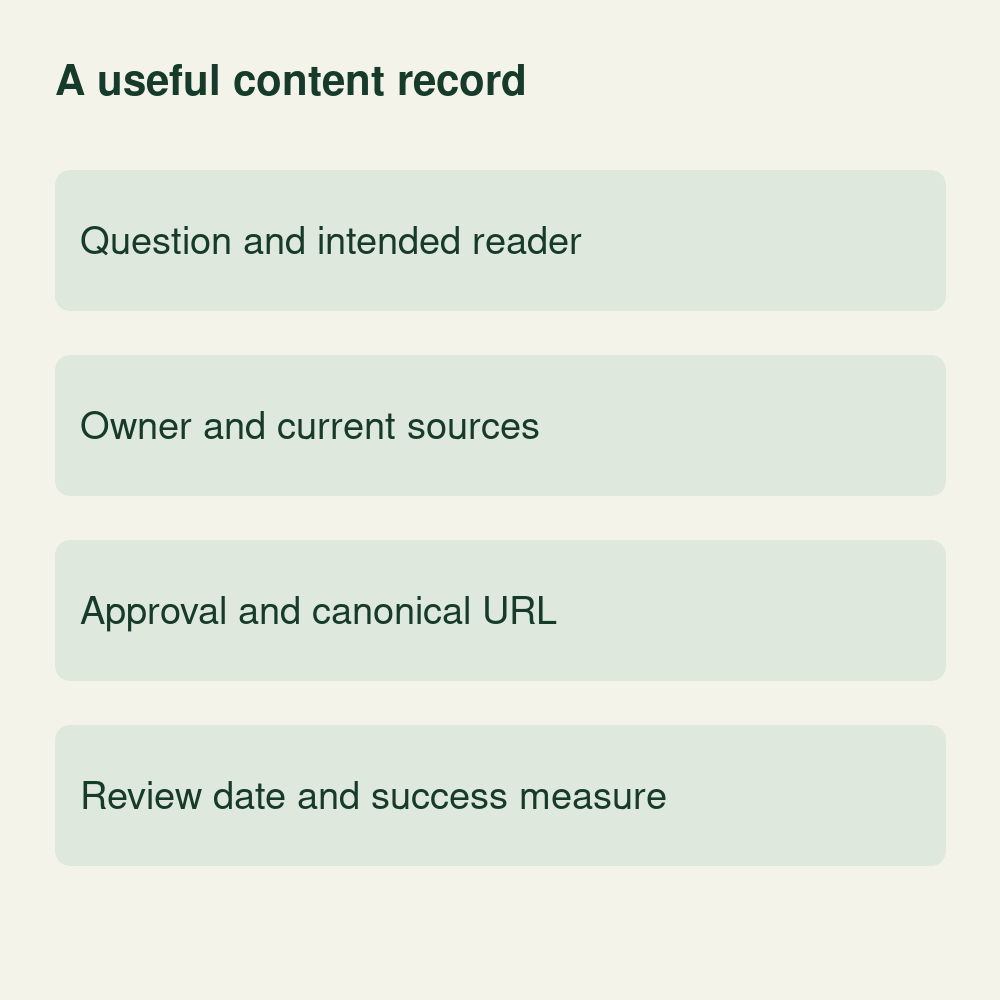
A content calendar should store the question, intended reader, owner, source and compliance status, canonical URL, last review date, and what will count as success. A spreadsheet is enough; software is not the strategy.
What belongs in a four-week pilot?
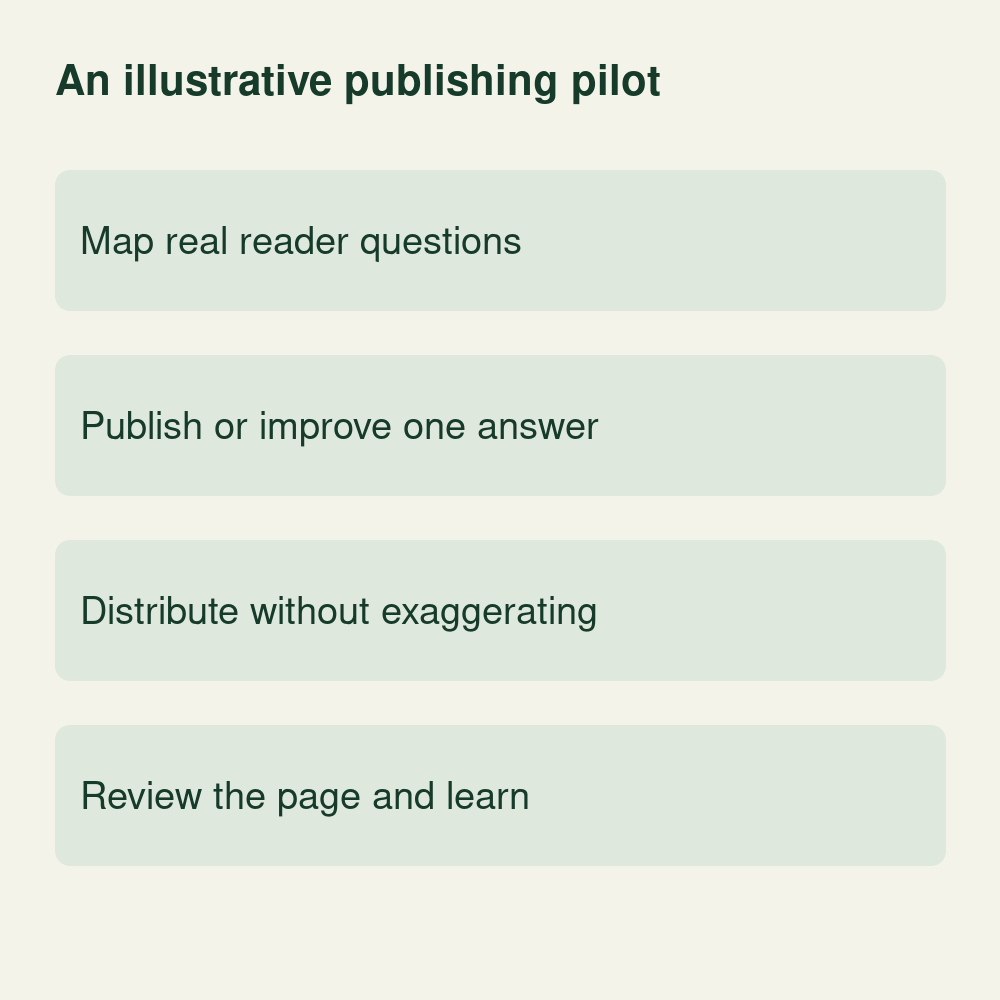
Use this as a planning example, not a mandate to publish four new articles.
Week one: map the questions. Review recent prospect notes without exposing private details. Group questions by intent: choosing an adviser, understanding a service, making a financial decision, or checking a claim. Pick one with a clear scope and an available qualified reviewer. Inspect the existing site and public firm profiles for an answer already in place.
Week two: publish or improve one durable answer. Lead with a plain-language answer, then explain the variables that could change it. Define terms, show boundaries, cite primary sources where a rule or product detail matters, and give the reader a sensible next step. If the question calls for individual advice, say that the article cannot decide for the reader. A content editor can improve prose, but a compliance or subject-matter reviewer must still own applicable claims.
Week three: distribute without changing the meaning. If the firm has an email list whose recipients agreed to receive updates, send a short introduction and link to the page under its email and recordkeeping procedures. For a social post, state one useful idea and link the full context. Do not turn a carefully qualified article into an absolute, sensational line just to earn a click. FINRA's social-media guidance addresses recordkeeping and supervisory duties for member firms; the exact obligations differ by registration and firm, so apply the firm's own policy rather than treating every adviser as a FINRA member. [2]
Week four: review and learn. Read the page on a phone, check links, accessibility and the call to action, and look at questions the piece prompted. A person spending time on a page is not a qualified inquiry; an inquiry is not a meeting; a meeting is not a client. Log those separately, with privacy in mind. If the page is not useful yet, improve it rather than adding another similar one.
The pilot can take longer than four calendar weeks. If it takes a month to source and approve one useful page, that is a real constraint. A low-quality weekly target should not override it.
How should an adviser write an answer that people can use?
Use an answer-first structure: first paragraph gives the conclusion and the conditions that matter; subsequent sections unpack the decision. For "How do I prepare for a first adviser meeting?" this might mean a short answer, a list of questions to bring, the firm's process if the article is on its own site, what cannot be concluded before reviewing the person's situation, and a clear next step. Do not imply that reading the article creates an advisory relationship.
Write question-shaped headings when they match the way readers think. Include a small number of FAQs for recurring points, not a long list of search-keyword variants. Keep the headline and meta description accurate. Links to regulators, primary documents and carefully chosen independent explanations can help the reader check a claim; they do not guarantee that any search engine or AI assistant will feature the page.
Kitces' account of how prospects choose an adviser notes that trust and specific problem-solving both matter, and that marketing channels such as a website, newsletter or social presence often reinforce each other. [3] That supports keeping the firm's service facts consistent across channels. It does not establish that every firm needs every channel.
Who should review the piece before it goes live?
Assign one person to fact-check the financial and legal statements, one to check the service and fee claims against the firm's current materials, and an approver under the firm's supervision policy. On a one-person team, the owner may fill more than one role, but the checks still need to be explicit. Record the source URL, date checked, copy version and approval decision so an update can be traced.
The SEC investment adviser marketing rule prohibits, among other things, materially misleading statements and has conditions for testimonials and endorsements. It also addresses substantiation for material statements of fact. [4] A generic disclosure cannot cure a false claim. The way the rule applies to a specific post depends on the firm and the communication; the firm's compliance adviser should review that, not a blog template.
Some topics deserve extra care. Tax thresholds and retirement-account rules can change. Product prices, software features and program availability should be checked against their current operators before they are published. A client story should not be used without appropriate consent and review. If a suitable reviewer is unavailable, select a lower-risk question the firm can answer accurately rather than issuing an unreviewed financial recommendation.
Should every article have a call to action?
A reader should be able to find the next step, but not every paragraph needs a button. A service-related article can link to a fit conversation and explain what that conversation covers. A general educational piece can point to a related service page only when it genuinely fits. Make clear what happens after a form submission and whether the request is for information, a meeting, or a paid service.
For this publication, an adviser curious about AI-answer visibility can request an AI-search readiness check. A point-in-time check may show examples of how a firm appears; it does not prove a future ranking, referral or client result. Valora is testing its advisor acquisition program, not representing an established flow of qualified introductions.
What should you measure after publishing?
Start with a dated page inventory: URL, question answered, source checks, approver, and last review. Then use analytics for directional signals such as page visits, search queries when available, and which related pages readers use. Do not call an indexed page an AI citation, or a mention a signed client. If a person reaches out, record the source they report, what they asked, whether the firm could serve them, and what happened next. With small numbers, describe individual observations instead of presenting a conversion-rate trend from two inquiries.
For a related check, see our guide to keeping, updating, merging or retiring older articles.
An article can be useful even when it never appears in a search result: an adviser can send it to a prospect who asked the question, subject to the firm's messaging rules. Likewise, a high-traffic page that attracts people outside the firm's service area can be a poor fit. The editorial review should consider usefulness, accuracy, maintenance cost, and actual inquiries rather than one traffic number.
The bottom line
The right weekly cadence is the one that yields an accurate, maintained answer to a real reader question. Use a calendar to reserve the work, not to force a new URL. Publish a useful page, distribute it without exaggeration, and learn from the questions readers ask next. If the work cannot pass sourcing and review this week, improve an existing page or wait.
Frequently asked questions
Does a solo RIA need to publish every week?
No. Weekly is one possible working rhythm. A slower, consistent cadence with source checks and updates is better than a weekly promise that produces thin or inaccurate pages.
Can I use AI to draft an article?
It can help outline or revise, but the adviser remains responsible for the facts, privacy, claims and approval. Verify every current rule or figure against its source. Do not paste private client information into a tool without the firm's permission and controls.
What if someone else has already written the answer?
A firm can still explain how the question connects to its actual service and link reputable sources. But a copied or lightly rephrased generic article adds little value. If the firm's existing page already answers it, improve that page instead.
Should I turn every client question into a case study?
No. Generalize the question. Client facts and outcomes are sensitive, and a testimonial or implied endorsement can trigger additional requirements. A useful explanation does not need to identify a client.
When should an old article be revised?
When a cited rule, product term or firm service changes, a link breaks, or a real reader question shows the answer is unclear. Put review dates in the calendar. An update to the same canonical URL is not a new article.
Sources
[1] Michael Kitces, "5 Tips To Get Started With Financial Advisor Blogging" (2016): https://www.kitces.com/blog/editorial-calendar-and-template-for-financial-advisor-blogging/
[2] FINRA, "Social Media" regulatory guidance hub: https://www.finra.org/rules-guidance/key-topics/social-media
[3] Sydney Squires, "How Prospects Choose A Financial Advisor: 3 Ways To Show Value" (2026): https://www.kitces.com/blog/prospects-information-seek-financial-advisor-marketing-value-proposition-decision-making-social-media-seo-newsletters/
[4] SEC, "Investment Adviser Marketing" compliance guide: https://www.sec.gov/resources-small-businesses/small-business-compliance-guides/investment-adviser-marketing



