
Does an RIA need a risk tolerance questionnaire?
No rule names one, but the SEC expects a reasonable inquiry into each client's investment profile. What a questionnaire covers, what it misses, and what to record.


No SEC rule reviewed for this page requires a registered investment adviser (RIA) to use a risk tolerance questionnaire by name. What the Securities and Exchange Commission (SEC) does expect is a reasonable inquiry into each retail client's investment profile, and updates when circumstances change.
A questionnaire is one way to collect and record part of that profile. Examiners may still ask to see one. In a public October 2026 discussion, one RIA said a state auditor did.
A questionnaire typically measures willingness to take risk, not the ability to absorb losses, and not how risky the client thinks markets are. It cannot carry the whole profile alone.
This is educational, not legal or compliance advice. This page does not map state-registered adviser rules on questionnaires. Those advisers should check their state securities regulator.
Short answer: the inquiry is expected; the questionnaire is a tool
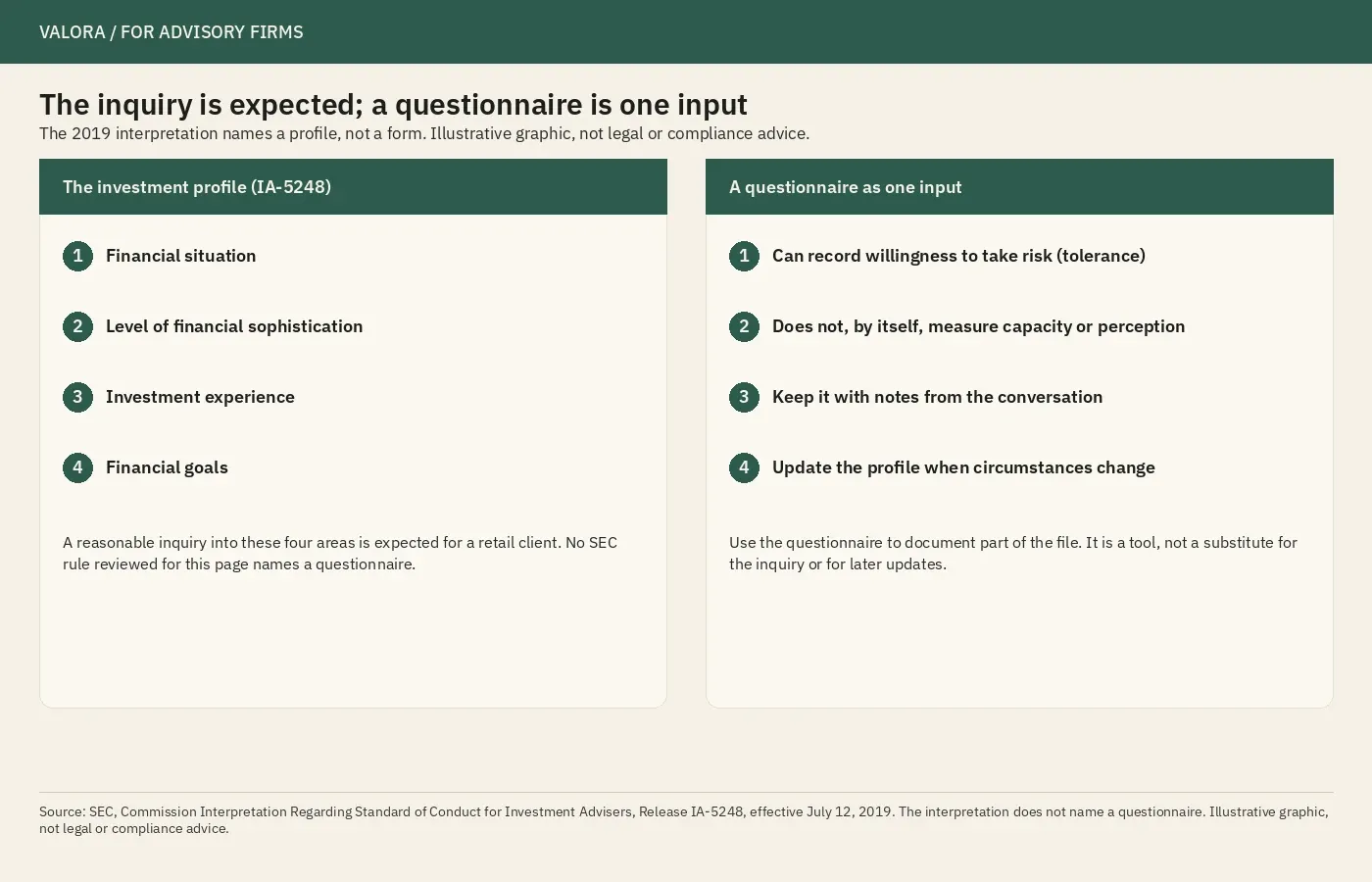
Start with the inquiry, not the form. For a retail client, make a reasonable inquiry into financial situation, financial sophistication, investment experience, and financial goals. Record what you learned, and update it when you become aware of changed circumstances.
A questionnaire can help you collect and document the willingness-to-take-risk part of that work. It is a tool, not a named SEC requirement, and it is not the whole file.
Your firm's policies, and any state rules that apply to you, may ask for more. Check those.
For first-call intake, see What should an RIA request before a first prospect call?.
What the SEC actually expects: a reasonable inquiry into the investment profile
In a 2019 Commission interpretation, Release IA-5248, effective July 12, 2019, the SEC described how an adviser should develop a reasonable understanding of a retail client's objectives.
An adviser should, at a minimum, make a reasonable inquiry into four areas. Those areas are the client's financial situation, level of financial sophistication, investment experience, and financial goals. The Commission refers to these, collectively, as the retail client's "investment profile."
How an adviser develops that understanding varies with the facts and circumstances, including the nature of the client, the scope of the relationship, and the nature and complexity of the anticipated advice. A comprehensive financial plan would generally need a fuller inquiry.
After a reasonable inquiry, it generally would be reasonable to rely on information the client provides. The adviser should not be held to have given advice not in the client's best interest if the client later is shown to have misled the adviser.
For a retail client, it will generally be necessary to update the investment profile. That keeps a reasonable understanding of the client's objectives and lets the adviser adjust the advice when circumstances change. The frequency turns on the facts and circumstances, including whether the adviser is aware of events that could make the current profile inaccurate or incomplete.
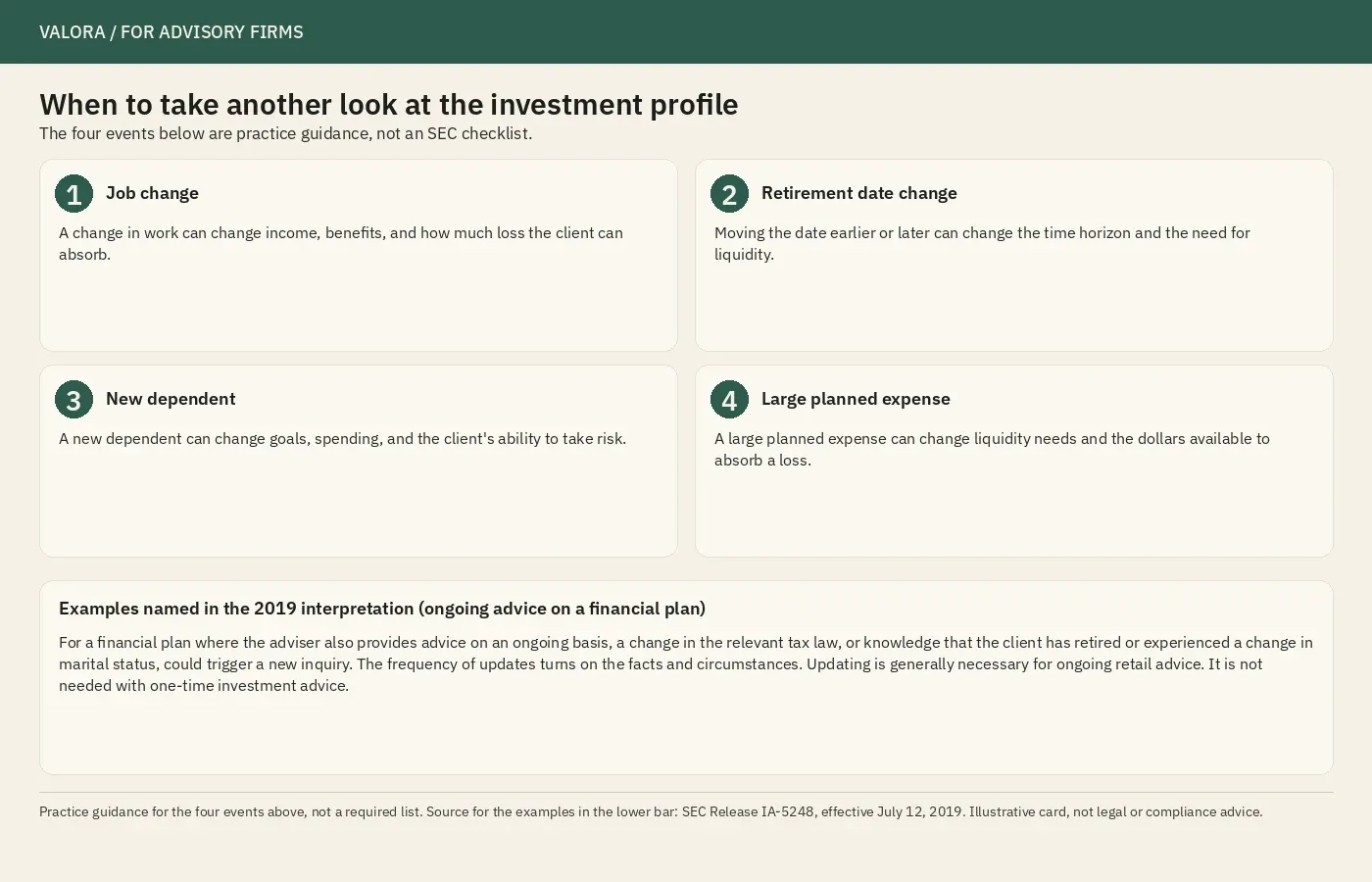
For a financial plan with ongoing advice, the Commission said a change in the relevant tax law could trigger a new inquiry. So could knowledge that the client has retired, or has had a change in marital status.
Updating would not be needed with one-time investment advice. In the proposed interpretation, the Commission had used the word "must" for updating. The final interpretation softened that language. Any obligation to update, like the inquiry itself, "turns on what is reasonable under the circumstances."
The investment-profile language is written for retail clients. For institutional clients, the inquiry is generally shaped by the client's investment mandate. Do not assume the retail profile applies in the same way.
This interpretation is not a checklist, and it does not name a questionnaire.
Dual registrants: FINRA names risk tolerance
The Financial Industry Regulatory Authority (FINRA) is more specific on one point, in a broker-dealer rule. FINRA Rule 2111 is a suitability rule for members and associated persons. It is not a rule for a firm that is only an RIA.
Under Rule 2111, a recommended transaction or investment strategy must be suitable for the customer. That belief has to rest on information obtained through reasonable diligence to ascertain the customer's investment profile.
A customer's investment profile "includes, but is not limited to," a listed set of facts. That list includes age, other investments, financial situation and needs, and tax status. It also includes investment objectives, investment experience, investment time horizon, liquidity needs, and risk tolerance. It also includes any other information the customer may disclose in connection with the recommendation.
Supplementary Material .08 says Rule 2111 does not apply to recommendations that are subject to Regulation Best Interest (Reg BI). Reg BI is the SEC standard for broker-dealer recommendations to retail customers. A dual registrant still needs to know which standard applies to which recommendation.
What advisors say in a public October 2026 discussion
In a public October 2026 discussion among advisers, people disagreed about whether a questionnaire is needed at a pure RIA. Those are views, not evidence, and not a recommended practice.
One commenter, contrasting RIAs with broker-dealers, wrote: "There's no compliance requirement to have a risk tolerance questionnaire." The same commenter said a simple investment policy statement (IPS) that clients sign "covers all your compliance risk, but not at a BD." That is one view. This page does not treat an IPS as required. Other people in the same discussion said their RIA does not have clients sign an IPS.
Another person wrote: "I'm at an RIA. During the last state audit, the auditor asked for them." That anecdote is a reason to keep a clear file. It is not a survey of what examiners request, and current SEC exam request lists were not reviewed for this page.
Some advisers doubted that a questionnaire, on its own, is a reliable record of how a client will behave. One described a client who filled one out "3 different days based on that days mood." Another firm said it uses a questionnaire "more as compliance for us than anything concrete for asset allocation."
A risk-scoring tool came up often in that discussion. This page does not name vendors and does not recommend a tool.
What a questionnaire measures, and what it misses
A traditional questionnaire often mixes two different things into one score. In a September 3, 2014 analysis, Kitces described that traditional approach. It gauges a client's attitudes about risk and the client's financial ability to take risk, such as time horizon, need for income, and other assets. It then mixes them into a composite score assigned to a portfolio. Kitces argued that this confuses capacity to take risk with the need or desire to do so, and that those parts should be kept separate. That is analysis, not a rule.
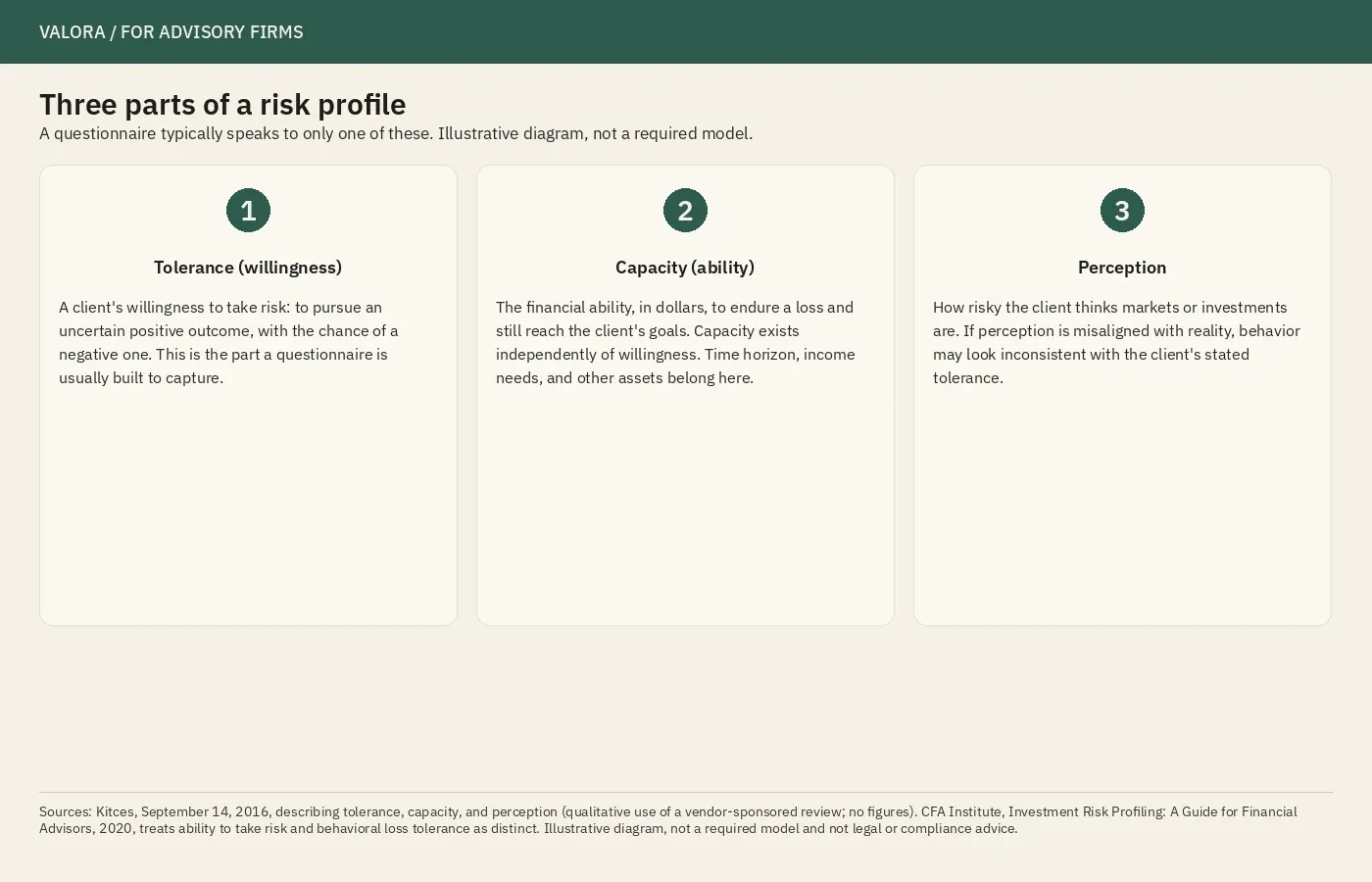
On September 14, 2016, Kitces described a risk profile as three parts, in an article summarizing a vendor-sponsored review. This page uses that framing qualitatively, with no figures from the review. The first part is risk tolerance: the client's willingness to take risk, meaning a willingness to pursue an uncertain positive outcome that could also turn out poorly. The second is risk capacity: the financial ability to endure a loss and still reach the client's goals. Capacity, and the risk a goal may require, exist independently of willingness. The third is risk perception: how risky the client thinks markets or investments are. If perception is misaligned with reality, behavior may look inconsistent with stated tolerance.
CFA Institute, in its 2020 guide Investment Risk Profiling, also treats these ideas as distinct. It groups time horizon, liquidity needs, and risk capacity under an investor's ability to take risk. Behavioral loss tolerance includes risk tolerance and risk perception, among other factors. The guide is an industry publication, not a rule.
CFA Institute wrote: "Best practice is to use psychometric tools (often questionnaires) that have demonstrated reliability and validity in predicting an investor's emotional and behavioral tendencies around loss of portfolio value and investing discipline." The same guide also said that, although current regulatory guidelines require a consistent process for compliance, "prescriptive standards for how and in what manner IRP data should be measured or applied are lacking." IRP here means investment risk profiling.
A questionnaire is usually built to capture willingness, or a related behavioral trait, not capacity, and not the full IA-5248 profile.
The tax dimension of risk is a separate conversation. See What should an advisory firm separate when discussing investment risk and tax-position risk?.
If you use one, make it count
If you use a questionnaire, make it count as a record, not only as a score. The points below are practice guidance, not a required form and not legal or compliance advice.
Use a tool that has demonstrated reliability and validity for what it claims to measure, in the sense CFA Institute described. This page does not recommend a vendor.
Record capacity separately. Time horizon, income needs, and other assets belong in that part of the file, not only inside a composite score.
If answers conflict with what you hear in conversation, or with the client's goals or financial ability, reconcile that in discussion and note the outcome. Do not let a single day's answers stand unreviewed when they do not match the rest of the file.
Update the investment profile when circumstances change, in line with IA-5248. Practice guidance, not an SEC list, is to take another look after a job change, a retirement date change, a new dependent, or a large planned expense. The interpretation itself names other examples for ongoing advice on a financial plan, including a tax-law change, retirement, or a change in marital status.
Keep the version the client actually completed, with the date. If later meeting notes mention risk, check those notes against the file. If an artificial intelligence (AI) draft of a meeting summary has already reached the client, correct it with care.
See How should an advisory firm correct an AI meeting summary after it has reached the client?.
If you don't use one, what replaces it
If you do not use a questionnaire, you still need a way to make the inquiry and to show what you learned. Practice guidance, not a required method, is a documented discovery conversation and a planning record that covers the four IA-5248 profile elements.
Some firms also use an IPS. The October 2026 discussion showed a split: some advisers treat a signed IPS as their record, and others do not use one. This page does not claim that an IPS is required.
Your firm's policies, and any state rules that apply to you, may require a questionnaire or another form. Check them. This page does not map those state rules, and it does not say that regulators ignore the issue.
Whatever method you use, the test in the 2019 interpretation is still a reasonable inquiry and, for ongoing retail advice, a reasonable update when circumstances change.
FAQ
Does the SEC require a risk tolerance questionnaire? No SEC rule reviewed for this page names one. The 2019 interpretation expects a reasonable inquiry into the retail client's investment profile, and updates when circumstances change. A questionnaire is one way to collect and record part of that work.
If I skip a questionnaire, am I out of compliance? Not automatically, based on the SEC interpretation reviewed here. You still need a reasonable inquiry and a way to record it. In one October 2026 anecdote, a state auditor asked an RIA for questionnaires. Firm policies and state rules may require more. Check them.
Does a questionnaire cover the whole investment profile? No. It typically measures willingness to take risk. It does not, by itself, measure capacity or perception, and it is not a complete investment profile under IA-5248.
Is an investment policy statement required instead? This page does not treat an IPS as required. Some advisers use one as a signed record. Others do not. Check your firm's policies and the rules that apply to you.
If your firm later wants help making its services easier for suitable prospects to find and understand, you can learn about Valora's work for advisory firms. The current public offer is $250 per booked appointment with a qualified prospect, with a 3-appointment minimum, paid in advance. An appointment is a call booked on your calendar with a prospect who has asked to speak with an advisor. There is no setup fee, retainer, or long-term contract. If a prospect does not attend or does not meet the agreed criteria, the appointment is replaced at no charge. Your firm reviews what goes out under its name.
This article is educational, not legal advice, tax advice, compliance advice or personalized investment advice. Valora is not a registered investment adviser and does not provide investment advice. Valora provides marketing services to advisory firms. Valora is not a risk-questionnaire or compliance service.
Sources
- SEC, Commission Interpretation Regarding Standard of Conduct for Investment Advisers, Release IA-5248, effective July 12, 2019: https://www.sec.gov/rules/interp/2019/ia-5248.pdf
- FINRA Rule 2111, Suitability, including Supplementary Material .08 on Regulation Best Interest (broker-dealer rule, not a pure RIA rule): https://www.finra.org/rules-guidance/rulebooks/finra-rules/2111
- CFA Institute, Investment Risk Profiling: A Guide for Financial Advisors (2020): https://www.cfainstitute.org/sites/default/files/-/media/documents/survey/investment-risk-profiling.pdf
- Kitces, The Sorry State Of Risk Tolerance Questionnaires For Financial Advisors, September 14, 2016 (qualitative use only; summarizing a vendor-sponsored review; no figures): https://www.kitces.com/blog/risk-tolerance-questionnaire-and-risk-profiling-problems-for-financial-advisors-planplus-study/
- Kitces, Separating Risk Tolerance From Risk Capacity, September 3, 2014 (analysis, not a rule): https://www.kitces.com/blog/separating-risk-tolerance-from-risk-capacity-just-because-you-can-afford-to-take-risk-doesnt-mean-you-should/
- Public discussion among advisers, posted October 13, 2026 (anecdotes only; no usernames or vendor names are used in this page): https://www.reddit.com/r/CFP/comments/1x59hpk/
- Valora, For Advisors: https://www.valorahq.com/for-advisors/ (offer terms only; not evidence of client results)