
When does a small RIA have custody of client assets?
Fee deduction, SLOAs, client logins and custodial paperwork can all mean custody. What counts under the SEC rule and what each triggers.


Under the SEC custody rule, a registered investment adviser (RIA) has custody if it holds client funds or securities, or has any authority to obtain possession of them. For a small firm that does not touch client money, custody usually comes from authority, not possession.
Deducting your advisory fee from client accounts can count. So can a standing letter of authorization (SLOA) to send money to a third party. So can a client login that lets you withdraw or transfer funds, or custodial paperwork that grants you more power than your advisory agreement. Fee deduction counts as custody, but it is excepted from the surprise-exam requirement if that is your only custody. SLOAs can avoid the surprise exam if seven conditions in a 2017 SEC staff letter are met.
Know which of these you have. It changes your Form ADV answers and what you must do.
This is educational, not legal or compliance advice. Confirm how the rule applies to your firm with counsel or your chief compliance officer (CCO). The SEC rule discussed here applies to advisers registered, or required to be registered, with the Securities and Exchange Commission (SEC). State-registered advisers should check their state securities regulator.
Short answer: authority counts, not just possession
You do not have to hold a client's cash or securities in your office to have custody. The rule treats authority to obtain possession the same way it treats holding the assets.
For many small firms, that authority shows up in ordinary work. You may deduct fees from client accounts. You may have a standing instruction to pay a third party. You may hold a login that can move money. You may also find broader powers in the custodian's paperwork than you meant to accept.
Each of those can be custody. They do not all carry the same extra steps. The rest of this page walks through the common cases, and what each one triggers under the current rule.
The rule's definition in plain English
The custody rule is Rule 206(4)-2 under the Investment Advisers Act of 1940. The text quoted below is from the Electronic Code of Federal Regulations (eCFR), a continuously updated online version of the Code of Federal Regulations. The eCFR is not the official legal edition of the CFR.
"Custody means holding, directly or indirectly, client funds or securities, or having any authority to obtain possession of them." You also have custody if a related person holds client funds or securities, or has any authority to obtain possession of them, in connection with advisory services you provide to clients.
The definition includes three kinds of situations. First is possession of client funds or securities, except checks drawn by clients and made payable to third parties. If you receive client funds or securities inadvertently, you must return them to the sender promptly, and in any case within three business days of receiving them.
Second is any arrangement, including a general power of attorney, under which you are authorized or permitted to withdraw client funds or securities maintained with a custodian, upon your instruction to the custodian.
Third is any capacity that gives you or your supervised person legal ownership of, or access to, client funds or securities. The rule names examples such as trustee of a trust, or general partner of a limited partnership.
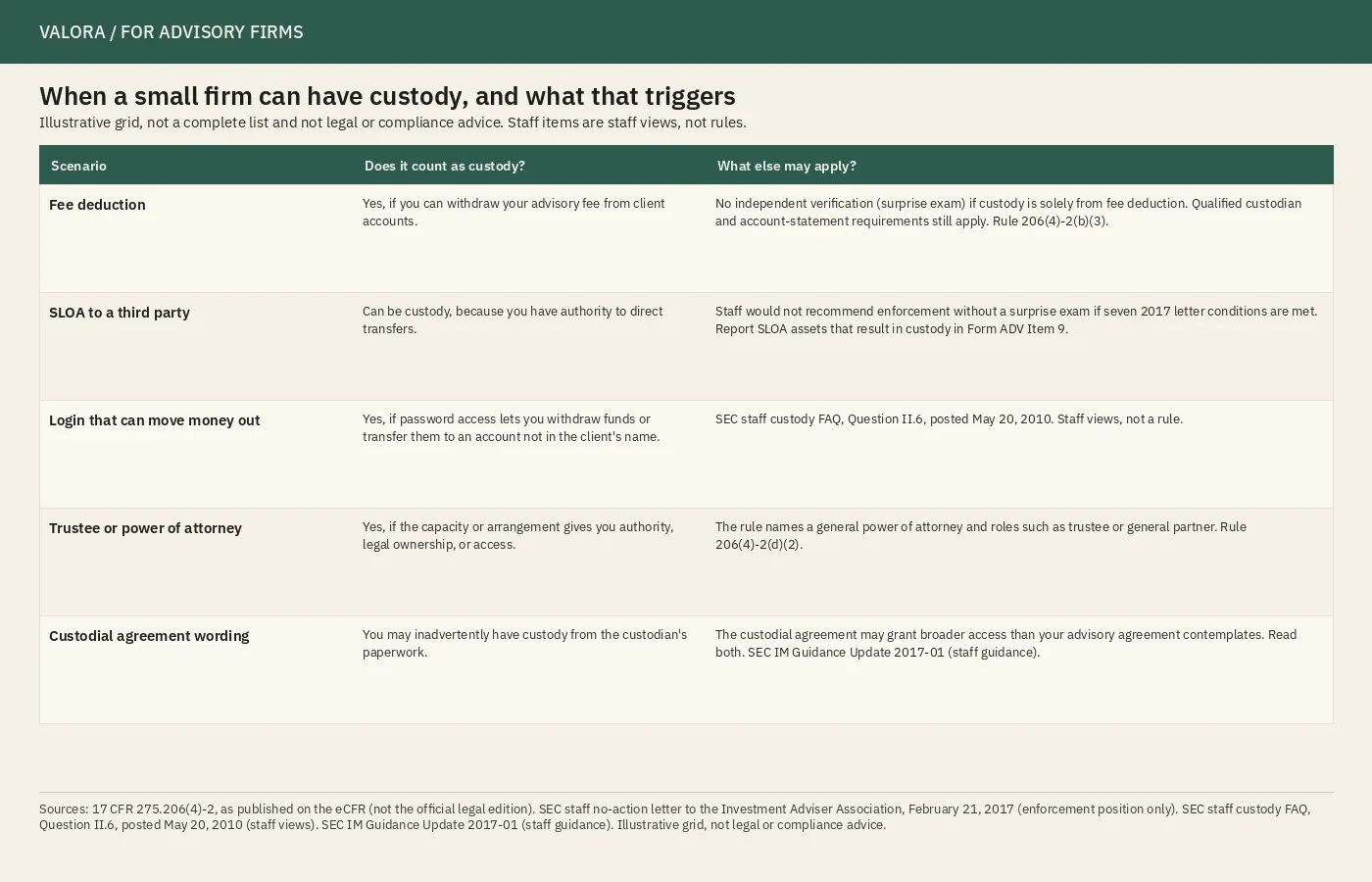
Fee deduction: custody, but no surprise exam
If you can withdraw your advisory fee from a client account, you have authority to obtain possession of client funds. That is custody under the definition above.
The rule then provides a narrow exception from independent verification, often called a surprise exam. The rule says you are not required to obtain that independent verification if you have custody "solely as a consequence of your authority to make withdrawals from client accounts to pay your advisory fee." If the qualified custodian is a related person, an additional condition in the rule also has to be met.
The exception is only from the surprise exam, and only if fee deduction is the sole reason you have custody. The qualified custodian and account-statement requirements still apply. Read the rule for those conditions. This page does not walk through how to bill a fee.
Standing letters of authorization (SLOAs)
A standing letter of authorization is described in a February 21, 2017 SEC staff letter to the Investment Adviser Association. In that letter, a SLOA is a standing letter of instruction, or a similar asset-transfer authorization, established by a client with a qualified custodian. In the facts described there, the client grants the adviser limited power to disburse funds to one or more third parties the client has designated.
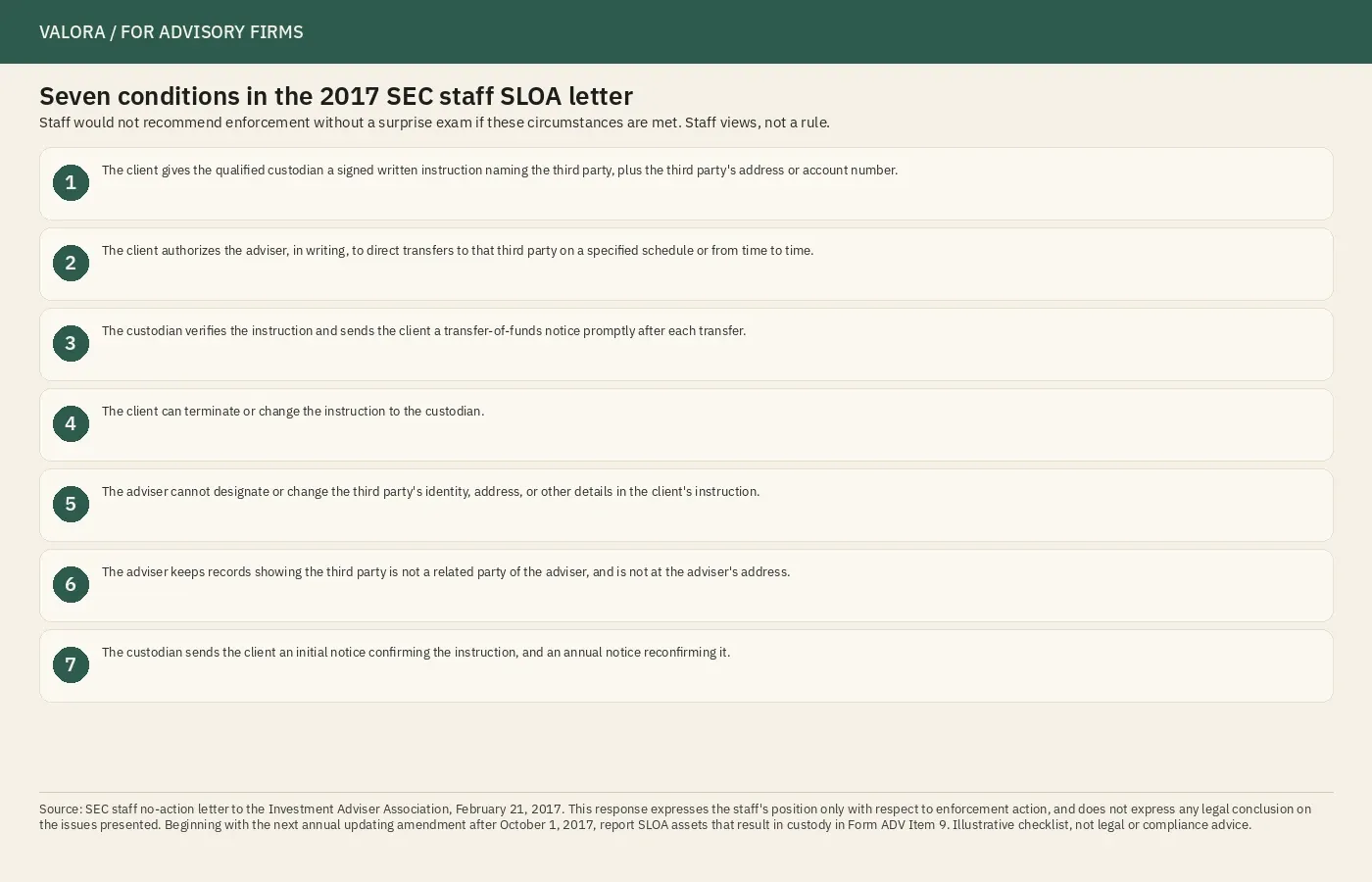
Staff of the Division of Investment Management took the view that such an arrangement can be custody, because the adviser is authorized or permitted to withdraw client funds upon instruction to the custodian. The same letter then gives an enforcement position, not a legal conclusion. Staff would not recommend enforcement action to the Commission if the adviser does not obtain a surprise examination, and if seven circumstances in the letter are met.
Those seven circumstances, in short, are these. The client gives the qualified custodian a signed written instruction naming the third party, plus the third party's address or account number. The client authorizes the adviser, in writing, to direct transfers to that third party on a specified schedule or from time to time. The custodian verifies the instruction and sends the client a transfer-of-funds notice promptly after each transfer. The client can terminate or change the instruction. The adviser cannot designate or change the third party's identity, address, or other details in the client's instruction. The adviser keeps records showing that the third party is not a related party of the adviser, and is not at the adviser's address. The custodian sends the client an initial notice confirming the instruction, and an annual notice reconfirming it.
The letter says this response expresses the staff's position only with respect to enforcement action, and does not express any legal conclusion on the issues presented. Different facts might require a different conclusion.
Beginning with the next annual updating amendment after October 1, 2017, an adviser should include, in Item 9, client assets that are subject to a SLOA that result in custody.
Client logins and passwords
A login can be enough. Question II.6 of the SEC staff custody FAQ, posted May 20, 2010, addresses password access. The staff was asked about an adviser that has the identification number and password to a client's pension fund account, in order to rebalance and adjust investments. The staff answer is direct. "The adviser has custody if password access provides the adviser with the ability to withdraw funds or securities or transfer them to an account not in the client's name at a qualified custodian."
Those are staff views, not a rule, regulation, or statement of the Commission. The Commission has neither approved nor disapproved that information. The current staff FAQ page was last reviewed or updated February 21, 2017.
How you access 401(k) or similar accounts you advise on matters for that test. In a public October 2026 discussion among advisers, one firm said it now applies its standard fee to 401(k) and similar accounts it advises on. That is one firm's practice, not evidence, and not a comment on whether any particular access method creates custody. This page does not name tools or vendors, and it does not claim that any specific product creates custody.
If you use a connected-account view of client holdings, check what that connection can actually do. See What should an advisory firm check before using a connected-account dashboard?.
When you end a vendor relationship, confirm that access is actually gone. See What should an advisory firm verify when disconnecting a former vendor's access to client data?.
"Inadvertent custody" in the custodian's paperwork
Custody can also hide in someone else's form. In IM Guidance Update 2017-01, dated February 2017, staff of the Division of Investment Management addressed custodial paperwork. The staff stated that an adviser "may inadvertently have custody of client funds or securities because of provisions in a separate custodial agreement" between the client and a qualified custodian.
The same update says the custodial agreement "may grant an adviser broader access to client funds or securities than the adviser's own agreement with the client contemplates." Depending on that wording, the adviser may have custody, and may also be subject to the surprise examination requirement, "even though it did not otherwise intend to have such access."
That is staff guidance, not a rule. The practice step is simple: read the custodial agreement, not only your advisory agreement.
Why it matters: exam history and what's current
Custody has long been an exam focus, but older figures need their date and their context. In a March 4, 2013 risk alert, the SEC's National Examination Program reviewed recent examinations that contained significant deficiencies. Approximately one-third of them (over 140) included custody-related issues. That 2013 figure describes that set of significant-deficiency exams. It is historical. It is not a current exam rate, and it is not a claim about today's deficiency rate.
The current rule is still Rule 206(4)-2 as it stands. On March 9, 2023, the Commission published a proposed new rule on safeguarding advisory client assets, and also proposed, among other things, to amend certain provisions of the current custody rule. In Release 33-11377, the Commission formally withdrew that proposal, among others, as of June 17, 2025. The Commission "does not intend to issue final rules with respect to these proposals." If it later pursues action in this area, it will issue a new proposed rule.
A quick custody self-check for a small firm
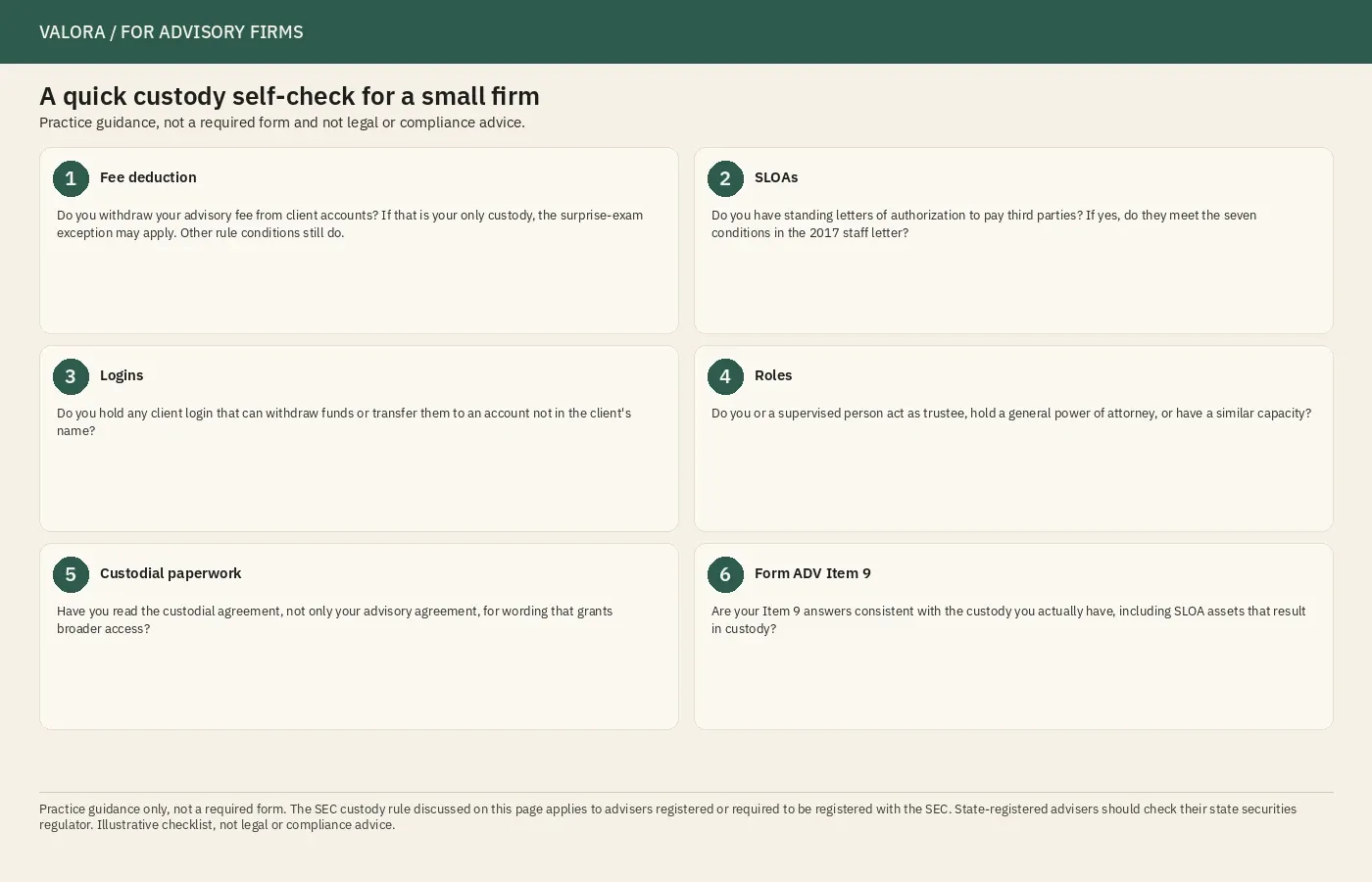
The questions below are practice guidance, not a required form and not legal or compliance advice.
Do you deduct your advisory fee from client accounts? If that is your only custody, the surprise-exam exception may apply, though other rule conditions still do. Do you have SLOAs to pay third parties, and if so, do they meet the seven conditions in the 2017 staff letter? Do you hold any client login that can withdraw funds or transfer them to an account not in the client's name? Do you or a supervised person act as trustee, hold a general power of attorney, or have a similar capacity? Have you read the custodial agreement, not only your advisory agreement? Are your Form ADV Item 9 answers consistent with the custody you actually have, including SLOA assets that result in custody?
If you are a solo adviser, also think about who can reach those logins or authorities if you are unavailable. See What should a solo RIA include in a business-continuity handoff?.
State-registered advisers should check their state securities regulator. This page does not describe state custody rules.
FAQ
Does deducting my advisory fee from client accounts create custody? Yes, under the SEC rule, if you have authority to withdraw the fee from client accounts. If that is your only custody, you are not required to obtain a surprise exam. The qualified custodian and account-statement requirements still apply. Read the rule.
If my SLOA meets the seven staff-letter conditions, do I still have custody? The 2017 staff letter treats the arrangement as one that can be custody, then gives an enforcement position on the surprise exam. Meeting the seven conditions is about that relief, not a finding that you lack custody. Report SLOA assets that result in custody in Form ADV Item 9. The letter is a staff enforcement position, not a legal conclusion.
Does a client login always mean custody? Not in every case. The staff FAQ, posted May 20, 2010, says you have custody if password access lets you withdraw funds or securities, or transfer them to an account not in the client's name at a qualified custodian. Those are staff views, not a rule.
Is the 2013 custody exam figure still a current rate? No. In a March 4, 2013 risk alert, the SEC's National Examination Program reviewed recent examinations that contained significant deficiencies. Approximately one-third of them (over 140) included custody-related issues. That figure is historical, and it describes that set of significant-deficiency exams, not today's exams.
If your firm later wants help making its services easier for suitable prospects to find and understand, you can learn about Valora's work for advisory firms. The current public offer is $250 per booked appointment with a qualified prospect, with a 3-appointment minimum, paid in advance. An appointment is a call booked on your calendar with a prospect who has asked to speak with an advisor. There is no setup fee, retainer, or long-term contract. If a prospect does not attend or does not meet the agreed criteria, the appointment is replaced at no charge. Your firm reviews what goes out under its name.
This article is educational, not legal advice, tax advice, compliance advice or personalized investment advice. Valora is not a registered investment adviser and does not provide investment advice. Valora provides marketing services to advisory firms. Valora is not a custody, compliance, or surprise-exam service.
Sources
- eCFR, 17 CFR 275.206(4)-2, Custody of funds or securities of clients by investment advisers (the eCFR is not the official legal edition of the CFR): https://www.ecfr.gov/current/title-17/chapter-II/part-275/section-275.206(4)-2
- SEC staff, no-action letter to the Investment Adviser Association, February 21, 2017 (staff position on enforcement only; not a legal conclusion): https://www.sec.gov/divisions/investment/noaction/2017/investment-adviser-association-022117-206-4.htm
- SEC, IM Guidance Update 2017-01, Inadvertent Custody: Advisory Contract Versus Custodial Contract Authority, February 2017 (staff guidance): https://www.sec.gov/investment/im-guidance-2017-01.pdf
- SEC staff, Staff Responses to Questions About the Custody Rule, Question II.6, posted May 20, 2010; page last reviewed or updated February 21, 2017 (staff views only). The original path, https://www.sec.gov/divisions/investment/custody_faq_030510.htm, redirected this turn to https://www.sec.gov/rules-regulations/staff-guidance/division-investment-management-frequently-asked-questions/staff-responses-questions-about-custody-rule
- SEC Office of Compliance Inspections and Examinations, National Examination Program risk alert, Significant Deficiencies Involving Adviser Custody and Safety of Client Assets, March 4, 2013 (historical exam observations): https://www.sec.gov/about/offices/ocie/custody-risk-alert.pdf
- SEC, Release 33-11377, Withdrawal of Proposed Regulatory Actions, withdrawing proposals as of June 17, 2025, including the March 9, 2023 safeguarding proposal: https://www.sec.gov/files/rules/final/2025/33-11377.pdf
- Public discussion among advisers, "CFP 401k Rollover Guidance," posted October 23, 2026 (context only; no usernames or vendor names are used in this page): https://www.reddit.com/r/CFP/comments/1xdqg0a/
- Valora, For Advisors: https://www.valorahq.com/for-advisors/ (offer terms only; not evidence of client results)