
Can a small RIA work with clients in other states?
Yes, within limits. The federal de minimis rule, when a sixth client triggers registration or notice filing, and why states differ.


Yes, a small registered investment adviser (RIA) can work with clients in other states. What you have to do depends on whether you are state-registered or registered with the Securities and Exchange Commission (SEC). It also depends on whether you have a place of business in that state, and on how many clients live there.
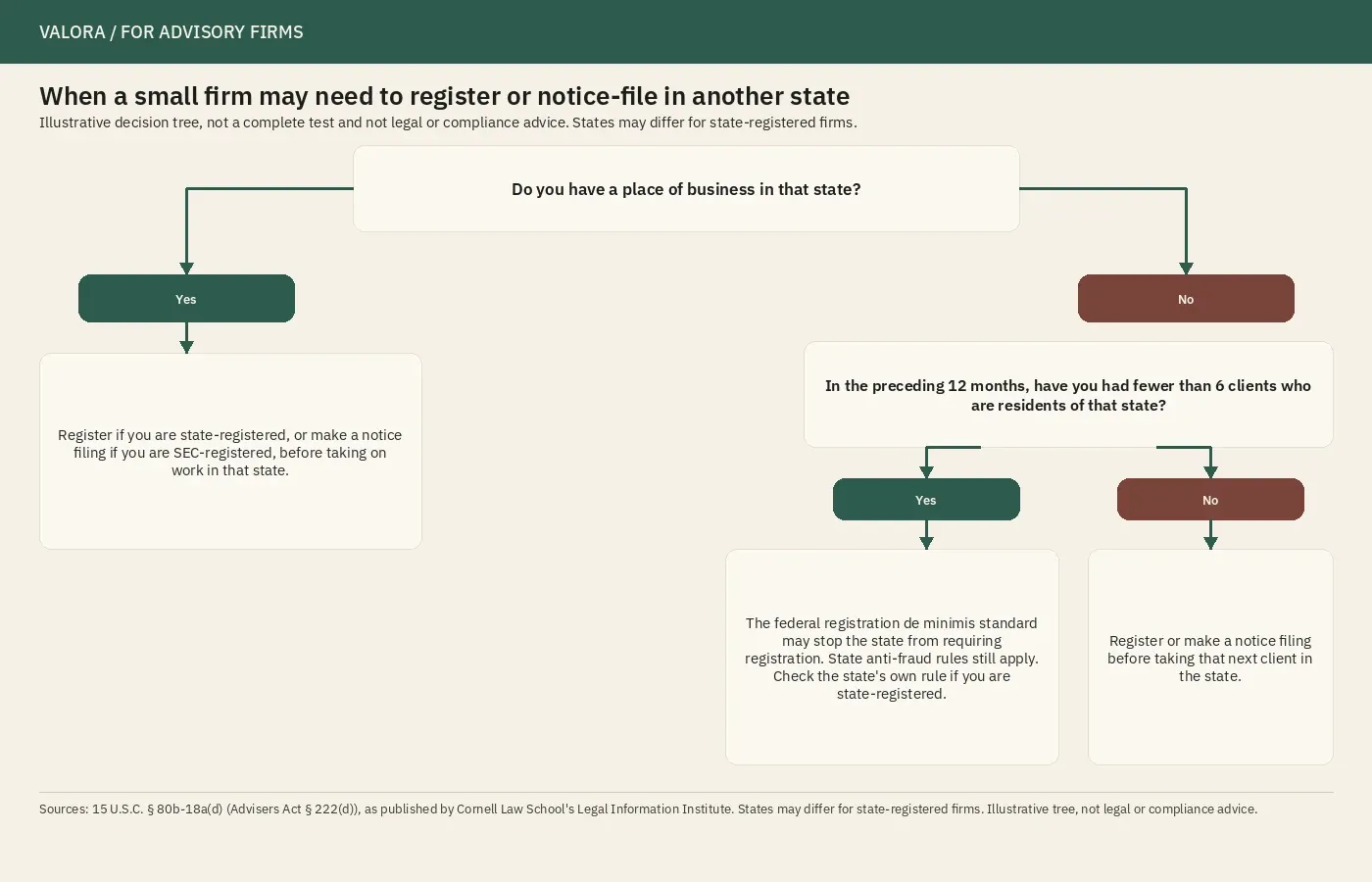
Federal law sets a registration de minimis standard. A state may not require an adviser to register if two conditions are met. The adviser has no place of business there, and has had fewer than six clients who are residents of that state during the preceding 12 months. Once you have a sixth client in that state, or a place of business there, plan the next step before taking that client on. Expect to register if you are state-registered, or to make a notice filing if you are SEC-registered. The clock is a rolling 12 months. Former clients from that window can still count.
Your investment adviser representatives (IARs) can have their own registration requirements too. Check each state's securities regulator, not just your home state's.
This is educational, not legal or compliance advice. The North American Securities Administrators Association (NASAA) says registration standards are complex, and you should consult an attorney if you have questions about whether you or your firm must register. Confirm the rule with counsel or your chief compliance officer (CCO).
Short answer: yes, but each state is its own registration question
You can serve a client who lives in another state. That fact alone does not tell you whether you must register or notice-file there. Both parts of the federal registration de minimis standard have to be true. You cannot treat "five clients anywhere" as a free pass.
This page uses "registration de minimis" for that federal standard. That is not the Marketing Rule phrase about compensation, which applies to SEC-registered advisers. State-registered advisers with a question about advertising rules should check their state securities regulator.
The federal floor: no place of business and fewer than 6 clients
The federal floor is Advisers Act section 222, published at 15 U.S.C. § 80b-18a. The text quoted below is from Cornell Law School's Legal Information Institute publication of the U.S. Code.
Subsection (d) is headed "National de minimis standard." Under that subsection, no law of any state or political subdivision requiring registration, licensing, or qualification as an investment adviser shall require an adviser to register with that state's securities commissioner. That limit applies if two conditions are met. The first condition is that the adviser "does not have a place of business located within the State." The second is that, "during the preceding 12-month period, has had fewer than 6 clients who are residents of that State."
The same subsection keeps one door open for the state. The limit does not apply to "any provision thereof prohibiting fraudulent conduct." In plain terms, a state can still enforce its anti-fraud rules even when the registration de minimis standard applies.
This is a federal floor, not a complete map of every state's rule. Always confirm the state's current rule before you rely on the exemption.
What counts as a "place of business" and a "client" (one state's example)
Section 222(d) uses "place of business" and "clients who are residents of that State," but it does not define those terms in detail. The Wisconsin Department of Financial Institutions publishes an Investment Adviser Guide on this registration de minimis exemption. What follows is one state's guidance, not a national rule. Check the state you are entering.
Wisconsin's guide says a firm headquartered in another state may be able to rely on an exemption from the registration or notice filing requirement if two conditions are met. The adviser has no place of business in the state. And, in the preceding 12 month period, it has had fewer than six Wisconsin clients.
On place of business, if you hold out a particular location as a business location of the adviser, it is considered a place of business. The guide's examples include business cards, stationery, a yellow page listing, a formal media advertisement, or notifying clients to contact you at that location. It is also a place of business if the adviser provides investment advisory services, solicits, meets with, or otherwise communicates with clients from that location. To meet the "no place of business" test, the adviser must have no regularly promoted location where advisory business is conducted.
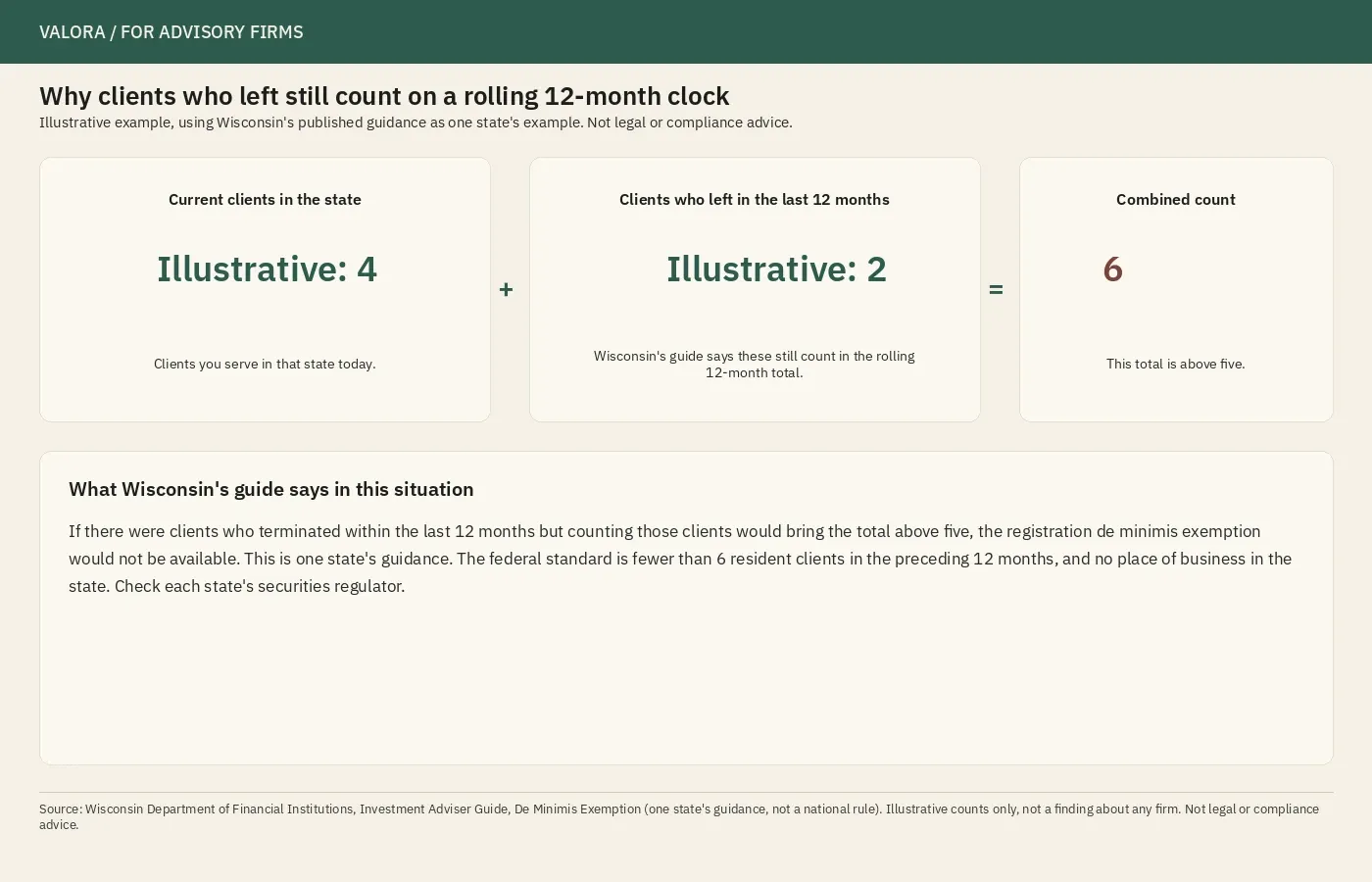
On the client count, Wisconsin's guide is explicit that the period is rolling. "This is a rolling 12 month period, so advisers need to be sure that during that time, they have not had a total of more than five Wisconsin clients." It also says: "If there were clients who terminated within the last 12 months but counting those clients would bring the total above five, the de minimis exemption would not be available." That is Wisconsin's wording for its registration de minimis exemption. The guide also says the Division of Securities counts clients in the same manner as set forth in SEC regulations. This page does not describe those SEC counting rules.
Wisconsin's guide calls the exemption self-executing. The adviser does not need to notify the division that it is relying on the exemption from registration or notice filing. But the guide also warns that if the firm has five clients, "it must take affirmative action to become registered before engaging a sixth Wisconsin client."
Treat that sixth-client warning as Wisconsin's example, not as every state's rule.
State-registered firms: register before the sixth client
If your firm is registered with a state, rather than with the SEC, work in another state is usually a registration question, not a notice-filing question.
NASAA states the general rule this way. All states require that investment advisers (IAs) and investment adviser representatives (IARs) conducting business in the state register with the state's securities regulatory authority, or qualify for an exemption from registration.
NASAA's 1956 Uniform Securities Act, with NASAA updates and commentary, is a model. It makes it unlawful to transact business in the state as an investment adviser or IAR unless the person is registered under the act, or meets an exemption. One exemption is for a person with no place of business in the state. The model also requires that, "during the preceding twelve-month period," the person "has had no more than five clients," other than certain institutional clients listed in the model. State versions vary. Do not treat the 1956 Act as the current law of any one state.
For a state-registered firm, confirm you have no place of business in the new state. Count resident clients on a rolling 12-month basis, including clients who left, using that state's counting method. If a sixth client would take you outside the exemption, register first.
Registration in another state can also be a running cost, not only a one-time filing. See How much should a new solo RIA budget for software and marketing in its first year?.
SEC-registered firms: notice filings, not registration
If your firm is registered with the SEC, other states generally do not register the firm itself. They may still require notice filings.
Form ADV's general instructions, form SEC 1707 (07-24), explain the process. If you are applying for, or amending, SEC registration, one or more state securities authorities may require copies of your SEC filings. "We call these filings “notice filings.”" Your notice filings will be sent electronically to the states that you check on Item 2.C. of Part 1A. The states to which you send notice filings may charge fees, which will be deducted from the account you establish with the Financial Industry Regulatory Authority (FINRA). The filings themselves are made through the Investment Adviser Registration Depository (IARD).
The instructions say to consult the relevant state investment adviser law or state securities authority to see which states require notice filings and fees. This page does not list those states or their fees.
The federal registration de minimis standard still matters here. Section 222(d) still limits when a state can require registration, or compliance with that registration law, other than anti-fraud provisions. Wisconsin's guide, as one state's example, applies its exemption to "the registration or notice filing requirement." Confirm what that state requires of an SEC-registered adviser before you accept a sixth resident client, or open a place of business there.
Form ADV's general instructions also describe a separate multi-state adviser exemption from the prohibition on SEC registration. A firm may be eligible if it is required to register as an investment adviser with the state securities authorities of 15 or more states. That is a different question from the registration de minimis standard on this page.
Don't forget the people: IAR registration
The firm is not the only registration question. NASAA says IARs conducting business in a state must register with that state's securities regulatory authority, or qualify for an exemption. How each state treats an out-of-state IAR with no place of business there can differ. This page does not describe those IAR rules beyond one state's example.
Wisconsin's guide, again as one state's example, addresses IARs when the firm itself is relying on the exemption. "Investment adviser representatives of an investment adviser or federal covered adviser that is exempt from registration or notice filing based on the above noted de minimis provision are not required to be registered." That is Wisconsin's statement about Wisconsin. Do not assume another state gives the same IAR result.
If you hire someone who will work with clients in another state, that person may have a separate IAR registration question. See How to make your first hire as a solo advisor. Check the state regulator for both the firm and the individual before the work begins.
A simple multi-state client log
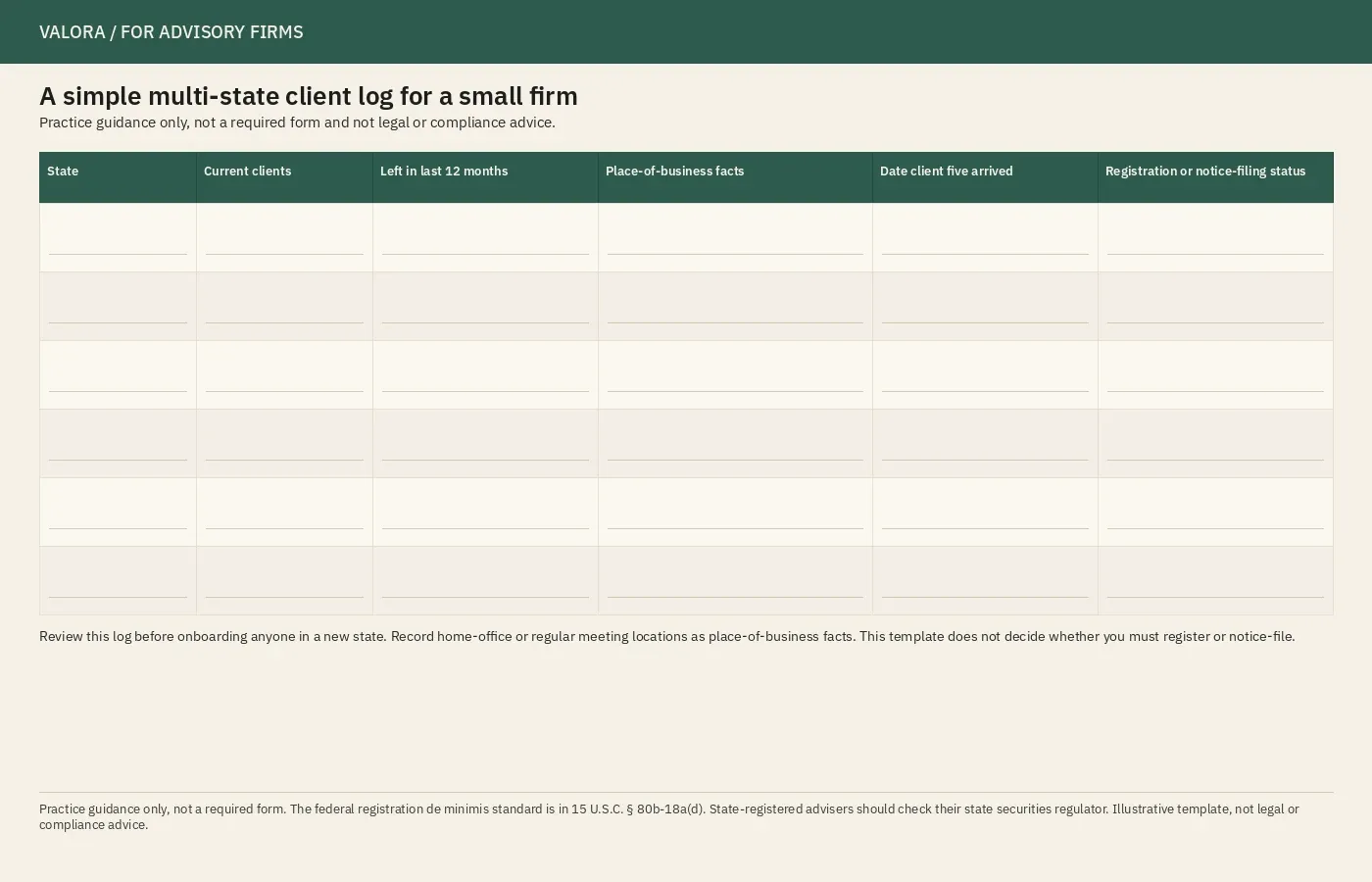
The checklist below is practice guidance, not a required form and not legal or compliance advice. Use it to see a sixth-client or place-of-business issue before you onboard someone in a new state.
For each state, track current resident clients and clients who left in the last 12 months, because they may still count on a rolling clock. Note place-of-business facts, including a home office or a regular meeting location you hold out or use to meet clients. Record the date the fifth client in that state arrived, and whether you are registered, have a notice filing, or are relying on a registration de minimis exemption.
Review the log before you accept a new client in a state where you are not already registered or notice-filed. If that person would be the sixth resident client in the rolling 12-month window, or would create a place of business there, pause and complete that step first. State-registered advisers should check that state's securities regulator, not only the federal standard.
FAQ
Can I have five clients in another state without registering there? Not automatically. Under the federal registration de minimis standard, both conditions must be true: no place of business in that state, and fewer than six resident clients there in the preceding 12 months. States can differ for state-registered firms, so check the state regulator.
Do clients who left during the past year still count? They can. Wisconsin's guide, as one state's example, treats the period as a rolling 12 months. If counting clients who terminated in that window would bring the total above five, Wisconsin says the exemption would not be available.
If my firm is SEC-registered, do I still have to do something in other states? You may. Form ADV's general instructions say states may require notice filings, sent electronically to the states you check on Item 2.C. of Part 1A, and those states may charge fees. Confirm each state's notice-filing rule.
Is "registration de minimis" the same phrase used in the Marketing Rule? No. This page uses "registration de minimis" for Advisers Act section 222(d). That is not the Marketing Rule phrase about compensation, which applies to SEC-registered advisers. State-registered advisers should check their state securities regulator on advertising rules.
Does a home office or an occasional meeting create a place of business? It can, depending on the state and on how you use or hold out that location. Wisconsin's guide, as one state's example, looks at hold-out and at meeting or communicating with clients from a location. Check the state you are entering.
If your firm later wants help making its services easier for suitable prospects to find and understand, you can learn about Valora's work for advisory firms. Growing beyond your home state starts with prospects who are a real fit. The current public offer is $250 per booked appointment with a qualified prospect, with a 3-appointment minimum, paid in advance. An appointment is a call booked on your calendar with a prospect who has asked to speak with an advisor. There is no setup fee, retainer, or long-term contract. If a prospect does not attend or does not meet the agreed criteria, the appointment is replaced at no charge. Your firm reviews what goes out under its name.
This article is educational, not legal advice, tax advice, compliance advice or personalized investment advice. Valora is not a registered investment adviser and does not provide investment advice. Valora provides marketing services to advisory firms. Valora is not a registration, notice-filing, or IAR-licensing service.
Sources
- 15 U.S.C. § 80b-18a (Investment Advisers Act of 1940, section 222), including subsection (d), "National de minimis standard," as published by Cornell Law School's Legal Information Institute: https://www.law.cornell.edu/uscode/text/15/80b-18a
- North American Securities Administrators Association, State Investment Adviser Registration Information: https://www.nasaa.org/industry-resources/investment-advisers/state-investment-adviser-registration-information/
- Wisconsin Department of Financial Institutions, Investment Adviser Guide, De Minimis Exemption (one state's guidance, not a national rule): https://dfi.wi.gov/Pages/Securities/RegistrationOfProfessionals/InvestmentAdviserIAGuideDeMinimisExemption.aspx
- North American Securities Administrators Association, Uniform Securities Act (1956) with NASAA Updates and Commentary (model act; state versions vary): https://www.nasaa.org/wp-content/uploads/2021/10/1956-Uniform-Securities-Act-with-NASAA-Updates-and-Commentary.pdf
- SEC, Form ADV General Instructions, SEC 1707 (07-24): https://www.sec.gov/about/forms/formadv-instructions.pdf
- Valora, For Advisors: https://www.valorahq.com/for-advisors/ (offer terms only; not evidence of client results)