
Should a new RIA register with the SEC or with its state?
Below $100M in RAUM most RIAs register with their state. The $100 to $110M buffer, the $90M exit, and the exemptions that change the answer.


A new registered investment adviser (RIA) usually registers with its home state, not the Securities and Exchange Commission (SEC). Under SEC rules, an adviser with less than $100 million in regulatory assets under management (RAUM) generally registers with the state, unless an exemption applies.
Between $100 million and $110 million, you may choose the SEC. At $110 million, you must apply with the SEC, within 90 days of the annual Form ADV amendment that reports it. Once you are SEC-registered, you may stay until RAUM falls below $90 million.
The main exceptions for a smaller firm are the multi-state exemption, if you are required to register in 15 or more states, and the internet adviser exemption. Either way, you file Form ADV through the Investment Adviser Registration Depository (IARD). Your representatives may still have to register with the states.
This is educational, not legal advice. The North American Securities Administrators Association (NASAA) says registration standards are complex, and you should consult an attorney.
Short answer: usually the state
For most new solo firms, the starting point is state registration. The SEC threshold is measured in RAUM, not in a casual assets-under-management figure. Form ADV Part 1A Instruction 5.b. explains how to calculate RAUM. This page does not restate that calculation.
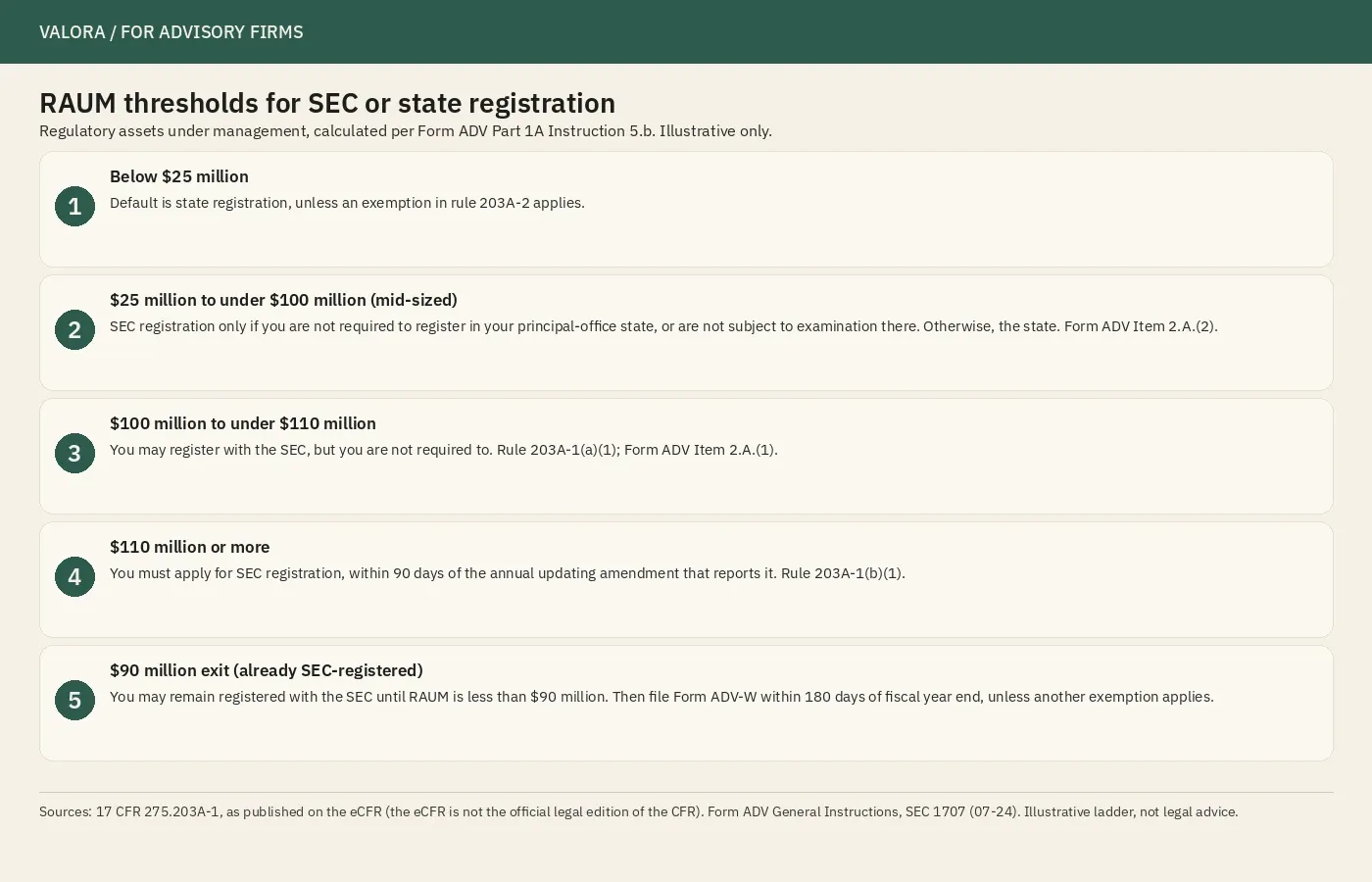
If your RAUM is below $100 million, you generally register with the state securities authority, unless an exemption lets you register with the SEC instead. If your RAUM is at least $100 million but less than $110 million, you may register with the SEC, but you are not required to. If your RAUM is $110 million or more, you must apply with the SEC.
Those dollar lines come from SEC rule 203A-1 and from the Form ADV General Instructions. The rule text quoted below is from the Electronic Code of Federal Regulations (eCFR), a continuously updated online version of the Code of Federal Regulations. The eCFR is not the official legal edition of the CFR.
Who is "state" and who is "SEC": the RAUM thresholds
Rule 203A-1(a)(1) sets the buffer and the exit line. "You may, but are not required to register with the Commission if you have assets under management of at least $100,000,000 but less than $110,000,000." The same sentence continues: "you need not withdraw your registration unless you have less than $90,000,000 of assets under management."
Form ADV uses the term regulatory assets under management for that test. Item 2.A.(1) of the General Instructions says you may check box 1 only if your RAUM is "$100 million or more." You may also check it if you are filing an annual updating amendment with the SEC and your reported RAUM "is $90 million or more." In the same item, you may register with the SEC if RAUM is at least $100 million but less than $110 million. You must apply if RAUM is $110 million or more. If you are already SEC-registered, you may remain registered if RAUM is $90 million or more.
The rule text says "assets under management." Form ADV says "regulatory assets under management." Use the Form ADV calculation, not a casual total.
The mid-sized band ($25 million to under $100 million)
A mid-sized adviser, in Form ADV Item 2.A.(2), has RAUM of $25 million or more but less than $100 million. In that band, you must register with the SEC if at least one of two things is true. You are not required to be registered as an investment adviser in the state where you maintain your principal office and place of business. Or you are not subject to examination by that state's securities authority.
If you are exempt from registration with that state, or excluded from the definition of investment adviser there, Form ADV says you must register with the SEC. Otherwise, a mid-sized adviser that does not meet either of those two tests is generally prohibited from SEC registration and registers with the state. Exemptions in rule 203A-2 can still change that answer.
Which states are not "subject to examination"? As of the SEC staff's mid-sized adviser FAQ, last reviewed or updated June 30, 2017, the staff answer was: "Only New York." The FAQ says a mid-sized adviser with its principal office and place of business in New York is not "subject to examination" by the New York state securities authority. That adviser would have to register with the SEC. A mid-sized adviser with its principal office in any other state is "subject to examination."
Those are staff views, not a rule, regulation, or statement of the Commission. The Commission has neither approved nor disapproved that information. The same page says the information will be updated promptly if a state securities authority notifies the staff of a change in examination status. This page has not verified whether any state's examination status has changed since 2017. Confirm the current status with counsel and with the state securities authority.
When you grow past $110 million, or shrink below $90 million
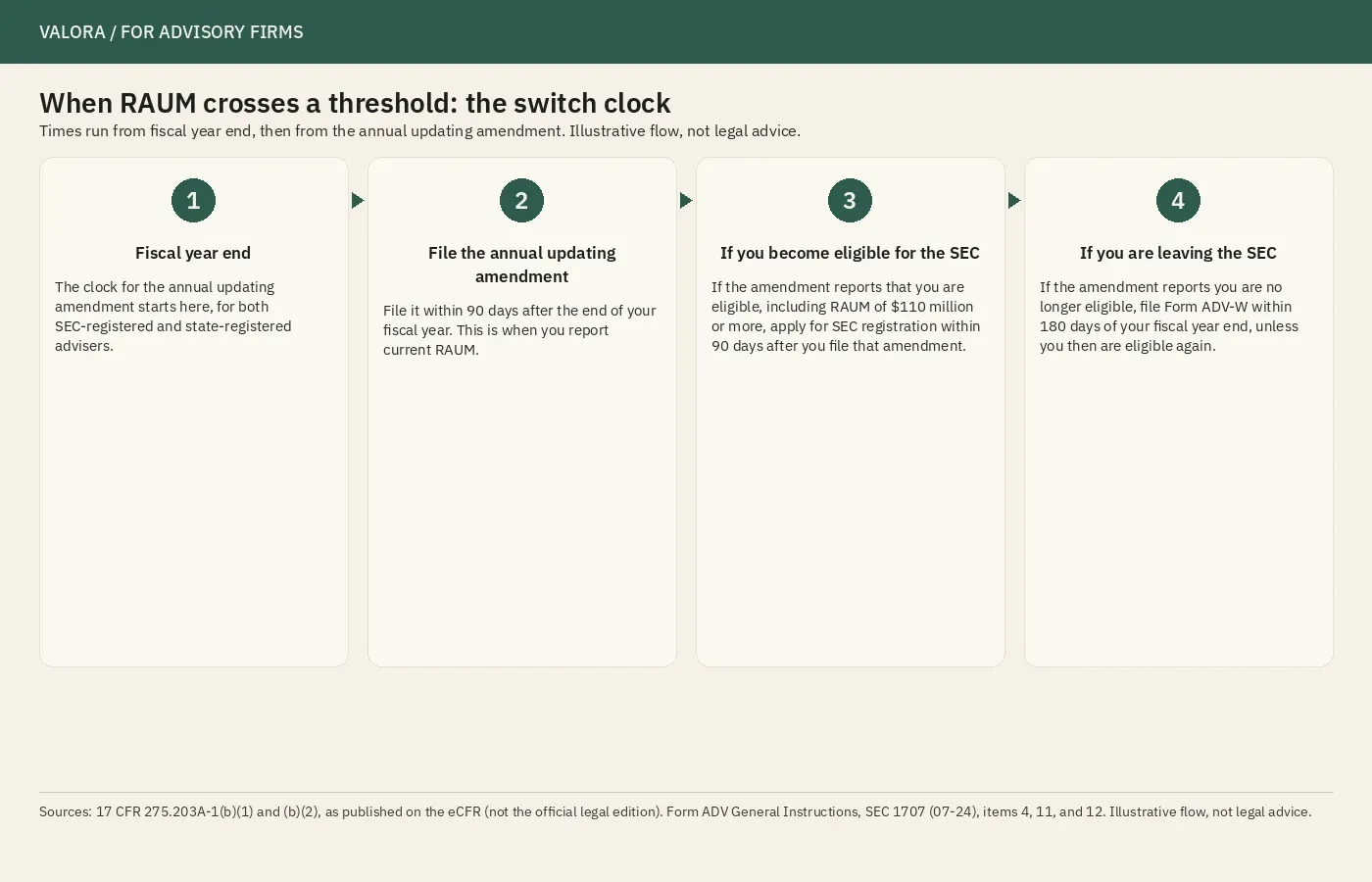
The switch is tied to your annual updating amendment, not to the day RAUM first crosses the line. Form ADV says both SEC-registered and state-registered advisers must file that amendment "within 90 days after the end of your fiscal year."
If you are state-registered and the amendment reports that you are eligible for SEC registration, rule 203A-1(b)(1) says you must apply for registration with the Commission within 90 days of filing that amendment. Form ADV is more specific on the $110 million line. If RAUM increased to $100 million or more, you may register with the SEC. If RAUM increased to $110 million or more, you must apply for registration with the SEC within 90 days after you file that annual updating amendment.
If you are SEC-registered and the amendment reports that you are no longer eligible, and you are not relying on another exemption, a withdrawal is required. Rule 203A-1(b)(2) says you must file Form ADV-W to withdraw your SEC registration within 180 days of your fiscal year end, unless you then are eligible for SEC registration. Form ADV General Instruction 12 says the same, and tells you to check box 13 in Item 2.A. when RAUM is less than $90 million and no other box applies.
During the period while you are registered with both the Commission and one or more states, the Advisers Act and applicable state law will apply to your advisory activities. Until you file Form ADV-W, you remain subject to SEC regulation, and you are also subject to regulation in any states where you register.
Growing the firm is a broader question than this registration switch. See How to grow a solo RIA into a real firm.
Exemptions that can put a small firm with the SEC
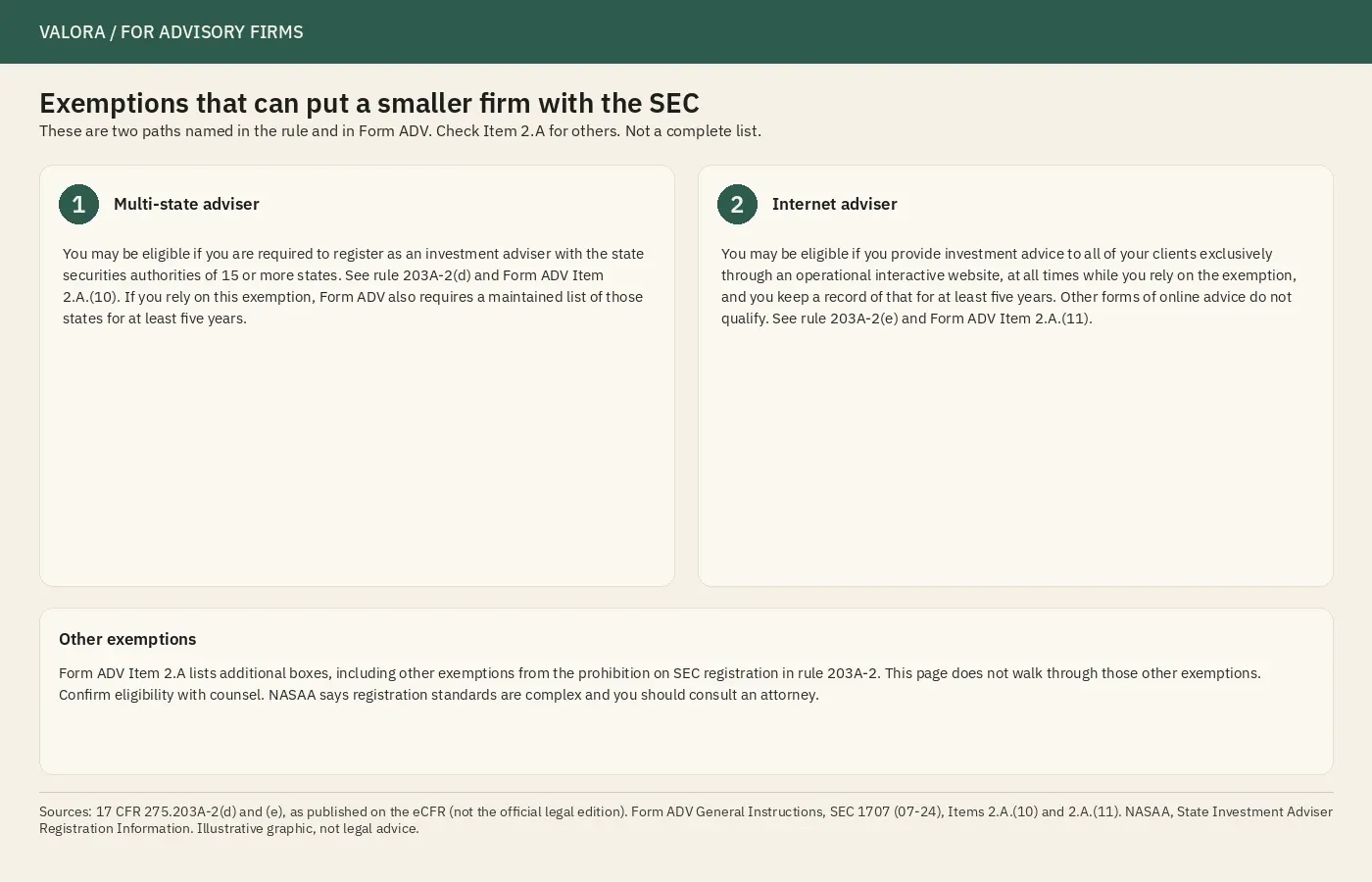
Rule 203A-2 lists exemptions from the prohibition on Commission registration. Two of them come up often for smaller firms.
The multi-state exemption, in rule 203A-2(d) and Form ADV Item 2.A.(10), is available if you are "required to register as an investment adviser with the state securities authorities of 15 or more states." If you rely on it, Form ADV also requires you to keep a list of those states, update it with each annual updating amendment, and maintain it for at least five years.
The internet adviser exemption, in rule 203A-2(e) and Form ADV Item 2.A.(11), is narrower than it may sound. You are eligible if you provide investment advice to all of your clients exclusively through an operational interactive website, at all times while you rely on the exemption. You also keep a record of that for at least five years. Form ADV adds: "Other forms of online or Internet investment advice do not qualify for this exemption."
Item 2.A. lists other boxes as well. This page does not walk through those other exemptions. Confirm eligibility with counsel.
Representatives register with states either way
Firm registration and representative registration are different steps. NASAA says: "All states require that investment advisers (IAs) and investment adviser representatives (IARs) conducting business in the state register with the state's securities regulatory authority (or qualify for an exemption from registration)." NASAA also says: "Registration standards are complex and you should consult an attorney if you have questions about whether you or your firm must register."
Form ADV General Instruction 11 makes the same split after a firm switches to the SEC. Once you register with the SEC, you are subject to SEC regulation, whether or not you remain registered with one or more states. Each of your investment adviser representatives, however, may be subject to registration in those states in which the representative has a place of business.
SEC-registered firms that file Form ADV through IARD may also submit notice filings to state securities authorities. This page does not list those state rules or fees. Check the states where you do business.
An applicant for IAR registration must file a Form U4, according to NASAA. Firms file Form ADV, Parts 1 and 2, through IARD, and may be asked for additional materials.
What breakaway advisors report about the process
In a public October 2026 discussion, one adviser described leaving two broker-dealers to start an RIA. The poster wrote: "I'm registered in Michigan and Ohio, and the entire process from initially forming the LLC to getting the RIA launched took roughly 45 days." The poster also said an outsourced compliance provider handled the registration process, Form ADV, policies and procedures, and state registrations.
That is one person's experience, not a typical timeline, and not a recommended vendor or method. This page does not generalize from it, and it does not use assets, fees, or cost figures from that discussion.
What changes with your regulator (and what doesn't)
Some parts of the file are the same either way. You still file Form ADV through IARD. You still file an annual updating amendment within 90 days after the end of your fiscal year, whether you are SEC-registered or state-registered.
What changes is which advertising standard applies to the firm. The SEC Marketing Rule applies to investment advisers registered, or required to be registered, with the SEC. The Marketing Rule does not, by its own terms, apply to advisers that are only state-registered. State-registered advisers should check their state securities regulator's advertising rules.
For a plain-English walk through the Marketing Rule itself, see SEC Marketing Rule in plain English for solo RIAs (testimonials, reviews, AI copy).
This page does not say that one regulator is easier than the other, and it does not compare exam frequency. Those points were not reviewed here. NASAA's advice still stands: consult an attorney if you have questions about whether you or your firm must register.
FAQ
Does a new RIA usually register with the SEC? No. Below $100 million in RAUM, the default is state registration, unless an exemption applies. Between $100 million and $110 million, you may choose the SEC. At $110 million or more, you must apply with the SEC.
When does the 90-day clock start if I cross $110 million? It starts when you file the annual updating amendment that reports you are eligible, not on the day RAUM first crosses the line. You must apply for SEC registration within 90 days after you file that amendment. The amendment itself is due within 90 days after the end of your fiscal year.
Is New York different for mid-sized advisers? As of the SEC staff's mid-sized adviser FAQ, last reviewed or updated June 30, 2017, the staff said "Only New York" was not "subject to examination." Those are staff views, not a rule. This page has not verified whether any state's examination status has changed since 2017.
If my firm registers with the SEC, do my representatives still register with states? They may. Form ADV says each investment adviser representative may be subject to registration in the states where the representative has a place of business. NASAA says all states require IAs and IARs conducting business in the state to register, or to qualify for an exemption. Consult an attorney.
If your firm later wants help making its services easier for suitable prospects to find and understand, you can learn about Valora's work for advisory firms. The current public offer is $250 per booked appointment with a qualified prospect, with a 3-appointment minimum, paid in advance. An appointment is a call booked on your calendar with a prospect who has asked to speak with an advisor. There is no setup fee, retainer, or long-term contract. If a prospect does not attend or does not meet the agreed criteria, the appointment is replaced at no charge. Your firm reviews what goes out under its name.
This article is educational, not legal advice, tax advice, compliance advice or personalized investment advice. Valora is not a registered investment adviser and does not provide investment advice. Valora provides marketing services to advisory firms. Valora is not a registration or compliance service.
Sources
- eCFR, 17 CFR 275.203A-1, Eligibility for SEC registration; Switching to or from SEC registration (the eCFR is not the official legal edition of the CFR): https://www.ecfr.gov/current/title-17/chapter-II/part-275/section-275.203A-1
- eCFR, 17 CFR 275.203A-2, Exemptions from prohibition on Commission registration (the eCFR is not the official legal edition of the CFR): https://www.ecfr.gov/current/title-17/chapter-II/part-275/section-275.203A-2
- SEC, Form ADV General Instructions, SEC 1707 (07-24): https://www.sec.gov/about/forms/formadv-instructions.pdf
- SEC staff, Frequently Asked Questions Regarding Mid-Sized Advisers, last reviewed or updated June 30, 2017 (staff views only; not a rule, regulation, or statement of the Commission). The original path still used in Form ADV, https://www.sec.gov/divisions/investment/midsizedadviserinfo.htm, redirected this turn to https://www.sec.gov/rules-regulations/staff-guidance/division-investment-management-frequently-asked-questions/division-investment-management-frequently-asked-questions-regarding-mid-sized-advisers
- NASAA, State Investment Adviser Registration Information: https://www.nasaa.org/industry-resources/investment-advisers/state-investment-adviser-registration-information/
- Public discussion among advisers, posted October 12, 2026 (anecdotes only; no usernames or vendor names are used in this page): https://www.reddit.com/r/CFP/comments/1x481nq/
- Valora, For Advisors: https://www.valorahq.com/for-advisors/ (offer terms only; not evidence of client results)