
How should an advisor document a 401(k) rollover recommendation?
A rollover is conflicted under any pay model. What to disclose, which alternatives to compare, and what to write down, per CFP Board and SEC staff.


Document a 401(k) rollover recommendation by recording three things. Write down the incentive you disclosed. Write down the alternatives you compared, always including leaving the money in the plan where that is an option. Write down the client-specific reasons for your recommendation.
The Certified Financial Planner Board of Standards (CFP Board) published a 2026 guide on applying the fiduciary duty to rollovers. It says this conflict "exists regardless of compensation model." Both commissions and assets under management (AUM) fees, in CFP Board's words, "create financial incentives to recommend a rollover." That language applies to CFP professionals. Cost is "not the only relevant factor." For advice that does not require financial planning, a written recommendation is generally not required. CFP Board still recommends documenting the alternatives considered and the analysis.
Staff at the Securities and Exchange Commission (SEC) go further on the file. When making a rollover recommendation, it may be difficult for a firm to demonstrate compliance with its obligations to retail investors without documenting the basis for the recommendation. Those are staff views, with no legal force or effect.
This is educational, not legal or compliance advice. This page does not say whether a rollover is usually a good or a bad idea. That depends on the client in front of you.
Short answer: disclose the incentive, compare the alternatives, record the reasons
Start with the file you would want to reread later. First, what specific incentive did you disclose, and in what words? Second, which alternatives did you actually compare, including staying in the plan? Third, why does this recommendation fit this client, on more than cost alone?
CFP Board's guide is written for CFP professionals. A registered investment adviser (RIA) that is not a CFP professional still faces a fiduciary standard under the Investment Advisers Act. In a 2019 interpretation, effective July 12, 2019, the SEC said an adviser's fiduciary duty applies to advice about account type, including whether to roll over assets. "We consider advice about 'rollovers' to include advice about account type." SEC staff views in the 2022 bulletin are not rules. This page does not map state-registered adviser rules on rollover documentation. Those advisers should check their state securities regulator.
Why every rollover recommendation is a conflict
CFP Board is direct about the incentive. Financial advice about whether to roll over assets, or keep them in an employer plan, presents a Material Conflict of Interest in a stated case. That case is when a rollover would result in compensation that a CFP professional, or their firm, otherwise would not receive. The next sentences matter just as much. "This Conflict of Interest exists regardless of compensation model." "Both commission payments and assets under management (AUM) fees create financial incentives to recommend a rollover."
That is the incentive mention this page uses, and it stops there. It is not an argument that one pay model is better than another, and it is not a claim about the value of a fee.
The SEC staff bulletin, dated March 30, 2022, addresses both broker-dealers and investment advisers. Selection of an account type, the staff wrote, is a consequential decision with potentially significant conflicts of interest.
In a public October 2026 discussion among advisers, some people treated the CFP Board guide as nothing new. Some were cynical about its purpose. One firm said it now applies its standard fee to 401(k) and similar accounts it advises on. Those are views, not evidence, and not a recommended practice.
Disclose the specific incentive, not just your pay type
Naming your pay type is not enough, according to CFP Board. "A CFP professional does not meet this standard by merely disclosing the type of compensation, as that information is not sufficiently specific to enable the Client to provide informed consent." The professional "also must explain the incentive that the compensation creates and how it could affect the Financial Advice."
A written disclosure is recommended, not required. "While a CFP professional is not required to disclose these conflicts in writing, CFP Board recommends written disclosure." Evidence of an oral disclosure will be given such weight as CFP Board in its judgment deems appropriate.
An illustrative sentence, with no fee numbers, is: "If you move this account to us, our fee would apply to it; that gives us a reason to prefer a rollover." That is an example, not a required script. Use words that match how you are actually paid.
How you explain fees before a first call is a different conversation from this rollover file. For that earlier disclosure, see How should an RIA explain fees before a first call?.
Compare staying in the plan with the real alternatives
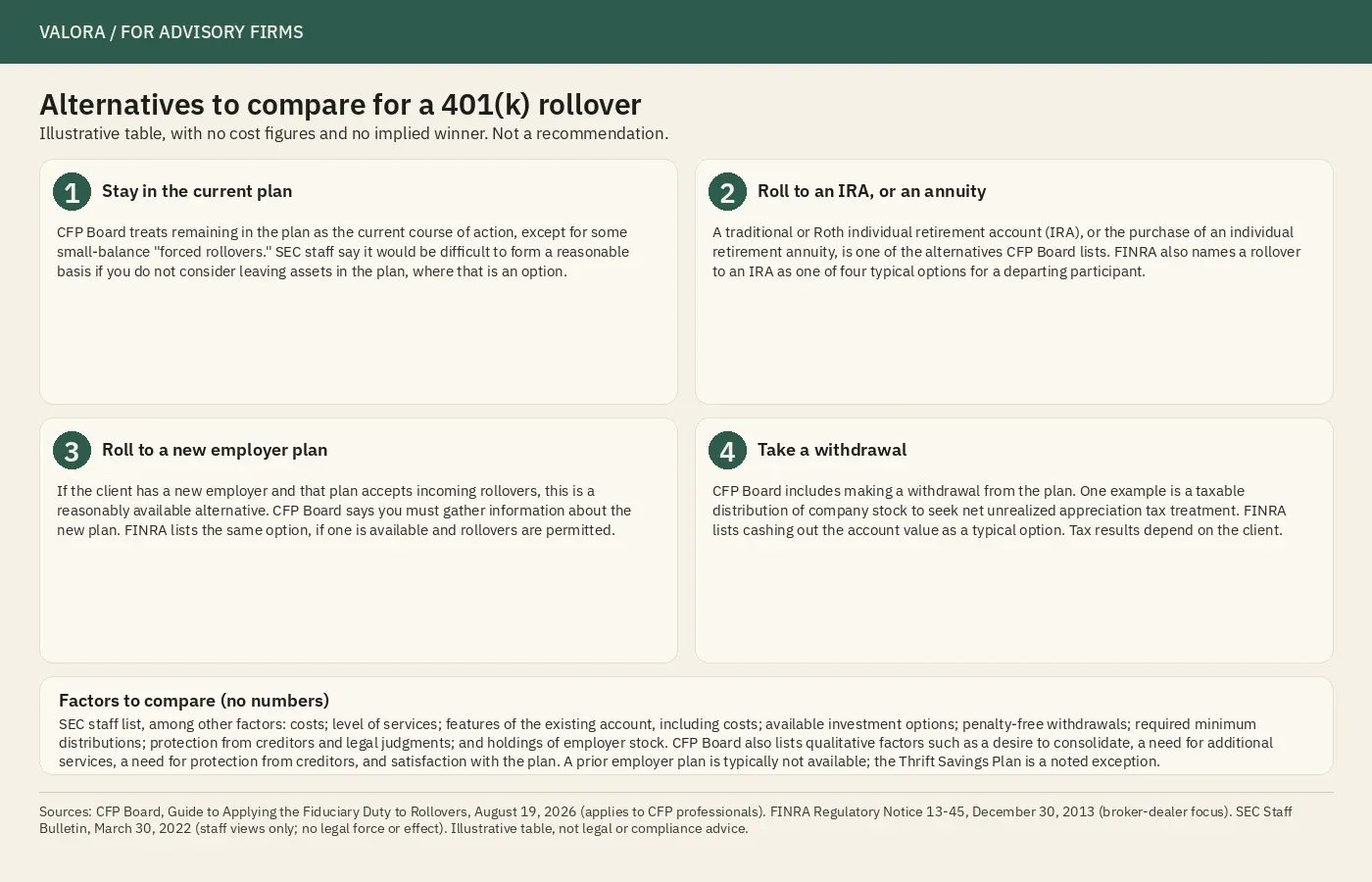
The current course of action, in CFP Board's Step 3, is remaining in the current employer-sponsored plan, except in the case of "forced rollovers" for small account balances. Potential alternatives include a traditional or Roth individual retirement account (IRA), or an individual retirement annuity. They also include a new employer's plan, a previous employer's plan, or a withdrawal from the plan.
A previous employer's plan is typically not available, because most plans do not permit incoming rollovers from separated employees. The Thrift Savings Plan (TSP) is a noted exception for former federal employees. A withdrawal example in the guide is a taxable distribution of company stock to receive net unrealized appreciation (NUA) tax treatment. That tax result depends on the client's facts. Confirm it with a tax professional. This page is not tax advice.
The Financial Industry Regulatory Authority (FINRA), in Regulatory Notice 13-45, published December 30, 2013, says a departing participant "typically has four options," and may use a combination of them. Those options are leaving the money in the former employer's plan, if permitted; rolling to a new employer's plan, if available and permitted; rolling to an IRA; or cashing out. The notice is written with a broker-dealer focus.
SEC staff, in the 2022 bulletin, focus on the option people skip. It would be difficult to form a reasonable basis for a rollover recommendation, the staff wrote, if you do not consider leaving the assets in the employer's plan, where that is an option. To evaluate a transfer out of a plan, you would need information about the existing plan, including the costs of the options available in it.
Look past cost
You still have to consider cost. CFP Board says the professional must always consider the costs of each alternative. Then the guide draws a hard line. "However, cost is not the only relevant factor." "In fact, making a recommendation based on a comparison of cost alone generally would not fulfill the Duty of Care."
Qualitative factors in the guide include a desire to consolidate or simplify holdings, and a desire for additional services and financial advice. They also include a need for protection from creditors, and the client's level of satisfaction with the current plan. This page does not rank those factors, and it does not claim that any one of them justifies a rollover on its own.
The SEC staff bulletin lists factors that are potentially relevant to rollovers, "without limitation." Those factors include costs, level of services available, and features of the existing account, including costs. They also include available investment options, penalty-free withdrawals, and required minimum distributions. They also include protection from creditors and legal judgments, and holdings of employer stock. Consider those factors in light of the investor's investment profile.
This page does not say that IRAs cost more or less than plan accounts. No such generalization was used here.
What to write down
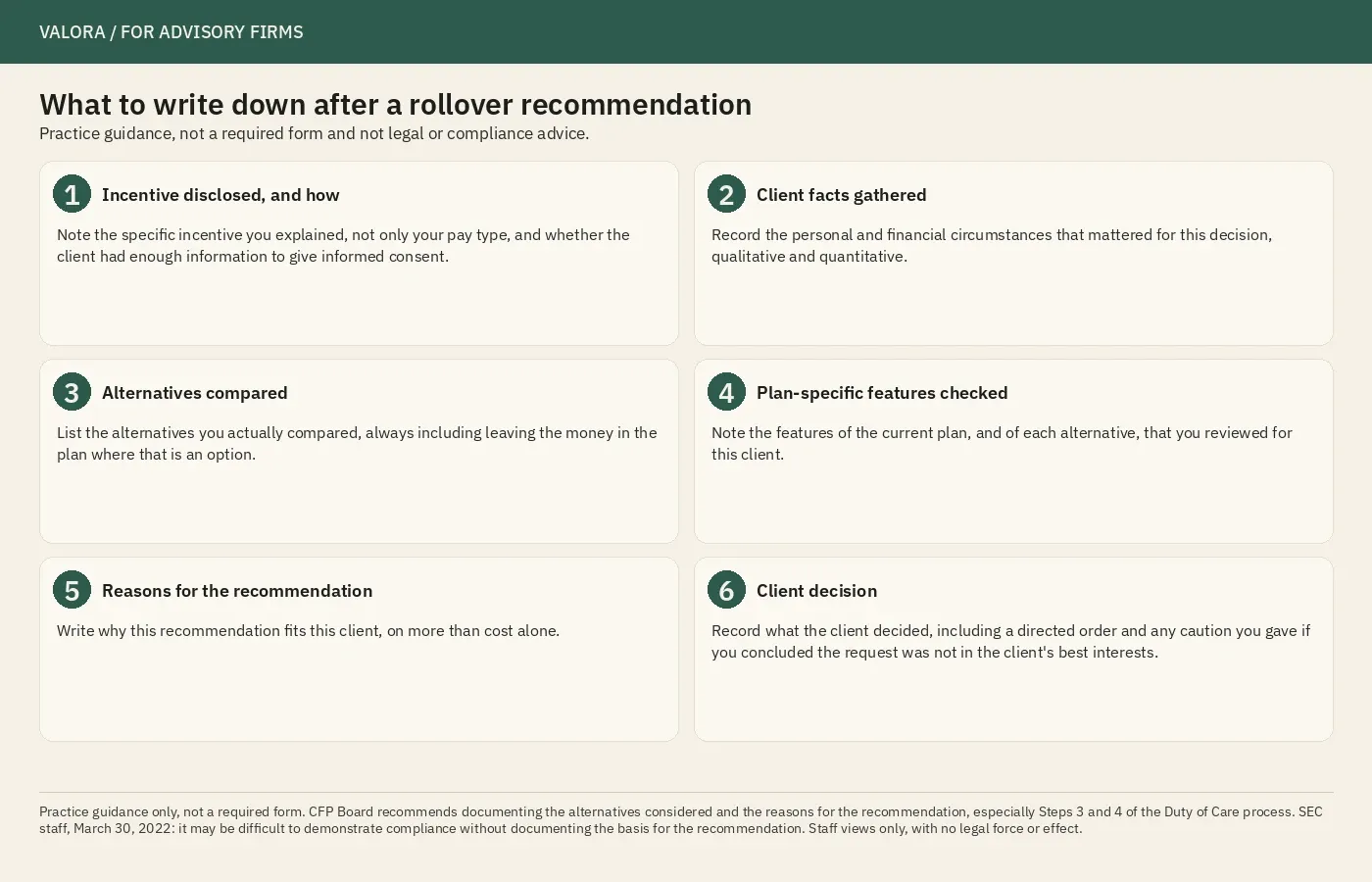
For financial advice that does not require financial planning, a CFP professional generally is not required to present a written recommendation or to document compliance with the Duty of Care process. CFP Board still recommends documenting how that process was applied, particularly with respect to Steps 3 and 4. Those steps concern the alternatives considered and the reasons that a rollover was in the client's best interests. The guide adds that a CFP professional might have difficulty demonstrating that the advice was in the client's best interests without contemporaneous documentation of the basis for the recommendation.
SEC staff make a similar point. It may be difficult for a firm to demonstrate compliance without documenting the basis for the recommendation. The staff also tied that difficulty to reviewing the adequacy of policies and procedures. Those are staff views, not a new rule.
Practice guidance, not a required form, is to record six items. Note the incentive you disclosed and how you disclosed it, and the client facts you gathered. Note the alternatives you compared, the plan-specific features you checked, the reasons for the recommendation, and the client's decision. The file can be a memo, a firm form, or contemporaneous meeting notes.
If you later write a short client summary, check it against the full explanation. See What should an advisory firm check before turning a full planning explanation into a one-page client summary?. If an artificial intelligence (AI) draft of meeting notes has already reached the client, correct it with care. See How should an advisory firm correct an AI meeting summary after it has reached the client?.
When the client asks you to roll it over
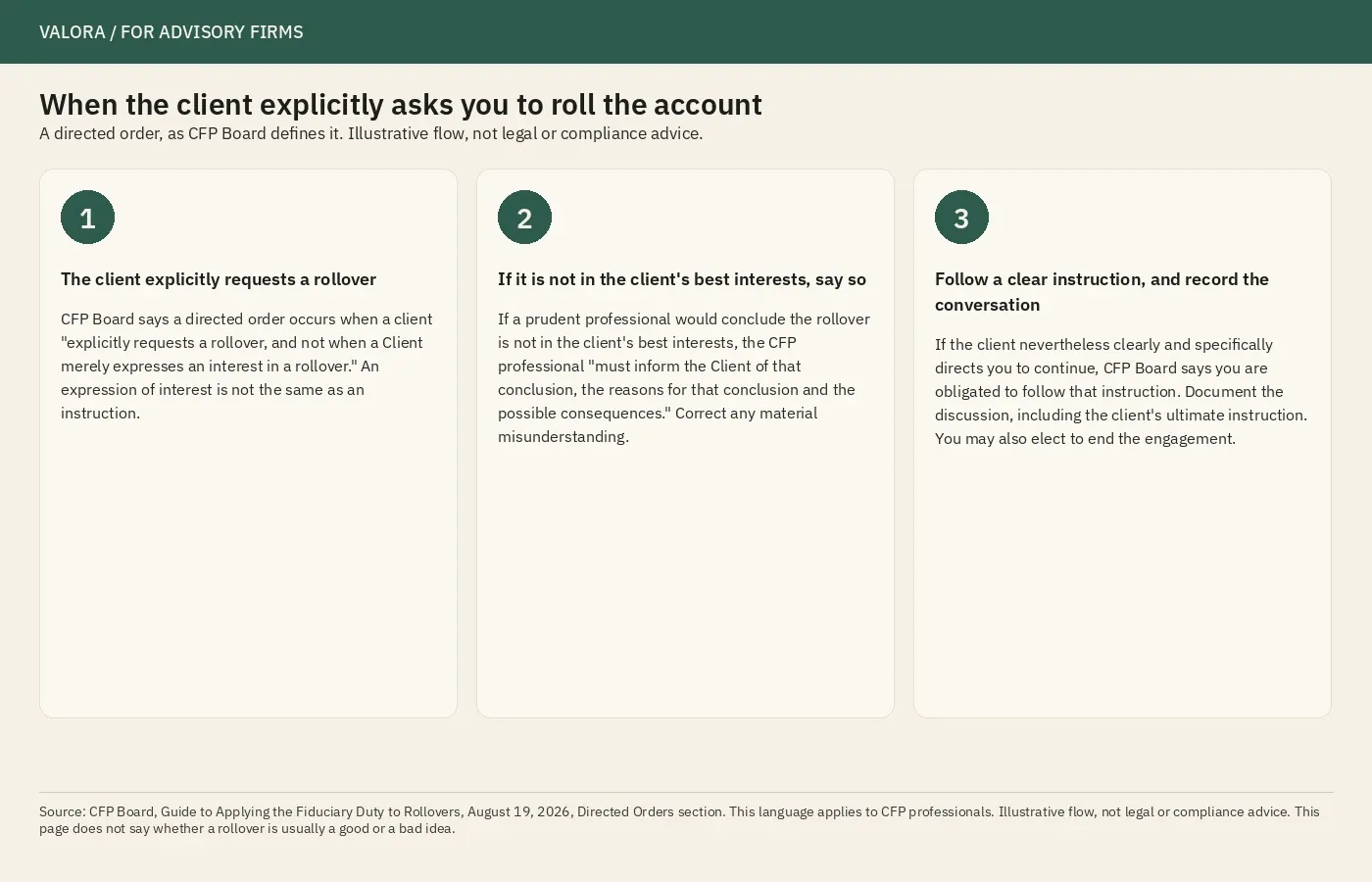
A directed order, as CFP Board defines it, occurs when a client "explicitly requests a rollover, and not when a Client merely expresses an interest in a rollover." An expression of interest is not an instruction.
If a prudent professional would conclude that the rollover is not in the client's best interests, you must say so. The CFP professional "must inform the Client of that conclusion, the reasons for that conclusion and the possible consequences of taking that course of action." If the request is based on materially inaccurate or incomplete information, you must correct that misunderstanding.
If the client nevertheless clearly and specifically directs you to continue, CFP Board says the professional is obligated to follow that instruction. "A CFP professional should document the discussion with the Client, including the Client's ultimate instruction." The professional may also elect to end the engagement.
Record the instruction and that conversation. Do not treat a casual "I might roll this" as a directed order.
Other rules may add requirements
This paragraph is a pointer, not an interpretation of those rules, and it does not state their current status.
CFP Board notes that individualized investment advice about plan assets, including a rollover, may bring other rules into play. The professional may be subject to requirements under the Employee Retirement Income Security Act of 1974 (ERISA) and the regulations implementing it. As an example, the guide names the Department of Labor's (DOL) Prohibited Transaction Exemption (PTE) 2020-02. Those rules, the guide says, "may include, if applicable, specific disclosures and acknowledgments as well as an annual retrospective compliance review process."
SEC staff, in the 2022 bulletin, also point to the Department of Labor. If you are relying on PTE 2020-02, the staff wrote, you may want to review DOL guidance on factors to consider in a rollover recommendation, as well as relevant documentation requirements. Follow your counsel and your firm's procedures on those points. This page does not interpret ERISA and does not state the status of PTE 2020-02.
FAQ
Do I have to put a rollover recommendation in writing? Not always, under CFP Board's guide. For advice that does not require financial planning, a written recommendation is generally not required. CFP Board still recommends documenting the alternatives considered and the reasons for the recommendation. SEC staff say it may be difficult to demonstrate compliance without documenting the basis for the recommendation. Those are staff views, not a rule.
Is naming my fee type enough to disclose the conflict? No, according to CFP Board. Merely disclosing the type of compensation is "not sufficiently specific to enable the Client to provide informed consent." You must also explain the incentive that the compensation creates and how it could affect the advice. CFP Board recommends written disclosure but does not require the conflict disclosure to be in writing.
Must I consider leaving the money in the plan? Yes, where that is an option. CFP Board treats remaining in the plan as the current course of action, except for some small-balance forced rollovers. SEC staff say it would be difficult to form a reasonable basis for a rollover recommendation if you do not consider that alternative, where it is available.
If your firm later wants help making its services easier for suitable prospects to find and understand, you can learn about Valora's work for advisory firms. The current public offer is $250 per booked appointment with a qualified prospect, with a 3-appointment minimum, paid in advance. An appointment is a call booked on your calendar with a prospect who has asked to speak with an advisor. There is no setup fee, retainer, or long-term contract. If a prospect does not attend or does not meet the agreed criteria, the appointment is replaced at no charge. Your firm reviews what goes out under its name.
This article is educational, not legal advice, tax advice, compliance advice or personalized investment advice. Valora is not a registered investment adviser and does not provide investment advice. Valora provides marketing services to advisory firms. Valora is not a rollover-documentation or compliance service.
Sources
- CFP Board, Guide to Applying the Fiduciary Duty to Rollovers, resource page dated August 19, 2026 (guidance for CFP professionals, not law): https://www.cfp.net/ethics/compliance-resources/2026/08/guide-to-applying-the-fiduciary-duty-to-rollovers
- CFP Board, Guide to Applying the Fiduciary Duty to Rollovers (PDF, 2026): https://www.cfp.net/-/media/2026/miscellaneous/cfp-board-rollover-guide.pdf
- SEC, Staff Bulletin: Standards of Conduct for Broker-Dealers and Investment Advisers Account Recommendations for Retail Investors, March 30, 2022, last reviewed March 30, 2022 (staff views only; no legal force or effect): https://www.sec.gov/tm/iabd-staff-bulletin
- SEC, Commission Interpretation Regarding Standard of Conduct for Investment Advisers, Release IA-5248, effective July 12, 2019: https://www.sec.gov/rules/interp/2019/ia-5248.pdf
- FINRA, Regulatory Notice 13-45, FINRA Reminds Firms of Their Responsibilities Concerning IRA Rollovers, published December 30, 2013 (broker-dealer focus): https://www.finra.org/rules-guidance/notices/13-45
- Public discussion, "CFP 401k Rollover Guidance," posted October 23, 2026 (anecdotes only; no usernames or brand names are used in this page): https://www.reddit.com/r/CFP/comments/1xdqg0a/
- Valora, For Advisors: https://www.valorahq.com/for-advisors/ (offer terms only; not evidence of client results)