
How to grow a solo RIA into a real firm
Build a less founder-dependent RIA through service capacity, clear responsibilities, careful hiring and repeatable operations after traction.


A solo practice is already a real firm. Building a team is not a requirement or proof of better advice. If you want a business that depends less on its founder, start with clear service promises, a record of the work behind them and named responsibility for each handoff. Add help only where the work and budget justify it.
A registered investment adviser, or RIA, can grow in several ways. More staff is one option. A smaller service menu, better coverage or clearer decisions may be more useful. The goal here is reliable delivery beyond the founder's memory, not a particular staff count or asset milestone.
This guide starts after traction, when an existing client book creates recurring work. It is about running the practice, not finding more leads.
What changes when a solo RIA becomes team-led?
In a founder-led practice, one person may know why every task exists, what each client expects and which requests need attention first. That knowledge can be valuable. It becomes a constraint when other people cannot act without asking the founder to explain it again.
A less founder-dependent firm makes more of that knowledge usable by others. People know what starts a task, what they own and when they must ask for a decision. The founder still has responsibilities. They do not need to be the source of every routine instruction.
This is an operating change, not a change in status. A solo advisor can build clear processes and outside coverage without becoming an employer. A team can remain highly dependent on its founder despite having several staff members. Look at how work gets done, not the number of names on the website.
Decide whether you want a team or a strong solo practice
Before choosing a role to hire, decide what kind of working life you want. Do you enjoy managing people? Do you want more time with clients, more control over your schedule or a business that can operate during an absence? These goals may lead to different choices.
A strong solo practice may suit a founder who values direct client work and wants limited management duties. A team may suit someone who wants to develop other professionals and share delivery. Neither path is objectively superior.
Write down what you want to preserve as well as what you want to change. For example, you may want clients to keep a direct relationship with you while routine preparation moves elsewhere. That is a clearer goal than “build something bigger.”
Also name the tradeoff you will accept. Help may add training, supervision, coordination and cost before it creates useful room in your week. Decide whether that is work you want to own.
Separate a demand problem from a delivery problem
A shortage of inquiries and an overloaded service calendar are different problems. Hiring to solve the second does not automatically solve the first. Buying more marketing does not resolve unclear responsibility for existing clients.
For this review, start with the work already promised. Which requests wait? What gets done late? Which decisions return to the founder because no one knows who can approve them? Those questions point toward delivery constraints.
Avoid using busyness alone as the diagnosis. A full week might reflect a temporary cluster of reviews, repeated rework or a service promise that is too broad. Each calls for a different response.
Write a plain problem statement before discussing candidates. “Client meeting preparation waits for the founder to gather documents” is something you can examine. “We need a senior person” is already a proposed solution. Keeping the two separate makes it easier to see whether a hire, a narrower promise or a better handoff fits the work.
Write down the service you can reliably deliver
List what clients receive, when they receive it and what you need from them. Include work between meetings, not just the meetings themselves. Identify exclusions and the limits of coordination with outside professionals.
The U.S. Securities and Exchange Commission (SEC) is the federal securities regulator. Its staff's account-opening bulletin tells investors to understand service types and frequency, fees, responsibilities and contract terms. For a founder, those questions offer a useful check: can the practice explain its actual service in writing?
Compare the description with current agreements and disclosures. If the website suggests ongoing work that the firm does not provide, a new employee will not fix the mismatch. Resolve the promise before building a process around it.
Some professionals hold CFP® certification, a financial-planning credential issued by CFP Board. CFP Board's standards address the agreed services and monitoring responsibilities of CFP® professionals. Those are certification standards, not a universal law for every RIA. Have a qualified reviewer check the requirements that apply to your firm.
Measure workload before choosing a hire
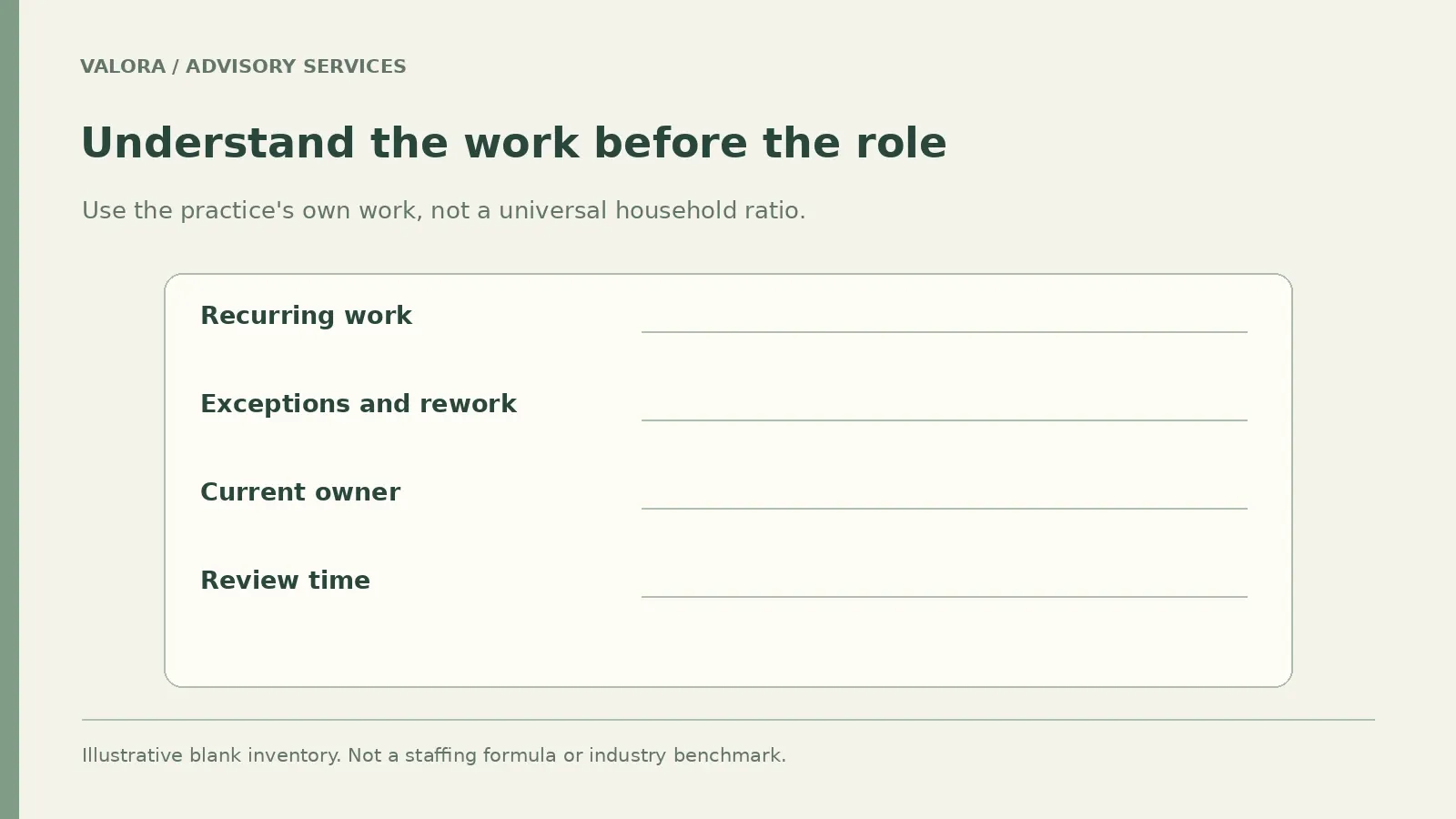
Use a work inventory rather than an assumed clients-per-advisor ratio. There is no universal capacity threshold established by the research used here. Two books with the same household count can create very different work.
Record recurring tasks, unexpected requests, preparation, follow-up and corrections. Note who does each task now, what information it needs and where it waits. Include the founder's review time. Work moved to another person is not fully removed if every step still requires founder approval.
Observe ordinary periods and busier parts of the service cycle. Do not use one quiet week as the whole picture. Mark estimates as estimates and update them when the work becomes clearer.
This inventory is an original editorial tool, not a validated staffing formula. Its purpose is to expose the task mix. If the main burden is chasing missing information, that points to a different need than a backlog of advice decisions. The distinction should shape any role you consider.
Turn recurring work into owned handoffs
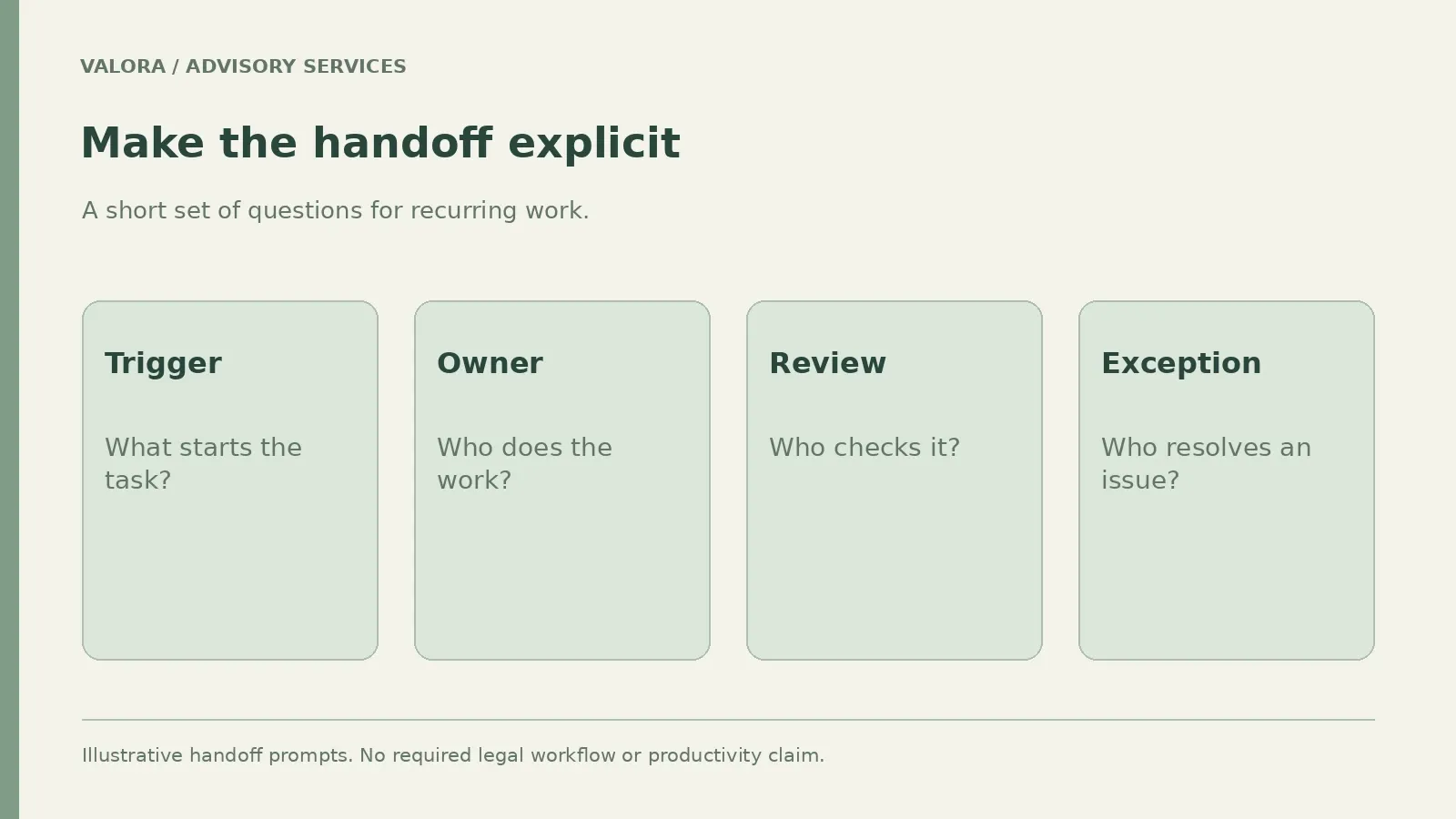
Choose a recurring task and describe its path in plain words. What starts it? Who receives it? What must be ready before work begins? Who reviews the result? Where does an exception go?
For an illustrative meeting-preparation handoff, the trigger could be an upcoming review. A support person checks whether required documents have arrived. The advisor decides how to handle missing information that affects the advice. The completed preparation and open issues are recorded where the team can find them.
That example is not a legal procedure or a required workflow. It shows why “help with meetings” is too vague to be a useful responsibility.
Keep the record short enough to use. A process document should answer the next person's question without requiring a long explanation from the founder. If it cannot, revise it during the handoff test.
Do not confuse a checked box with completed client work. Decide what evidence shows the task was done, and what remains open when it was not.
Choose the bottleneck role, not an impressive title
The right help depends on the work that needs an owner. Administrative or operations support might fit scheduling, document collection and task tracking. Planning support might fit preparation and analysis within defined limits. Another advisor might be relevant when client-facing advice work needs more capacity.
These are illustrative options, not a universal first-hire order. Role titles alone do not establish competence, permitted activities or the level of supervision needed.
Write the role around outcomes the person can control. State the recurring work, decision limits, review arrangements and information access. Make clear what they should not do. A broad instruction to “take things off my plate” leaves both people guessing.
Consider whether the work is steady enough for the arrangement you are evaluating. Employment and outside services create different practical questions. Neither removes the need to check qualifications, protect client information and assign responsibility. Get qualified advice on licensing, employment and other requirements before treating a role description as permission to act.
Check the economics before creating fixed costs
Build a budget from the practice's own records and actual quotes. Start with recurring revenue, committed costs and the cash the business needs to keep operating. Then add the full proposed cost of help.
Include relevant recruiting, tools, access, training and supervision costs. Founder time belongs in the decision even when it does not create a separate invoice. A person may need support before they can own the work you intend to hand over.
Ask what happens if revenue is weaker than expected or training takes longer. Do not make the plan depend on an assumed jump in new clients. A role that only works under the most hopeful forecast deserves another look.
There is no universal revenue threshold or margin target offered here. This is a budget worksheet, not a claim that a certain hire pays for itself. A sensible decision may be to reduce scope, test a smaller arrangement or wait. Pausing is not evidence that the practice has failed to become a firm.
Keep responsibility when you delegate
Assigning a task does not by itself settle who can make decisions or who reviews the work. State the difference between support, advice and approval. Give people a clear route for raising an issue outside their authority.
CFP Board's supervision standard requires CFP® professionals to exercise reasonable care when supervising people under their direction. It aims to prevent violations of applicable laws, rules and the Board's standards. That is a scoped certification requirement. It should not be presented as the complete supervisory rule for every registered adviser.
Ask your compliance reviewer to check the firm's actual duties and controls. A general operating article cannot resolve state-specific registration, employment or supervision questions.
Include access in the review. People should have the information and authority needed for their work, with controls appropriate to their role. A shared task list is not a reason to give everyone unrestricted access to client records. Clear responsibility needs practical controls as well as clear words.
Move founder time toward decisions only the founder should own
After a handoff begins, review where founder time goes. If you still redo every task, ask why. The instructions may be unclear, training may be incomplete or the review process may be broader than the risk calls for.
Keep ownership of decisions that belong with you. These may include service scope, budgets, staff development and difficult quality questions. Do not delegate simply to avoid a conversation only the owner can resolve.
Schwab's 2026 RIA Benchmarking Study offers context on documentation and talent management. Its data came from firms that custody assets with Schwab and was self-reported, not independently verified. The study's performance grouping also includes operating inputs. It does not establish that documentation or hiring causes growth.
Use the narrower idea: make training and responsibility explicit enough to examine. That is different from promising a productivity lift. The test is whether the work is handled properly without avoidable dependence on one person's memory.
Plan continuity without confusing it with headcount
Adding a colleague does not automatically create coverage. They may not know which deadlines matter, have the right access or be authorized to handle a particular decision. Ask what happens when the founder is unexpectedly unavailable.
Identify the dependencies first. Which client commitments depend on information only you hold? Which approvals have no alternate route? Where would someone find the current status of open work?
Use those questions to identify gaps for a proper continuity review. Do not assume that a list of passwords or an informal promise from a peer is a complete plan. Access, authority, client communication and applicable requirements need separate attention.
A solo practice can address founder absence without adopting a team growth goal. A staffed firm still needs to test its arrangements. The relevant question is whether the intended coverage can work, not whether the practice looks large enough from the outside. This is a dependency review, not a succession or legal manual.
Review a small change before expanding again
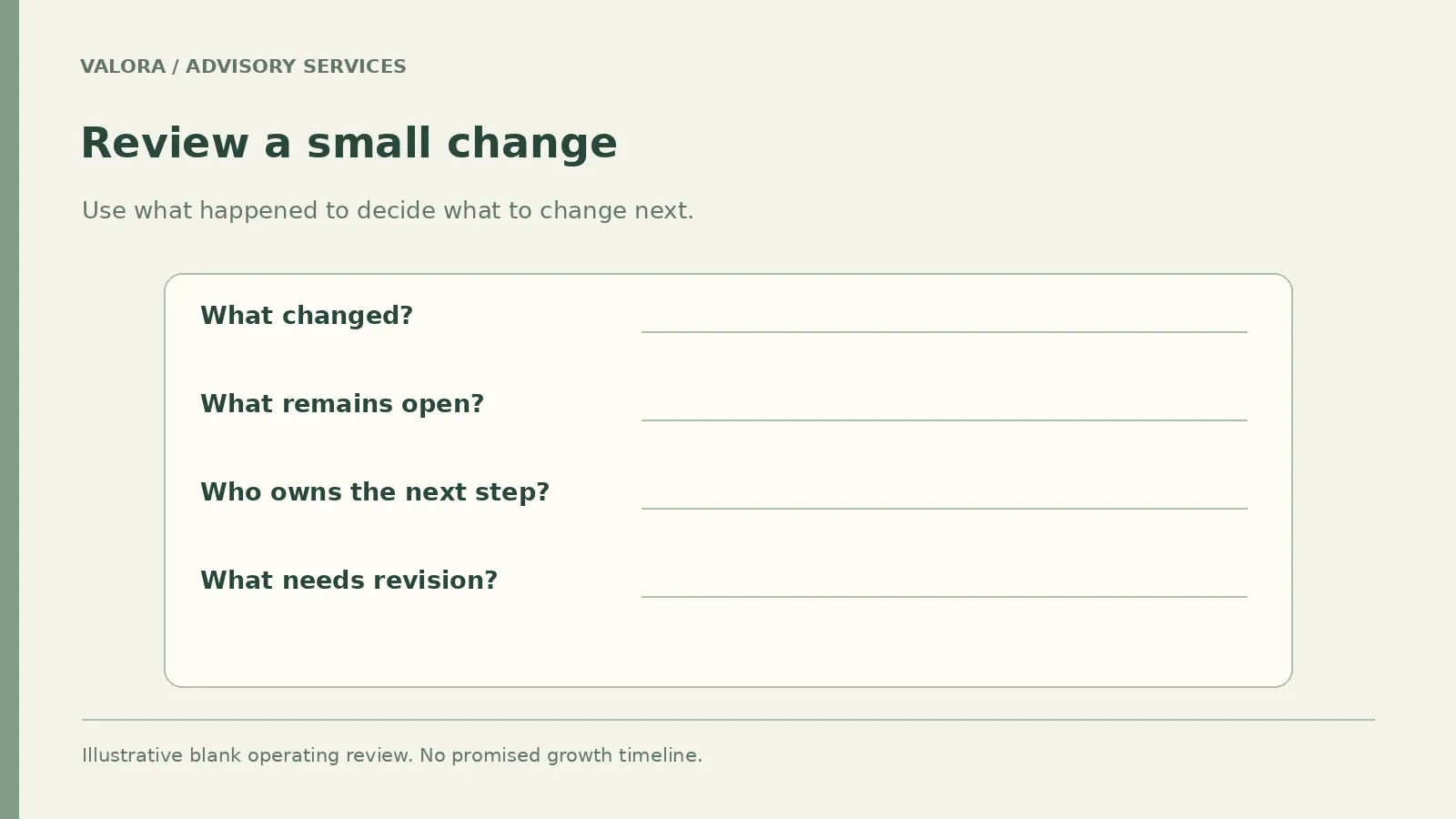
Start with a defined piece of work. Record the current problem, agree on the handoff and review what happens. Did the task reach the right person? Were exceptions raised? Did review reveal errors or missing information?
Use the result to revise the role or process before adding more responsibility. There is no fixed transformation timetable. A slower handoff that protects service may be preferable to a quick transfer that leaves ownership unclear.
Must growth mean hiring? No. A narrower service promise or better coverage may fit the founder's goals better.
When is the practice ready for another role? When its own workload, budget and responsibilities support that decision. No universal household count answers it.
What should change first? Start with the recurring dependency that is making delivery harder, not the job title that sounds most like progress.
If your firm later wants help making its services easier to understand, you can learn about Valora's work for advisory firms. Marketing is a separate decision from service capacity.
This article is educational, not legal advice or personalized investment advice. Valora provides marketing services, not investment advice.
Sources
- Investor.gov, Opening an Investment Advisory Account (2017, updated 2020). Staff bulletin.
- CFP Board, Code of Ethics and Standards of Conduct (current online standards). Engagement, monitoring and supervision standards.
- Schwab Advisor Services, 2026 RIA Benchmarking Study (2026). Summary and methodology.