
What client minimum makes sense for a solo RIA?
Set a solo RIA client minimum from your time and overhead, then raise or grandfather it without copying someone else's number.


A solo registered investment adviser (RIA) should set a client minimum from the time and overhead of the practice, not from a number copied from another firm. U.S. regulators do not set a standard client minimum. Michael Kitces has said there is not research that states a required minimum (Kitces and Carl, episode 115, June 29, 2023). He also said he cannot tell you the average minimum fee per client until you say how many clients you want to serve. An account-size minimum and a fee minimum can reach the same revenue target, but they do not open the same households.
This article is for solo and small RIA owners. An RIA is a firm registered to give investment advice for compensation. It is firm-side education, not legal advice or a recommended minimum.
What is a client minimum, and why does a solo practice need one?
A client minimum is the floor a firm sets for the revenue, assets, or fee it will accept from a new household. Some firms state it as an account-size floor, such as a minimum portfolio they will manage. Some state it as a dollar fee floor, billed annually, quarterly, or monthly. Some use both.
A solo practice has a hard limit: the founder's time. If some households pay far less than it costs to serve them, the calendar fills with work that does not support the income the founder needs. Kitces has put this simply: some minimum level of revenue per client is necessary for an advisory firm to run as a business (Kitces, September 21, 2017). That floor is a firm decision, not a copied benchmark. The arithmetic below is illustrative. The inputs have to come from your practice.
Start with your own math, not a copied number
Kitces describes two ways to set the dollar floor (Kitces, September 21, 2017).
The first way starts with cost. Add up overhead, then divide by the number of households you serve. His illustration is a firm with $450,000 of overhead and 180 clients, which comes to $2,500 a year per client just to cover rent, staff, and other overhead, before owner pay. That example is a staffed firm, not a solo default.
The second way starts with time, which Kitces calls especially useful for a solo adviser whose main constraint is the calendar. In his illustration, an adviser who wants to earn $200,000 and has about 1,200 productive client-facing hours needs about $166 an hour of client work. If a household takes 12 hours a year to serve, Kitces rounds $166 times 12 to a $2,000 annual minimum. Those inputs are examples, not a recommended floor.
A later Kitces and Carl conversation walks through a related method that Carl Richards calls the Lifestyle Practice Revenue Model Generator (Kitces and Carl, episode 115, June 29, 2023). Personal income divided by the profit margin you assume equals target revenue. Divide that revenue by the number of clients you want to serve. The result is the minimum fee. Richards's illustration is $100,000 of personal income, a 50 percent margin, $200,000 of revenue, and 100 clients, which produces a $2,000 minimum fee. He said those were not his own goal numbers, only simple figures. Do not treat 100 clients or a 50 percent margin as typical.
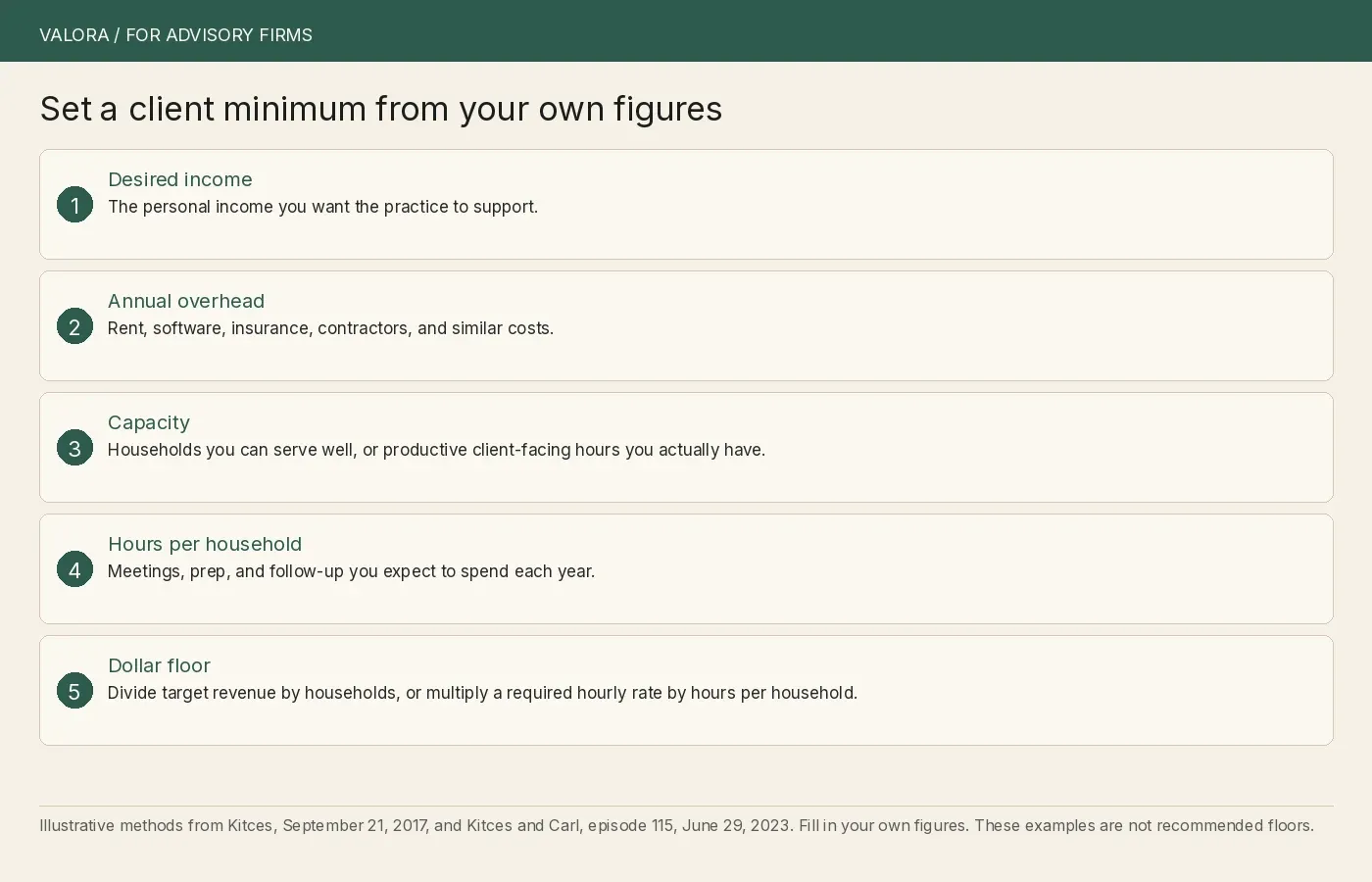
Use a short worksheet with your own figures:
- The personal income you want the practice to support.
- Annual overhead, such as rent, software, insurance, and contractors.
- The number of households you can serve well, or the productive client-facing hours you actually have.
- The hours you expect to spend on a household each year, including meetings, prep, and follow-up.
- A dollar floor from those inputs. Divide target revenue (income plus overhead, or income divided by your margin) by the number of households, or multiply a required hourly rate by hours per household.
Leave the lines blank until you fill them from your records. A peer's number, by itself, is a guess, not a minimum.
Choose an account-size minimum, a fee minimum, or both
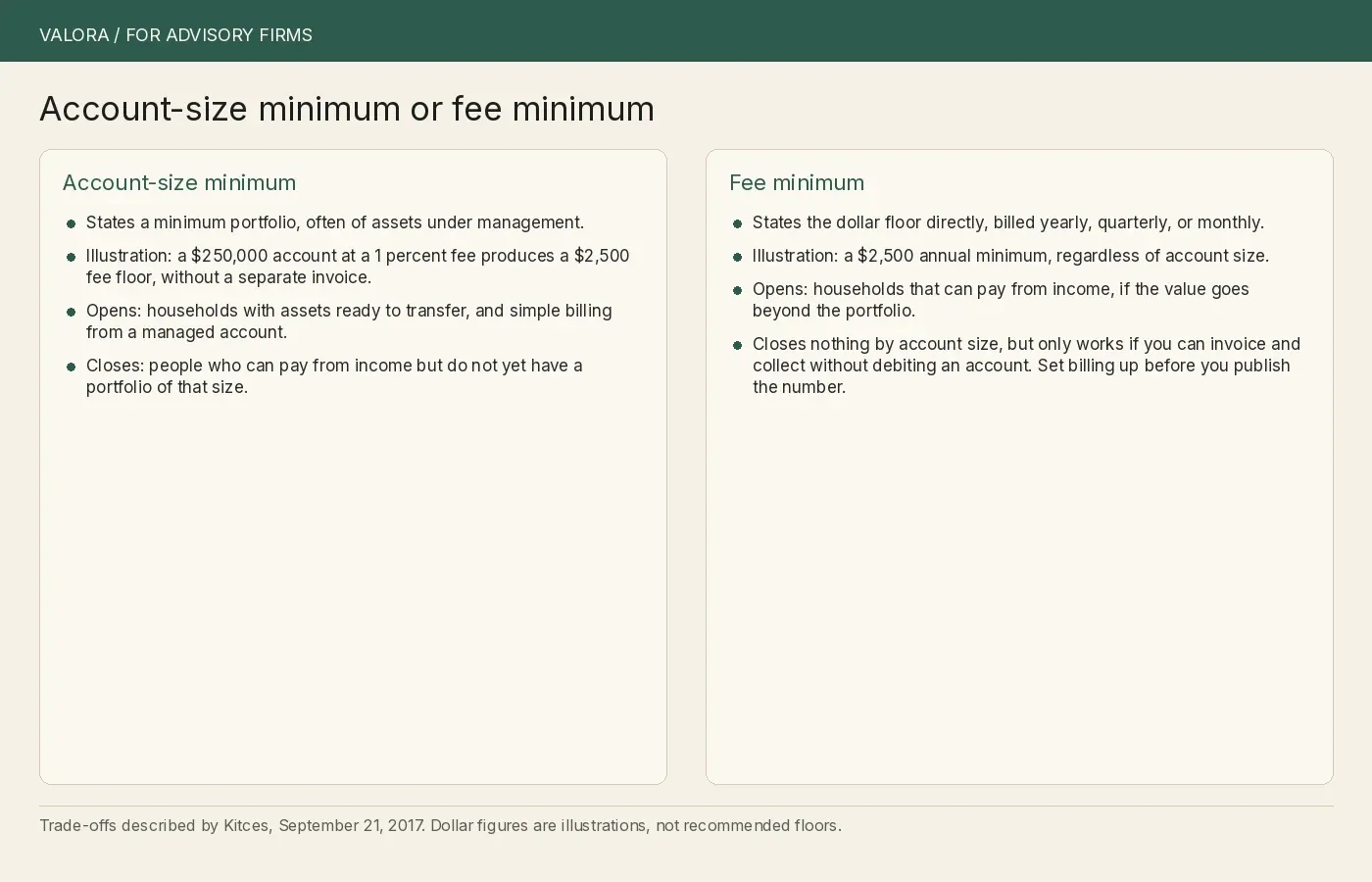
An account-size minimum, often stated as a minimum of assets under management (AUM), is simple to explain and bill if you already collect a percentage fee from a managed account. Kitces's illustration is a $250,000 account minimum at a 1 percent advisory fee, which produces a $2,500 fee floor without a separate invoice (Kitces, September 21, 2017). That $250,000 figure is an example of the arithmetic, not a recommended account size. The trade-off is that this structure limits you to households that already have assets ready to transfer. That can close younger professionals who can pay from income but do not yet have a portfolio of that size.
A fee minimum states the dollar floor directly, such as a $2,500 annual minimum, billed annually, quarterly, or monthly. Kitces notes that this can open work with people who pay from income rather than from a managed account. It only works if the value you deliver goes beyond the portfolio. The trade-off is billing. If there is no investment account to debit, you need a way to invoice and collect the fee. Set that process up before you publish the number.
You can use both: an account-size guide for households you will manage, and a fee floor so a smaller account can still meet the revenue target by paying the difference. The published number should match the way you bill.
Before you announce a new minimum, review the documents a prospect will receive. An Investor.gov bulletin on opening an investment advisory account covers what the brochure must include (Investor.gov, updated June 24, 2020). The brochure is required to include how the adviser is compensated, its fee schedule, and whether the fees are negotiable. If your new minimum changes what those documents say, update them and have your compliance reviewer approve the copy.
Tell prospects the minimum before the first meeting
A prospect should be able to see the floor, and how the fee works, before they book time or share a detailed file. Investor.gov tells people to make sure they understand what fees will apply before they open an investment advisory account (Investor.gov, updated June 24, 2020).
Put the minimum where a prospect can find it before booking, and make it agree with the current brochure and relationship summary. For a worksheet on how to do that on a public fee page, see How should an RIA explain fees before a first call?.
If you are registered with the U.S. Securities and Exchange Commission (SEC), or required to be, public statements that offer your advisory services can be advertisements. That is under the SEC Marketing Rule (Rule 206(4)-1). The rule applies to advisers registered, or required to be registered, with the Commission that directly or indirectly disseminate an advertisement. It does not, by its own terms, apply to advisers that are only state-registered. State-registered advisers should check their state securities regulator's advertising rules.
The rule's general prohibitions include a ban on untrue statements of material fact (SEC small entity compliance guide, April 28, 2021). They also ban omitting a material fact needed to make a statement, in light of the circumstances, not misleading. A public page that states a minimum or a fee should match the way the firm works. That is not a claim that every firm must post a minimum on its website. If you describe a floor, describe it accurately, and have your compliance reviewer approve the wording.
How to raise a minimum, including grandfathering and referral-out
A practice that started with a low floor often outgrows it. New households may come in at a higher number while early clients remain at the old one.
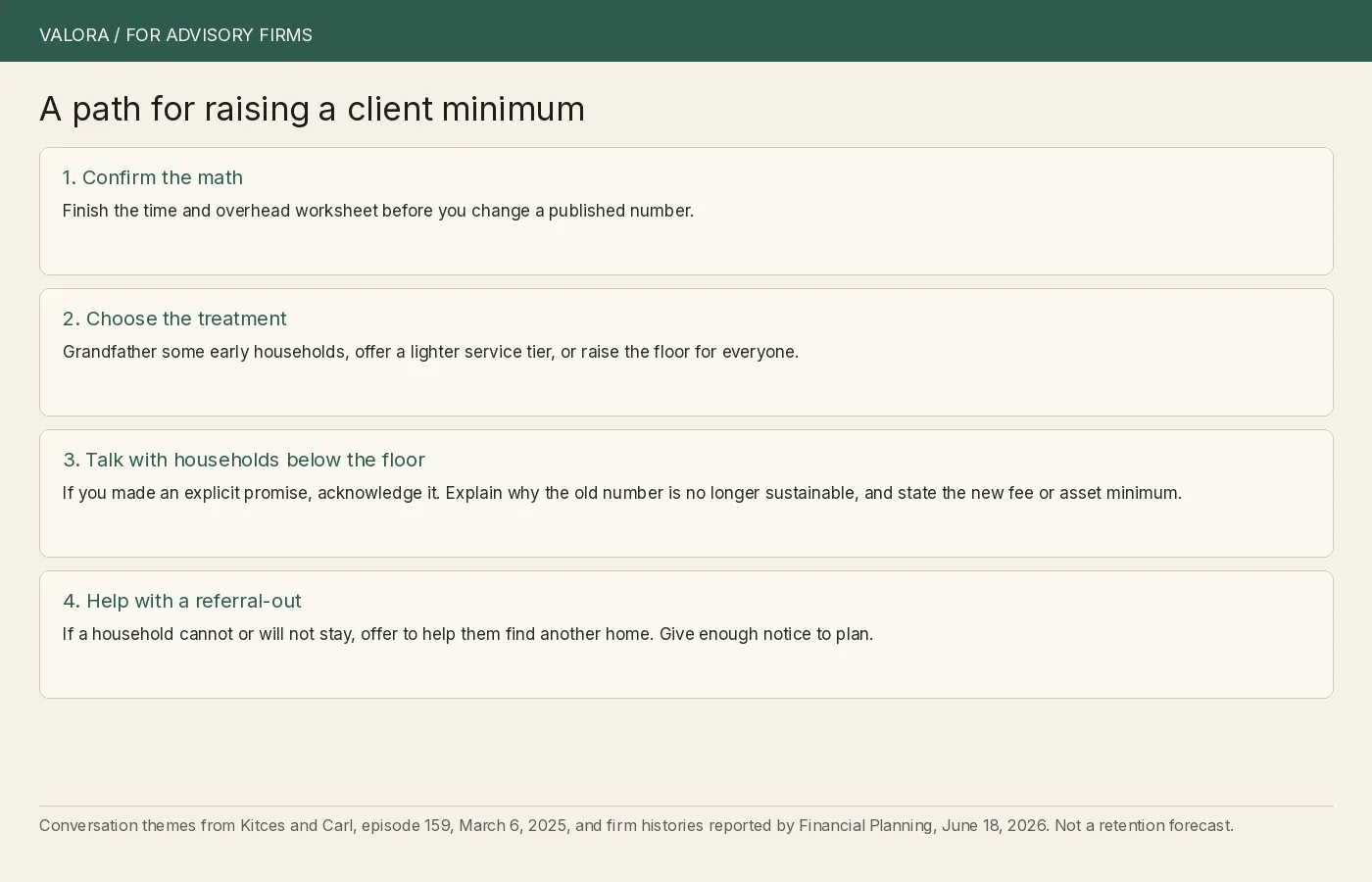
Kitces's 2017 outline is to finish the math, choose the structure, then go back to households below the new floor and explain what it now costs to deliver the service. Some clients will step up, especially when a fee minimum lets them stay without moving more assets. Some will leave. In his framing, the households that leave were already unprofitable once you have done the cost or time math (Kitces, September 21, 2017).
The later Kitces and Carl episode on early-client fees adds a caution: distinguish an actual promise from a feeling of obligation (Kitces and Carl, episode 159, March 6, 2025). Many advisers feel grateful to the first households that took a chance on a new firm. One or two relationships below the current rate may not hurt the business. A stack of exceptions can. If the lower fees are not a problem for the business, Kitces's point is that they are not a problem. If they are, the practice still has to stay sustainable.
If you did make an explicit promise that a fee would stay the same, that episode's advice is to have a direct conversation. Acknowledge the promise, explain why the original number is no longer sustainable, and state where the fee or the asset minimum needs to be. The client can accept the new number, or not. If they cannot or will not, offer to help them find another home.
Grandfathering is one option, not a requirement. You can keep some early households at the old number, move them to a lighter service tier, or raise the number for everyone, with a clear path out and enough notice to plan.
Named firms have described their own histories, which are not recommended floors or assumed retention rates. Carolyn McClanahan, of Life Planning Partners, told Financial Planning she started her firm's minimum at $2,500 (Financial Planning, June 18, 2026). She later raised it as the practice grew, reevaluates whether to raise or lower fees every two years, based on complexity, and has nearly no client turnover. Alvin Carlos, of District Capital Management, said the firm gave months of notice. Clients could pay more and keep three meetings a year, or keep the existing fee and meet twice a year. The firm did not lose a client over those two years. Bridget Borel, of Clairwell Financial Planning, offered smaller accounts a comprehensive relationship with a $10,000 annual minimum or an investment-management-only arrangement with one meeting a year (Financial Planning, June 18, 2026). Those are one-firm stories, not a script or a standard minimum.
Review the minimum as the practice changes
A minimum is not a one-time announcement. The Kitces and Carl episode on minimum fees notes that a growing practice has to reassess its revenue model as costs and services change (Kitces and Carl, episode 115, June 29, 2023). McClanahan's two-year review, described above, is one firm's cadence, not a required schedule. Rerun the worksheet when your hours, overhead, or service model changes. If the new math points to a higher floor, use the raise, grandfathering, and referral-out steps rather than leaving an outdated number on the site.
FAQ
Is there a standard client minimum I should copy? No official source in the citations below sets a standard minimum. Kitces has said he cannot tell you an average minimum fee until you say how many clients you want to serve (Kitces and Carl, episode 115, June 29, 2023). Build the number from your time, overhead, and capacity.
Should I use an account-size minimum or a fee minimum? Either can reach the same dollar floor. An account-size minimum is simpler to bill from a managed account and tends to limit you to households with assets ready to transfer. A fee minimum can open work with people who pay from income, but only if you deliver value beyond the portfolio and can collect the fee (Kitces, September 21, 2017). Some firms use both.
Do I have to publish the minimum on my website? No cited source requires every firm to post a minimum on a public website. Investor.gov tells people to understand fees before they open an advisory account, and the brochure is required to include the fee schedule (Investor.gov, updated June 24, 2020). If you describe a minimum in public, SEC-registered advisers should treat that wording with care under the Marketing Rule, and state-registered advisers should check their state securities regulator. Put the number where a prospect can find it before booking, and keep it consistent with your brochure.
How do I tell existing clients that the minimum is going up? Finish the math first. Then explain what it now costs to deliver the service, give people time to decide, and be ready to help a household that cannot or will not stay. Some firms have offered a lighter service tier. Those histories are examples, not a required script.
What if I promised early clients that their fee would stay the same? Separate an explicit promise from a feeling of gratitude. If you made that promise and the old number is no longer sustainable, have a direct conversation (Kitces and Carl, episode 159, March 6, 2025). Acknowledge the promise, explain why it cannot hold, state the new number, and help with a referral if the client does not stay.
Next step for firms that want help being found
If your firm later wants help making its services easier for suitable prospects to find and understand, you can learn about Valora's work for advisory firms. The current public offer is $250 per booked appointment with a qualified prospect, with a 3-appointment minimum, paid in advance. An appointment is a call booked on your calendar with a prospect who has asked to speak with an advisor. There is no setup fee, retainer, or long-term contract. If a prospect does not attend or does not meet the agreed criteria, the appointment is replaced at no charge. Your firm reviews what goes out under its name. Marketing is a separate decision from the client minimum.
This article is educational, not legal advice, tax advice, compliance advice or personalized investment advice. Valora is not a registered investment adviser and does not provide investment advice. Valora provides marketing services to advisory firms.
Sources
- Michael Kitces, Setting Advisory Fee Minimums: Best Practices For Advisors (September 21, 2017). Kitces article.
- Kitces and Carl, episode 115, Setting The Right Minimum Fee and The Revenue Model Generator (June 29, 2023). Kitces and Carl episode 115.
- Kitces and Carl, episode 159, When You Promised Early Clients Fees You Can No Longer Honor (March 6, 2025). Kitces and Carl episode 159.
- Kathryn Miller, How to raise fees without losing clients, Financial Planning (June 18, 2026). Financial Planning article. Figures from this article are one-firm histories, not recommended floors or expected retention rates.
- Investor.gov, Investor Bulletin: Opening an Investment Advisory Account (September 25, 2017, updated June 24, 2020). Investor.gov Bulletin.
- U.S. Securities and Exchange Commission, Investment Adviser Marketing, a small entity compliance guide (April 28, 2021). SEC Marketing Rule small entity guide. The Marketing Rule applies to advisers registered or required to be registered with the Commission.
- Valora, For advisors, offer terms as of November 10, 2026. Valora for advisors.