
Where do wealthy people look for financial advisors?
Where affluent prospects can find advisor names, what they can verify, and why an introduction is only the start of a careful comparison.


Wealthy people can find advisor names through trusted contacts, accountants, attorneys, financial institutions, search and advisor directories. Those are places to start, not proof of a good fit. The next step is to check the advisor's background, services, fees, conflicts and working arrangements.
There is no verified ranking of discovery channels for wealthy households in the research used for this guide. This is a practical map of possible routes and checks, not a claim about where most wealthy people hire an advisor.
For advisory firms, the useful lesson is simple: help a prospect understand what they can verify. An introduction may begin the conversation. It cannot answer every question about the relationship.
Where can wealthy prospects start looking?
Separate finding a name from choosing a professional. A family member might suggest an advisor. A search might reveal another firm. An accountant might know someone whose work could be relevant. Each route can add a name to a shortlist without settling whether that person belongs on it.
Start with the work the household wants help with. Write down the questions, decisions and services that matter. That gives the search a purpose beyond finding someone with a polished website or familiar job title.
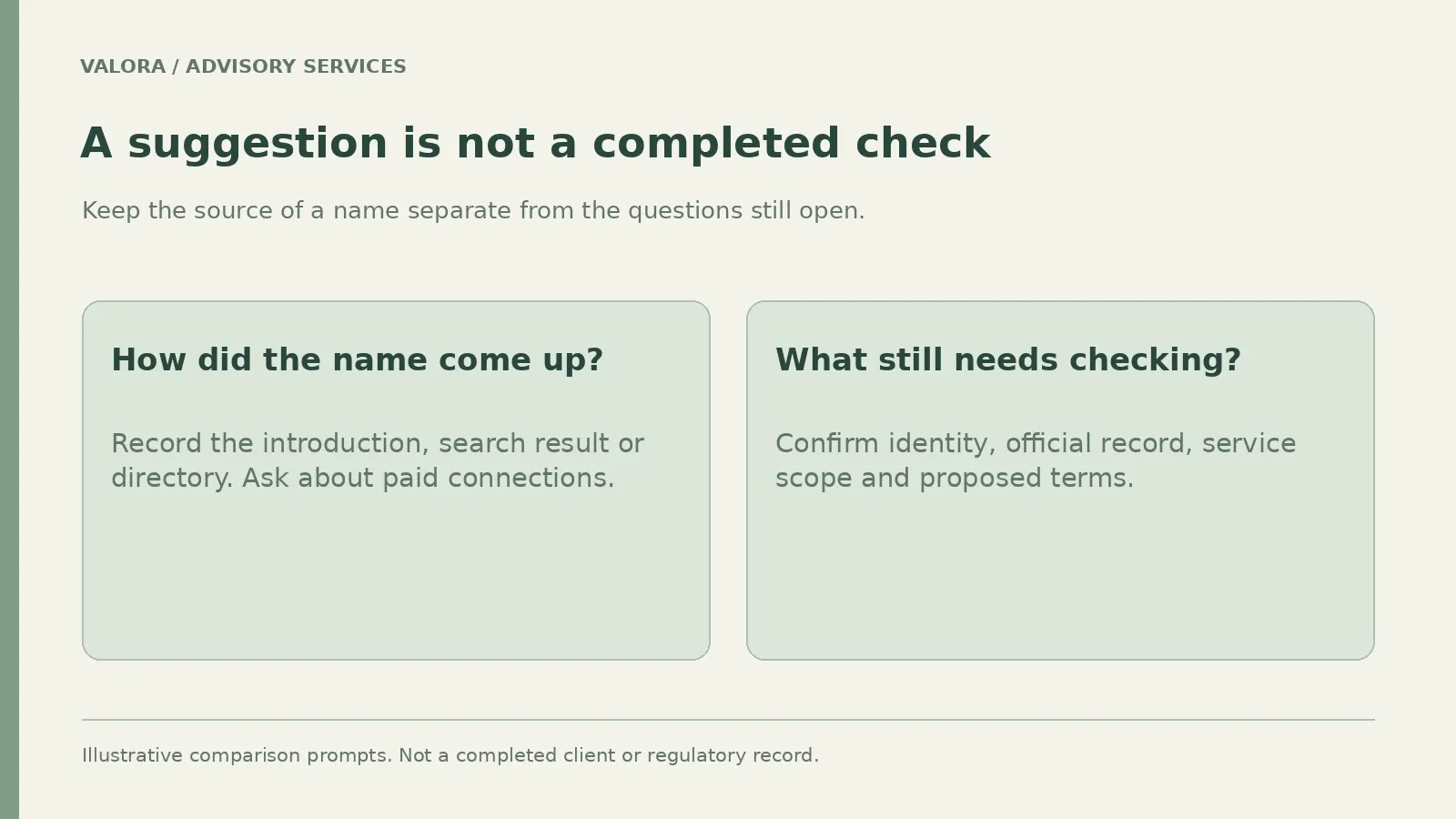
A useful search record has two parts: how the name came up, and what still needs checking. Keep them separate. The strength of a personal connection does not establish the advisor's service scope. A prominent search result does not establish the quality of the advice. Neither is a substitute for the firm's written terms.
What does “wealthy” mean in this guide?
Here, wealthy describes a household whose finances may involve several connected decisions. It is not a legal category or a required asset threshold. A household might need help understanding how its investments, business interests and future spending plans fit together. Another might have simpler needs despite having substantial assets.
High income is not the same as high net worth. Income is money received over a period. Net worth concerns assets less liabilities. A survey screened by income cannot simply be relabeled a study of wealthy households.
That distinction matters because the study discussed below uses household income, not a verified high-net-worth screen. Its findings cannot establish how wealthy households behave as a group. This guide therefore focuses on questions a prospect can ask, rather than claiming that wealth determines one correct way to find advice.
A trusted introduction can supply a name
A trusted contact can explain why they thought of an advisor. The useful question is not just whether they like the person. It is what work the advisor actually does for them and which parts of that relationship might be relevant.
A friend may value regular planning conversations. A colleague may mainly use portfolio management. Those are different reasons for making an introduction. Neither proves the same service will suit another household.
The contact also may not know the advisor's current fee schedule, available capacity or full disciplinary record. They can describe their own experience, but they cannot complete the prospect's checks.
Treat the introduction as context. Ask the advisor directly about services and terms. There is no need to share another client's private financial details to find out whether a firm offers the right kind of work. A referral should make it easier to begin asking questions, not harder to ask them.
Other professionals and institutions can suggest options
An accountant or attorney may be a place to ask for names. A bank or other financial institution may also offer a route to advisory services. These routes deserve the same care as any other introduction.
Ask why a particular advisor was suggested. Is the recommendation based on work the professional has seen? Is there an affiliation or paid arrangement? Does the person making the introduction consider a broad group of firms, or only a limited pool?
These are questions to clarify the relationship, not accusations that a recommendation is improper. A familiar institution's name does not explain which person will serve the household or what that person's role will be.
Also ask how the professionals would work together. Coordination can mean a meeting, an exchange of documents or a separate engagement. Do not assume that an introduction includes tax advice, legal work or responsibility for another professional's decisions.
Search, directories and artificial intelligence can build a shortlist
Search engines and advisor directories can help a prospect find firms to investigate. Artificial intelligence (AI) tools can also suggest names or summarize offerings. Treat those outputs as leads to source material, not completed background checks.
Open the firm's own documents. Check that a profile refers to the right person and current firm. Follow an important claim back to its source. If a summary says the advisor handles a certain need, ask whether that work is included in the actual engagement.
A directory may have paid placements, eligibility rules or a limited set of participating firms. Read how it works before treating its results as a complete market comparison. This guide does not recommend one directory as the best option.
An AI answer can miss context or repeat an outdated description. It cannot replace an official record or signed agreement. Avoid putting sensitive account details into a public search prompt just to get a more specific list of names.
What one income-screened survey says, and does not say
The Wealthtender 2025 Study of $100K+ Households Seeking Financial Advice offers limited context. Through Pollfish mobile and web-app sampling, Wealthtender surveyed 500 US adults ages 35 to 64 in late July 2025. Participants met a household-income screen of at least $100,000 and expected to hire an advisor within five years.
The answers were self-reported intentions, not observed hiring decisions. The sample was screened for people who take part in household financial decisions. It excluded satisfied existing advisor clients with no plans to change. Respondents could select more than one discovery resource. Wealthtender is also a commercial advisor directory, so the sponsor has an interest in the topic. The findings do not describe wealthy households as a whole.
The useful distinction is between finding names and evaluating them. The report asks about both. It does not justify a general ranking of how wealthy people find advisors.
We have not verified net-worth-specific discovery evidence for this article. That is a limit of this research, not a claim that no such research exists. No channel percentages or wealthy-household league table are needed to use the checks that follow.
Check registration and disciplinary history
Begin with official records rather than a badge on a website. Investor.gov's guide to Form CRS, the client relationship summary explains how to use its investment-professional search tool to research firms and individuals. It also explains where to find relationship summaries and reported disciplinary information.
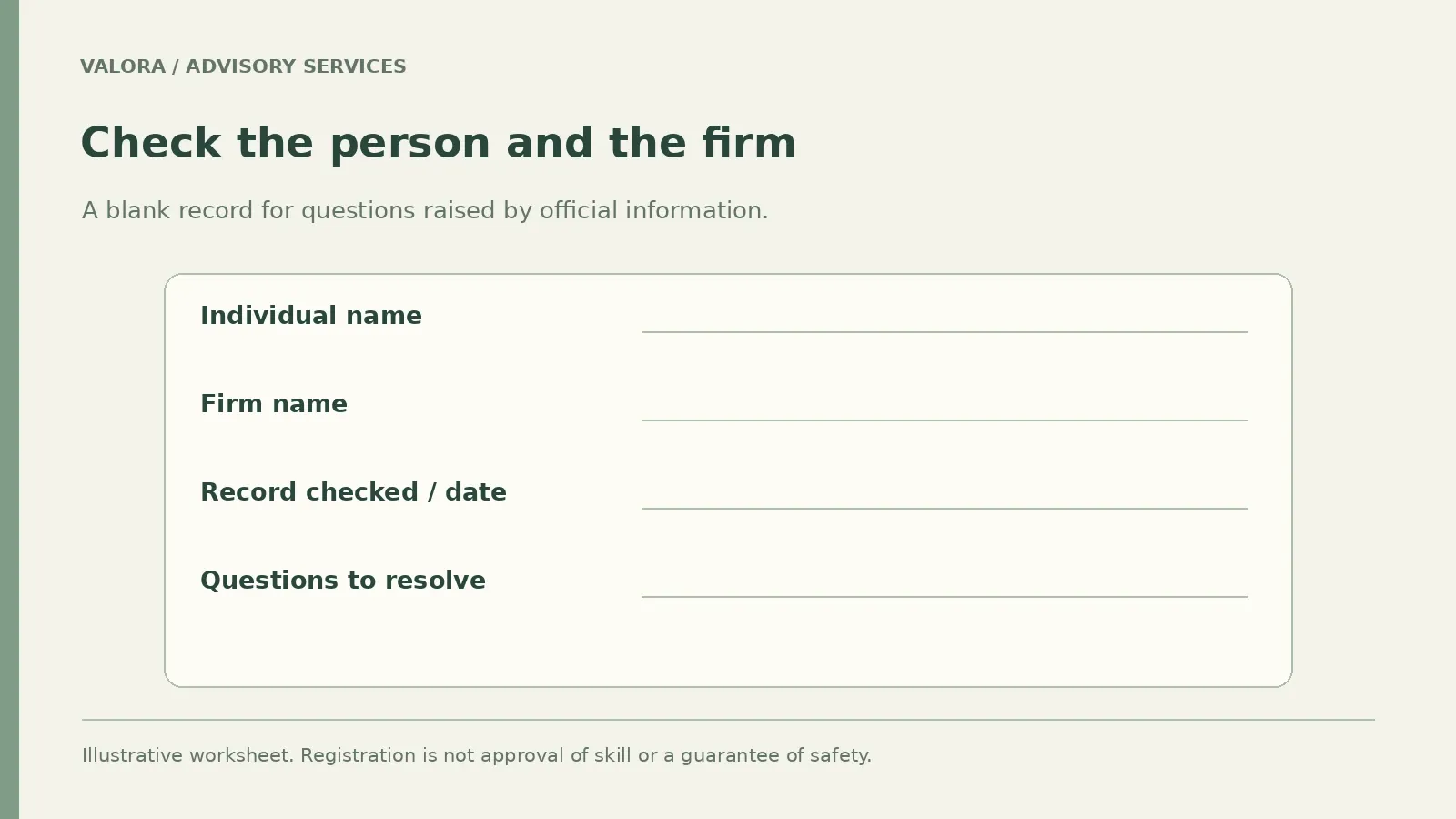
Check the individual and the firm. Match the record carefully to the person under consideration. Where a firm provides both brokerage and advisory services, review the relevant records for both. Ask for help understanding any entry that is unclear rather than guessing from a short label.
Registration is not regulatory approval of an advisor's skill. The absence of reported disciplinary history is not a guarantee of safety or future conduct.
Form CRS can help with comparison where it applies. It covers services, fees, conflicts, standards of conduct and reportable history. Investor.gov also explains that some firms act as both brokers and advisers. A prospect should understand which capacity applies to the proposed service, rather than assume every interaction has the same terms.
Check relevant experience and actual service scope
A broad phrase such as “wealth management” does not tell a household exactly what it will receive. Ask what work is included, who performs it and what sits outside the agreement.
The U.S. Securities and Exchange Commission (SEC), the federal securities regulator, publishes a bulletin on opening an investment advisory account. It encourages discussion of goals, desired service, investment size, time horizon, risk and costs. It also suggests asking about the types of clients an adviser typically serves.
Use those questions to make the discussion concrete. Does planning cover assets the firm does not manage? Does a review produce written recommendations? Who handles implementation? These are questions, not services every firm necessarily offers.
Credentials deserve their own check with the issuing body. A qualification, a job title and an offered service are different things. Ask what a credential means for the work proposed. Do not infer that a long list of letters establishes expertise in every part of a household's finances.
Check compensation, conflicts and the full cost
Ask how the advisor and firm are paid. Then ask what the household would pay under the proposed terms. Those are related questions, but one does not fully answer the other.
The SEC account bulletin describes hourly, fixed or flat, asset-based and commission compensation. It also notes that costs can be paid to third parties rather than to the advisor. The quoted advisory charge may not be the whole cost of the arrangement.
Request a written explanation of the fee calculation, billing timing, included work and other expected charges. Ask about circumstances that could change the cost. Avoid comparing one firm's headline number with another firm's fuller estimate.
Ask how conflicts could affect recommendations and how the firm addresses them. A compensation label alone does not resolve that question. Nor should a higher or lower price be treated as proof of better advice. Compare the actual service and terms without assuming any arrangement will pay for itself through investment gains or savings.
Check who serves the household and how
The person in an introductory meeting may not do every part of the work. Ask who makes recommendations, who handles routine requests and who can respond when the main contact is unavailable.
The SEC account bulletin highlights service frequency, monitoring, contact arrangements and cancellation terms as points to understand. A prospect can turn these into direct questions: How often will we meet? What will you review between meetings? What changes should we report? How do we raise a concern?
Ask about coordination too. If an outside accountant or attorney remains involved, clarify who requests documents and follows up on open questions. Shared work can leave gaps when everyone assumes someone else owns the next step.
Firm size alone cannot answer these questions. A large team still needs clear responsibility. A solo advisor still needs a workable coverage arrangement. Evaluate the proposed relationship rather than using headcount as a shortcut for reliability.
Compare what each shortlisted firm puts in writing
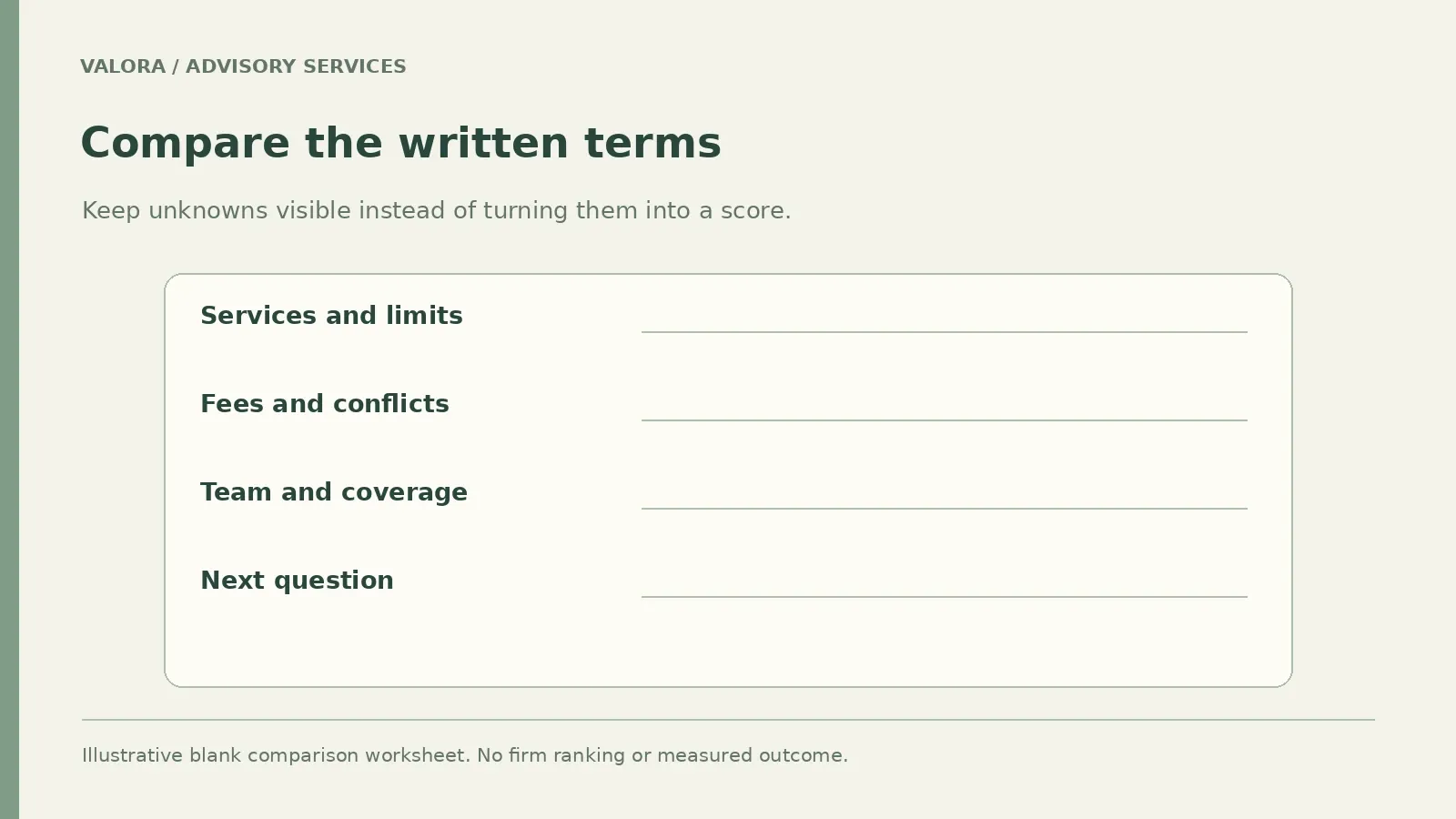
Use a simple comparison record. This is an editorial worksheet, not a scoring system or a tested method for picking the best advisor.
For each firm, record:
- Discovery source: how the name came up and any known paid connection.
- Official record: the individual and firm checked, the date and open questions.
- Services: included work, frequency, exclusions and client responsibilities.
- Compensation: how the firm is paid and how the household's cost is calculated.
- Conflicts: what was disclosed and what needs explanation.
- Team: the main contact, other roles and coverage arrangements.
- Next question: the most important issue still unresolved.
Keep unknowns visible. A blank field is a reason to ask, not a reason to fill it with an assumption. If a spoken explanation differs from a document, ask the firm to reconcile the difference before relying on it.
The aim is a clearer conversation. There is no need to turn personal fit, service scope and unresolved risks into one artificial numerical score.
Common questions and a low-pressure next step
Can a trusted introduction replace background and service checks? No. It can explain why a name is worth considering. It does not establish the firm's current terms, record or fit for another household.
Can AI verify an advisor? Not by itself. It can point to material to check. Official records, source documents and direct explanations still matter.
Is a bigger firm safer? Size alone is not enough to decide. Ask about responsibility, controls and continuity rather than assume a large or small firm is always better.
What should an advisory firm take from this? Make the answers easy to find and keep them consistent with the actual service. Clear explanations should help a prospect decide whether to continue, not pressure them to hire.
If your firm wants to make its services easier to understand, you can learn about Valora's work for advisory firms.
This article is educational, not legal advice or personalized investment advice. Valora provides marketing services to advisory firms, not investment advice.
Sources
- Wealthtender, 2025 Study of $100K+ Households Seeking Financial Advice (2025). Report and methodology.
- Investor.gov, Form CRS: Client Relationship Summary (undated guide). Official guide.
- Investor.gov, Opening an Investment Advisory Account (2017, updated 2020). Staff bulletin.