
Can financial advisors give clients holiday gifts? What to check first
Before sending client holiday gifts, check the $25 tax limit, any FINRA gift rule exposure, review-or-referral strings, and your own gift policy.


Yes, an advisory firm can send a client a holiday gift, but the gift itself is rarely the issue. Four checks come first. The tax deduction for business gifts is capped at $25 per recipient per year. If you are also a registered representative of a broker-dealer, the gift rule of the Financial Industry Regulatory Authority (FINRA) exempts gifts to individual retail customers. Its $300-per-person limit still applies to gifts tied to someone's employer, such as a plan-sponsor contact. If a gift is conditioned on a review or a referral, it is no longer just a gift. Staff at the Securities and Exchange Commission (SEC) have flagged gift cards given to clients for reviews. And whatever you send should match your own written policy and be recorded.
Gifts are not required, and they are not a substitute for the work you already do. Advisers have been comparing year-end gift ideas, which is one reason this question is live. Some send a seasonal item. Some send nothing. That split is part of the honesty of the choice. This page does not treat any discussion thread as a study, and it does not claim that gifts improve retention or referrals.
This is educational, not legal, tax, or compliance advice. Confirm tax treatment with your tax professional. Confirm policy questions with your compliance counsel.
Yes, with four checks first
Start with the four checks, not with a catalog. First, how much of the cost is deductible. Second, whether the recipient is an individual retail client or someone's employee, which matters if you are also a registered representative. Third, whether the "gift" is actually payment for a review or a referral. Fourth, whether the item matches your written policy and will be recorded.
A firm that is not associated with a broker-dealer still has the tax cap, the review-or-referral question, and its own code of ethics and gift policy. FINRA Rule 3220 does not apply directly to that firm. This page does not invent an SEC dollar limit on client gifts, because no such limit was found in the sources used here.
The sections below walk through each check, then look at what advisers have actually been sending, including why some send nothing.
Check 1: the $25 business-gift deduction limit
The tax cap is a deduction limit, not a ban on sending the gift. Internal Revenue Service (IRS) Publication 463 (2025) states the rule in plain language. "You can deduct no more than $25 for business gifts you give directly or indirectly to each person during your tax year." The same cap appears in the statute, 26 U.S.C. section 274(b)(1).
That means a $60 item can still be sent. Only $25 of the cost is deductible. The rest is not a deduction issue to solve with a smaller bow. It is a bookkeeping fact to take to your tax professional.
Incidental costs are generally not counted toward the $25. Publication 463 lists engraving, packaging, insuring, and mailing as examples, so long as the cost does not add substantial value to the gift. Gift wrapping is treated as incidental. An ornamental basket that is worth a lot relative to the food inside is not.
The statute and the publication also set out a narrow exclusion. An item that costs $4.00 or less is not treated as a gift for purposes of the $25 limit if two other conditions are met. The firm's name must be clearly and permanently imprinted. The item must be one of a number of identical items distributed generally. Signs or display racks for the recipient's business premises are also excluded.
The 2025 edition of Publication 463 was the current edition when this page was written. A later edition had not been issued. The $25 cap itself is in the statute, but you should still confirm the current language with your tax professional before you file. This page is not tax advice.
Check 2: is the recipient a retail client or someone's employee?
This check matters if you are also a registered representative of a broker-dealer, sometimes called a dual registrant. FINRA Rule 3220 limits gifts of more than $300 per individual per year where the payment or gratuity is "in relation to the business of the employer of the recipient." Supplementary Material .09 of that rule says the rule does not apply to gifts from a member or an associated person to individual retail customers.
The practical line is easy to miss at year end. A tin of cookies sent to a household client is, for FINRA 3220, a different act from a gift to a workplace retirement plan sponsor's human resources contact. The second person may be receiving something in relation to the business of their employer. In that case, the $300-per-person yearly limit can apply, along with the rule's valuation, aggregation, and recordkeeping provisions.
The $300 limit is the current figure. FINRA raised it from $100 to $300 in amendments that took effect on March 30, 2026, as announced in Regulatory Notice 26-05, published February 27, 2026. Value gifts at cost, not counting tax and delivery, except for event tickets, where the rule requires the higher of cost or face value.
If your firm is a registered investment adviser (RIA) and is not associated with a broker-dealer, FINRA Rule 3220 does not apply directly. Your own code of ethics and gift policy govern. This page does not claim an SEC dollar limit on gifts to retail clients, because none was found in the sources used here. State-registered advisers should also check any gift rules of their state securities regulator. This page does not map those state rules.
Check 3: is it a gift, or payment for a review or a referral?
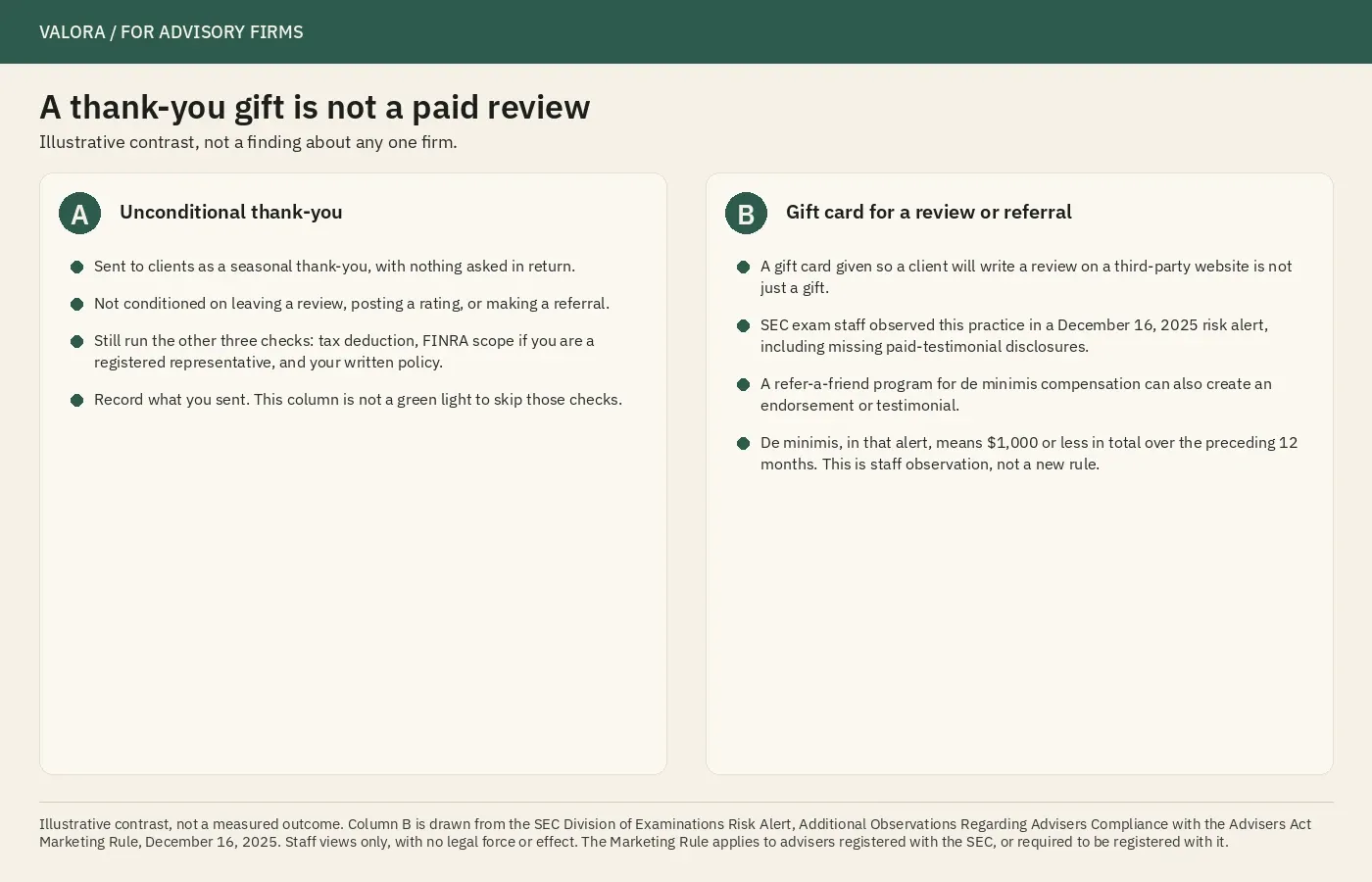
An unconditional thank-you sent to every client is a different act from "leave us a review and get a gift card." Keep that line bright.
On December 16, 2025, the SEC Division of Examinations issued a risk alert on advisers' compliance with the Marketing Rule. The staff observed advisers that provided compensation in the form of gift cards to clients to write reviews on third-party websites, without a basis to believe the paid-testimonial disclosures were made. The staff also observed "refer-a-friend" programs for de minimis compensation, where firms did not recognize that an endorsement or testimonial had been created.
In that alert, de minimis compensation means $1,000 or less in total. The staff also flagged firms that treated each payment as if it stood alone, even when the total over the preceding 12 months exceeded $1,000. Those observations are staff views. The alert itself states that it has no legal force or effect, and that it is not a rule or a statement of the Commission.
The Marketing Rule, officially Rule 206(4)-1 under the Investment Advisers Act, applies to advisers registered with the SEC, or required to be registered with it. Advisers that are only state-registered should check the rules of their state securities regulator. This page does not restate the Marketing Rule. For the mechanics of testimonials and reviews, see SEC Marketing Rule in plain English for solo RIAs (testimonials, reviews, AI copy). For a pre-use checklist, see What should an RIA check before using a client testimonial?.
Check 4: your written policy and a simple record
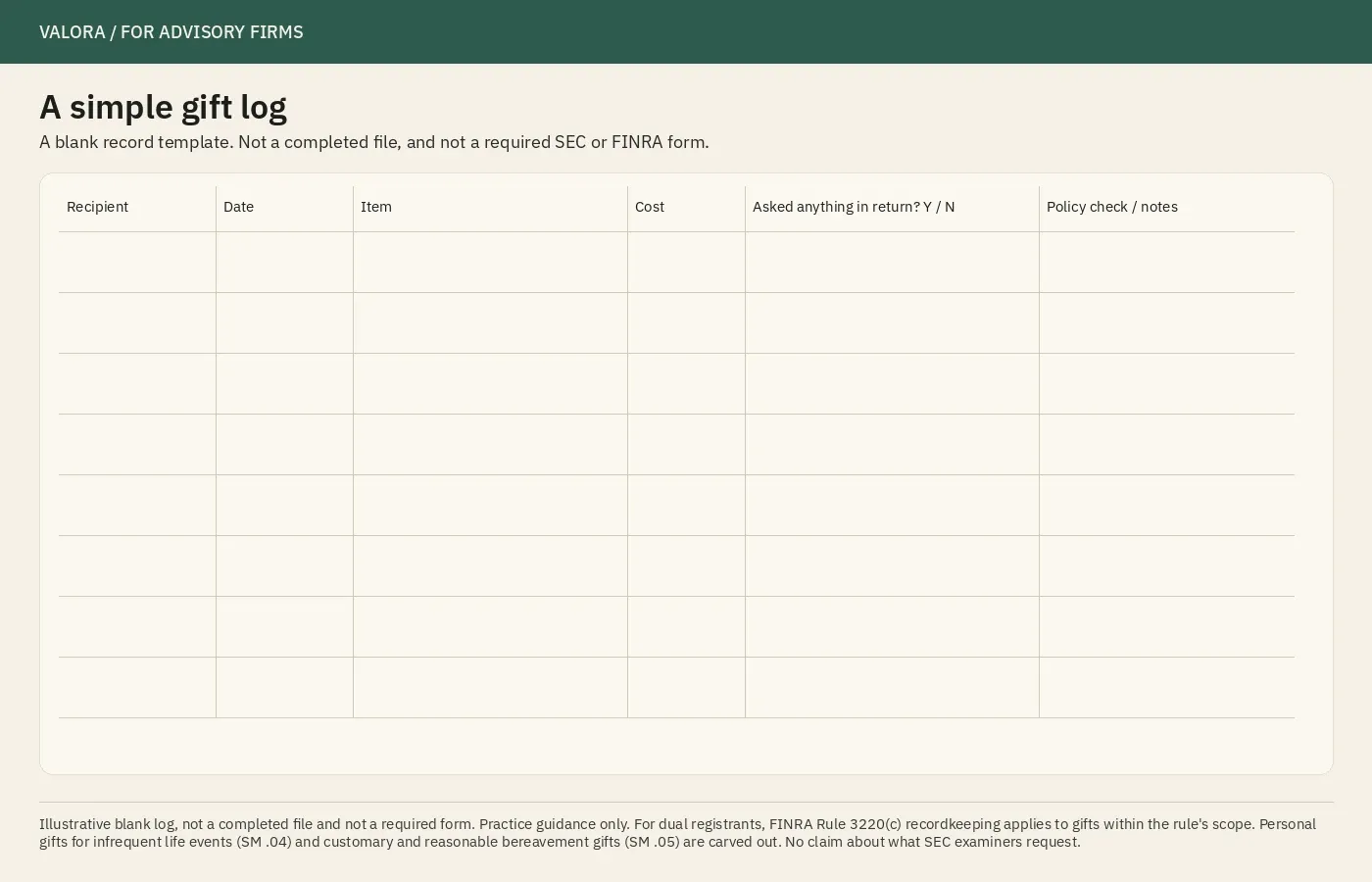
Whatever you send should match a written gift policy you can actually follow. Practice guidance, not a rule quote, is to note the recipient, the date, the item, the cost, and whether anything was asked in return. That short record helps you see a pattern before it becomes a problem. It is not a claim about what SEC examiners request.
For dual registrants, FINRA Rule 3220(c) requires a separate record of payments or gratuities that fall within the rule's scope. The rule also carves out some gifts from the dollar limit and from that recordkeeping. Supplementary Material .04 excludes personal gifts for infrequent life events, such as a wedding or the birth of a child. The gifts must be customary and reasonable, personal in nature, and not in relation to the business of the recipient's employer. Supplementary Material .05 excludes customary and reasonable bereavement gifts. A year-end client gift is usually not in those carved-out categories. Do not stretch a holiday package into a "personal" gift in order to skip the file.
A firm that is not under Rule 3220 can still keep the same simple log as a matter of policy. Consistency is the point. If two similar households receive very different treatment, the file should show why.
What advisors actually send, and why some send nothing
In a public November 2026 discussion among advisers, people described food boxes, pies delivered to local clients, wreaths, logo items, and donations split by a client vote. One adviser described a loaf from a charity bakery at around $25 per client. Those are anecdotes, not a sample, and this page does not treat them as a recommended list or a typical spend.
A vocal minority takes the other path. One comment was, "I don't provide gifts, I provide value." Another was simply, "No gifts." That view is part of the record of how advisers actually decide. This page does not rank gifts against no gifts, and it does not argue that either path produces better retention or more referrals. No source used here measured that.
If you do send something, choose the item for the household in front of you, not for a catalog of what other firms bought. This page does not name vendors.
Practice guidance is to keep any gift easy to receive. Not every household celebrates the same winter holiday. In the same November 2026 discussion, one firm described sending a non-holiday plant to clients who do not celebrate Christmas. A donation in the client's honor is another option some advisers use. Neither is required, and neither is a proven result.
Also think about what the item looks like in the client's hands. Items that read as personal financial value, such as gift cards or other cash equivalents, sit closer to the review-or-referral problem in Check 3. A gift card is not forbidden as such in the sources used here. It becomes a different act when it is the price of a review, a rating, or a referral. When in doubt, send an unconditional seasonal item, or send nothing, rather than attaching a string.
This section is practice guidance, not a rule, and not a finding that inclusive gifts are safer in every case. Your policy, your tax professional, and, if you are a registered representative, FINRA Rule 3220 still come first.
A one-page pre-send checklist
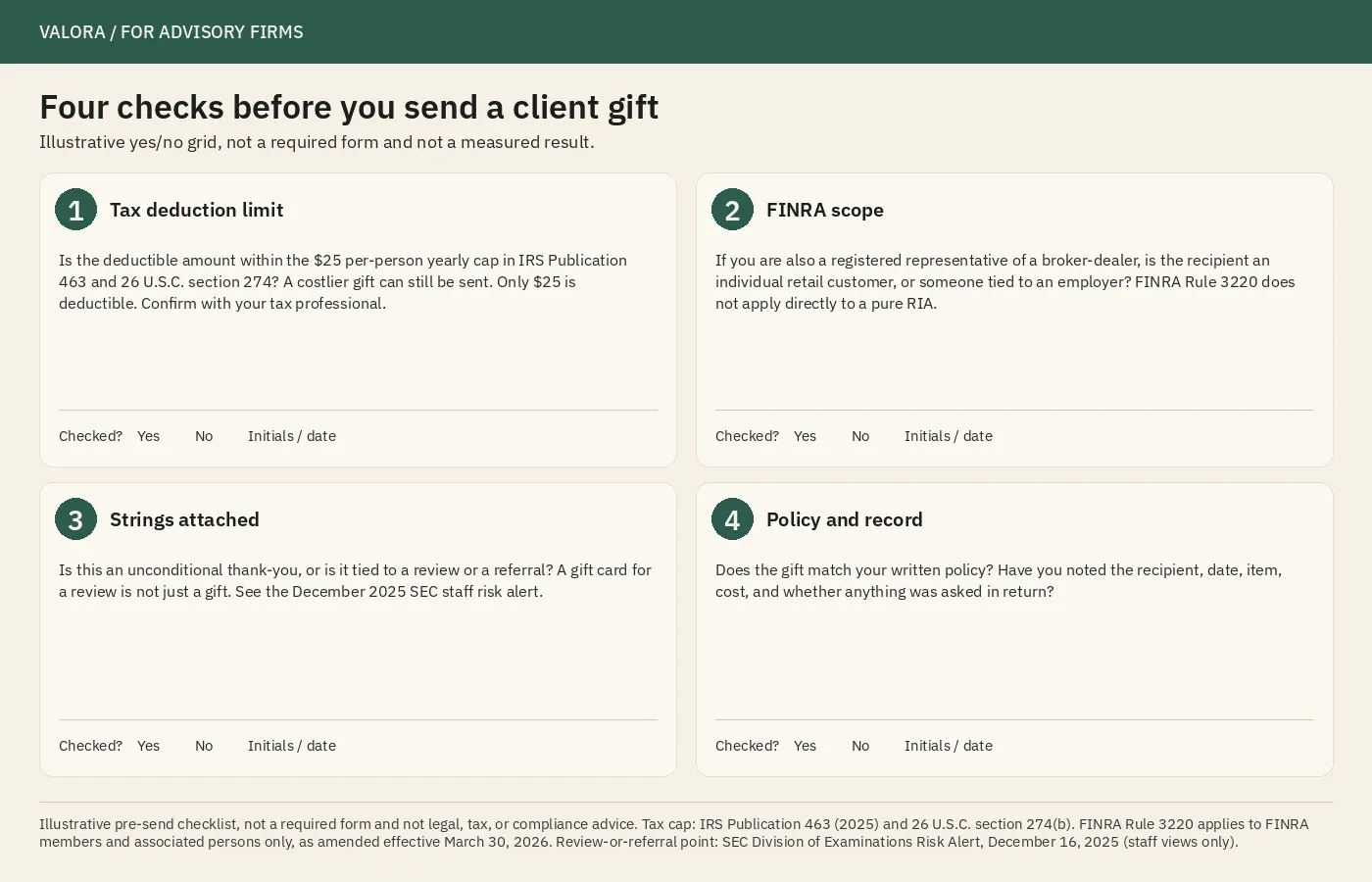
Before anything leaves the office, run the four checks as a yes-or-no grid. Is the deductible amount within the $25 yearly cap, and have you confirmed treatment with your tax professional? If you are a registered representative, is the recipient an individual retail customer, or someone whose employer may bring Rule 3220 into scope? Is the gift unconditional, or is it tied to a review or a referral? Does it match your written policy, and is it recorded?
If any answer is no, stop and fix that check before you ship. The grid below is illustrative. It is not a required form, and it is not a substitute for counsel.
FAQ
Is a client holiday gift tax-deductible? You can deduct no more than $25 per recipient per year for business gifts, according to IRS Publication 463 (2025) and 26 U.S.C. section 274(b)(1). A costlier gift can still be sent. Only $25 is deductible. Confirm the current language with your tax professional.
Does FINRA limit gifts to clients? FINRA Rule 3220 does not apply to gifts from a member or an associated person to individual retail customers, according to Supplementary Material .09. The $300-per-person yearly limit can still apply when a gift is in relation to the business of the recipient's employer. The rule applies to FINRA members and associated persons, not directly to a pure RIA.
Can I give a gift card for a Google review? That is not just a gift. SEC exam staff, in a December 16, 2025 risk alert, observed gift cards given to clients to write reviews on third-party websites, without a basis to believe paid-testimonial disclosures were made. For the Marketing Rule mechanics, use the plain-English Marketing Rule page. Those observations are staff views, not a new rule.
If your firm later wants help making its services easier for suitable prospects to find and understand, you can learn about Valora's work for advisory firms. The current public offer is $250 per booked appointment with a qualified prospect, with a 3-appointment minimum, paid in advance. An appointment is a call booked on your calendar with a prospect who has asked to speak with an advisor. There is no setup fee, retainer, or long-term contract. If a prospect does not attend or does not meet the agreed criteria, the appointment is replaced at no charge. Your firm reviews what goes out under its name.
This article is educational, not legal advice, tax advice, compliance advice or personalized investment advice. Valora is not a registered investment adviser and does not provide investment advice. Valora provides marketing services to advisory firms. Valora is not a gift-policy or compliance service.
Sources
- IRS, Publication 463 (2025), Travel, Gift, and Car Expenses, Chapter 3, Gifts (current edition when this page was written): https://www.irs.gov/publications/p463
- 26 U.S.C. section 274(b), limitation on gifts (Cornell Law School Legal Information Institute): https://www.law.cornell.edu/uscode/text/26/274
- FINRA Rule 3220, Influencing or Rewarding Employees of Others, including Supplementary Material .04, .05, .09, and paragraph (c), as amended effective March 30, 2026: https://www.finra.org/rules-guidance/rulebooks/finra-rules/3220
- FINRA, Regulatory Notice 26-05, FINRA Adopts Amendments to Rule 3220 (Influencing or Rewarding Employees of Others), published February 27, 2026, effective March 30, 2026: https://www.finra.org/rules-guidance/notices/26-05
- SEC Division of Examinations, Additional Observations Regarding Advisers' Compliance with the Advisers Act Marketing Rule, Risk Alert, December 16, 2025 (staff views only; no legal force or effect): https://www.sec.gov/files/exams-riskalert-mrkt-rule-2512-508.pdf
- Public discussion, "Holiday gift ideas 2026," posted November 9, 2026 (anecdotes only; no usernames or brand names are used in this page): https://www.reddit.com/r/CFP/comments/1xrhjq3/
- Valora, For Advisors: https://www.valorahq.com/for-advisors/ (offer terms only; not evidence of client results)