
SEC Marketing Rule in plain English for solo RIAs (testimonials, reviews, AI copy)
Plain-English SEC Marketing Rule for solo RIAs: ads, testimonials, ratings, performance basics, Google reviews, and AI draft risks. Not legal advice.


The SEC Marketing Rule (Rule 206(4)-1 under the Investment Advisers Act) sets advertising standards for investment advisers. It covers firms registered, or required to be registered, with the SEC. In plain English: do not say anything false or misleading, be able to back up what you say, show risks alongside benefits, and follow extra conditions before you use testimonials, endorsements, third-party ratings, or performance. Keep copies of what you publish.
AI tools do not change any of this. If ChatGPT drafts your website copy, the claims are still yours. Review them as you would anything else.
This guide is educational only and is not legal advice. It summarizes public SEC materials. Confirm how the rule applies to your firm with your chief compliance officer or counsel, and read the primary sources linked below.
Key takeaways
- The rule covers SEC-registered advisers. State-registered firms follow their state's rules, which this guide does not cover.
- An "advertisement" is broad: most marketing aimed at more than one person, plus any paid testimonial or endorsement.
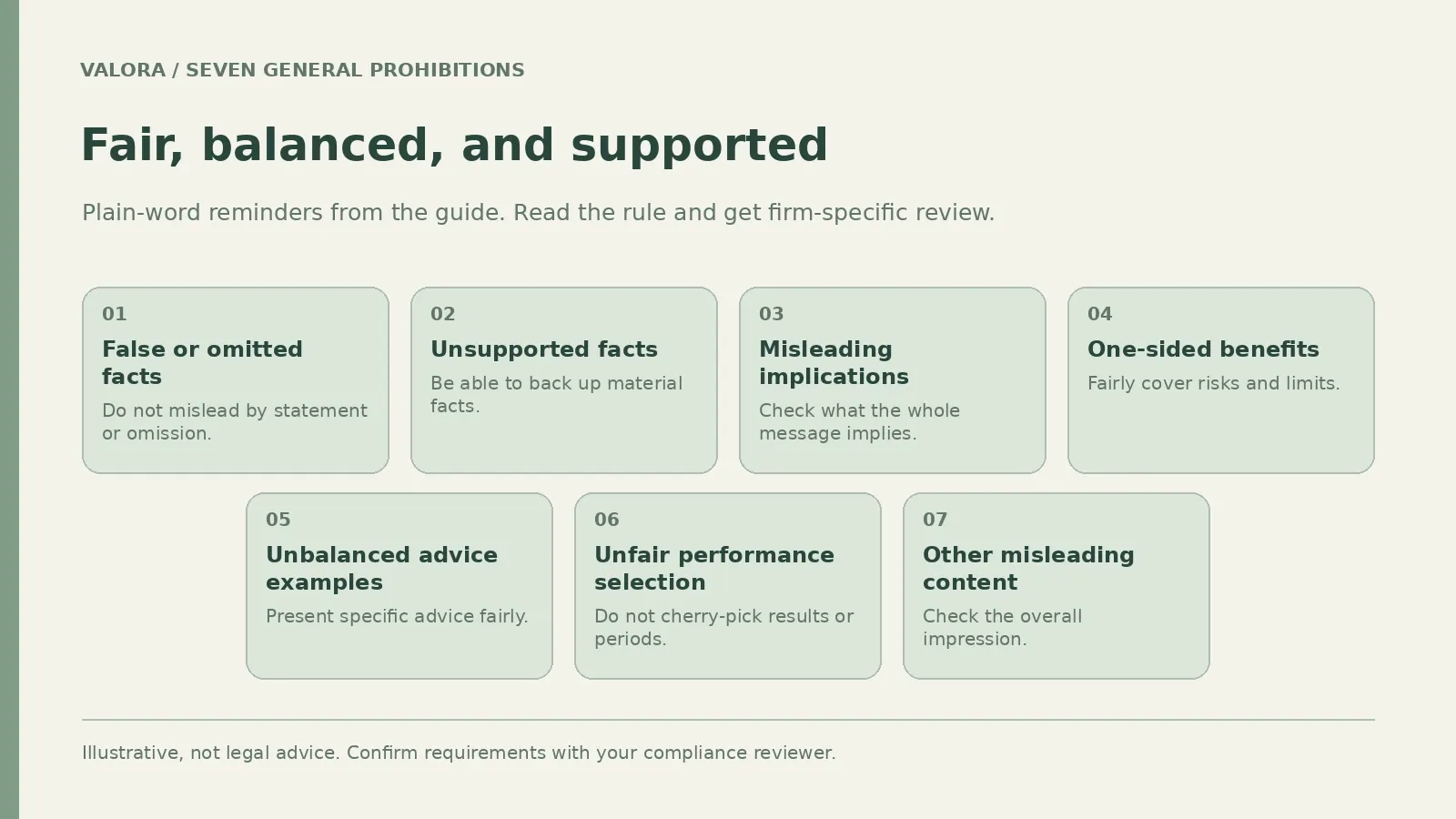
- Seven general prohibitions apply to every advertisement. The core idea is fair, balanced, and provable.
- Testimonials come from current clients. Endorsements come from everyone else. Both are allowed if you meet disclosure, oversight, and eligibility conditions.
- SEC staff have flagged problems with review sites, refer-a-friend programs, lead-generation firms, and award logos.
- AI-written copy is held to the same standards. You remain responsible for every claim.
Does the Marketing Rule apply to my firm?
The SEC's small entity compliance guide says the rule applies to any investment adviser registered or required to be registered with the SEC that directly or indirectly disseminates an advertisement. The rule took effect May 4, 2021, and compliance was required from November 4, 2022.
Many solo RIAs (registered investment advisers) are registered with their state instead. State rules can differ from the SEC rule. In May 2026, NASAA announced that its members adopted model rule amendments that give states a framework to allow testimonials, endorsements, and certain performance reporting. Model rules are a framework, not law. Each state decides whether to adopt them. If you are state-registered, ask your state regulator or counsel what applies to you.
What counts as an advertisement?
The rule text in the eCFR defines an advertisement in two parts.
Part one: any direct or indirect communication to more than one person that offers your advisory services about securities to prospective clients, or offers new advisory services to current clients. Your website, a newsletter, a social media post, and a mass email can all fit here.
Part one excludes:
- Extemporaneous, live, oral communications, such as answering questions on the spot at a live event.
- Information in a required notice or filing, such as Form ADV.
- One-on-one communications, with special limits when hypothetical performance is involved.
Part two: any testimonial or endorsement you pay for, directly or indirectly. Payment can be cash or non-cash. The SEC guide lists examples such as directed brokerage, awards or prizes, and reduced fees.
Whether a specific post or email is an advertisement depends on the facts. When unsure, ask your reviewer before you publish.
The seven general prohibitions
These apply to every advertisement. The SEC guide lists them. In plain words, an advertisement may not:
- Say something materially untrue, or leave out a fact that makes what you said misleading.
- State a material fact you could not back up if the SEC asked.
- Imply something untrue or misleading about your firm, even if each sentence is technically true.
- Talk about benefits without fairly covering the risks and limits.
- Mention specific advice you gave in a way that is not fair and balanced.
- Pick or present performance results or time periods unfairly.
- Be materially misleading in any other way.
A useful test for solo RIAs: could you show the SEC the proof for each factual claim today? "Top-rated," "best," "guaranteed," or "we specialize in" all need support.
Testimonials and endorsements: what is the difference?
Under the rule, a testimonial is a statement by a current client about their experience with you, or one that solicits or refers someone to you. An endorsement is a similar statement by anyone who is not a current client: a former client, a friend, an influencer, or another professional.
Both are allowed if you meet three sets of conditions.
Disclosure. At the time it is shared, the testimonial or endorsement must say, clearly and prominently, whether the person is a current client and whether they were paid. It must include a brief statement of any material conflicts. You must also disclose the material terms of any payment and describe the conflicts.
Oversight. You need a reasonable basis to believe the testimonial or endorsement complies. For paid promoters, you need a written agreement that describes the activities and the pay. The exception is de minimis pay: $1,000 or less in total, or the same value in non-cash pay, over the preceding 12 months. Affiliated persons have a separate exception.
Eligibility. You may not pay certain people with disqualifying disciplinary history to promote you. The rule defines who is ineligible. The SEC staff FAQ, updated January 15, 2026, addresses one edge case on self-regulatory organization orders. FAQs are staff views, not rules.
What SEC staff found when they looked
The SEC's Division of Examinations published a risk alert on December 16, 2025 on testimonials, endorsements, and ratings. Like the FAQ, it is a staff statement, not a rule. It is still useful, because it shows where advisers went wrong.
Staff observed:
- Missing disclosures at the time a testimonial or endorsement was shared. This was the most common problem.
- Disclosures hidden behind a hyperlink or set in smaller or lighter type. The alert, citing the SEC's adopting release, notes that disclosures must be at least as prominent as the testimonial itself.
- Client reviews copied from third-party sites onto an adviser's website without saying they came from clients.
- Gift cards given to clients for writing reviews.
- Lead-generation firms, social media influencers, adviser referral networks, and refer-a-friend programs used without the adviser realizing they created endorsements.
- Firms claiming the de minimis exception because each payment was under $1,000, when the 12-month total was more.
If you use any of these, review them now.
Online reviews, ratings, and awards
What about Google reviews? The rule text has no special exception for any review platform, and how it applies to a review depends on the facts. What you do with a review matters. Sharing it, quoting it on your site, linking to it in your marketing, or rewarding clients for writing it can bring testimonial conditions into play. The risk alert shows each of these causing problems. Ask counsel before you display, link to, or encourage reviews.
Third-party ratings are rankings or ratings from an unrelated party that provides them in the normal course of business. The rule allows them in an advertisement if:
- You have a reasonable basis to believe any survey behind the rating made favorable and unfavorable answers equally easy, and was not designed to produce a set result.
- You disclose, clearly and prominently, the date of the rating, the period it covers, who created it, and whether you paid anything to get or use it.
Staff observed award logos without the rating provider's name, wrong award years, and undisclosed fees paid to be considered, to use a logo, or for better placement. If you show an award badge, check each of these items.
Performance: the short version
If you never show performance in your marketing, you can skim this section. This guide will not teach composite math. If you do show performance, the rule adds strict conditions. The SEC guide lists them. Among them:
- Show net performance alongside any gross performance, with at least equal prominence.
- For most advertisements other than private fund ads, show 1-, 5-, and 10-year periods.
- Never state or imply that the SEC approved or reviewed your performance.
- Hypothetical, extracted, and predecessor performance each carry extra conditions.
The staff FAQ adds guidance on topics such as model fees and extracted performance. If performance appears anywhere in your marketing, get specialist review.
AI-written copy: what changes and what does not
Using an AI tool to draft content is not banned by the rule. The standards above apply to the output exactly as they would to a human draft. The tool does not share your responsibility.
Common risks when AI drafts adviser marketing:
- Invented facts. AI tools can produce confident statistics, credentials, or awards that do not exist. Each one fails the "could you prove it?" test.
- Unbalanced claims. Drafts often list benefits and skip risks and limits.
- Implied testimonials. A made-up "client story" can mislead even when labeled as an example. Ask your reviewer before you use any.
- Claims about your own use of AI. In March 2024, the SEC settled charges against two advisers over false and misleading claims about their use of AI. One was also charged under the Marketing Rule. If you say you use AI, make sure it is true and you can show how.
A simple rule: AI drafts, a human checks every fact against a source, compliance reviews, and you save the final version.
For AI channel visibility work that still needs the same review, see How RIAs get clients from ChatGPT and AI search.
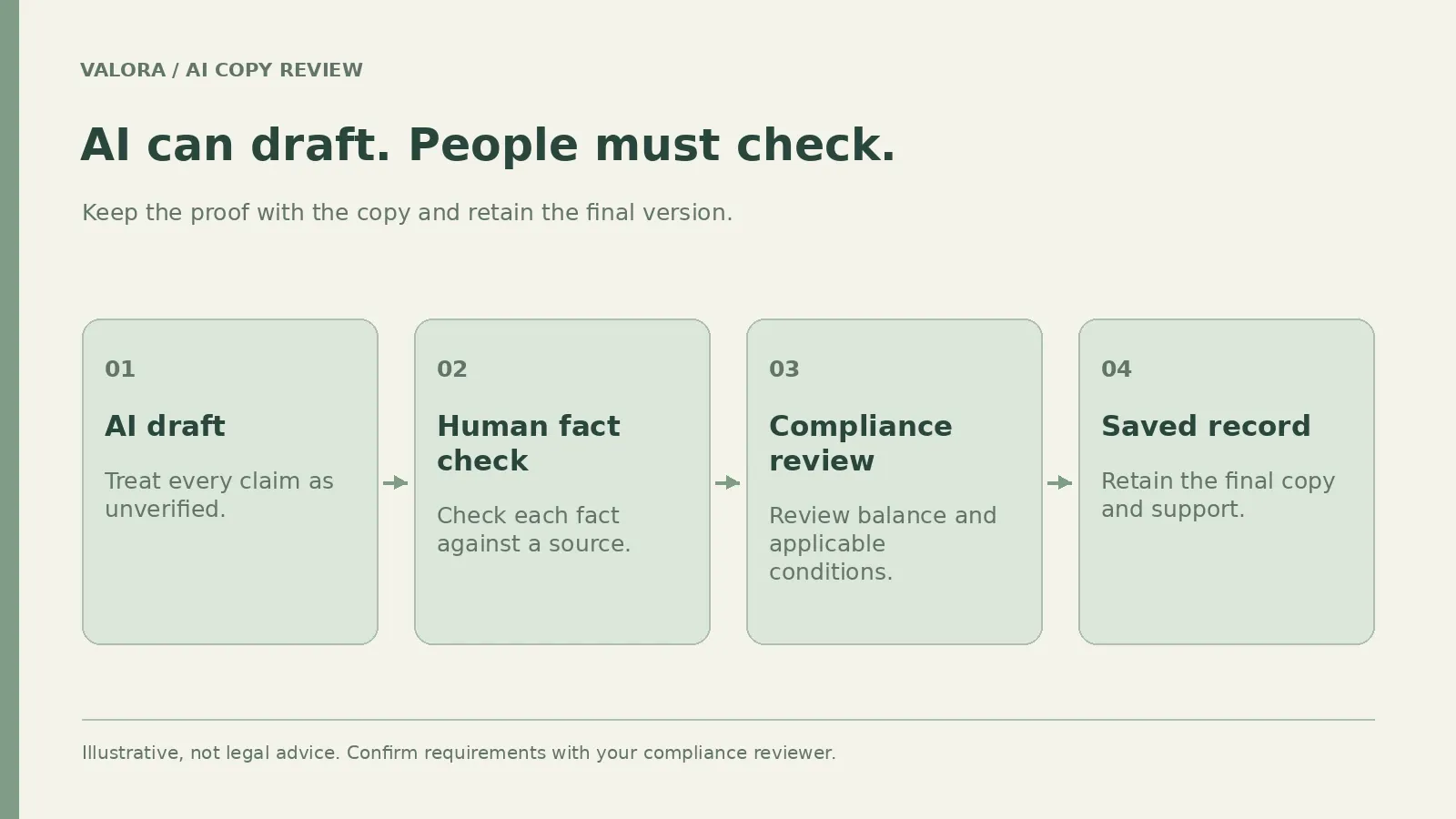
A simple review workflow for a solo RIA
You may be your own compliance department. This is operational hygiene, not legal advice:
- Decide if it is an advertisement. If it might be, treat it as one.
- Check every factual claim. Keep the source or proof with the draft.
- Check balance. Are risks and limits stated near the benefits?
- Check testimonials, endorsements, reviews, and ratings. Are the required disclosures in the content itself, as prominent as the statement?
- Check any payment. Is there a written agreement? Have you tracked 12-month totals?
- Get review. From your CCO, outside compliance help, or counsel.
- Save a copy. The SEC guide says advisers must keep copies of all advertisements they disseminate, with extra records for performance, testimonials, endorsements, and ratings.
Form ADV also asks about marketing practices, so keep your answers consistent with what you do.
The same standards apply whatever channel you use, including the ones in the lead-source guide and AI visibility work like Can ChatGPT find your firm?
Website visibility tactics are covered in What is GEO vs SEO for an RIA website?. Consent-based marketing without hard selling is covered in How do I market myself as a financial advisor if I hate selling?.
Where Valora fits
Valora helps advisory firms reach people seeking their services and books appointments with prospects who have asked to speak with an advisor. It is a marketing service, not a compliance service. Valora does not review your advertisements for legal sufficiency, and using Valora does not make any advertisement compliant. Your firm reviews anything published or sent under its name.
Paid lead and appointment arrangements are one of the areas SEC staff flagged. If you use any outside source of prospects, including Valora, ask your compliance reviewer whether the arrangement raises testimonial or endorsement questions.
The current public offer is $250 per booked appointment, starting with 3 appointments paid in advance, with no setup fee or retainer. Valora does not guarantee clients, rankings, or AI citations.
Frequently asked questions
Can I put client testimonials on my website?
If you are SEC-registered, generally yes, if you meet the disclosure, oversight, and eligibility conditions. State-registered firms must check their state's rules.
Can I reply to Google reviews?
The rule has no Google-specific guidance. Replies, sharing, and quoting can raise testimonial questions. Ask counsel before you set a policy.
Is a LinkedIn post an advertisement?
It can be, if it offers your advisory services to more than one person. It depends on the content and context. When unsure, treat it as one.
Can I use ChatGPT to write marketing emails?
The rule does not ban it. You must check every claim, keep balance, get review, and keep records, as you would for any other draft.
Can I say I am "SEC approved"?
Avoid it. The rule specifically prohibits stating that the SEC approved or reviewed any performance calculation or presentation, and a broader "approved" claim risks misleading readers under the general prohibitions.
Where can I ask the SEC a question?
The SEC guide says small entities can email IMOCC@sec.gov or call the Division of Investment Management's Office of Chief Counsel at (202) 551-6825.
Sources
Educational only, not legal advice. Valora is not a registered investment adviser or a law firm. SEC staff FAQs and risk alerts are staff views with no legal force. Read the primary sources.
- U.S. eCFR, 17 CFR 275.206(4)-1, Investment adviser marketing: rule text and definitions. Fetched 7 Nov 2026 (Asia/Makassar). https://www.ecfr.gov/current/title-17/chapter-II/part-275/section-275.206(4)-1
- SEC, Investment Adviser Marketing: A Small Entity Compliance Guide, April 28, 2021. Fetched 7 Nov 2026 (Asia/Makassar). https://www.sec.gov/resources-small-businesses/small-business-compliance-guides/investment-adviser-marketing
- SEC Division of Investment Management, Marketing Compliance: Frequently Asked Questions, updated January 15, 2026. Fetched 7 Nov 2026 (Asia/Makassar). https://www.sec.gov/rules-regulations/staff-guidance/division-investment-management-frequently-asked-questions/marketing-compliance-frequently-asked-questions
- SEC Division of Examinations, Additional Observations Regarding Advisers' Compliance with the Advisers Act Marketing Rule, December 16, 2025. Fetched 7 Nov 2026 (Asia/Makassar). https://www.sec.gov/files/exams-riskalert-mrkt-rule-2512-508.pdf
- SEC, SEC Charges Two Investment Advisers with Making False and Misleading Statements About Their Use of Artificial Intelligence, press release 2024-36, March 18, 2024. Fetched 7 Nov 2026 (Asia/Makassar). https://www.sec.gov/newsroom/press-releases/2024-36
- NASAA, NASAA Modernizes Investment Adviser Advertising Rules to Align with Federal Standards, May 4, 2026. Fetched 7 Nov 2026 (Asia/Makassar). https://www.nasaa.org/81020/nasaa-modernizes-investment-adviser-advertising-rules/
- Valora, For Advisors: price, prepaid minimum, firm review, and limits. Fetched 7 Nov 2026 (Asia/Makassar). https://www.valorahq.com/for-advisors/