
How can a solo RIA manage marketing compliance without a compliance department?
A solo RIA can be its own CCO: write policies that match real channels, review and archive ads, and document the annual review.


A solo registered investment adviser (RIA) does not need a separate compliance department to have a compliance program. An RIA is a firm registered to give investment advice. Rule 206(4)-7 under the Investment Advisers Act of 1940 sets three requirements. The firm needs written policies reasonably designed to prevent violations, a review of those policies at least once a year, and a designated chief compliance officer (CCO). The CCO is the supervised person who administers those policies. In a one-person practice, that CCO is usually the founder.
The work is to make the program real. Write down how advertisements are reviewed and stored. Cover the website and social channels the firm actually uses. Keep copies. Finish a documented annual review on time, and follow through when it finds a problem.
This page is the year-round operating workflow for a solo CCO. It is educational, not legal advice. The Marketing Rule itself, the difference between testimonials and endorsements, and the per-advertisement checklist already live on SEC Marketing Rule in plain English for solo RIAs (testimonials, reviews, AI copy). Use that page when you review a single draft. This article does not restate the rule.
The Marketing Rule and Rule 206(4)-7 apply to advisers registered with the Securities and Exchange Commission (SEC), or required to be registered with it. Advisers that are only state-registered should check the advertising and compliance-program rules of their state securities regulator.
Can a solo RIA run marketing compliance without a department?
Yes. Rule 206(4)-7 does not require a separate compliance staff. It requires three things. The firm must adopt and implement written policies reasonably designed to prevent violations of the Advisers Act and its rules by the firm and its supervised persons. It must review the adequacy of those policies, and the effectiveness of their implementation, no less frequently than annually. It must designate an individual, who is a supervised person, to administer the policies (17 CFR 275.206(4)-7).
In a solo firm, the founder is usually that designated person. The rule asks for a real program, not a department chart. It does not promise that any workflow will prevent a deficiency letter.
This is not a second Marketing Rule explainer. When you review one draft, use the live Marketing Rule page. If the draft uses a client quote, use What should an RIA check before using a client testimonial?. A website claim-review ledger can be one tool in the program. That tool is already covered in How should an RIA build a website claim-review ledger?. This page does not walk through a testimonial or rebuild that ledger.
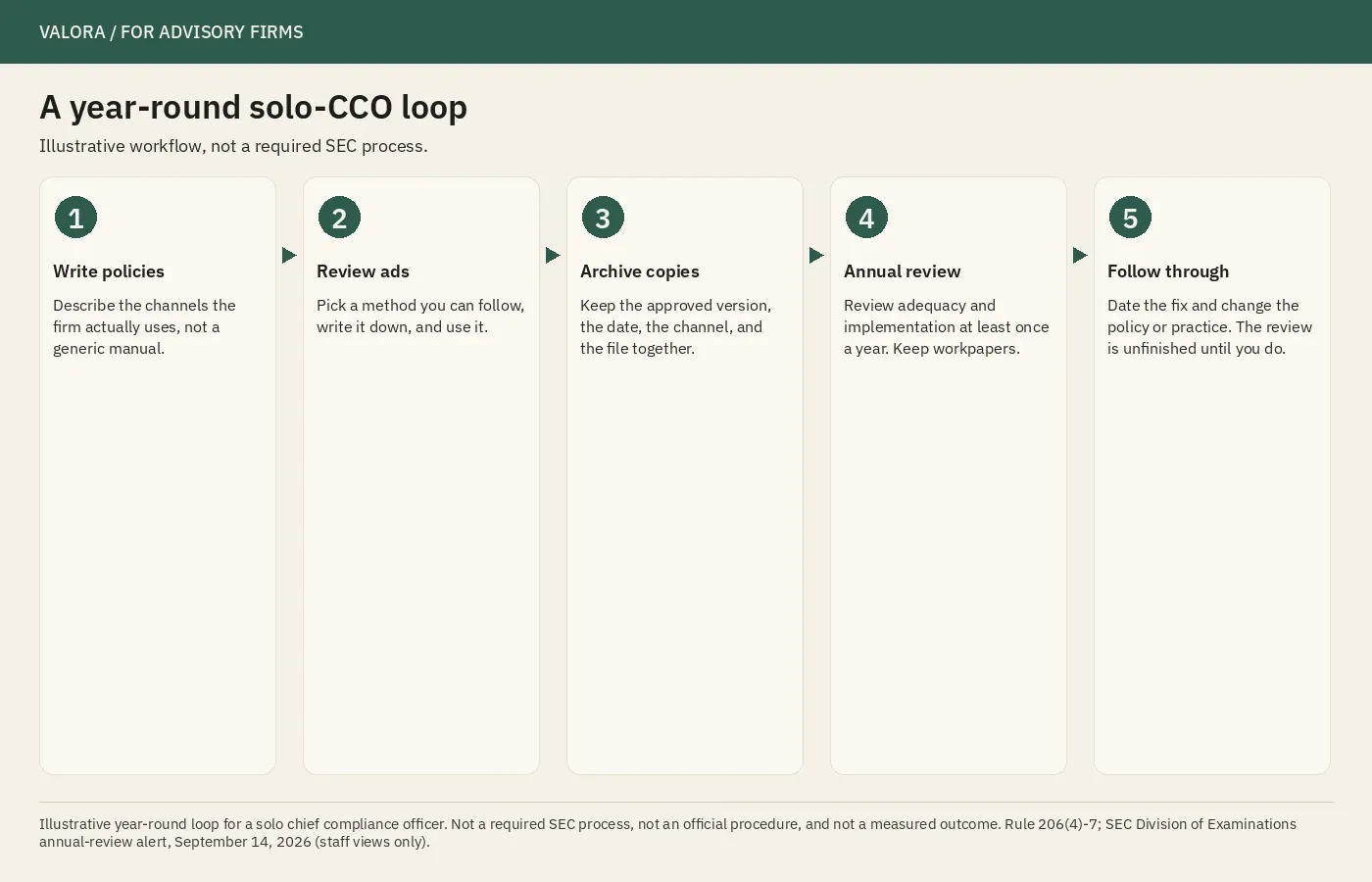
Write policies that match the channels you actually use
A policy that could belong to any firm is a weak policy for your firm. The April 17, 2024 risk alert from the SEC Division of Examinations is staff observation, not a new rule, and it creates no new obligations. Staff saw marketing policies that were only general descriptions. Some did not cover the channels the firm actually used, including websites and social media. Some were informal rather than written. Some were incomplete, only partly updated, or not tailored to the firm's actual advertisements. Some were updated to reflect the Marketing Rule but were not implemented (SEC Division of Examinations, April 17, 2024).
A later staff alert, dated September 14, 2026, also observed marketing policies that had not been updated to reflect the Marketing Rule (SEC Division of Examinations, September 14, 2026). That alert is staff views only.
The job is to describe the firm's real website, email, social channels, and any paid-promoter activity. Write how each channel is reviewed and stored. If the firm does not use a channel, say so, rather than pasting a generic manual that pretends it does.
If the firm later starts using testimonials, endorsements, or third-party ratings, the written policies need to cover that practice before the advertisements go out. A December 16, 2025 staff alert observed some advisers who used testimonials, endorsements, or third-party ratings without updating their written policies. Some updated policies but did not implement them, and then disseminated advertisements that did not appear to comply (SEC Division of Examinations, December 16, 2025). That alert is also staff views only. The detailed conditions for those advertisements belong on the live testimonial page and the live Marketing Rule page, not here.
Choose a review method and actually use it
The Marketing Rule does not require pre-approval of every advertisement. The 2024 staff alert, citing the Marketing Rule adopting release, notes that advisers may test through a variety of tools. Those tools include reviewing a sample of advertisements based on risk, or pre-approving templates. The same alert observed that many examined firms did require pre-approval (SEC Division of Examinations, April 17, 2024). That is a description of what staff saw, not a requirement that every solo firm copy it.
For a solo CCO, pick one method that can be followed on a busy week. Write it down, and follow it. One workable pattern is to pre-approve templates for routine posts, and to record a review of anything new, or anything that includes performance, testimonials, or ratings. That pattern is an example, not a required process.
Do not reprint a per-draft checklist here. When you review a single advertisement, use the workflow already on the live Marketing Rule page. The year-round job is to choose the method, put it in the written policies, and use it the same way you wrote it.
Keep the advertisement, including what you posted on social media
The SEC small entity compliance guide says investment advisers must make and keep copies of all advertisements they directly or indirectly disseminate. Additional records apply to performance, testimonials, endorsements, and third-party ratings (SEC, Investment Adviser Marketing: A Small Entity Compliance Guide, April 28, 2021). The guide is a staff summary, not a substitute for the rule or legal advice.
Rule 204-2 is the books and records rule. It requires a copy of each advertisement the adviser disseminates, directly or indirectly, with limited alternatives for oral advertisements (17 CFR 275.204-2(a)(11)). It also requires records that document the annual review of the compliance policies (17 CFR 275.204-2(a)(17)(ii)).
Those records generally must be kept in an easily accessible place for at least five years from the end of the fiscal year of the last entry. The first two years must be in an appropriate office of the adviser (17 CFR 275.204-2(e)(1)). For advertisements, that clock runs from the end of the fiscal year in which the advertisement was last disseminated (17 CFR 275.204-2(e)(3)(i)).
The 2024 staff alert observed firms that did not keep copies of information posted to social media. It also observed policies that did not adequately address preservation of advertisements and related documents (SEC Division of Examinations, April 17, 2024). A post that has left the screen is still an advertisement you disseminated.
Keep the approved version, the date it went out, the channel, and the substantiation file together. The cited sources do not require a particular software vendor. They require the records.
Do the annual review on time, and keep the workpapers
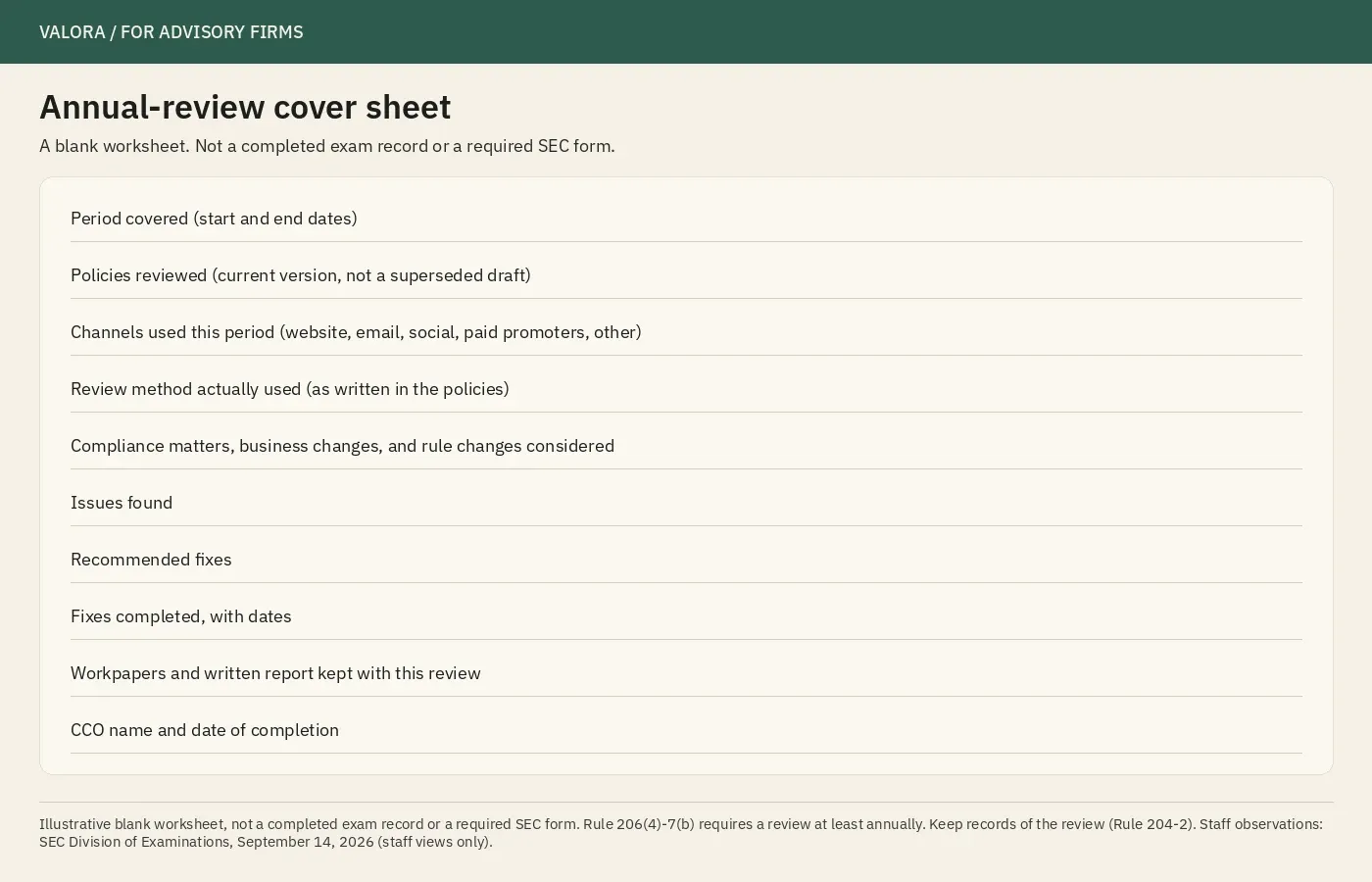
Rule 206(4)-7(b) requires a review, no less frequently than annually, of the adequacy of the policies and the effectiveness of their implementation (17 CFR 275.206(4)-7(b)). The rule does not set a more specific calendar than that. It also does not treat a training session as the review.
The September 14, 2026 risk alert is staff observation, not a new rule, and it creates no new obligations. Staff saw firms that skipped a year. Some stretched the interval past 12 months. Some treated training or attestations as a substitute for the review. Some lacked procedures for how to do the review. Some did not follow their own written process. Some reviewed superseded policies. Some failed to keep testing and workpapers, or produced no written report even when their own policy required one (SEC Division of Examinations, September 14, 2026).
The Compliance Rule adopting release, as quoted in that staff alert, sets out what the review should consider (Advisers Act Release No. 2204, quoted in SEC Division of Examinations, September 14, 2026). The review should consider compliance matters that arose during the previous year. It should consider changes in the business activities of the adviser or its affiliates. It should consider changes in the Advisers Act or applicable regulations that might suggest a need to revise the policies. The same release, as quoted there, says advisers should also consider the need for interim reviews in response to significant compliance events, changes in business arrangements, and regulatory developments.
Keep the workpapers. Rule 204-2 requires the firm to make and keep records documenting the annual review (17 CFR 275.204-2(a)(17)(ii)). If your own policy requires a written report, checklists, or a defined review period, follow that process and keep what it produces.
Fiscal year 2026 examination priorities from the Division of Examinations are staff views, not a rule. Examinations that look at the effectiveness of advisers' compliance programs typically include, as applicable, marketing, valuation, trading, portfolio management, disclosure and filings, and custody. They typically also include an analysis of advisers' annual reviews. The same document notes a focus on whether policies and procedures are implemented and enforced (SEC Division of Examinations, Fiscal Year 2026 Examination Priorities). That is context, not a prediction that a particular firm will be examined, and not a ranking of topics.
Close the loop when the review finds a problem
An annual review that only names a problem is unfinished. The 2026 staff alert observed firms that identified issues, including recommended changes to policies, disclosures, or practices, and then did not make the changes. In some cases the written report said the fix had already happened, and the issue was still there (SEC Division of Examinations, September 14, 2026).
For a solo CCO, close the loop in writing. Date the follow-up. Change the policy or the practice. Keep the record with the review file. A later review should look at the current policies, not a superseded draft, and should confirm that last year's fixes were actually made.
When the founder-CCO should get outside help
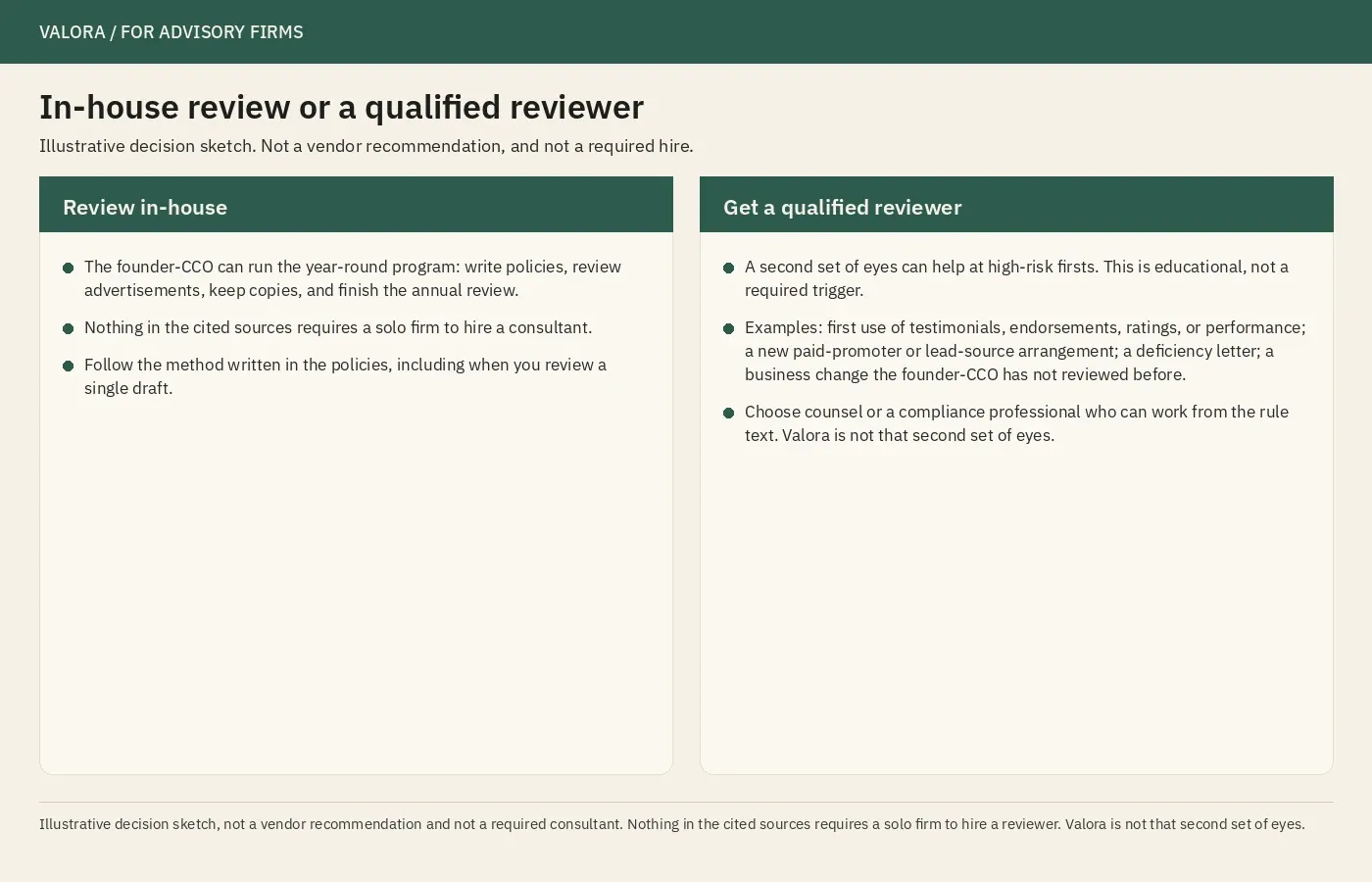
Nothing in the sources cited below requires a solo firm to hire a consultant. Many founders still get a second set of eyes at a few high-risk firsts. Those moments can include the first use of testimonials, endorsements, ratings, or performance advertising. They can include a new paid-promoter or lead-source arrangement. They can include a deficiency letter, or a business change the founder-CCO has not reviewed before.
That second set of eyes should be a qualified reviewer the firm chooses, such as counsel or a compliance professional who can work from the actual rule text. This list is educational, not a required trigger or a vendor recommendation.
Valora is not that second set of eyes. Valora provides marketing services, not investment advice, and is not a compliance service. Using Valora does not make an advertisement compliant. The firm reviews anything published or sent under its name.
If those firsts involve a client testimonial, start with the live testimonial checklist, then get qualified review if you need it.
FAQ
Does a solo founder have to be the CCO? Rule 206(4)-7 requires the firm to designate an individual who is a supervised person to administer the policies. It does not require a separate hire. In a one-person firm, the founder is usually that person (17 CFR 275.206(4)-7(c)).
Is pre-approval of every advertisement mandatory? No. The Marketing Rule does not require pre-approval of every advertisement. The 2024 staff alert, citing the adopting release, notes that advisers may use a variety of tools, including risk-based sampling or pre-approved templates. Some examined firms did require pre-approval. Whatever method you choose should be written down and actually used (SEC Division of Examinations, April 17, 2024).
Does an annual training session satisfy the annual review? No. The 2026 staff alert observed firms that treated training or attestations as a substitute for the review. Staff said that this did not satisfy the requirement to review the adequacy of the policies and the effectiveness of their implementation (SEC Division of Examinations, September 14, 2026). That alert is staff views only, not a new rule. The rule itself still requires the review at least annually.
Do these SEC rules apply if my firm is only state-registered? The Marketing Rule and Rule 206(4)-7, as discussed here, apply to advisers registered with the SEC, or required to be registered with it. Advisers that are only state-registered should check the rules of their state securities regulator. This article is not a state-rule inventory.
Is this legal advice? No. This article is educational firm-side material. It is not legal advice, compliance advice, or personalized investment advice. It does not promise that following this workflow will prevent a deficiency letter.
If your firm later wants help making its services easier for suitable prospects to find and understand, you can learn about Valora's work for advisory firms. The current public offer is $250 per booked appointment with a qualified prospect, with a 3-appointment minimum, paid in advance. An appointment is a call booked on your calendar with a prospect who has asked to speak with an advisor. There is no setup fee, retainer, or long-term contract. If a prospect does not attend or does not meet the agreed criteria, the appointment is replaced at no charge. Your firm reviews what goes out under its name.
This article is educational, not legal advice, tax advice, compliance advice or personalized investment advice. Valora is not a registered investment adviser and does not provide investment advice. Valora provides marketing services to advisory firms.
Sources
- 17 CFR 275.206(4)-7, Compliance procedures and practices: https://www.ecfr.gov/current/title-17/chapter-II/part-275/section-275.206(4)-7
- 17 CFR 275.204-2, Books and records to be maintained by investment advisers: https://www.ecfr.gov/current/title-17/chapter-II/part-275/section-275.204-2
- U.S. Securities and Exchange Commission, Investment Adviser Marketing: A Small Entity Compliance Guide, April 28, 2021: https://www.sec.gov/resources-small-businesses/small-business-compliance-guides/investment-adviser-marketing
- SEC Division of Examinations, Initial Observations Regarding Advisers Act Marketing Rule Compliance, April 17, 2024 (staff views only): https://www.sec.gov/files/exams-risk-alert-marketing-observation-2024.pdf
- SEC Division of Examinations, Additional Observations Regarding Advisers' Compliance with the Advisers Act Marketing Rule, December 16, 2025 (staff views only): https://www.sec.gov/files/exams-riskalert-mrkt-rule-2512-508.pdf
- SEC Division of Examinations, Examinations Observations Regarding Investment Adviser Annual Compliance Reviews, September 14, 2026 (staff views only): https://www.sec.gov/files/examinations-observations-regarding-investment-adviser-annual-compliance-review-091426.pdf
- SEC Division of Examinations, Fiscal Year 2026 Examination Priorities (staff views only): https://www.sec.gov/files/2026-exam-priorities.pdf
- Valora, For Advisors: https://www.valorahq.com/for-advisors/ (offer terms only; not evidence of client results)