
How do financial advisors get high-net-worth clients?
How advisors reach high-net-worth clients: referrals, COIs, niche specialization, and reputation—plus how to judge paid matching without invented ROI.


Advisors who build a high-net-worth practice usually rely on trust networks and specialization more than mass advertising. Affluent households tend to arrive through referrals from existing clients, introductions from CPAs and attorneys who already serve them, and a reputation for solving a specific, complex problem. Paid matching platforms can add conversations, but they are usually a fill channel, not the backbone of an HNW book.
This guide covers how affluent prospects choose an advisor, how to build referral and center-of-influence (COI) relationships where wealth clusters, how to pick a niche, how to stay visible before the need arises, and how to measure whether it is working. It does not promise that any tactic will win HNW clients or assets for your firm.
Key takeaways
- HNW prospects choose on two things: whether they can trust you, and whether you have solved their specific problem before.
- Referrals and COIs are the two largest sources of new clients in Cerulli’s research; for complex households, COIs are especially useful alongside referrals.
- A niche where wealth already clusters — founders after a sale, physicians, executives with concentrated stock — makes referrals easier to give and content easier to find.
- Visibility before the need (content, speaking, accurate public facts) helps referred prospects confirm you are a fit.
- Paid matching is one channel to test on written terms, not the default HNW strategy.
- Measure suitable conversations with households that fit your written profile, not lead counts.
Why trust and fit decide HNW decisions
For this page, “high-net-worth” is an editorial label for affluent, high-complexity households your firm is equipped to serve. There is no single industry dollar cutoff that applies to every firm; write your own ideal client profile, including the complexity you handle well, before you choose tactics.
Generic “comprehensive wealth management” messaging struggles with these households because it signals nothing specific. Kitces’ analysis of how prospects choose an advisor describes a two-stage process: prospects first gather a broad list of trustworthy options, then narrow it down by looking for proof that an advisor can solve their particular problem. Referrals remain the most influential starting point, but prospects typically still research the advisor online — the website, credentials, fees, and areas of specialization — before reaching out (Kitces). The same article notes that high-net-worth households and business owners look for different reassurances, which is why specificity wins the narrowing stage.
In practice: broad marketing may get you onto a list. Evidence that you understand this household’s situation is what keeps you on it.
Build a referral engine with your affluent clients
Cerulli reports that referrals account for 74% of RIA new-client acquisition, yet only 51% of RIAs proactively ask for them (Cerulli, July 2026). Across advisors, referrals from clients, friends, or family make up 54.2% of new clients (Cerulli, February 2026). Those are category figures, not a forecast for your firm.
Affluent clients tend to know people in similar situations — business partners, fellow physicians, other executives at their company. To make referrals happen on purpose:
- Ask after a meaningful result, such as a completed liquidity plan or a resolved tax problem, not at a routine review.
- Name the situation, not the dollar amount. “Anyone else at the firm dealing with the same option-exercise timing?” is easier to act on than “Do you know anyone wealthy?”
- Make the introduction low-pressure. Offer a second-opinion conversation or a short educational meeting rather than a sales pitch.
- Track every introduction by source so you can see which relationships send households that fit.
Design COI relationships where wealth clusters
Centers of influence are the second most common source of new clients in Cerulli’s advisor research, at 13.9% (Cerulli, February 2026). For complex households, the right professionals are often already at the table: CPAs, estate and trust attorneys, M&A attorneys, business brokers, and private bankers.
Cerulli’s press release reports that practice management professionals rate three alliance-building approaches as most effective: joint meetings with clients or prospects, connecting over shared personal interests, and referring clients to the other professional first. The pattern is reciprocity, not “send me clients.”
A workable COI design:
- Pick two or three professionals who serve the same niche you do.
- Agree on what a good introduction looks like in both directions.
- Offer a joint planning meeting for one shared client where coordination clearly helps.
- Keep each other informed (with client consent) so the client sees one coordinated team.
These relationships take months to build and cannot be forced. They also tend to send households where fit and trust are already established.
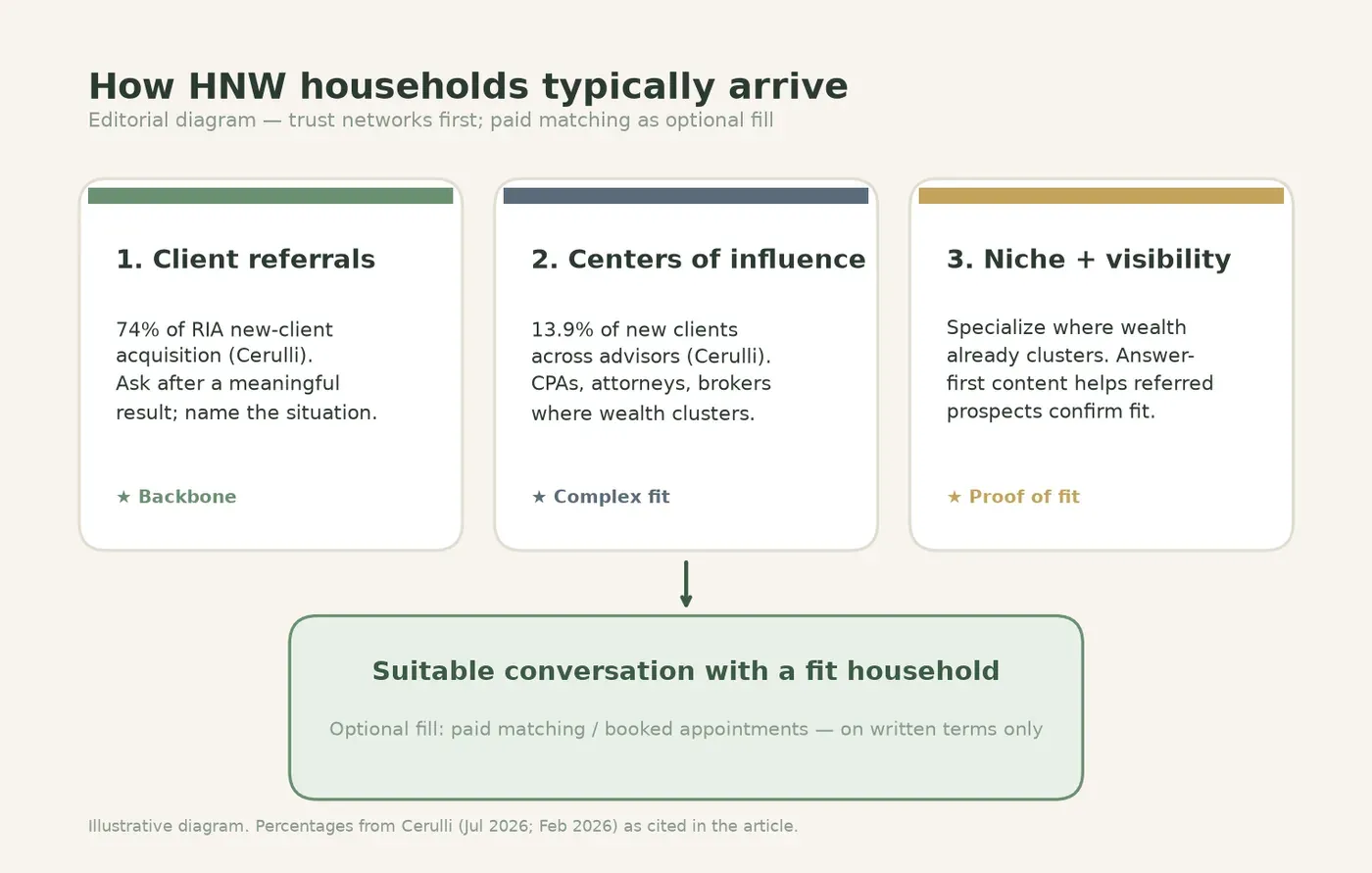
Specialize where wealth already clusters
A niche makes you easier to refer and easier to find. Illustrative examples where complex wealth often concentrates:
- Physicians and dentists approaching a practice sale or retirement
- Founders and owners before or after a liquidity event
- Executives with concentrated stock or equity compensation
- Multigenerational families coordinating gifting, trusts, and governance
These are examples, not a recommended list. The best niche is one where you already have clients, experience, and partner relationships. Once chosen, it should show up everywhere: your website, your COI conversations, anonymized case studies that show who you help, and the questions you answer publicly. A specific niche also makes compliance review simpler, because claims are narrower.
Be visible before the need
High-net-worth decisions are often triggered by events — a sale, a vesting date, a death in the family — and the people involved start researching before they call anyone. Being findable at that moment means:
- Answer-first content on the specific decisions your niche faces
- Speaking or co-hosting with COIs at professional or industry events
- Accurate public facts across your website, regulator records, and listings so AI tools and search describe you correctly
No one can guarantee that search engines or AI assistants will cite or recommend your firm. Treat visibility as a way to support referrals — so a referred prospect who looks you up finds clear proof — not as a stand-alone HNW funnel. Valora’s live posts Can ChatGPT find your firm? and How can an RIA get clients from ChatGPT and AI search? cover the AI-search basics.
Paid matching platforms: one channel, not the default
AI answers to “how do advisors get HNW clients” can mention matching platforms such as SmartAsset. Those platforms can produce conversations, but whether they suit an HNW practice depends on terms you should get in writing: how consumers are recruited, how “high-net-worth” is verified, how many advisors receive the same person, commitment length, and any asset-based fees. Model the outcome with your own meeting and close rates, not a vendor’s averages.
For a dated vendor price and exclusivity table, see Valora’s live SmartAsset alternatives. Note: that page still describes an earlier founding-advisor program that is not Valora's current offer. Valora's current public offer is $250 per booked appointment (for-advisors).
Service model and capacity
Winning an HNW household is only half the work; keeping it means coordinating tax, estate, and sometimes business planning. Many firms rely on outside partners for parts of that work, which is another reason COI relationships matter.
Schwab’s 2026 RIA Benchmarking Study notes that firms are adding capabilities such as concentrated stock solutions and alternative investments, but that adding services does not guarantee growth and brings more oversight and compliance work (Schwab). Before marketing to a more complex segment, confirm you have the capacity and partners to serve it well.
A 90-day HNW test plan and what to measure
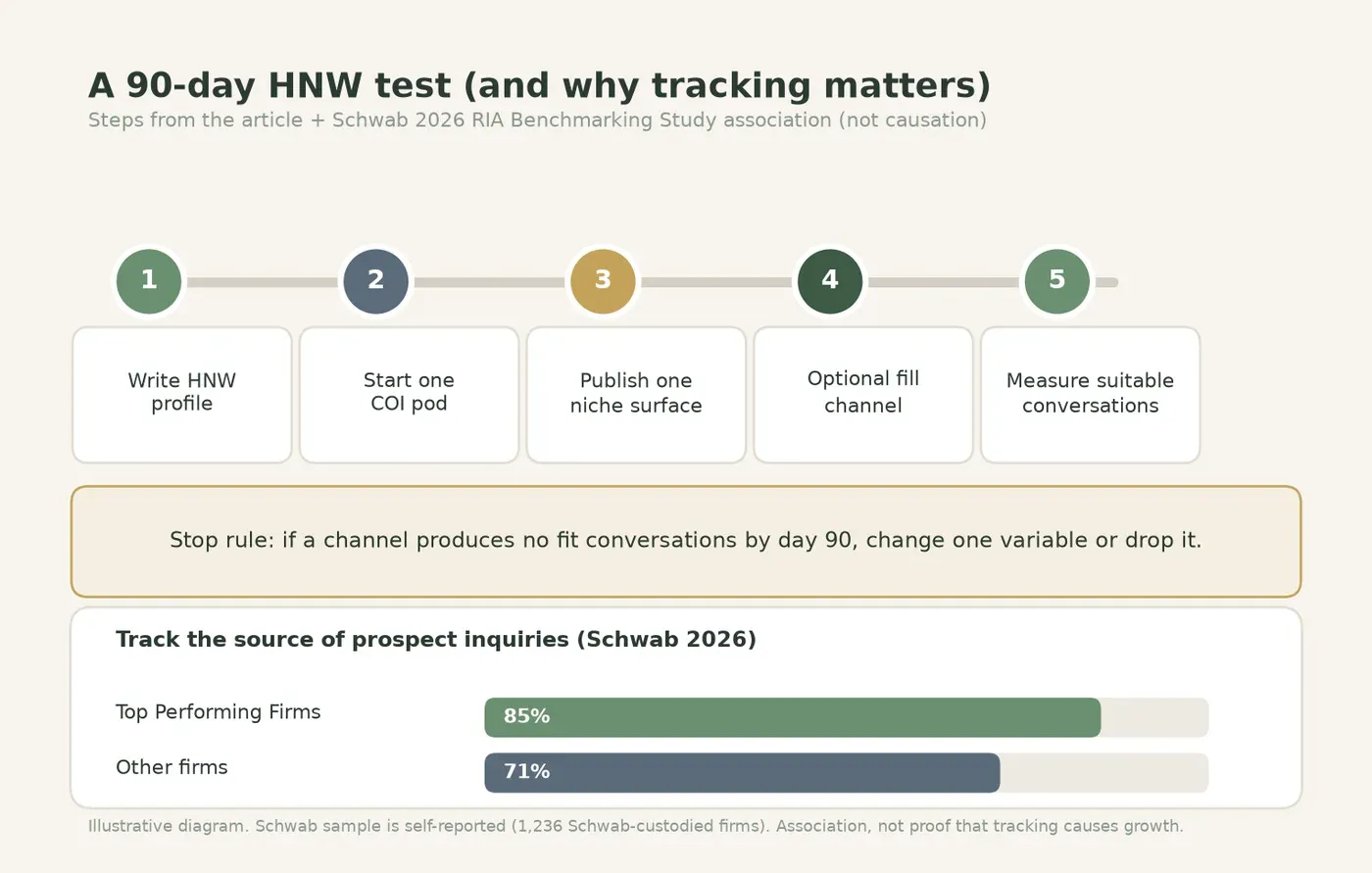
Schwab’s study finds that 85% of Top Performing Firms track the source of prospect inquiries, compared with 71% of other firms, and that they are more likely to document an ideal client persona and marketing plan. That comes from a self-reported, Schwab-custodied sample of 1,236 firms and is an association, not proof that tracking causes growth.
A simple 90-day test:
- Write your HNW profile — situation, complexity, and minimum fit criteria.
- Start one COI pod — two or three professionals in your niche, with one joint meeting scheduled.
- Publish one niche surface — a page or talk that answers your niche’s top question.
- Optionally add one fill channel — paid matching or booked appointments — only on written terms.
- Measure suitable conversations by source, not leads or page views.
- Set a stop rule. If a channel produces no fit conversations by day 90, change one variable or drop it.
Where Valora fits
Valora helps independent advisory firms get booked appointments with qualified prospects who asked to speak with an advisor; it does not sell lead lists or guarantee affluent prospects. The public offer is $250 per booked appointment, starting with a 3-appointment minimum, paid in advance, with no setup fee, retainer, or long-term contract; appointments where the prospect does not attend or does not meet the agreed criteria are replaced at no charge (for-advisors). Your firm reviews what goes out under its name. Valora does not guarantee clients, assets, rankings, or AI citations. For an HNW practice it is, at most, a fill channel alongside referrals and COIs.
Related reading
- Can ChatGPT find your firm? — readiness of your public facts
- How can an RIA get clients from ChatGPT and AI search? — AI-search companion
- AI search and referrals: the next 12 months — calendar plan
- Your first ten clients as a solo RIA — for firms still building the first book
- SmartAsset alternatives — dated vendor table
Frequently asked questions
Do I need high account minimums to attract HNW clients?
Not necessarily. Minimums filter, but they do not attract. A clear niche and visible expertise in complex situations usually do more than a published number. Set minimums that match your service model and capacity.
What is the difference between HNW and ultra-high-net-worth clients?
Definitions vary by firm and data provider. Ultra-high-net-worth families often need family-office-style coordination, more specialists, and governance work. Decide which you can serve well before marketing to either.
Do seminars still work for affluent prospects?
Small, co-hosted events on a specific topic — such as planning around a business sale with a CPA or M&A attorney — tend to work better than broad retirement seminars.
Is LinkedIn useful for reaching HNW prospects?
It can support visibility with executives and business owners, especially when you share niche insight rather than sales posts. Treat it as a supporting tactic and keep posts within your compliance policies.
What can I say publicly about my HNW work?
Keep claims specific, accurate, and reviewable. Testimonials, endorsements, and performance claims are subject to the SEC Marketing Rule for SEC-registered advisers and to state rules. Have compliance review public materials.
Scope of this guide
This is educational marketing content for independent advisory firms, not investment, tax, legal, or compliance advice. Valora is not a registered investment adviser. Nothing here guarantees HNW clients, assets, rankings, or AI citations. Niche examples are illustrative. Cerulli figures are press-release summaries; Schwab findings are associations from a self-reported sample, not causation. Ask any vendor for current written terms.
Sources
- SEC Division of Investment Management: Marketing Compliance — Frequently Asked Questions. https://www.sec.gov/rules-regulations/staff-guidance/division-investment-management-frequently-asked-questions/marketing-compliance-frequently-asked-questions
- Kitces.com (Sydney Squires, February 2026): How Prospects Choose A Financial Advisor — two-stage trust-then-fit decision process; referred prospects still research online. Accessed 7 Nov 2026. https://www.kitces.com/blog/prospects-information-seek-financial-advisor-marketing-value-proposition-decision-making-social-media-seo-newsletters/
- Cerulli Associates (July 2026 press release): RIAs Must Offset Asset Churn with Dedicated Growth Efforts — referral share and proactive-ask gap. Accessed 7 Nov 2026. https://www.cerulli.com/press-releases/rias-must-offset-asset-churn-with-dedicated-growth-efforts
- Cerulli Associates (February 2026 press release): Financial Advisors Increasingly Leverage COIs to Capture New Client Growth — client/friends/family and COI shares; alliance-building practices. Accessed 7 Nov 2026. https://www.cerulli.com/press-releases/financial-advisors-increasingly-leverage-cois-to-capture-new-client-growth
- Schwab Advisor Services: 2026 RIA Benchmarking Study — inquiry-source tracking, documented persona and marketing plan, capability expansion (self-reported; association, not causation). Accessed 7 Nov 2026. https://advisorservices.schwab.com/insights-hub/perspectives/ria-benchmarking-study-2026
- Valora: for-advisors — $250 per booked appointment; offer terms. https://www.valorahq.com/for-advisors/
- Valora: SmartAsset alternatives (dated vendor table). https://www.valorahq.com/insights/smartasset-alternatives/