
How do independent advisors find clients who are already looking?
Find prospects already looking for an advisor: high-intent search, niche pages, directories, trigger-timed referrals, and booked appointments.


People who are actively looking for a financial advisor are in a short intent window: something happened, they have a problem to solve, and they are searching, asking, or comparing right now. Independent advisors reach them by being easy to find and easy to trust in that window — through problem-specific search content, an accurate local profile, the directories and AI answers people check, referrals timed to life events, and, optionally, appointment-based outreach to people who asked to talk with an advisor.
This guide explains how to recognize intent, which surfaces matter, how to treat marketplaces fairly, and how to measure results. It does not promise that any channel will produce clients for your firm.
Key takeaways
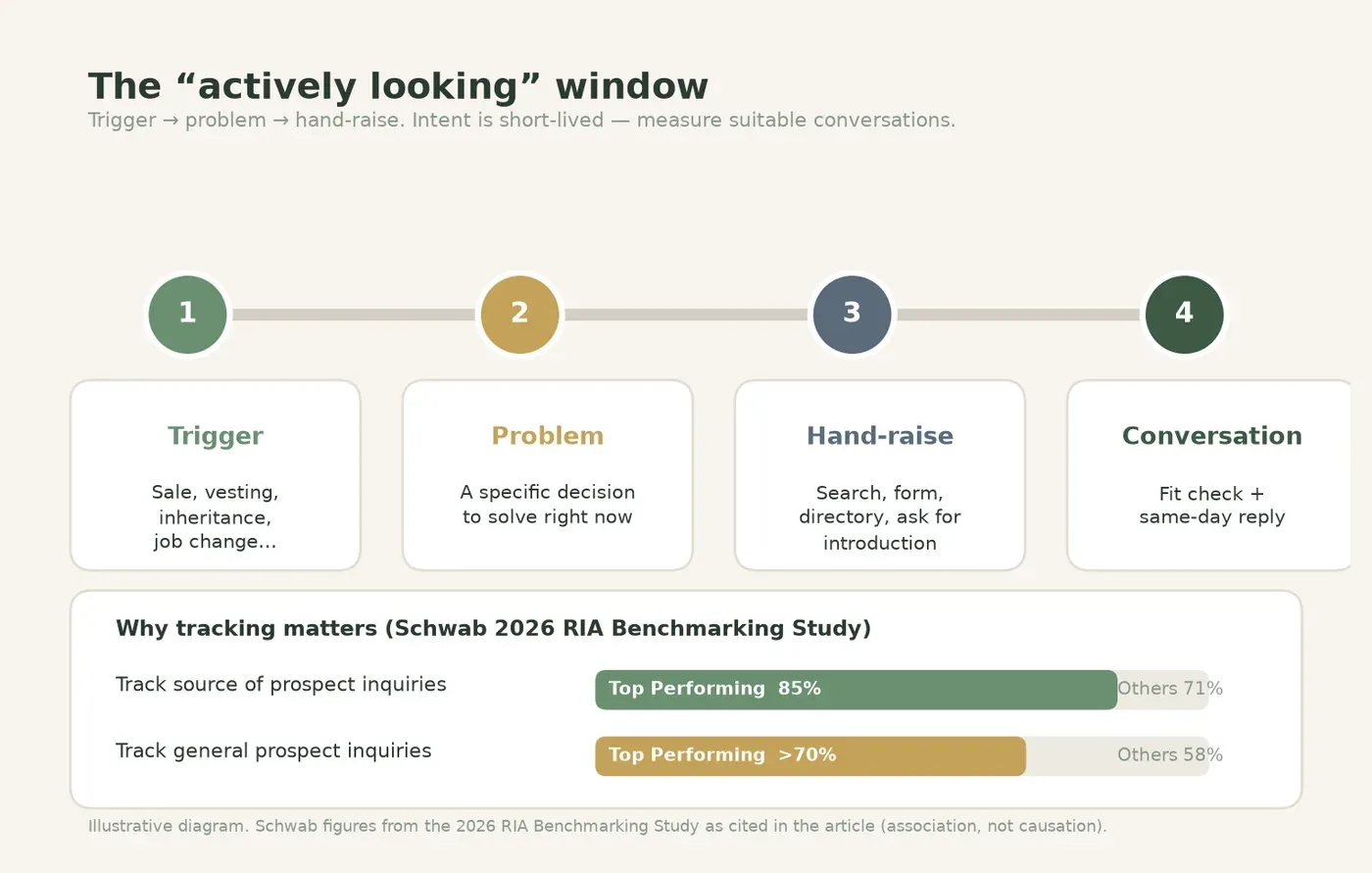
- “Actively looking” means a trigger, a problem, and a hand-raise: a search, a form, a directory inquiry, or an explicit ask.
- Situation-specific pages beat generic “wealth management” copy for people who are searching.
- Local visibility is about accurate profiles and honest service areas, not city landing pages.
- Marketplaces partly own the “find an advisor” moment; compare them on written terms.
- Referrals are most likely when you ask around a trigger event.
- Measure suitable conversations from intent sources, not traffic.
What does “actively looking” mean?
Most marketing reaches people who might need an advisor someday. Actively-looking prospects are different: they have a trigger (a job change, inheritance, business sale, approaching retirement, a death or divorce), a specific problem, and they have taken a step to find help. Write down what counts as “looking” for your firm. A practical definition includes any of:
- A search for a specific situation or advisor type
- A website form, call, or email to your firm
- An inquiry through a directory or matching service
- A direct request to a client or professional for an introduction
That definition matters because it is what you measure. Someone who downloaded a guide is interested; someone who asked to talk is looking.
The window also closes. Someone comparing advisors after a business sale or a parent’s death may speak with two or three firms within weeks and then commit. That has two consequences: you need to be visible before the trigger, and you need to respond quickly once someone raises a hand.
High-intent search: become the obvious niche answer
People in the intent window search the way they talk about their problem: “fee-only planner for physicians,” “what to do with stock options after an acquisition,” “advisor after selling a business.” Those queries are more specific — and more winnable — than “financial advisor.”
To show up for them:
- Pick one or two situations you serve best and publish an answer-first page for each, written for the person in that moment.
- State who you serve, what you do, and how you charge in plain language; fee clarity helps a searcher decide to reach out.
- Show proof of fit, such as anonymized case examples (reviewed for compliance).
- Make the next step obvious: a short form or a link to book a call.
Then track where inquiries come from. Schwab’s 2026 RIA Benchmarking Study finds that more than 70% of Top Performing Firms track general prospect inquiries, versus 58% of other firms, and 85% track the source of inquiries, versus 71% (Schwab). The study is self-reported by Schwab-custodied firms and shows association, not causation — but you cannot improve a source you do not track.
Local presence without doorway pages
Many people looking for an advisor still want someone in their region or time zone. Local visibility is mostly hygiene:
- Keep your Google Business Profile accurate — name, address, hours, services, website, and categories matching your site and regulator records.
- If your compliance policies allow client reviews or testimonials on public profiles, ask only in the manner those policies approve — and treat any public review used in advertising as a testimonial under the Marketing Rule.
- Be honest about service area. If you work virtually across several states, say so on your site.
Avoid creating a stack of near-identical city pages. They rarely help a real searcher and can make your site look thin. One accurate profile and clear service-area copy usually do more.
Directories and matching marketplaces
Directories and matching services are where many people go once they decide to look. Some list advisors for prospects to browse; others match a consumer with one or more advisors after a questionnaire. AI answers to “how do advisors find people actively looking” can name marketplaces such as SmartAsset — a sign that marketplaces partly own this moment, not that they suit every firm.
Before you join one, get written answers on: how consumers are recruited, whether each introduction goes to one firm or several, what “qualified” means, commitment length, and total cost. Then compare it with your other sources using your own show and close rates.
For a dated price and exclusivity table, see Valora’s live SmartAsset alternatives. Note: that page still describes an earlier founding-advisor program that is not Valora's current offer. Valora's current public offer is $250 per booked appointment (for-advisors).
AI answers and public firm facts
More people in the intent window now ask an AI assistant who to talk to. Those answers draw on what is publicly written about firms, so the work is the same as for search: consistent facts across your website, listings, and regulator records, and clear pages that answer the questions your ideal clients ask. Nobody can guarantee that an AI tool will cite or recommend your firm; check what the tools say on a schedule and save dated examples.
Valora’s live posts Can ChatGPT find your firm?, How can an RIA get clients from ChatGPT and AI search?, and the 12-month referrals and AI-search review go deeper.
Referrals at trigger moments, and where looking people gather
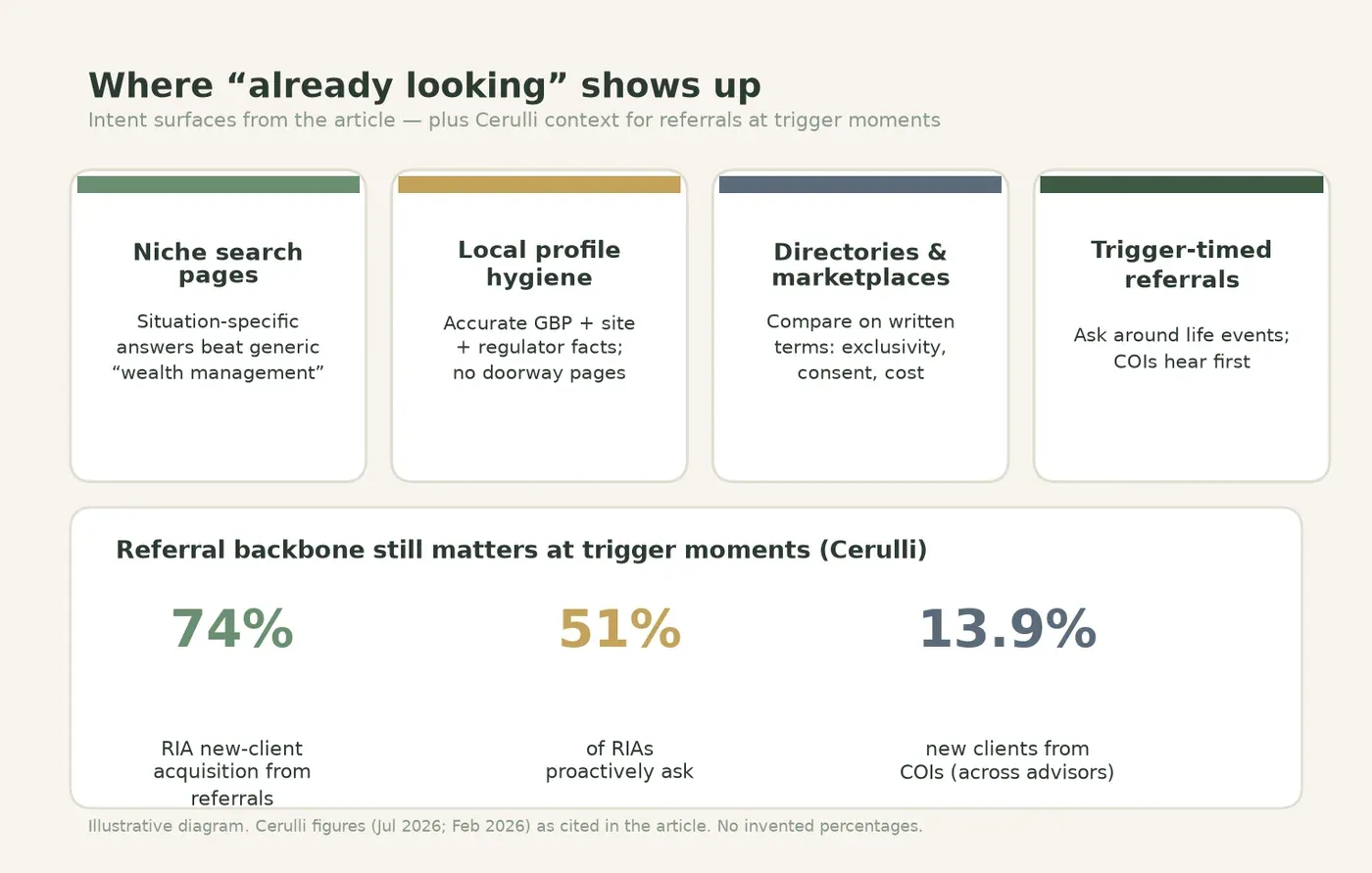
Referrals remain the largest source of new clients. Cerulli reports referrals account for 74% of RIA new-client acquisition, yet only 51% of RIAs proactively ask (Cerulli, July 2026). Centers of influence such as CPAs and attorneys are the second most common source across advisors, at 13.9% (Cerulli, February 2026).
Referrals work best when they are tied to a trigger. Clients and professionals hear about life events first: a colleague’s company being acquired, a friend’s parent passing away, a business owner preparing to sell. Help them recognize the moment:
- Tell clients and COIs which situations you help with most.
- Ask specifically: “If you hear of anyone at work facing the same retirement decision, I’m happy to talk with them.”
- Give them something easy to pass along, such as a short explainer on that situation.
Looking people also gather in professional associations, alumni networks, industry groups, and online communities. Show up as a helpful expert — answer questions, speak, or co-host — rather than pitching, and keep everything within your compliance policies.
Appointment-based outreach
Appointment-based outreach targets the end of the intent window: people who have already asked to speak with an advisor. Instead of a raw list to call, you get a meeting on your calendar. That saves qualification and booking time, but a meeting is not a client. Ask how prospects are found, what “qualified” means for your profile, what happens when a prospect does not attend or does not fit, and who reviews outreach that goes out under your name.
How to measure intent sources
Count what matters: suitable conversations — people who fit your profile, asked to talk, and showed up — by source. Page views, impressions, and list sizes are inputs, not results.
Watch response time as well. Because intent is short-lived, a same-day reply to a form or directory inquiry often matters more than another page of content. Decide who answers new inquiries, how fast, and what the first reply offers — usually a short call to see whether you are a fit. Log no-shows and poor-fit meetings by source too; a channel that produces many meetings but few suitable conversations is not working, whatever its volume.
A 90-day test:
- Choose one or two intent surfaces (for example, one niche page plus your local profile, or one directory).
- Define “suitable conversation” in writing.
- Ask every new prospect how they found you and log it.
- Review monthly; at day 90 keep, change one variable, or stop.
Where Valora fits
Valora works with independent advisory firms to reach people who are already looking for the kind of advice the firm gives, and books appointments with prospects who asked to speak with an advisor. It does not sell lead lists. The public offer is $250 per booked appointment, starting with a 3-appointment minimum, paid in advance, with no setup fee, retainer, or long-term contract; if a prospect does not attend or does not meet the agreed criteria, the appointment is replaced at no charge (for-advisors). Your firm reviews what goes out under its name. Valora does not guarantee clients, rankings, AI citations, or appointment volume.
Related reading
- Can ChatGPT find your firm? — readiness of your public facts
- How can an RIA get clients from ChatGPT and AI search? — AI-search companion
- AI search and referrals: the next 12 months — calendar plan
- Your first ten clients as a solo RIA — for brand-new firms
- SmartAsset alternatives — dated vendor table
Frequently asked questions
Should I buy leads or build inbound?
They solve different problems. Paid sources can add conversations quickly on contract terms; inbound search and referrals compound more slowly but are exclusive to you. Compare both on cost per suitable conversation.
Does LinkedIn reach people who are actively looking?
Sometimes, especially around job changes and retirements. It works best as a place to share niche expertise so people who are looking recognize you, not as a cold-message channel.
Are webinars worth running?
A webinar on a specific trigger, such as an acquisition or retirement deadline, can surface people in the window. Track how many attendees ask to talk.
I have no minimums and still struggle to find clients. Why?
Removing minimums widens who you can serve but does not make you easier to find. A clear niche and visible answers to that niche’s questions usually matter more.
What compliance rules apply to inbound marketing?
Reviews, testimonials, and paid referral or solicitation arrangements fall under the SEC Marketing Rule for SEC-registered advisers and under state rules. Have compliance review your public materials.
Scope of this guide
This is educational marketing content for independent advisory firms, not investment, tax, legal, or compliance advice. Valora is not a registered investment adviser. Nothing here guarantees clients, rankings, AI citations, or appointment volume. Cerulli figures are press-release summaries; Schwab findings are associations from a self-reported sample, not causation. Ask any vendor for current written terms.
Sources
- SEC Division of Investment Management: Marketing Compliance — Frequently Asked Questions. https://www.sec.gov/rules-regulations/staff-guidance/division-investment-management-frequently-asked-questions/marketing-compliance-frequently-asked-questions
- Schwab Advisor Services: 2026 RIA Benchmarking Study — inquiry and inquiry-source tracking among Top Performing Firms (self-reported; association, not causation). Accessed 7 Nov 2026. https://advisorservices.schwab.com/insights-hub/perspectives/ria-benchmarking-study-2026
- Cerulli Associates (July 2026 press release): RIAs Must Offset Asset Churn with Dedicated Growth Efforts — referral share and proactive-ask gap. Accessed 7 Nov 2026. https://www.cerulli.com/press-releases/rias-must-offset-asset-churn-with-dedicated-growth-efforts
- Cerulli Associates (February 2026 press release): Financial Advisors Increasingly Leverage COIs to Capture New Client Growth — COI share of new clients. Accessed 7 Nov 2026. https://www.cerulli.com/press-releases/financial-advisors-increasingly-leverage-cois-to-capture-new-client-growth
- Valora: for-advisors — appointment definition; $250 per booked appointment; offer terms. https://www.valorahq.com/for-advisors/
- Valora: SmartAsset alternatives (dated vendor table). https://www.valorahq.com/insights/smartasset-alternatives/
- Valora: How can an RIA get clients from ChatGPT and AI search? https://www.valorahq.com/insights/how-can-an-ria-get-clients-from-chatgpt-and-ai-search/