
How RIAs get clients from ChatGPT and AI search
How RIAs make firm facts usable for ChatGPT and AI search: who-what-where, answer-first pages, listings, dated baselines. No placement guarantees.


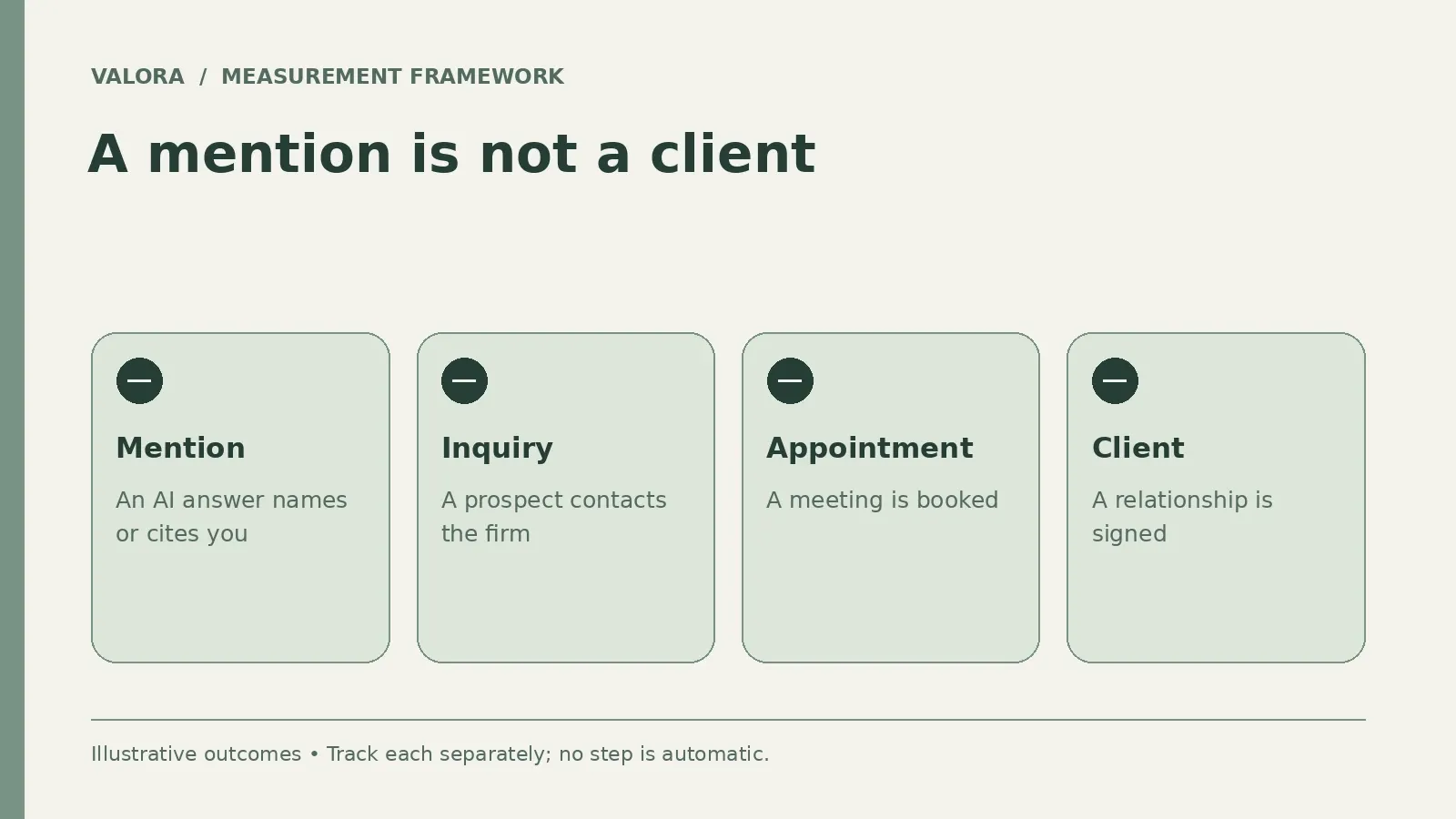
Prospects sometimes ask ChatGPT, Google AI Overviews, or similar tools for help finding an advisor. A firm can improve the odds that those answers use accurate public facts about who it serves, what it does, and where it works. That is different from getting a signed client. A mention, a site visit, an inquiry, and a booked appointment are separate steps. None of them is automatic, and none is guaranteed by publishing a page or fixing a listing.
This guide covers the practical “how” for that first stretch of work: a consistent who-what-where, answer-first pages, accurate third-party records, and a dated baseline of what AI tools actually say. It does not replace a readiness check or a 12-month firm calendar; those live on adjacent Valora posts linked at the end.
This is educational marketing for advisory firms. It is not personalized investment, tax, legal, or compliance advice, and it does not promise placement in any AI tool.
Key takeaways
- A mention in an AI answer is not a client. Track mentions, visits, inquiries, booked meetings, and signed relationships as separate outcomes.
- Write one true who-what-where statement and repeat it across the pages and profiles you control.
- Publish pages that answer one real discovery question each, with the answer in the first screen of text.
- Keep listings and regulator records consistent with your site; accurate facts support answers but do not force them.
- Save a dated baseline of what AI tools return, and compare like with like over time.
- Google says the same SEO foundations apply to its AI features, with no special AI-only files or schema required. It also gives no guarantee of being shown.
What can “clients from ChatGPT” mean?
It can mean (observable):
- A prospect says an AI tool mentioned your firm or a related topic.
- An AI answer cites or paraphrases a public page, directory profile, or regulator record that names you.
- Someone finds your site after an AI-assisted search and then contacts you through a normal path (form, phone, calendar).
It cannot mean (not something a vendor or a blog post can promise):
- That ChatGPT, Gemini, Perplexity, or Google will recommend your firm on demand.
- That a citation equals a qualified lead or a signed client.
- That there is a secret ranking trick, schema hack, or “AI SEO score” that forces inclusion.
Google’s documentation for site owners says the same foundational SEO practices apply to AI features such as AI Overviews and AI Mode: pages must meet Search’s technical requirements, and indexing or serving is never guaranteed even when best practices are followed. Google also notes that no extra special files or special schema are required solely to appear in those features. Source: AI features and your website (Google Search Central).
Google’s consumer help article for AI Overviews likewise states that AI responses may include mistakes and should be checked against linked sources. Source: AI Overviews (Google Search Help).
Treat AI answers as dated snapshots of what a tool returned for a specific prompt. They are useful for deciding what to fix, not a scoreboard of clients won.
Start with a clear who-what-where
Before you publish more content, write one short statement that is true and repeatable:
- Who: your name and firm name
- What: your niche or specialty (whom you serve and what you help with)
- Where: your location or service area
A Kitces guest post on AI-search marketing for advisors recommends establishing this Who-What-Where and using it consistently across the website, directory listings, bios, and other public profiles, because AI tools and search engines rely on recognizable, repeated patterns to connect content back to a firm. Source: Ways Advisors Can Optimize For AI Search (Kitces.com).
Example pattern (illustrative only; use your real facts): “[Name] is a [fee-only / fiduciary] advisor at [Firm]. [They] work with [niche] in [city / region / service area].”
Put that statement, or a close variant, on:
- Homepage and About / bio pages
- Contact and service-area pages
- ADV / IAPD and other regulator-facing records you control or can update
- Association and directory profiles you maintain
- LinkedIn and other bios that still represent the firm publicly
If two pages you control disagree about niche, city, or credentials, fix the contradiction before you invest in new articles. Consistency does not guarantee a citation; inconsistency makes accurate answers harder for both people and machines.
How should an answer-first page work?
AI-assisted search often starts with a question, not a brand name. A page that opens with a direct answer to one discovery question is easier to quote than brochure copy.
Prefer:
- “How should a [niche client] in [place] think about [specific planning question]?”
- Two or three plain sentences that answer first, then detail, limits, and sources.
Avoid as the lead:
- “Our comprehensive, holistic approach to wealth.”
- Adjective stacks with no who, what, or where.
The Kitces piece argues that AI models tend to reward clarity, topical depth, and specificity (including local and niche framing) more than generic keyword stuffing, and that short, direct answers can matter when they address a high-intent question. That is editorial guidance from a marketing consultant’s guest post, not a ranking formula Valora can verify or sell. Source: Kitces.com, linked above.
Practical rules for RIAs:
- One primary discovery question per URL.
- Answer in the first screen of text.
- State advice boundaries (education vs personalized advice) where needed.
- Add FAQ questions and answers only when they appear on the page. If you later use FAQ structured data, it must match that visible text; Google’s AI-features guidance says structured data should match visible text and no special AI-only schema is required.
- Link related answers to each other when they share a niche. The point is not to manufacture authority. It is so readers and crawlers can follow a coherent topic.
Do not publish city doorway pages or invented specialist claims. Specificity only helps when it is true and reviewable.
Keep listings and third-party facts accurate
Third-party pages sometimes appear in AI answers. You do not control how often that happens. You do control whether your profiles are wrong.
Checklist:
- NAPFA, XYPN, Fee Only Network, CFP Board, state / SEC records, Google Business Profile, and similar listings you chose to maintain: name, niche, location, URL, and credentials match the site.
- Remove or correct outdated claims, dead phone numbers, and old office addresses.
- Do not invent awards, “#1 in [city]” claims, or citation counts.
- Testimonials and endorsements: follow the SEC marketing rule or state requirements that apply to your registration. Compliance is separate from AI visibility and does not create an AI ranking advantage.
Accurate listings support verifiable public facts. They are not a switch that turns ChatGPT into a referral engine.
How do you run a dated baseline?
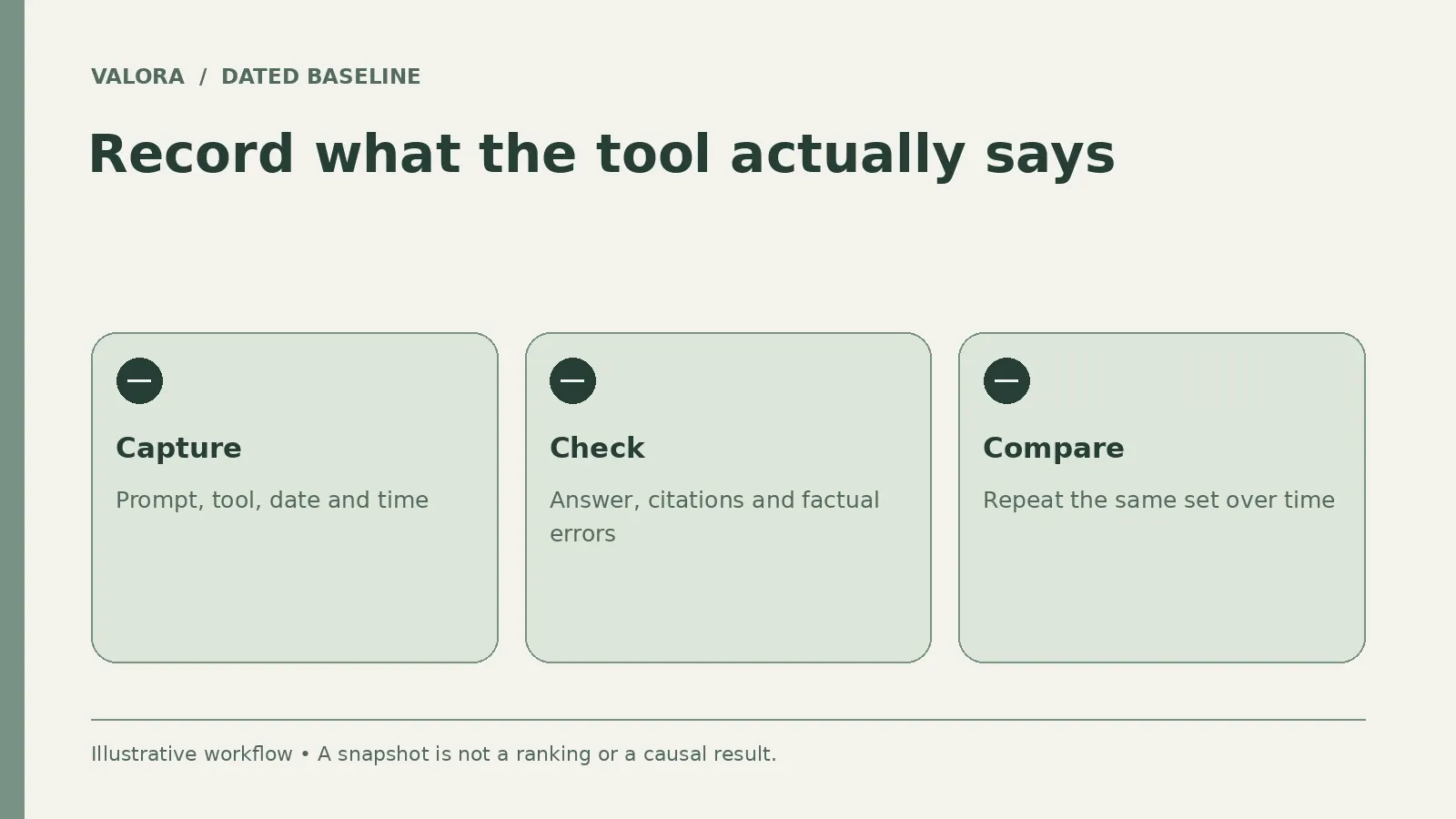
Once a month (or at least once before and once after a batch of site fixes), record what the tools actually return.
- Pick 5–10 prompts your ideal clients would ask before they know your name, plus 1–2 branded prompts (“What do you know about [Firm]?”).
- Run them in the tools you care about (for example ChatGPT, Gemini, Perplexity, and a Google search that may show an AI Overview).
- For each run, save the exact prompt, the tool or model label if shown, the date and time (with time zone), the full answer text, and any citations or named sources.
- Note errors separately from omissions.
- Re-run the same set later and compare. Do not draw a trend line from one sample.
Use an incognito or logged-out session when you want a less personalized view; results may still vary by region and over time. A baseline is a working record for your firm, not a public ranking claim.
Where Valora fits
Valora helps independent RIAs get booked appointments with qualified prospects. On the visibility side, that starts with clearer public firm facts, not with a promise that an AI tool will recommend you.
A free next step, if useful: Valora’s free AI-search readiness review looks at what a prospect or AI tool can readily learn about your firm from public information and returns a short, dated report. It does not guarantee placement, ranking, or leads in ChatGPT or other AI tools. See Can ChatGPT find your firm?
About Valora’s paid advisor offer: the public offer is $250 per booked appointment, with a 3-appointment minimum, prepaid. A booked appointment means a calendar meeting with a prospect who asked to speak with an advisor, subject to current written terms. Results vary. Valora does not guarantee clients, AI citations, rankings, or a set number of appointments from any content or readiness review.
Related reading on Valora
- Readiness check (the free review): Can ChatGPT find your firm?
- Earlier companion post (the 30-day-test version): How can an RIA get clients from ChatGPT and AI search?
- Firm calendar (12-month playbook): How should advisory firms review referrals and AI-search visibility over the next 12 months?
Frequently asked questions
Can ChatGPT send clients to my RIA?
It can sometimes mention a firm or cite public sources in an answer. That is not the same as sending a client. Track mentions, visits, inquiries, and signed relationships as separate outcomes. No vendor can guarantee that ChatGPT will recommend your firm.
What should we fix first?
Make your who-what-where identical on the pages and key listings you control, then publish a few answer-first pages that match real discovery questions. Run a dated baseline so you know what the tools say today. Technical SEO still matters for Google; Google states the same foundations support eligibility to be considered as supporting links in AI features, without a special AI-only format. Source: Google Search Central: AI features.
Do we need special AI files or schema?
Google’s site-owner guidance says you do not need new machine-readable AI text files or special schema.org types solely to appear in AI Overviews or AI Mode. Focus on indexable, people-first pages; if you use structured data, keep it aligned with visible text. Source: Google Search Central: AI features.
How is this different from Valora’s readiness review post?
Can ChatGPT find your firm? explains the free review and what it checks. This page is the longer operational guide to who-what-where, answer-first content, listings, and baselines. The two are meant to be used together.
How is this different from the 12-month referrals playbook?
The 12-month playbook schedules the work across a year. This page answers the tactical question (how do RIAs get clients from ChatGPT and AI search?) in one place, without repeating that month-by-month calendar.
How is this different from Valora’s earlier “How can an RIA get clients…” post?
The live How can an RIA get clients from ChatGPT and AI search? post is the earlier published answer. It is the 30-day-test version: verifiable facts, a 30-day test outline, and measurement basics. This page is the longer operational guide: who-what-where, answer-first pages, listings, and a dated baseline method. Use both; they are companion posts, not the same article.
What does Valora charge advisors?
The public paid offer is $250 per booked appointment, with a 3-appointment minimum, prepaid. Confirm current written terms before buying. The free readiness review has no charge for the check itself. Neither guarantees clients or AI placement.
Will following this guide get us into ChatGPT’s answers?
No honest guide can promise that. These steps improve the clarity and consistency of your public facts. Whether a given model cites you on a given day has to be observed in a dated baseline, not inferred from effort.
The bottom line
Getting clients from ChatGPT and AI search starts with facts, not tricks. Write one true who-what-where and repeat it, answer real discovery questions first, keep listings and regulator records consistent, and save dated evidence of what the tools actually say. A mention is not a meeting, and a meeting is not a client. Measure each step on its own.
Scope of this guide
This is educational marketing for independent advisory firms. It is not personalized investment, tax, legal, or compliance advice. Valora is not a registered investment adviser. Nothing here guarantees placement, citations, rankings, inquiries, appointments, or clients in ChatGPT, Google, or any other tool. Google and Kitces statements are summarized as of the access date below and may change. Firms should apply their own compliance review to any public marketing, testimonials, or listings.
Sources
- Google Search Central: AI features and your website. Site-owner guidance that standard SEO practices apply to AI Overviews and AI Mode, that no special AI-only files or schema are required, and that indexing or serving is not guaranteed. Accessed 7 Nov 2026. https://developers.google.com/search/docs/appearance/ai-features
- Google Search Help: AI Overviews. Consumer help stating AI responses may include mistakes and should be checked against linked sources. Accessed 7 Nov 2026. https://support.google.com/websearch/answer/14901683
- Kitces.com (guest post, Brent Carnduff): Ways Advisors Can Optimize For AI Search. Marketing guidance on a consistent Who-What-Where and clear, specific answers; a consultant’s view, not a verified ranking formula. Accessed 7 Nov 2026. https://www.kitces.com/blog/artificial-intelligence-ai-search-engine-optimization-seo-financial-advisor-marketing-content-strategy/
- Valora: Can ChatGPT find your firm? Companion post on the free readiness review. https://www.valorahq.com/insights/can-chatgpt-find-your-firm/
- Valora: How can an RIA get clients from ChatGPT and AI search? Earlier companion post (the 30-day-test version; soft-link OK). https://www.valorahq.com/insights/how-can-an-ria-get-clients-from-chatgpt-and-ai-search/
- Valora: How should advisory firms review referrals and AI-search visibility over the next 12 months? Companion 12-month playbook. https://www.valorahq.com/insights/ai-search-is-eating-the-referral-game-heres-what-advisors-do-in-the-next-12-months/