
How to explain fee-only vs fee-based pay to prospects
Help advisory firms explain fee-only and fee-based pay to prospects: payment sources, conflicts and disclosures, without confusing labels with advice quality.


Fee-only means the client is the only one paying. Fee-based means the advisor may also earn commissions. Under the Certified Financial Planner Board of Standards (CFP Board) Code of Ethics and Standards of Conduct, those labels are compensation representations for CFP® professionals (holders of the Certified Financial Planner certification). They are not a universal law for every advisor.
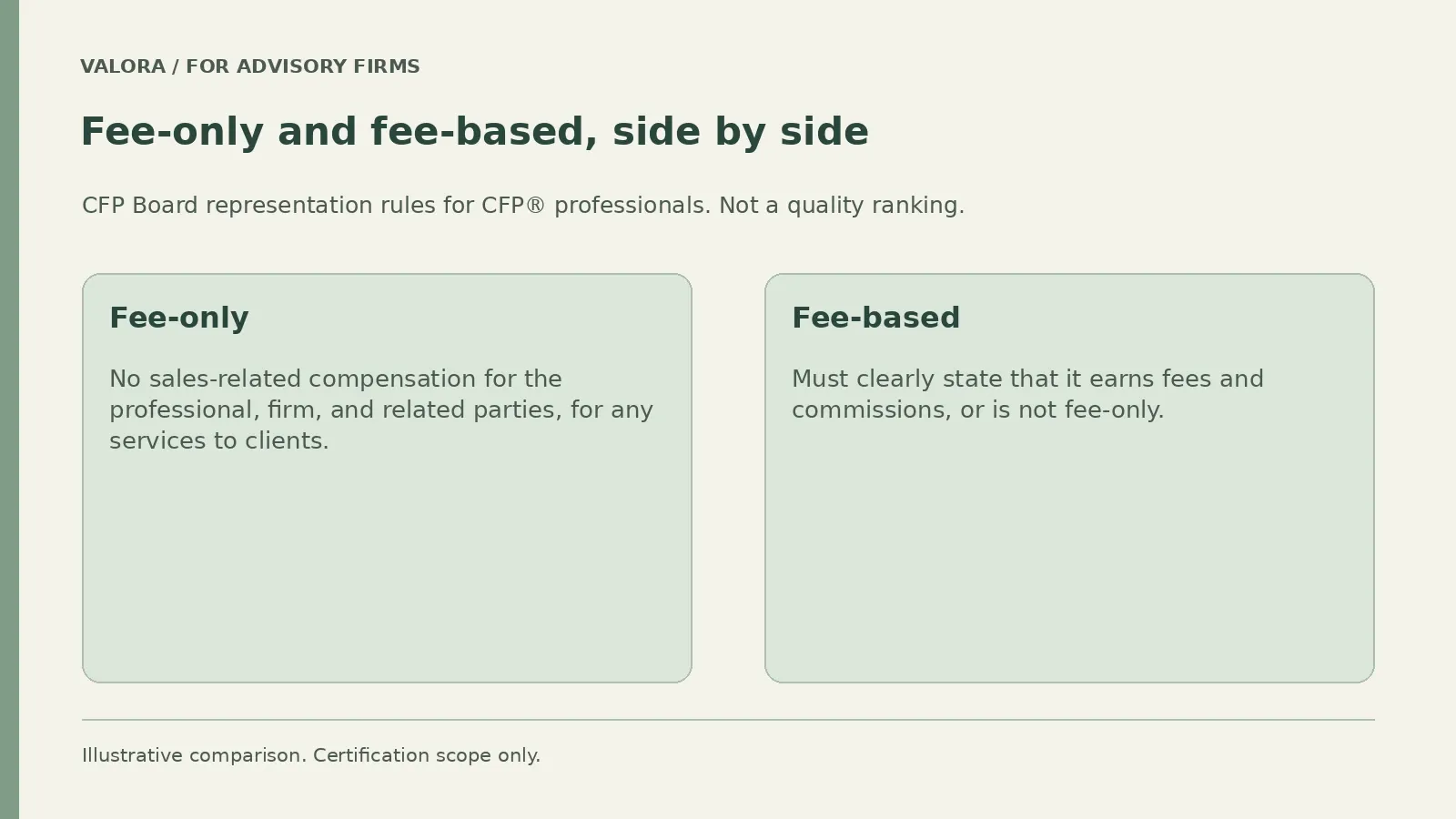
For CFP® professionals, a fee-only claim requires that the professional and firm receive no sales-related compensation. Related parties must also receive none in connection with any professional services the CFP® professional or firm provides to clients. A fee-based claim must not sound like fee-only. The professional must clearly say that the professional or firm earns fees and commissions, or is not fee-only.
Explain who pays the firm, for what work, and what conflicts may exist. A fiduciary is someone required to put the client's interest first. A compensation label is not proof of that duty, a quality ranking or proof that conflicts are gone.
This guide is for advisory firms that need a plain answer for prospects. It does not replace your brochure (Form ADV Part 2A, the disclosure document an adviser gives clients), relationship summary or engagement agreement. See How should an RIA explain fees before a first call? for fee pages and billing details. This one covers what the labels mean. Prospects comparing labels as consumers can also read Valora's fee-only vs commission-based guide.
What is the difference between fee-only and fee-based?
For CFP® professionals, the difference is about sales-related compensation.
Fee-only, under CFP Board Standard A.12, means the CFP® professional and the CFP® professional's firm receive no sales-related compensation. Related parties receive none in connection with any professional services the CFP® professional or firm provides to clients.
Fee-based, under the same standard, is a term that is not fee-only. CFP Board uses "fee and commission" for people who receive both fees and sales-related compensation. A CFP® professional who says fee-based must not suggest fee-only. They must clearly state that the professional or firm earns fees and commissions, or is not fee-only.
Outside that certification standard, firms and trade groups may use similar words with their own membership rules. Keep the source of each definition in view. A registered investment adviser (RIA) is a firm registered to give investment advice under securities law. Registration is not the same as a CFP® mark, and it is not the same as a compensation label.
Fee-only describes sources of pay, not a price format
Fee-only answers who pays and whether product sales create compensation. It does not mean free advice. It does not mean a low fee. It does not mean a percentage of assets under management (AUM), the assets a firm manages for clients. An hourly fee, a flat project fee, a retainer or an asset-based fee can all be client fees. The Securities and Exchange Commission (SEC) staff account-opening bulletin lists hourly, fixed or flat, and asset-based client fees. It also notes commissions as another way some professionals are paid. The National Association of Personal Financial Advisors (NAPFA) likewise notes that Fee-Only advisors may be paid hourly, as a retainer, as a percentage of assets, or as a flat fee.
Under the CFP Board standard, the hard line is the absence of sales-related compensation for the professional, the firm and related parties for any professional services provided to clients. A percentage billed to the client can still be fee-only under that standard if the other conditions are met. A low sticker price can fail the label if sales-related compensation is present.
Fee-based must not be presented as fee-only
If a CFP® professional uses fee-based or another term that is not fee-only, the representation must stay clear. Marketing should not blur the two. A prospect may hear "fee" and assume there are no product payments. The standard requires an explicit statement that the professional or firm earns fees and commissions, or is not fee-only.
A label also does not list every dollar the firm may receive. Disclosures, the brochure and the engagement still matter. Saying fee-based once on a website does not replace a current conflict and fee discussion in writing.
Which payment methods can a prospect encounter?
SEC Investor.gov guidance describes several payment methods a prospect may meet:
- Hourly or fixed client fees for advice or defined work
- Asset-based fees tied to account value
- Commissions or similar transaction-based pay
- Product and account costs paid to other providers, such as fund expenses or account maintenance fees
Form CRS is a short relationship summary. SEC-registered broker-dealers (firms that buy and sell securities for customers) and investment advisers must give it to retail investors. It helps a prospect compare services, fees and costs, conflicts, standards of conduct and reportable history. Dual registrants (firms registered as both a broker-dealer and an investment adviser) may act as a broker in some moments and as an adviser in others. Ask which capacity applies to the work being discussed.
A percentage fee is a billing format. It is not, by itself, the definition of fee-only.
Who pays the advisor or firm?
Use a simple payment-source map when you explain your firm. Keep it tied to your actual disclosures.
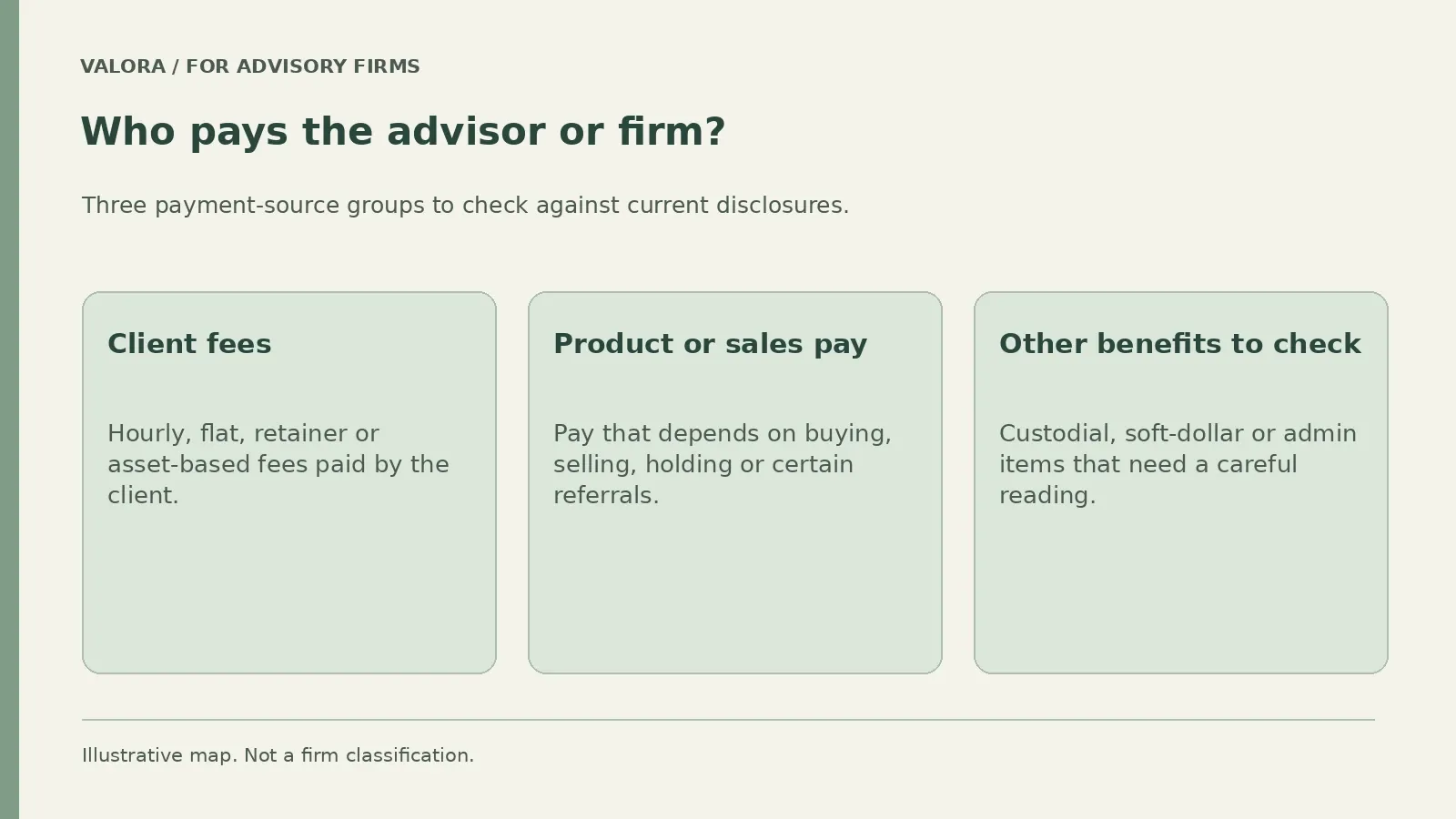
- Client fees. Money the client pays the firm for advice or planning, such as hourly, flat, retainer or asset-based fees.
- Product or sales compensation. Money that depends on buying, selling or holding a product, or on referring the client to someone else for a product sale.
- Other benefits to check. Soft-dollar research (research paid for through client trading commissions), custodian benefits that help delivery, or administrative fees that are not tied to trade size. Some of these need a careful reading of the standard.
CFP Board Standard A.12 defines sales-related compensation and also lists exclusions. Not every third-party payment is automatically a commission under that standard. NAPFA publishes its own membership definition: compensation solely from the client, with neither the advisor nor a related party receiving compensation contingent on buying or selling a financial product. That is a membership rule. Do not treat NAPFA membership, CFP® certification and RIA registration as interchangeable.
Classify only what your own current disclosures support.
What counts as sales-related compensation under CFP rules?
Under CFP Board Standard A.12, sales-related compensation is more than a trivial (de minimis) economic benefit. It can result from a client buying or selling financial assets. It can also result from a client holding assets for purposes other than receiving financial advice. Or it can result from referring a client to someone outside the CFP® professional's firm.
Examples include commissions, trailing commissions, transaction fees, and some referral or solicitor fees. They also include 12b-1 fees (ongoing marketing and distribution fees paid out of a mutual fund's assets), spreads (the markup between buy and sell prices) and revenue sharing (payments from a product sponsor to the firm).
The same standard lists exclusions. These include certain soft-dollar research under a securities-law safe harbor (Section 28(e)). They also include reasonable custodial or administrative fees not based on transaction amount or value. And they include some non-monetary provider benefits that improve client service and are not tied to transaction size. Related-party rules also matter. Read the full standard before simplifying a borderline arrangement.
This section explains a certification standard for CFP® professionals. A broker-dealer or a state-registered firm may face other payment rules.
Fee-only does not mean conflict-free
A fee-only label under the CFP Board standard removes a class of sales-related pay. It does not erase every conflict.
An asset-based fee can create incentives to gather or retain assets. A flat project fee can create incentives to limit scope. An hourly fee can create incentives to expand hours. These are possible incentives, not claims about any firm. CFP Board standards also require CFP® professionals to disclose and manage material conflicts of interest. The SEC's account-opening bulletin notes that an adviser's brochure must describe how the firm is paid and its conflicts of interest, and suggests asking how those conflicts are handled.
Describe the conflict and how you manage it. A compensation label does not make conflicts disappear.
Keep fiduciary duty separate from compensation
A duty, a job title and a payment model answer different questions.
CFP Board Standard A.1 says that when providing financial advice to a client, a CFP® professional must act as a fiduciary and therefore act in the client's best interest. That is a certification duty tied to the advice being given. The Financial Industry Regulatory Authority (FINRA), which oversees brokerage firms, notes that people who call themselves financial planners can come from many backgrounds. They may or may not hold a particular credential. They may be regulated based on the other services they provide. A title alone does not settle duty or pay.
A fee-only or fee-based label does not prove fiduciary duty. A fiduciary claim does not prove a compensation model. Point prospects to current disclosures and to the capacity in which you will act.
Show the full cost, not just how the advisor is paid
How the adviser is paid is only one layer. Investors may also pay fund expenses, platform or account costs, and charges from other professionals. The SEC staff fees bulletin explains that ongoing and transaction fees reduce returns over time. Disclosure documents and statements are the place to inspect them. Its long-term dollar examples are hypothetical illustrations under stated assumptions. They do not prove that any advice model is better.
For a worksheet that checks a website fee page against your brochure and agreement, see How should an RIA explain fees before a first call?.
Reconcile the explanation with actual disclosures
Before you publish a compensation explanation for your firm, compare it with:
- Current brochure and fee schedule
- Relationship summary, where applicable
- Advisory agreement or engagement letter
- Marketing pages and scripts that use fee-only or fee-based language
If the website says one thing and the brochure says another, fix the mismatch. Do not publish a hypothetical label as if it described a real firm. For SEC-registered advisers, the SEC Marketing Rule bars untrue or misleading statements of material fact and requires a reasonable basis to substantiate material facts, and fair and balanced claims. See also SEC Marketing Rule in plain English for solo RIAs.
Answer a prospect in ordinary words
Use short, accurate scripts. Leave blanks for your real facts. These are sample scripts, not testimonials.
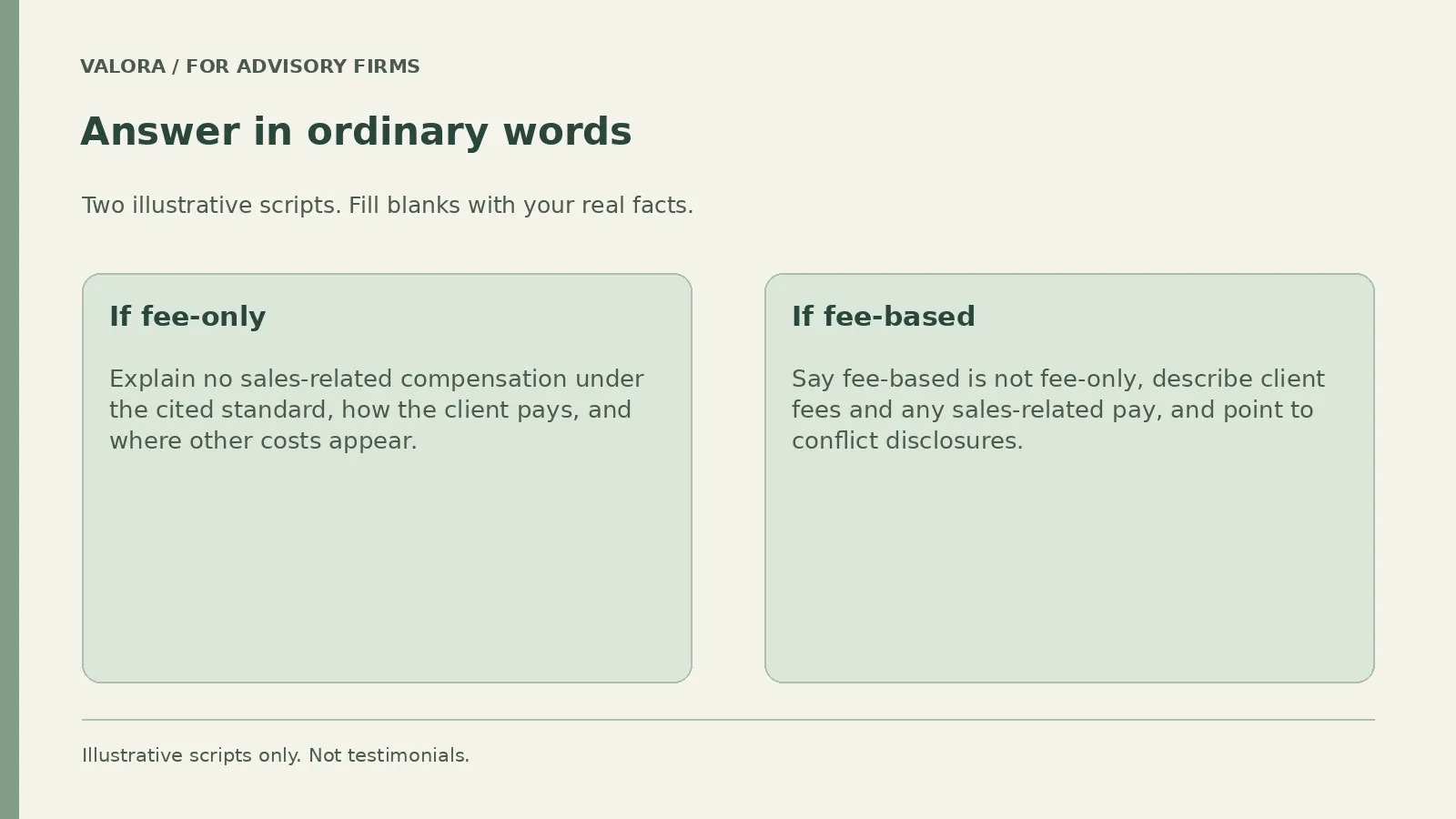
If your firm is fee-only under the CFP Board standard: "Under CFP Board rules, fee-only means we and our firm receive no sales-related compensation. No related party receives it for any professional services we provide to clients. You pay us [hourly / flat / retainer / asset-based]. Other investment and account costs may still apply. Here is where those costs appear in our disclosures."
If your firm is fee-based under that standard: "Fee-based is not the same as fee-only. [Choose one: We earn both fees and commissions. / We are not fee-only.] For the work we are discussing, you would pay [client fee description], and [product or sales compensation description] may also apply. Here is the conflict summary in our current disclosures."
Invite questions. Do not rush a signature.
Frequently asked questions
Is fee-only always cheaper? No. Fee-only describes payment sources under a stated standard. It does not set a price level.
Does fee-based mean bad advice? No. Fee-based means the compensation is not fee-only under the CFP Board representation rules for CFP® professionals. Advice quality still depends on the work, the disclosures and the fit.
Is a 1% asset-based fee automatically fee-only? No. A percentage is a billing format. Fee-only depends on whether sales-related compensation is present under the standard you are citing.
What if an advisor wears two hats? Some firms are dual registrants, and some people work in more than one role. Ask which capacity applies to the recommendation and how pay changes in each capacity. Form CRS is designed to support that conversation.
Where should I put the detailed billing math? On a fee page that matches your brochure and agreement. Start with the fee explainer linked above.
If your firm later wants help making its services easier for suitable prospects to find and understand, you can learn about Valora's work for advisory firms. The current public offer is $250 per booked appointment with a qualified prospect, with a 3-appointment minimum, paid in advance. An appointment is a call booked on your calendar with a prospect who has asked to speak with an advisor. There is no setup fee, retainer, or long-term contract. If a prospect does not attend or does not meet the agreed criteria, the appointment is replaced at no charge. Your firm reviews what goes out under its name. Marketing is a separate decision from how you describe compensation.
This article is educational, not legal advice, compliance advice or personalized investment advice. Valora is not a registered investment adviser and does not provide investment advice. Valora provides marketing services to advisory firms.
Sources
- CFP Board, Code of Ethics and Standards of Conduct (current online standards). Compensation representations (A.12) and fiduciary duty when providing Financial Advice (A.1). Certification standards for CFP® professionals.
- SEC Investor.gov, Opening an Investment Advisory Account (updated June 24, 2020). Staff bulletin on services, fees, contracts and conflicts.
- SEC Investor.gov, How Fees and Expenses Affect Your Investment Portfolio (July 23, 2025). Staff bulletin on fee layers and disclosures.
- SEC Investor.gov, Form CRS. Relationship summary topics for retail investors.
- NAPFA, Our Standards for Membership. Fee-Only membership definition. Membership standard.
- NAPFA, What is Fee-Only Financial Advising. Fee methods within Fee-Only: hourly, retainer, AUM, flat.
- FINRA, Financial Planners. Planner backgrounds, services and regulation.
- Valora, For Advisors (live read 2026-11-10). $250 per booked appointment; offer terms.
- SEC, Investment Adviser Marketing: A Small Entity Compliance Guide (April 28, 2021). Investment Adviser Marketing small entity compliance guide. Scope: SEC-registered advisers. See also Valora plain-English Marketing Rule guide.