
How to grow an RIA practice: where to start
Where to start growing an RIA practice: find one bottleneck, run one measured test, and add non-cold channels with compliance checks. No guarantees.


If you already run an advisory practice and you are asking where to start growing it, do not begin with a longer channel list. Name the stage you are in, pick the one bottleneck that is actually blocking growth, and run one measured test for about 30 days. Count qualified conversations and booked meetings, not impressions, followers, or “reach.”
There is no honest universal ranking of “what works for every advisor in 2026.” Industry studies can show which habits show up more often among faster-growing firms. They cannot tell you which single channel will produce your next client. This page is a starting-point plan for practicing advisors (including how to grow without cold calling), with category context from Schwab’s 2026 RIA Benchmarking Study and clear compliance gates. It is marketing education, not legal advice, and it does not guarantee clients.
This guide covers diagnosis, one measured test, Schwab category context, and non-cold options with compliance gates. It is not a first-book checklist for brand-new solos; that plan lives on a separate Valora post linked below.
If you are a brand-new solo still hunting for your first book, use Valora’s separate plan instead: Your first ten clients as a solo RIA: where they actually come from.
Key takeaways
- Diagnose one bottleneck before you pick a channel; changing niche, channel, and pricing in the same month hides what moved.
- Run one 30-day measured test with a written success metric; count qualified conversations and booked meetings, not vanity metrics.
- Schwab’s 2026 study associates Top Performing Firms with personas, marketing plans, and inquiry-source tracking. These are associations, not proof of causation.
- Non-cold options (warm introductions, COIs, communities, answer pages, eligible listings) still need a compliance and consent gate before you scale them.
- Public firm facts should match Who / What / Where across the pages and listings you control.
- Valora’s public paid offer, when mentioned, is $250 per booked appointment, with a 3-appointment minimum, prepaid. It is not a client guarantee.
Diagnose the bottleneck before you pick a channel
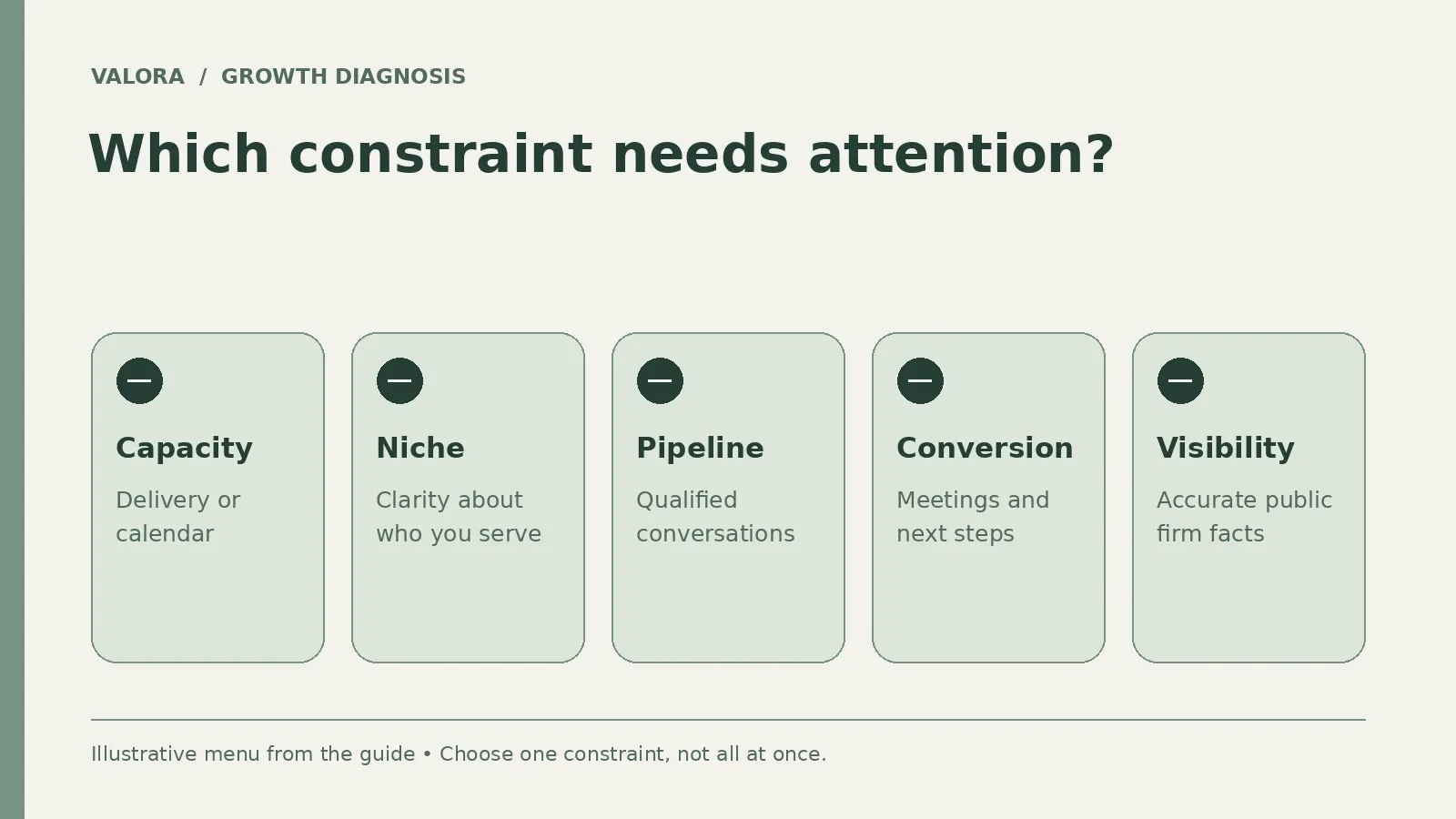
Write one sentence that names your current stage. Common growth stalls include:
- Capacity: you already have enough demand; delivery, staffing, or calendar is the constraint.
- Niche clarity: introducers and prospects cannot repeat who you serve and what problem you solve.
- Pipeline: you are not generating enough qualified conversations.
- Conversion: conversations happen, but meetings, proposals, or closes stall.
- Visibility: people who would fit cannot find accurate public facts about the firm (site, listings, regulator records).
Pick one bottleneck. If you change niche, channel, and pricing in the same month, you will not know what moved. A clear next step beats appearing on every platform.
A useful clarity check (borrowed from AI-search marketing guidance for advisors, not as a growth guarantee) is a consistent Who / What / Where across the properties you control: name and firm, niche or specialty, and location or service area. Source: Ways Advisors Can Optimize For AI Search (Kitces.com guest post by Brent Carnduff). Fix contradictions on your homepage, About page, and maintained listings before you invest in a new campaign.
Also make the firm easy to check. Prospects can look up registration and background for free through Investor.gov, which points to the SEC’s Investment Adviser Public Disclosure (IAPD) site and FINRA’s BrokerCheck. Source: Updated Investor Bulletin: How to Check Out Your Investment Professional (Investor.gov). Public claims should agree with the record and with the services you actually offer.
What can “what actually works” mean in 2026?
When advisors ask what actually works, they often want a ranked channel list. The better reading of public benchmarking is: which operating habits show up more often among firms that grew faster in a given sample. Those habits are associations, not proof of causation.
Schwab’s 2026 RIA Benchmarking Study is in its 20th year and includes insights from 1,236 firms. It was fielded January–March 2026 using self-reported data from firms that custody with Schwab; Schwab states it did not independently verify that data. Source: 2026 RIA Benchmarking Study (Schwab Advisor Services).
Figures on that page that are useful as category context (re-checked 2026-11-07):
- In 2025, firms under $250M AUM grew assets 19.6%; larger firms 16.6%. Net asset flows accounted for 7.2% of AUM growth among smaller firms and 4.8% among larger firms.
- Top Performing Firms (top 20% of Schwab’s Firm Performance Index) grew 25.4% in 2025, with 12.9% in net new asset flows. They captured 2.8× more assets from new clients and 4.2× more from existing relationships versus all other firms in the study.
- Top Performing Firms are more likely to have an ideal client persona, a client value proposition, and a marketing plan.
- More than 70% of Top Performing Firms track general inquiries from prospects versus 58% of all other firms; 85% track inquiry source versus 71%.
- On AI for automating manual workflows, the study reports 31% of Top Performing Firms versus 19% of all other firms.
Read this carefully: association is not causation. The sample is Schwab-custodied and self-reported. Nothing on this Valora page claims that copying a checklist will make your firm a Top Performing Firm, or that any one marketing channel “won” 2026. Use the study as a prompt to document persona, plan, and inquiry-source tracking. Then measure your own conversations.
Run one 30-day measured test
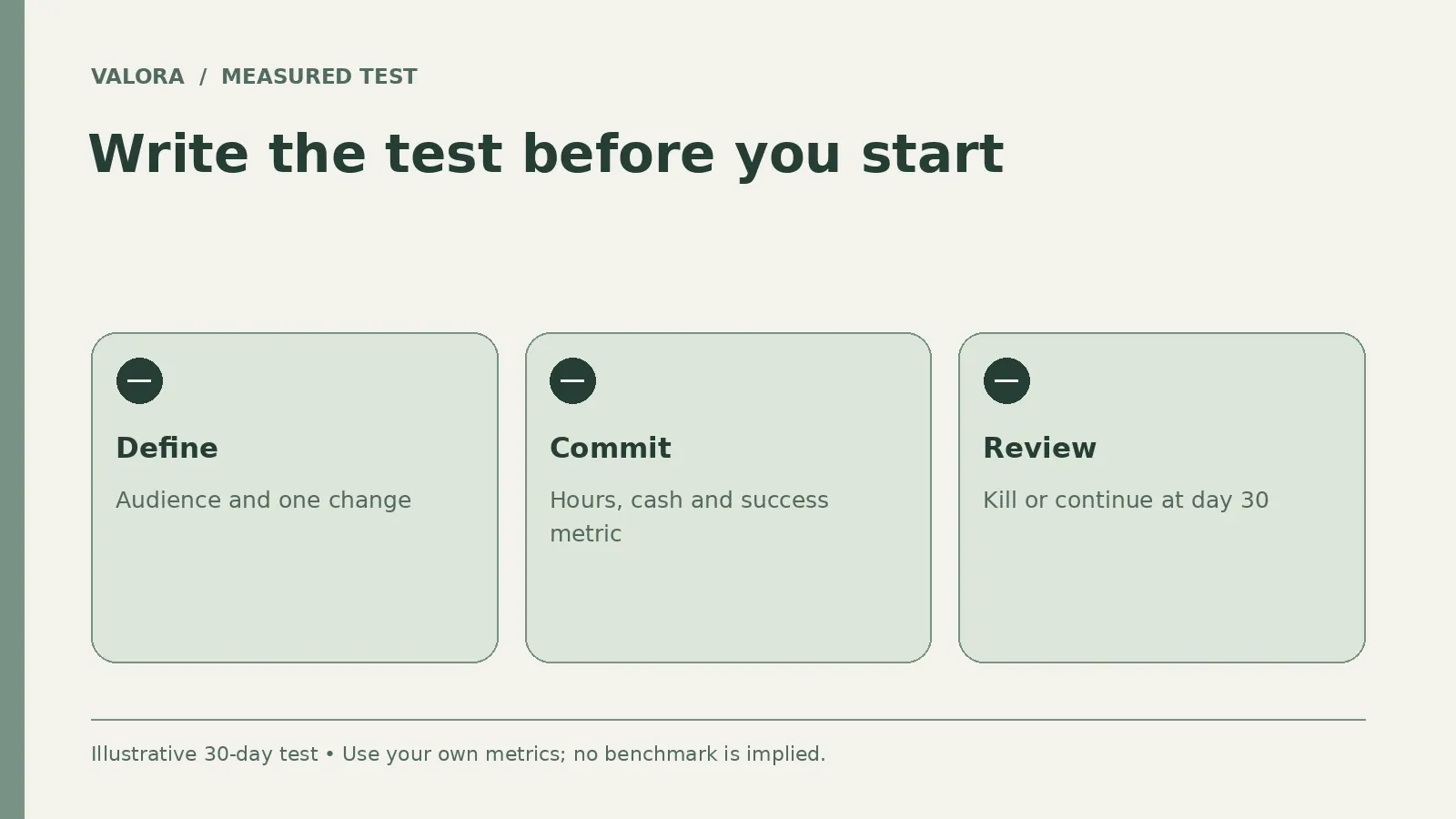
After you name the bottleneck, design one test (one channel or one process change) with a written success metric before you start.
Define a qualified conversation up front. Example definition you can adapt (not an industry benchmark): a person whose needs plausibly fit your service, who agreed to a next step, and whose source you recorded. A form fill, a page view, an indexed URL, or an AI mention is not a qualified conversation and not a client.
Write the test in one paragraph:
- Channel or process under test (only one).
- Audience or niche the test is for.
- Hours and cash you will spend.
- Success metric (e.g. number of qualified conversations, meetings booked, meetings attended).
- Kill / continue rule at day 30.
Track source, problem raised, fit, whether a meeting was booked and attended, and whether the person became a client. Count the same person once even if they found you twice. Keep testing what produces useful conversations; fix vague positioning or a broken contact path before you declare a channel dead.
Grow without cold calling, with a compliance gate on every option
“Without cold calling” is a real preference, not a loophole around rules. Consent-based introductions, centers of influence (COIs), niche communities, useful answer pages, and eligible directories are common alternatives firms discuss. Treat the list below as a menu of options to consider with your compliance reviewer, not as Valora-proven playbooks and not as a ranked conversion table.
For each option, run the same gate before you publish, promote, or ask for introductions:
- Does this communication meet the definition of an “advertisement” under the rules that apply to your firm?
- Are testimonials, endorsements, or compensated promoters involved, including non-cash compensation?
- Are claims substantiated, and do disclosures match the arrangement?
- Has the prospect or introducer actually consented to the contact you plan?
For SEC-registered advisers, the SEC’s small-entity compliance guide for the investment adviser marketing rule (Rule 206(4)-1) covers the definition of advertisement, general prohibitions on misleading ads, and conditions for testimonials and endorsements (disclosure, oversight, written agreement in many cases, and promoter disqualification). Compensation can be cash or non-cash. Source: Investment Adviser Marketing: SEC small entity compliance guide. State-registered firms must check state rules and firm policy. This article is not legal advice.
Menu (examples of how firms talk about non-cold growth; not Valora proof):
| Option | What “good” looks like in a test | Compliance / consent gate |
|---|---|---|
| Existing relationships (warm, permission-based) | You explain whom you serve and ask whether an introduction would be welcome, not “does anyone need an advisor?” | Record introductions only when the person agrees to be contacted. Review testimonials, client stories, and any referral arrangement before use. |
| Centers of influence (COIs) | A small set of professionals who already serve your niche; you listen first, then agree how introductions work. | Written understanding of any compensation or reciprocal expectation; marketing-rule conditions if endorsements apply. |
| Niche communities | Answer real questions where group rules allow; earn conversations rather than blast pitches. | Follow community rules; treat public promotional posts as advertisements until compliance says otherwise. |
| One useful answer page | Direct answer to one discovery question your niche actually asks; clear contact path; measure inquiries, not vanity metrics. | Claims, performance language, and reviews need review before publish. |
| Eligible directories / association listings | Profile matches Who-What-Where; you count inquiries from the listing, not the mere existence of a profile. | Check eligibility, fees, and whether the listing is an endorsement (many directories state that a listing is not an endorsement). Keep facts consistent with ADV / IAPD. |
| AI / search visibility work | Consistent public facts and answer-first pages so tools and search can describe you accurately. | Same advertising and substantiation rules; no promise of citations or clients. See How RIAs get clients from ChatGPT and AI search. |
Schwab’s benchmarking page associates stronger organic growth with documented referral plans, ideal client personas, marketing plans, and inquiry-source tracking among Top Performing Firms. That is category evidence for process, not a promise that any row in the table above will convert for you. Source: 2026 RIA Benchmarking Study.
If you are still building the first book
Brand-new solos without a practice yet should not treat this page as their first checklist. Start with niche clarity, two low-cash-cost channel tests, and qualified-conversation counting on Your first ten clients as a solo RIA. Come back here once you have a book and a clearer bottleneck.
Where Valora fits
Valora helps independent RIAs get booked appointments with qualified prospects, built for RIAs. When the paid advisor offer is mentioned publicly, the line is $250 per booked appointment, with a 3-appointment minimum, prepaid. Confirm current written terms before buying. Results vary. Valora does not guarantee clients, rankings, or AI citations, and Valora is not a registered investment adviser. Firms should review what goes out under their name.
For AI-search readiness of public firm facts, see Can ChatGPT find your firm? and How should advisory firms review referrals and AI-search visibility over the next 12 months?.
For the longer operational guide, see How RIAs get clients from ChatGPT and AI search.
The bottom line
Growing an RIA practice starts with diagnosis, not with a longer marketing menu. Name one bottleneck, run one measured test, track inquiry sources the way stronger firms in Schwab’s sample tend to, and put a compliance gate on every non-cold channel before you scale it. Category benchmarks can inform your process. They cannot promise your next client.
Frequently asked questions
Is there a best channel for RIA growth in 2026?
No honest page can publish a universal ranking that fits every firm. Schwab’s 2026 study reports associations between Top Performing Firms and habits such as personas, marketing plans, and inquiry-source tracking. That is not the same as a channel leaderboard, and it is not causal proof. Source: Schwab 2026 RIA Benchmarking Study.
How is this different from Valora’s first-ten-clients guide?
The first-ten-clients guide is for new solos building an initial book with two low-cash-cost tests. This page assumes you already have a practice and need a growth starting point: one bottleneck, one measured test, Schwab category context, and non-cold options with compliance gates.
Can I grow without cold calling?
Often yes, through warm introductions, COIs, communities, useful content, and eligible listings, if consent and marketing rules are respected. “No cold calling” does not mean “no compliance review.” See the SEC marketing rule guide linked above and ask your reviewer about your exact facts.
Does Valora guarantee clients?
No. The public paid offer line is $250 per booked appointment, with a 3-appointment minimum, prepaid. A booked appointment is not a signed client. No guarantee of clients, rankings, or AI citations.
Will AI search replace referrals?
Unclear, and not something this page claims. Treat AI answers as dated snapshots of public facts. For a year-shaped calendar, see Valora’s live 12-month referrals-and-AI-search review. For the tactical ChatGPT and AI-search guide, see How RIAs get clients from ChatGPT and AI search.
Scope of this guide
This is educational marketing for independent advisory firms. It is not personalized investment, tax, legal, or compliance advice. Valora is not a registered investment adviser. Nothing here guarantees clients, rankings, AI citations, or that any channel will convert for your firm. Schwab figures are category associations from a self-reported, Schwab-custodied sample as of the access date below and may change. Firms should apply their own compliance review to any public marketing, testimonials, introductions, or listings.
Sources
- Schwab Advisor Services: 2026 RIA Benchmarking Study. Category figures on growth, Top Performing Firms, personas, marketing plans, and inquiry-source tracking; self-reported Schwab-custodied sample; association is not causation. Accessed 7 Nov 2026. https://advisorservices.schwab.com/insights-hub/perspectives/ria-benchmarking-study-2026
- Kitces.com (guest post, Brent Carnduff): Ways Advisors Can Optimize For AI Search. Used here for a consistent Who-What-Where method only; not a verified ranking formula. Accessed 7 Nov 2026. https://www.kitces.com/blog/artificial-intelligence-ai-search-engine-optimization-seo-financial-advisor-marketing-content-strategy/
- SEC: Investment Adviser Marketing, small entity compliance guide (Rule 206(4)-1). Advertisement definition, testimonials/endorsements conditions. Accessed 7 Nov 2026. https://www.sec.gov/resources-small-businesses/small-business-compliance-guides/investment-adviser-marketing
- Investor.gov: Updated Investor Bulletin: How to Check Out Your Investment Professional (IAPD / BrokerCheck). Accessed 7 Nov 2026. https://www.investor.gov/introduction-investing/general-resources/news-alerts/alerts-bulletins/investor-bulletins/updated-0
- Valora: Your first ten clients as a solo RIA. Companion for brand-new solos. https://www.valorahq.com/insights/your-first-ten-clients-as-a-solo-ria-where-they-actually-come-from/
- Valora: Can ChatGPT find your firm? Free readiness review companion. https://www.valorahq.com/insights/can-chatgpt-find-your-firm/
- Valora: How should advisory firms review referrals and AI-search visibility over the next 12 months? https://www.valorahq.com/insights/ai-search-is-eating-the-referral-game-heres-what-advisors-do-in-the-next-12-months/