
Should a new advisor offer one-time financial plans?
When a one-time plan can start a relationship, how to set the conversion boundary, and when that offer is the wrong fit for the household or the firm.


A new advisor can offer a one-time financial plan as a way to start a relationship, but it is not automatically a good door-opener. It can help a prospect see the work, test fit, and decide whether ongoing advice is worth paying for. It can also consume a lot of unpaid or underpaid time, set a low price anchor for later work, or leave a household without the monitoring they actually need. The useful design choices are scope, price relative to ongoing service, a clear end to the one-time engagement, and an honest account of when the offer does not fit. None of the sources cited below measures how often a one-time plan turns into an ongoing client.
This article is for new advisors and small firm owners who are designing a first offer. A registered investment adviser (RIA) is a firm registered to give investment advice for compensation. This is firm-side education, not legal advice or a recommended offer.
Should a new advisor offer a one-time plan as a door-opener?
The offer is a design choice with tradeoffs, not a required startup tactic. A defined one-time plan can make a first piece of work visible. It can help both sides test fit. It can give the household a bounded deliverable. Those outcomes are useful when the scope is clear and the ending is real.
A one-time plan does not replace monitoring after tax, family, or law changes. Derek Tharp has written that ongoing planning is not the same as a one-time plan (Tharp, May 25, 2022). He also wrote that asking for a standalone plan once a year is not necessarily equivalent to receiving ongoing services. If you offer a one-time plan, you still have to explain what ends when the document is delivered, and what would continue only under a later engagement.
Separate a proposal, a one-time plan, and ongoing advice
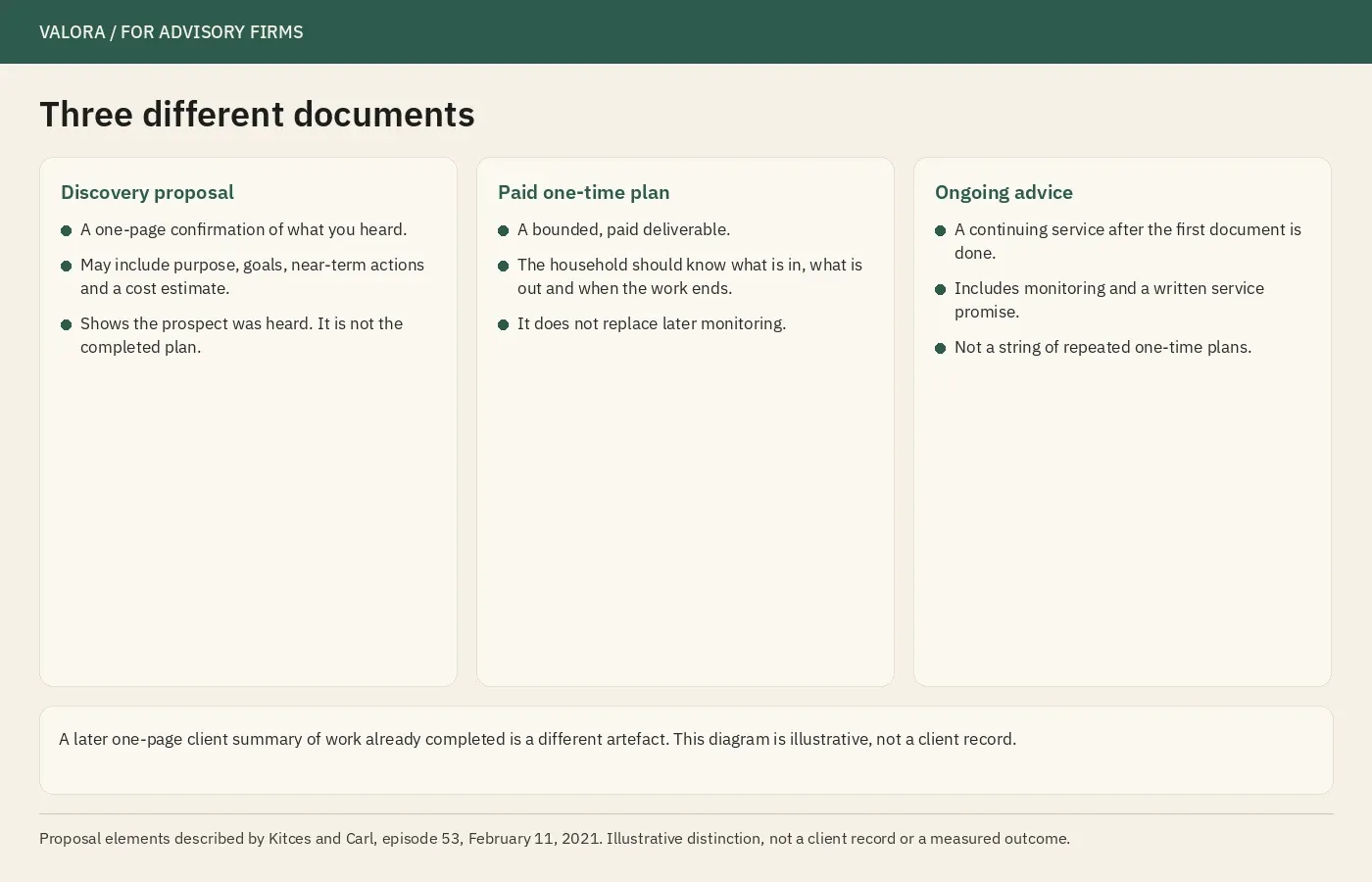
These are three different documents, and mixing them confuses the household.
A discovery proposal or a one-page confirmation of what you heard is not a paid one-time plan. In Kitces and Carl, episode 53, Carl Richards describes a one-page artefact with a statement of purpose, a list of goals, near-term actions, and a cost estimate (February 11, 2021). The point of that page is to show that the prospect was heard. It is a way to start a conversation, not the completed plan. Michael Kitces discusses a sample plan in the same episode as a way to show the work. That is still sales collateral, not the paid engagement itself.
A paid one-time plan is a bounded, paid deliverable. The household should know what is in, what is out, and when the work ends. Ongoing advice is a continuing service. It includes monitoring and a written service promise after the first document is done.
A later one-page client summary of work already completed is a different artefact again. It is a quality-control problem for shortening a full explanation, not a first offer. For a checklist on that later document, see What should an advisory firm check before turning a full planning explanation into a one-page client summary?.
What the Tharp experiment shows, and the anchoring risk
Tharp ran an experimental online survey with 602 participants (Tharp, May 25, 2022). Each person was given a vignette in which they had just received a $1 million inheritance and would meet an advisor for an initial plan. The plan was priced as free, $1,000, $2,000, or $3,000, depending on the group. Every group was shown the same projected tax-savings figure. Participants were then asked what ongoing annual fee seemed reasonable.
At the median, the free-plan group stated $2,000, which was the highest of the four groups. The $1,000 and $2,000 groups stated $1,500. The $3,000 group stated $1,750. This is stated willingness to pay in a hypothetical online survey. It is not observed hiring, retention, or a conversion rate. The same tax-savings figure appeared in every treatment, so the results should not be read as "free plans always raise fees." That tax-savings figure was part of the experiment prompt. It is not a result a firm may advertise.
Tharp's interpretation is a design warning, not a measured loss of clients. A typical standalone plan price can become a reference point for later ongoing fees. It can also make a string of one-time plans look interchangeable with ongoing service. If you price a one-time plan, you should be able to explain why ongoing work is a different service, not a repeat of the same document.
A free plan is not automatically safer. Tharp notes that a free plan can increase skepticism if it feels like a pitch. That is a possible downside he describes, not a measured result from the survey. Do not treat "always offer free plans" or "never offer free plans" as a finding of the study.
Write the scope, the ending, and the next step in advance
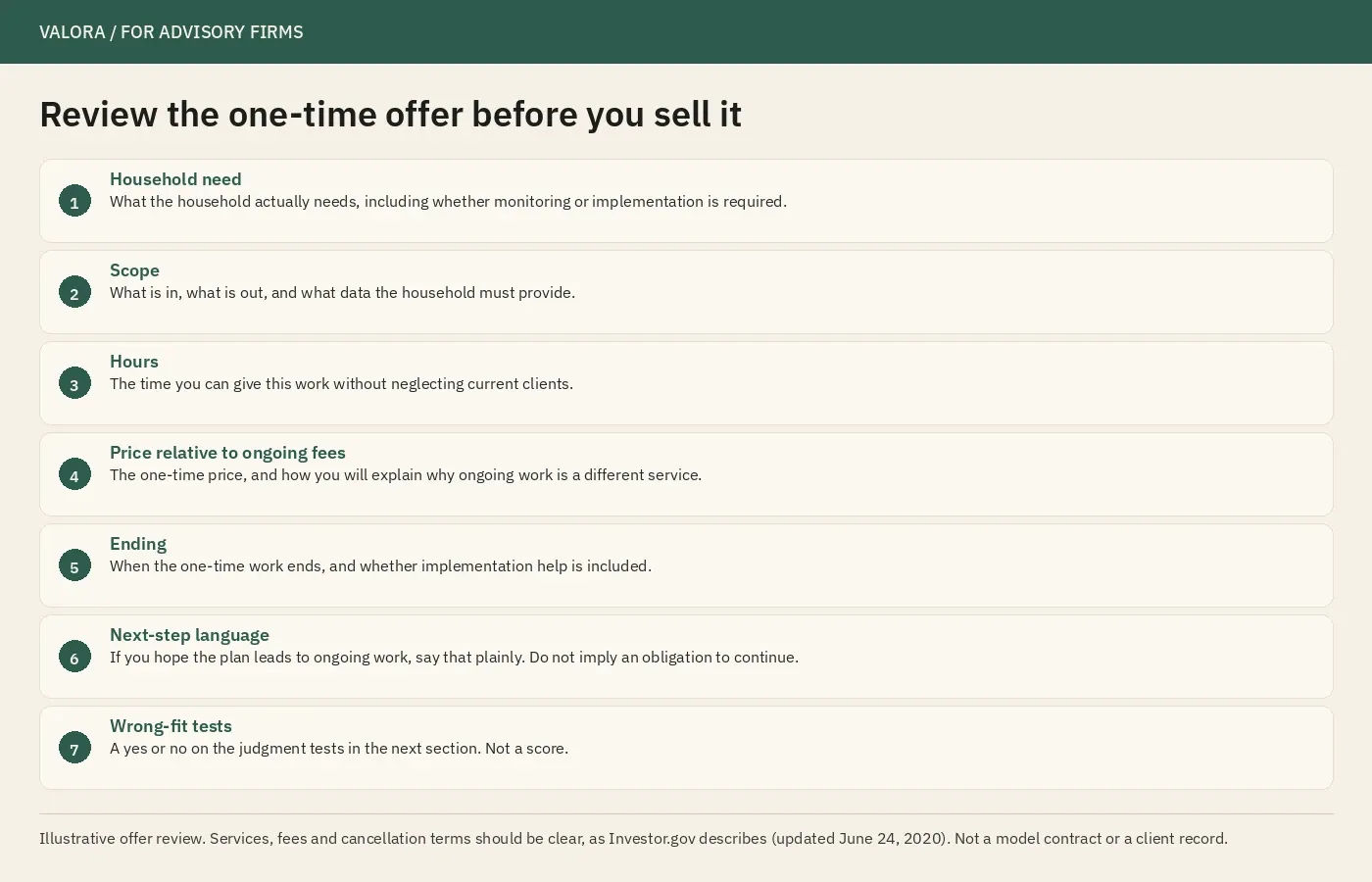
Write the offer before you sell it. An illustrative review can cover the household need, the scope, the hours, and the price relative to ongoing fees. It can also cover the ending, the next-step language, and a yes or no on the wrong-fit tests in the next section. This is an organizing list, not a model contract and not a client record.
Be specific about what is in and what is out. State what data the household must provide, and what happens if that data does not arrive. State whether implementation help is included. State when the work ends. State how a later ongoing engagement would differ, including monitoring after the plan is delivered.
Investor.gov tells people to understand the types and frequency of services, how fees are calculated, and how to cancel an advisory contract before they open an account (Investor.gov, updated June 24, 2020). That bulletin is staff education, not a rule. If you offer a one-time plan, those same points still need to be clear in the agreement the household signs.
If you hope the plan will lead to ongoing work, say that plainly. Still give the household a complete one-time ending. Do not imply that buying the plan obliges them to continue. Do not cite a conversion percentage. None of the sources cited below measures how often a one-time plan becomes an ongoing engagement.
When a one-time plan is the wrong fit
A one-time plan can be the wrong offer even when it is popular as a way to start. Treat the tests below as judgment questions, not a scored algorithm. You can still offer a narrower scope, propose an ongoing engagement instead, or refer the household out.
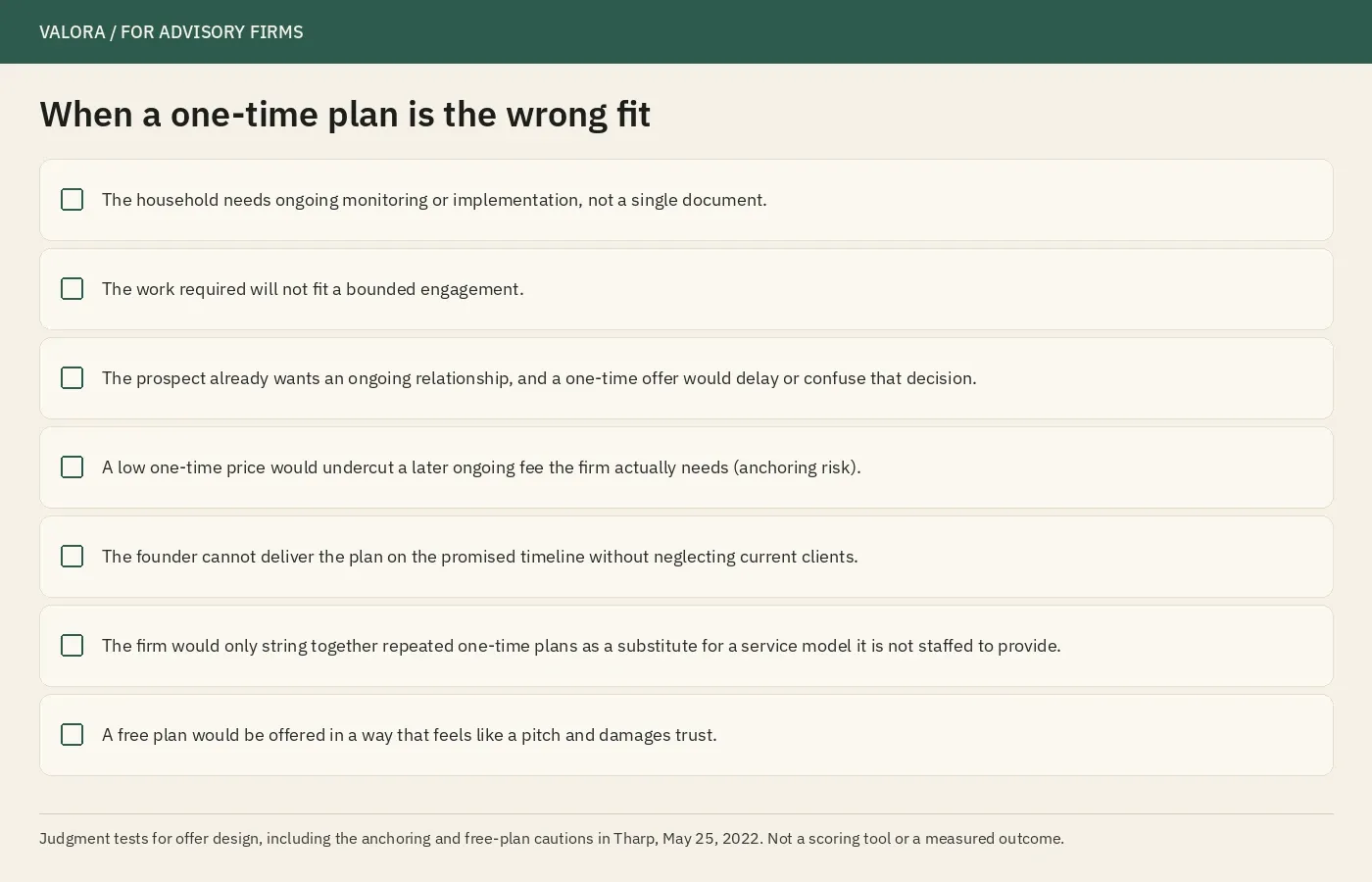
The offer is a poor fit when any of the following is true:
- The household needs ongoing monitoring or implementation, not a single document.
- The work required will not fit a bounded engagement.
- The prospect already wants an ongoing relationship, and a one-time offer would delay or confuse that decision.
- A low one-time price would undercut a later ongoing fee the firm actually needs. This is the anchoring risk Tharp describes, not a measured loss of clients (Tharp, May 25, 2022).
- The founder cannot deliver the plan on the promised timeline without neglecting current clients.
- The firm would only be stringing together repeated "one-time" plans as a substitute for a service model it is not staffed to provide.
- A free plan would be offered in a way that feels like a pitch and damages trust. Tharp notes that risk as a possible downside, not as a measured survey result.
None of these tests produces a score. They are a way to stop before you sell an offer you cannot deliver, or an offer the household does not actually need. If the household needs monitoring after tax, family, or law changes, a single document will not do that work. If the prospect came to hire ongoing advice, a one-time plan can put a delay in front of the relationship they already want.
The same caution applies to the firm. A price that is easy to say yes to can become the reference point for later fees. A timeline you cannot keep will land on current clients first. A series of "one-time" plans is not a service model if you are not staffed to monitor the work after each document is done. In those cases, the honest next step is a tighter scope, an ongoing proposal, or a referral.
How this sits next to ongoing service, and what you can say in an advertisement
Once a household continues, they need a written service promise. A one-time plan does not write that calendar for you. For how to turn an ongoing service model into deliverables, triggers, and responsibilities, see How should an RIA turn a client service model into a written service calendar?.
If a prospect treats a one-time software output as the whole service, the firm still has to explain judgment, monitoring, and accountability. For a fuller treatment of that value conversation, see How to explain what clients pay for when software does the math.
If the offer appears in an advertisement, the SEC Marketing Rule's general prohibitions apply to advisers that are registered with the Securities and Exchange Commission, or required to be registered with it. An advertisement may not include an untrue statement of a material fact, or a material claim the adviser cannot substantiate. Benefits need fair and balanced treatment of associated risks and limits (SEC small entity compliance guide, April 28, 2021). Do not promise tax savings, returns, or a conversion result. The Marketing Rule does not, by its own terms, apply to advisers that are only state-registered. State-registered advisers should check their state securities regulator's advertising rules.
FAQ
Is a free plan always a bad idea? No. Tharp's experiment does not show that free plans always help or always hurt. A free plan can be a way to show the work. It can also feel like a pitch and raise skepticism. Treat "free" as a design choice with those limits, not as a rule from the study.
Can a new advisor only get clients by giving plans away? No cited source says that. A one-time plan is one possible offer, not a required startup tactic. Some households will need ongoing service from the start, and a free or low-priced plan will not fix a capacity or scope problem.
Does a one-time plan prove the firm's advice? No. A bounded deliverable can show how the firm works. It does not prove later advice, and it does not replace monitoring after facts change.
Next step for firms that want help being found
If your firm later wants help making its services easier for suitable prospects to find and understand, you can learn about Valora's work for advisory firms. The current public offer is $250 per booked appointment with a qualified prospect, with a 3-appointment minimum, paid in advance. An appointment is a call booked on your calendar with a prospect who has asked to speak with an advisor. There is no setup fee, retainer, or long-term contract. If a prospect does not attend or does not meet the agreed criteria, the appointment is replaced at no charge. Your firm reviews what goes out under its name. Marketing is a separate decision from the one-time plan offer.
This article is educational, not legal advice, tax advice, compliance advice or personalized investment advice. Valora is not a registered investment adviser and does not provide investment advice. Valora provides marketing services to advisory firms.
Sources
- Derek Tharp, How A Free Financial Plan Retains More Perceived Value Than An Average Priced One (May 25, 2022). Kitces article. The figures are median stated fees in a hypothetical online survey, not observed hiring or a conversion rate.
- Kitces and Carl, episode 53, Using Financial Plan Proposals To Show Planning Value To Prospective Clients (February 11, 2021). Kitces and Carl episode 53. This is a discussion of proposals and sample plans, not a study of one-time-plan conversion.
- Investor.gov, Investor Bulletin: Opening an Investment Advisory Account (September 25, 2017, updated June 24, 2020). Investor.gov Bulletin. Staff education, not a rule.
- U.S. Securities and Exchange Commission, Investment Adviser Marketing, a small entity compliance guide (April 28, 2021). SEC Marketing Rule small entity guide. The Marketing Rule applies to advisers registered or required to be registered with the Commission.
- Valora, For advisors, offer terms as of November 11, 2026. Valora for advisors.