
How to explain what clients pay for when software does the math
Help advisory firms explain what clients pay for when software runs the numbers: judgment, integration, monitoring and accountability, without promising returns.


Prospects can open planning software, consumer tax tools, or a chatbot and get a number in seconds. The honest firm-side answer is that clients pay for judgment, integration, monitoring, and accountability around those numbers, not for the arithmetic alone.
This piece is for advisory firms. It helps you name that work in discovery without promising returns or claiming that software never helps. Community observations from planner forums are paraphrased and anonymized below. They are not a survey.
The question firms hear, and sometimes ask about other professions
In planner communities, a familiar fight shows up around hiring a CPA, a certified public accountant, for a planner's own return. Some planners say many tax pros mainly feed documents into software. Others reply that consumers say the same thing about planners: plug data into software and charge a percentage fee.
Treat that exchange as a warning, not as research. The point is the test. If your firm cannot show what a person does after the software runs, a prospect will treat the fee as a markup on a tool they could buy alone.
A related thread argued that cheap tools make it easy to open a solo firm, while winning and keeping clients stays hard. Launch cost is not the same as proving value. Treat those cost figures as one poster's claims, not industry data.
What the math layer actually does
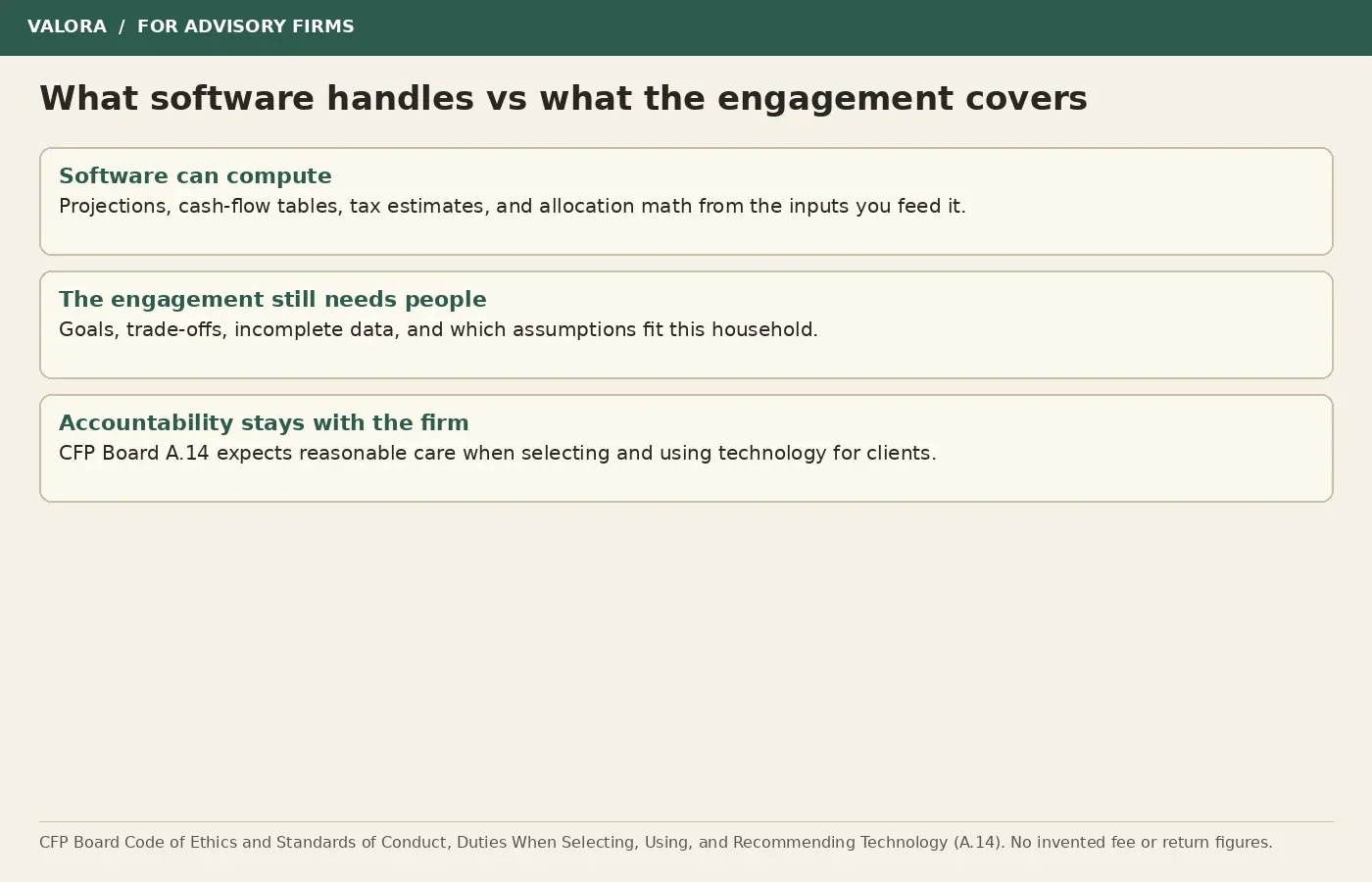
Planning software and consumer calculators are good at repeating arithmetic. They project cash flow from the inputs you enter. They estimate taxes under stated assumptions. They rebalance toward a target mix when you set one.
None of that chooses the household's goals. None of it decides which assumption is too optimistic for this client. None of it owns the file when life changes mid-year.
Say that out loud in the first meeting. Show a sample output if you use one, then show the decisions the output does not make. That frame keeps the tool useful without letting it define the engagement.
What CFP Board requires when technology is in the room
CFP® is a certification mark owned by Certified Financial Planner Board of Standards, Inc. (CFP Board). For CFP® professionals, the Code of Ethics and Standards of Conduct includes Duties When Selecting, Using, and Recommending Technology (section A.14).
A.14 says a CFP® professional must exercise reasonable care and judgment when selecting, using, or recommending technology for a client. That includes software and digital advice tools used while providing professional services. The professional must understand the assumptions and outcomes of the technology employed. The professional must also have a reasonable basis for believing the technology produces reliable, objective, and appropriate outcomes.
That duty does not ban software. It puts the professional between the tool and the client. If your discovery script only demos the dashboard, you are hiding the work A.14 assumes someone is doing.
Financial planning is a collaborative process, not a printout
CFP Board defines financial planning as a collaborative process. It helps maximize a client's potential for meeting life goals through financial advice that integrates relevant elements of the client's personal and financial circumstances.
"Collaborative" and "integrates" are the load-bearing words. A printout can list accounts. It cannot, by itself, weigh a parent's care plan against a retirement date, or decide whether a business sale should wait a year.
When a prospect asks what they pay for, point to that definition. Then map your engagement to the practice standards steps you actually perform.
Practice standards steps software cannot finish alone
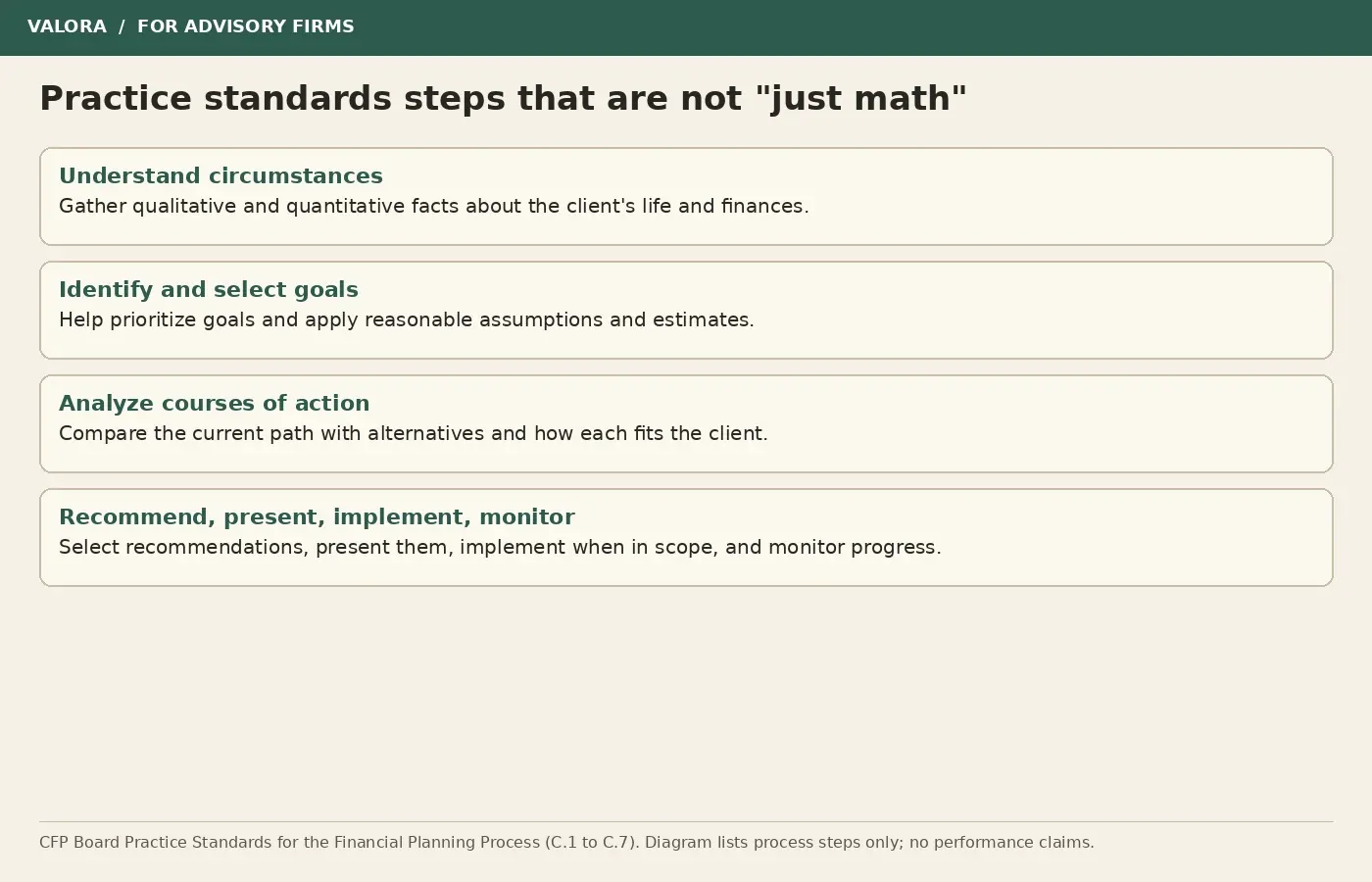
CFP Board's Practice Standards for the Financial Planning Process run from understanding the client's circumstances through monitoring progress and updating.
Understanding circumstances means gathering qualitative and quantitative information, then analyzing it. Qualitative items include values, attitudes, family circumstances, and risk tolerance. Quantitative items include income, assets, liabilities, and insurance coverage. Incomplete data forces a scope limit or an exit, not a silent guess inside the tool.
Identifying and selecting goals includes discussing the effect one goal has on others, and applying reasonable assumptions and estimates. Analyzing the current course of action includes material advantages and disadvantages, and whether that course maximizes the potential for meeting the client's goals. Alternatives get the same treatment when appropriate.
Developing recommendations means selecting one or more recommendations designed to maximize the potential for meeting the client's goals. Presenting them means showing the client the information that was required when those recommendations were built. Implementation and monitoring apply when they are inside the scope of engagement.
Each of those steps can use software. None of them reduces to "the software said so."
What Investor.gov says a typical adviser may provide
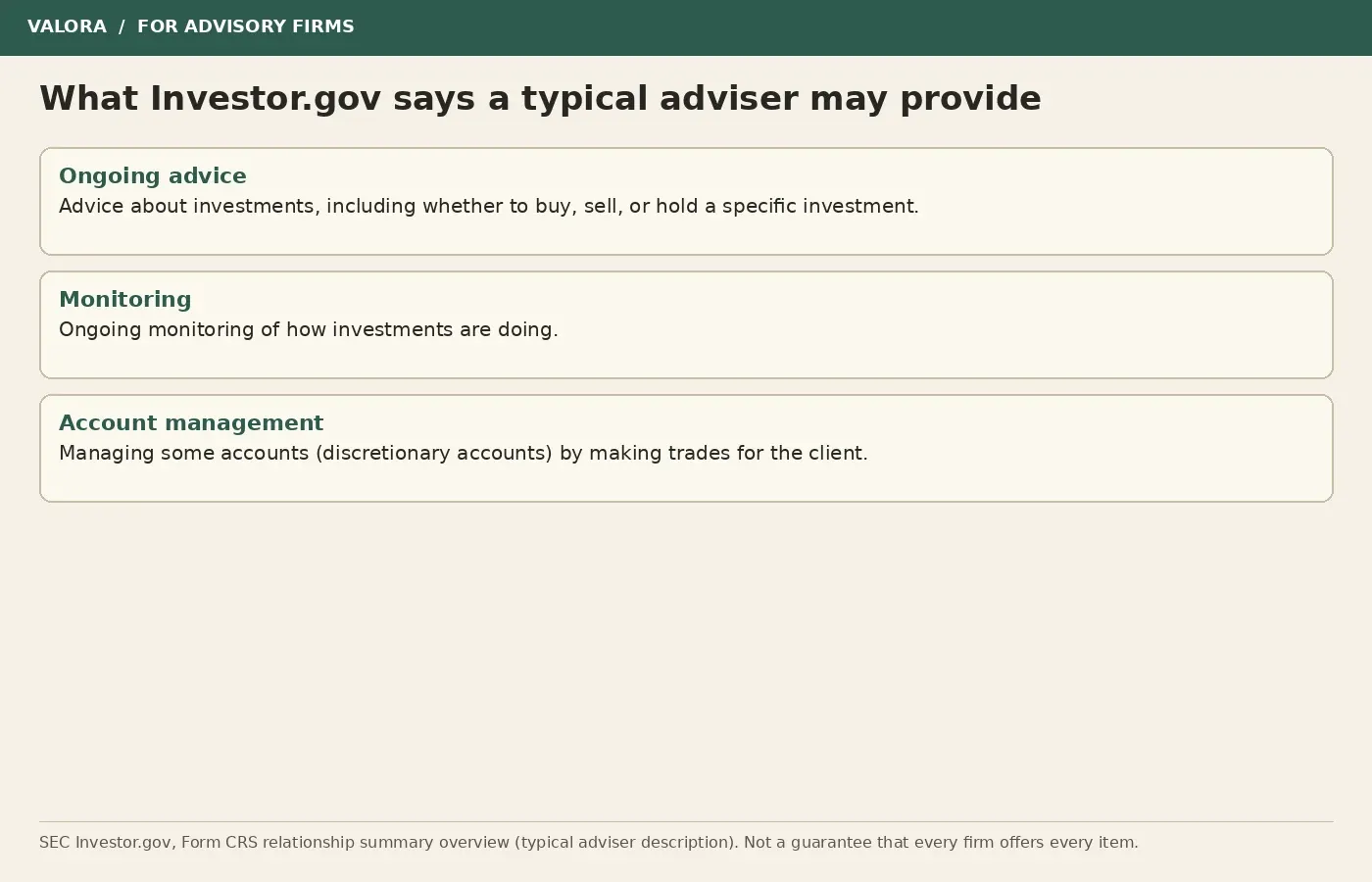
The U.S. Securities and Exchange Commission (SEC) publishes Investor.gov material for the public. Its Form CRS (Client Relationship Summary) overview describes what a typical adviser may provide. That picture includes ongoing advice about investments, including whether to buy, sell, or hold a specific investment. It includes ongoing monitoring of how investments are doing. It also includes managing some accounts, called discretionary accounts, by making trades for the client.
Form CRS is the short relationship summary many broker-dealers and investment advisers must deliver to retail investors. A broker-dealer is a firm that buys and sells securities for customers or for its own account. An investment adviser is a firm or person in the business of providing advice about securities for compensation.
Those Investor.gov lines are descriptions, not a promise that your firm offers every item. Use them to show that monitoring and ongoing advice sit in the public picture of advisory work. A one-time software report does not match that picture unless your contract says the engagement ends after delivery.
Opening an advisory account: services, fees, and expectations
SEC Investor.gov's bulletin on opening an investment advisory account tells investors to understand the services the adviser will provide. Examples in that bulletin include financial planning, portfolio management, and advice about selecting other investment advisers. It also tells investors to ask how fees work, what conflicts exist, and what monitoring they should expect.
Bring those questions into your own discovery outline. Ask the prospect which services they think the fee buys. Write the list. Strike anything your engagement does not include. Add the judgment and coordination work that software does not show on a screen.
That list becomes the answer to "is it just software?" It is specific to your firm, dated to this conversation, and free of return promises.
Make the non-software work visible
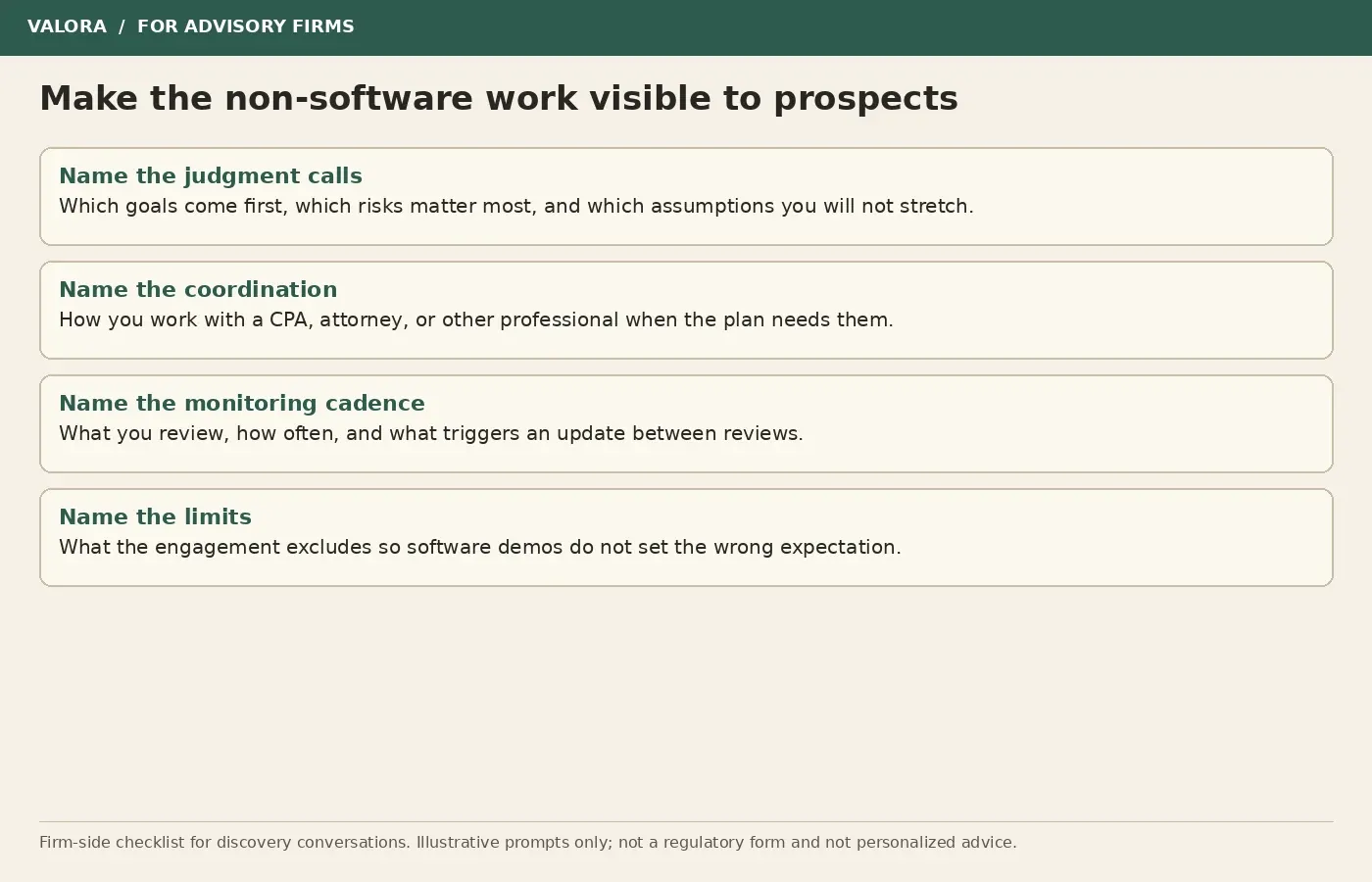
Name the judgment calls. Which goals come first. Which risks matter most for this household. Which assumptions you refuse to stretch.
Name the coordination. How you work with a CPA, an estate attorney, or another professional when the plan needs them. CFP Board's duties when recommending, engaging, and working with additional persons appear in section A.13. They require a reasonable basis for recommendations based on reputation, experience, and qualifications. They also require disclosure of material economic benefits tied to the referral.
Name the monitoring cadence. What you review, how often, and what triggers an update between reviews. If monitoring is outside scope, say so in writing.
Name the limits. What the engagement excludes. Limits stop a software demo from setting an expectation your contract never accepted.
How this sits next to AI drafting and fee conversations
When AI drafts a plan package inside the firm, the same visibility problem appears on the delivery side. See how to redesign the junior advisor role when AI drafts the plan. That piece covers review, ownership, and what stays human after the draft. Point prospects there when they ask who stands behind the file.
When the question shifts to whether a percentage fee fits the scope, use the firm-side fee frame. Start with How to answer 'Is a 1% fee worth it?' without hype. Cost talk and "is it just software?" talk are cousins. One names dollars. The other names labor. Pair them without promising alpha, meaning excess return above a stated benchmark, or a behavioral-return guarantee (a promise that advice will improve investor behavior enough to offset cost).
If the prospect is still sorting role titles and duties, share wealth manager vs financial planner vs fiduciary. That piece covers role, credential, registration, and duty language. For pay-method words, see how to explain fee-only vs fee-based pay to prospects.
Community observations to use carefully
Planner-forum replies often say hiring a CPA is as much about a referral relationship as about return complexity. Others say complexity such as a small business or K-1s (pass-through partnership or S-corp tax schedules) tips the decision toward a pro. A minority argues consumer software plus a chatbot is enough.
These are anonymized forum observations, not a study.
The usable insight is simple. Professionals judge each other with the same "is it just software?" test consumers use on advisers. Firms that answer with visible process keep trust. Firms that only demo tools invite the discount.
FAQ
Does using planning software mean the fee is only for the tool?
No. Software can produce tables and projections from inputs. CFP Board A.14 still expects reasonable care and an understanding of assumptions when a CFP® professional uses technology for a client. It also expects a reasonable basis for believing outcomes are reliable, objective, and appropriate.
What should we say when a prospect compares us to a consumer app?
Compare scopes, not brand names. Name the judgment, coordination, monitoring, and accountability your engagement includes. Name what the app does not take responsibility for. Avoid return claims.
How do we talk about CPAs and other specialists without overpromising?
Describe when you bring in another professional, how you choose them, and what you disclose about any economic benefit tied to a referral. Stay inside A.13, and avoid guaranteeing a referral outcome.
Is this personalized advice for our clients?
No. This article is firm-side education for advisory teams. It is not legal advice, compliance advice, or personalized investment advice for any household.
Next step for firms that want help being found
If your firm later wants help making its services easier for suitable prospects to find and understand, you can learn about Valora's work for advisory firms. The current public offer is $250 per booked appointment with a qualified prospect, with a 3-appointment minimum, paid in advance. An appointment is a call booked on your calendar with a prospect who has asked to speak with an advisor. There is no setup fee, retainer, or long-term contract. If a prospect does not attend or does not meet the agreed criteria, the appointment is replaced at no charge. Your firm reviews what goes out under its name. Marketing is a separate decision from how you explain what clients pay for when software runs the math.
This article is educational, not legal advice, compliance advice or personalized investment advice. Valora is not a registered investment adviser and does not provide investment advice. Valora provides marketing services to advisory firms.
Sources
- CFP Board, Code of Ethics and Standards of Conduct, Duties When Selecting, Using, and Recommending Technology (A.14); Financial Planning definition; Practice Standards for the Financial Planning Process (C.1 to C.7); Duties When Recommending, Engaging, and Working With Additional Persons (A.13). Code and Standards.
- SEC Investor.gov, Form CRS relationship summary overview (typical adviser description: ongoing advice, monitoring, discretionary accounts). Investor.gov Form CRS.
- SEC Investor.gov, Opening an Investment Advisory Account (updated June 24, 2020). Staff bulletin on services, fees, contracts and conflicts.
- Community observations paraphrased from planner-forum threads summarized in Valora's Reddit research pack, 2026-11-09 (r/CFP threads on hiring a CPA and related "is it just software?" debate). Not a survey. No usernames. No invented quotes.