
Wealth manager vs financial planner vs fiduciary: role, credential and duty
Help advisory firms explain role, credential, registration and fiduciary duty so prospects do not mistake fiduciary for a job title or a designation.


Wealth manager and financial planner describe kinds of work. A credential is a separate qualification. Fiduciary is a duty owed in a relationship: a duty to act in the client's best interest when a stated standard applies. It is not a job title. Some private designations use the word fiduciary, but a designation does not create or replace a legal duty.
One person can plan, manage investments and owe fiduciary duties at the same time. Ask what work is covered, in which capacity the person acts, and what written standards apply.
This guide is for advisory firms that explain these words to prospects. It does not replace your brochure (Form ADV Part 2A, the disclosure document an adviser gives clients), your Form CRS relationship summary or your engagement agreement.
Are wealth manager, financial planner and fiduciary alternatives?
No. They answer different questions.
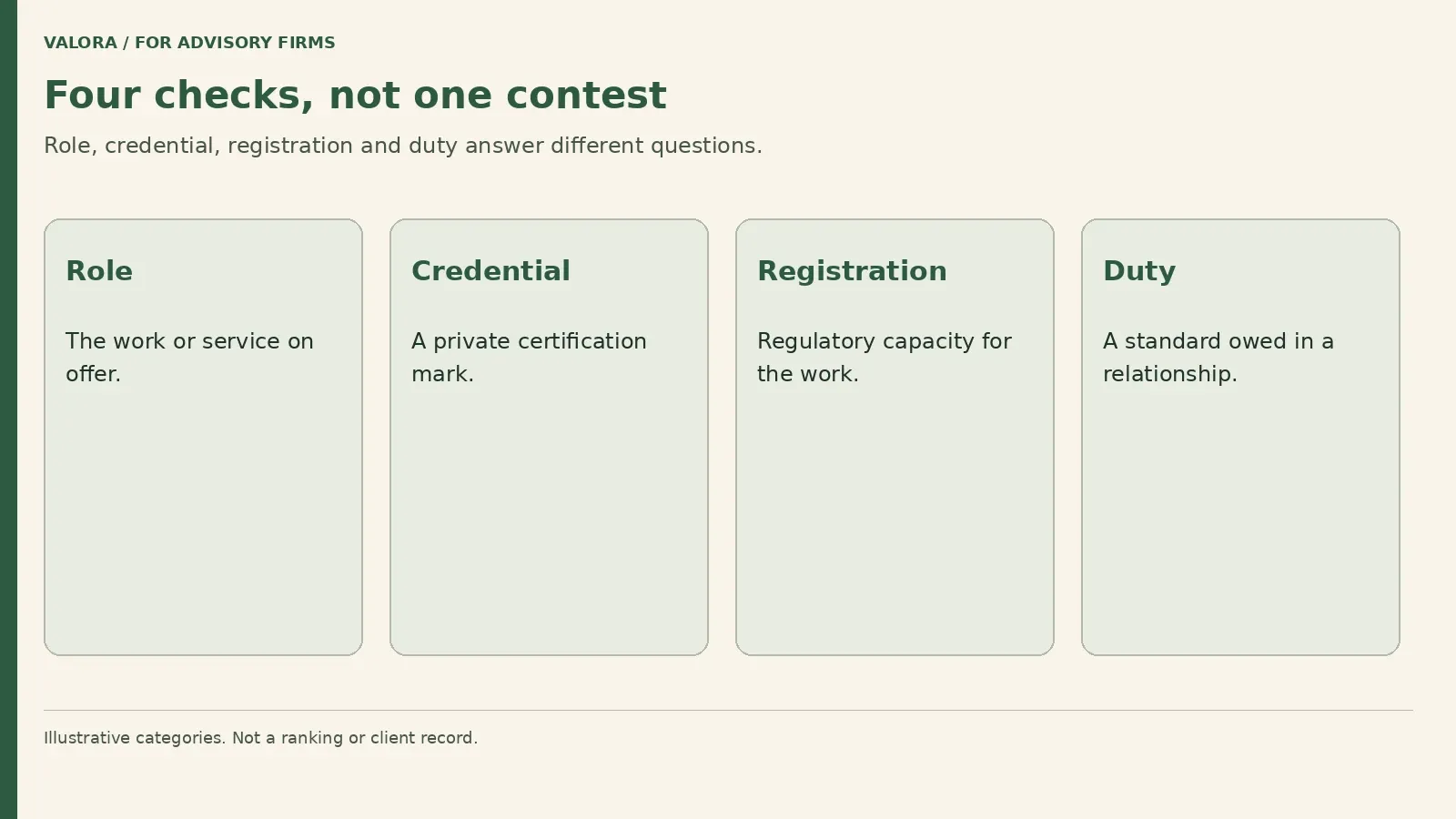
A role or service label describes the work on offer. A credential shows a private certification. Registration shows regulatory capacity. Fiduciary describes a duty owed when a stated standard applies.
A prospect may hear the three phrases as rivals. They are not. Add registration and you have four separate checks: role, credential, registration and duty. Tie each answer to documents the prospect can read.
Wealth manager describes an offering, not automatic credentials
"Wealth manager" is a title a firm chooses for its offering. The title alone does not prove scope, skill, registration or a wealth minimum.
Two firms can use the same title for different menus. One may focus on portfolio management. Another may add tax coordination, estate topics or insurance referrals. None of that follows from the words on a business card.
Prospects may assume the title means a required asset level. The title does not set a wealth minimum. Ask the firm what criteria it actually uses.
Ask what accounts, planning topics and product lines the engagement covers. Ask what is out of scope. Put the answer next to the written agreement and the brochure.
Financial planner can describe a broad range of work
The Financial Industry Regulatory Authority (FINRA), which oversees brokerage firms, says financial planners can come from many backgrounds. They may be brokers, investment advisers, insurance agents or accountants. Some may have no financial credential at all.
FINRA also notes that financial planning has no single dedicated regulator. Regulation often follows the other services the person provides. An accountant who prepares plans may face accountancy rules. An investment adviser who plans may face adviser rules.
The breadth of work also varies. Some planners build a wide plan across savings, investments, insurance, education, retirement, taxes and estate topics. Others focus on a narrower slice. Some prepare plans only. Others also sell products. FINRA warns that product sellers often recommend what they sell.
A designation is one input. It is not the only selection test.
A credential is different from a job title
A credential is issued by a private organization. Examples include CFP® (the Certified Financial Planner certification), CFA® (Chartered Financial Analyst) and ChFC® (Chartered Financial Consultant). FINRA's Professional Designations lookup lists those marks and many others.
Job titles are chosen by firms. They are not the same as issuer-granted marks. Check the issuer's directory before you treat a mark as current. The Certified Financial Planner Board of Standards (CFP Board) hosts a verify tool for CFP® professionals. FINRA's Professional Designations page explains what many marks require.
FINRA also notes that some designations need little experience or study. Some lack strong ways to verify the holder or to file complaints. Other marks are harder to earn and keep. Point prospects to the issuer and to current disclosures.
Federal adviser duty: care, loyalty and agreed scope
Under federal law, an investment adviser is a fiduciary. The U.S. Securities and Exchange Commission (SEC) explains that duty in Release IA-5248. It has two parts: a duty of care and a duty of loyalty.
The duty covers the whole adviser-client relationship. It follows the agreed scope of that relationship. It cannot be waived. For an investment adviser, a contract line saying it will not act as a fiduciary is inconsistent with the Investment Advisers Act of 1940 (the Advisers Act), the main federal law for investment advisers.
Care includes advice in the client's best interest based on a reasonable understanding of objectives. It includes seeking best execution (the most favorable overall terms for client trades) when the adviser selects broker-dealers (firms that buy and sell securities for customers). It includes monitoring at a frequency suited to the relationship.
Loyalty means not subordinating the client's interests to the adviser's. Loyalty also requires full and fair disclosure of material facts. Some private designations use the word fiduciary. None of them replaces this legal duty.
IA-5248 discusses federal Advisers Act duty for SEC-registered, state-registered and certain exempt advisers (advisers exempt from registration). It does not settle separate state-law fiduciary theories.
What does CFP Board require of CFP professionals?
CFP Board sets private certification standards for CFP® professionals. Standard A.1 says that at all times when providing Financial Advice to a Client, a CFP® professional must act as a fiduciary and therefore act in the client's best interests.
That duty includes loyalty, care and following client instructions under the engagement. It is a certification rule for CFP® professionals. It is not a universal statute for every planner or wealth manager.
CFP Board standards and securities-law duties are separate. A person can be subject to both, or to only one. Say which standard you mean.
Disclosure, monitoring and capacity need separate checks
Under IA-5248, an adviser must make full and fair disclosure of material facts and conflicts. Disclosure should let the client give informed consent. Saying a conflict "may" exist is not enough when it does exist. Disclosure alone does not satisfy the duty to act in the client's best interest.
Monitoring follows the agreed scope. Unless the agreement says otherwise, a one-time plan for a one-time fee is unlikely to create a duty to monitor. When an adviser has an ongoing relationship and charges a periodic asset-based fee, the SEC says the duty to advise and monitor is relatively extensive.
Federal Advisers Act duty is one frame. CFP Board standards are another. Regulation Best Interest (Reg BI) is a separate SEC rule for broker-dealer recommendations to retail customers. IA-5248 treats that broker standard as separate from the Advisers Act fiduciary duty. State-law fiduciary claims need their own review.
Form CRS helps ask which capacity applies. Dual registrants (firms registered as both a broker-dealer and an investment adviser) may act as a broker in some moments and as an adviser in others.
What can the client verify in writing?
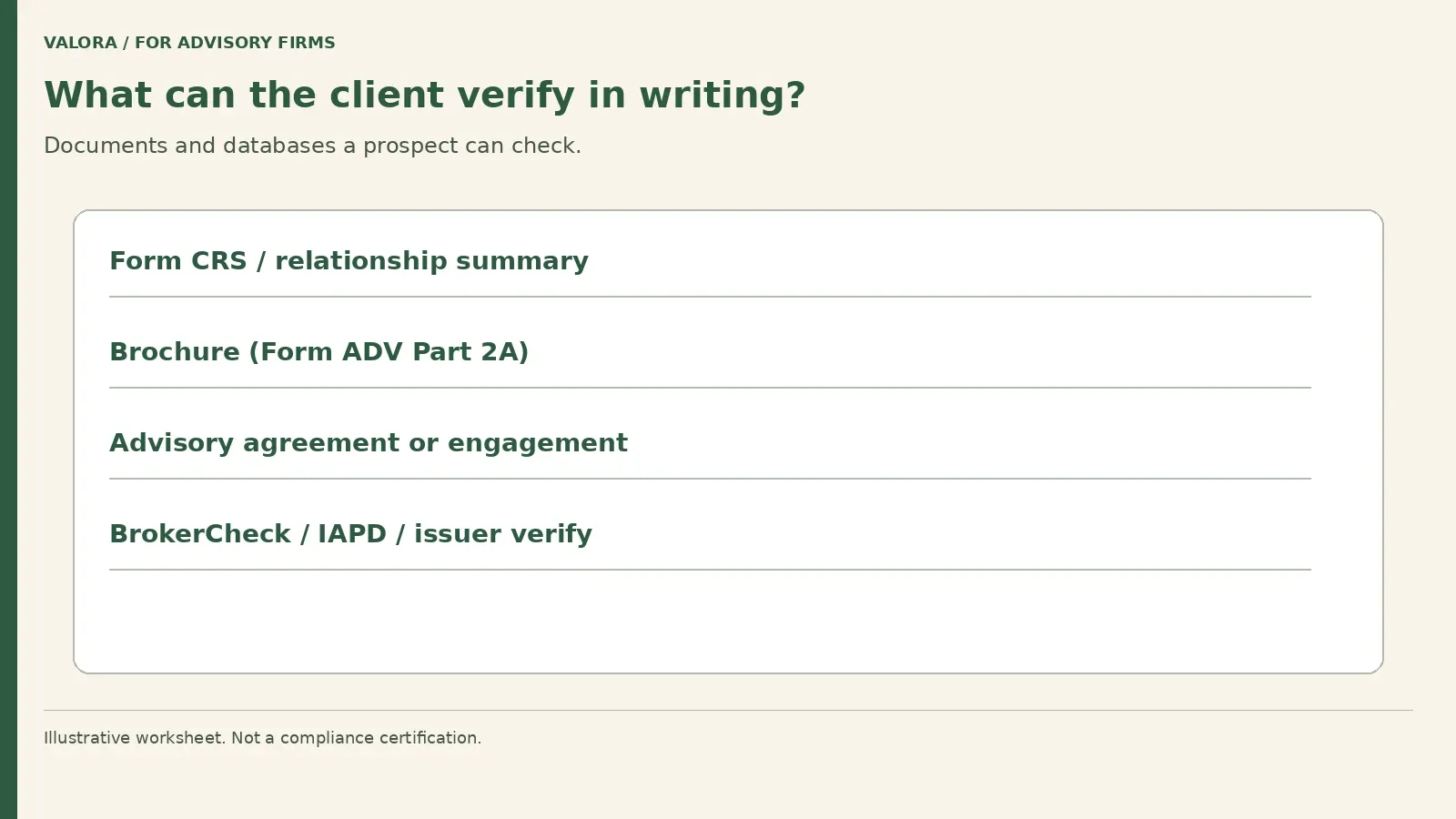
Start with current documents. Use Form CRS, the brochure, the advisory agreement and any fee schedule.
Form CRS covers services, fees and costs, conflicts, standards of conduct and reportable history. Investor.gov explains how to find a firm's relationship summary through its professional search tool.
Check registration and history. FINRA BrokerCheck covers many brokerage professionals and firms. The SEC's Investment Adviser Public Disclosure (IAPD) site covers advisory firms and investment adviser representatives (IARs), the people who give advice for an advisory firm. Investor.gov also links a free search that reaches these records. Registration shows that a firm or person is registered. It does not rate skill or quality.
The North American Securities Administrators Association (NASAA) is a voluntary association whose members are state, provincial and territorial securities administrators.
The SEC staff account-opening bulletin also points prospects to scope, service frequency, contract terms, fees, cancellation and conflicts. Use it as a conversation aid, not as a substitute for your own current forms.
If your firm calls itself a fiduciary in marketing, that is likely a material statement of fact. For SEC-registered advisers, the SEC Marketing Rule bars untrue or misleading statements of material fact. It requires a reasonable basis to substantiate material facts, and fair and balanced claims. State-registered firms should check their state securities regulator's advertising rules.
Can one person fill several roles?
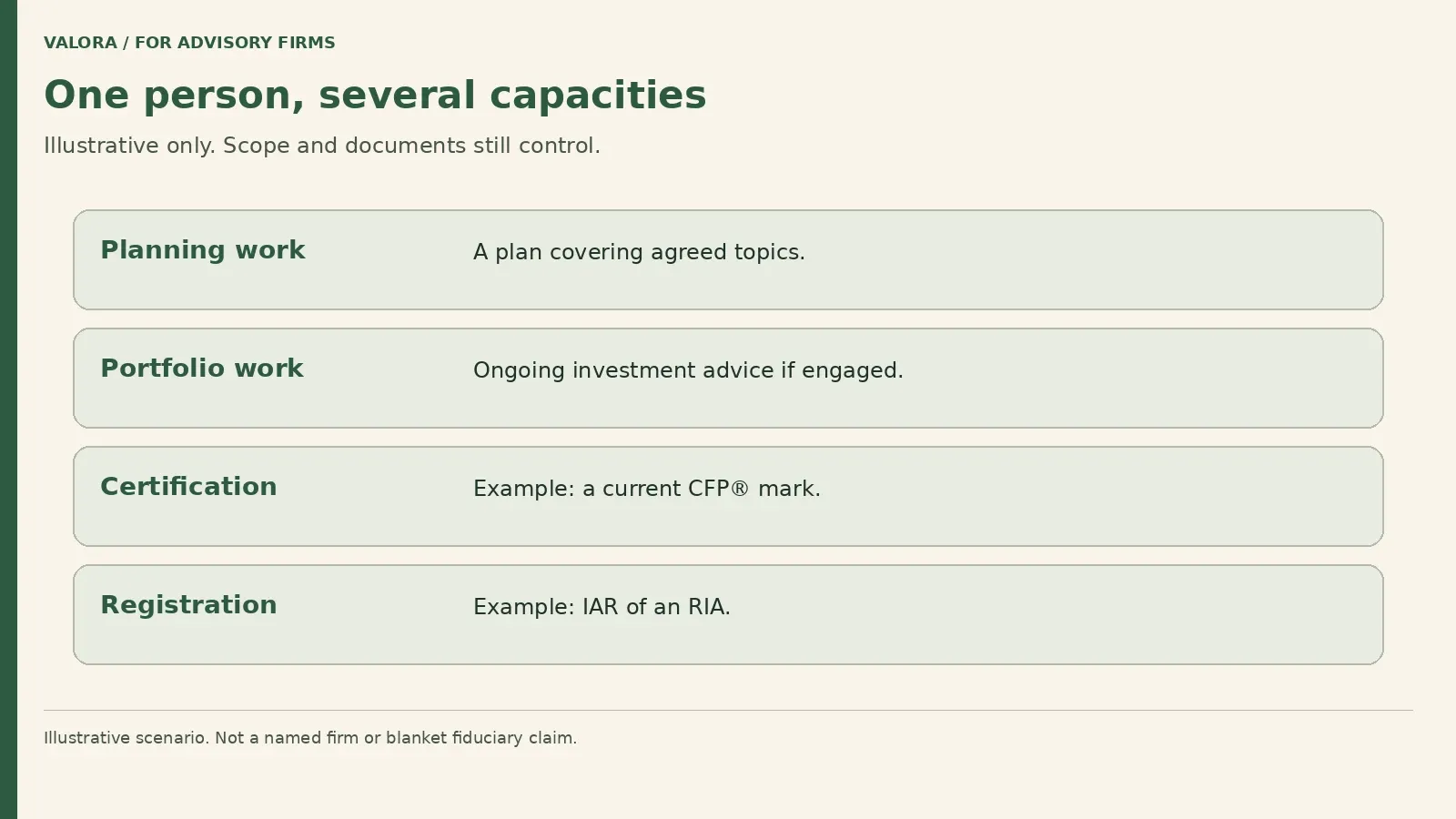
Yes. An illustrative example: one professional may deliver a financial plan and also manage a portfolio. The person may hold a CFP® mark and work as an IAR of a registered investment adviser (RIA), a firm registered to give investment advice under securities law.
Holding several roles does not mean every activity is fiduciary under every standard. A dual registrant may switch capacity during a relationship. Scope, capacity and the written engagement still control. One title does not make every recommendation fiduciary.
Compensation is another dimension, not a proxy for duty
How someone is paid is not the same as the duty they owe. A fee label does not prove fiduciary duty. A fiduciary claim does not prove a compensation model.
The SEC staff account-opening bulletin lists hourly, fixed or flat, and asset-based client fees. It also notes commissions as another way some professionals are paid. Those are payment methods. They are not duty labels.
For fee-only and fee-based payment labels under CFP Board rules, see How to explain fee-only vs fee-based pay to prospects. That guide covers how advisors are paid. This one covers role, credential, registration and duty.
A plain-English role and duty question set
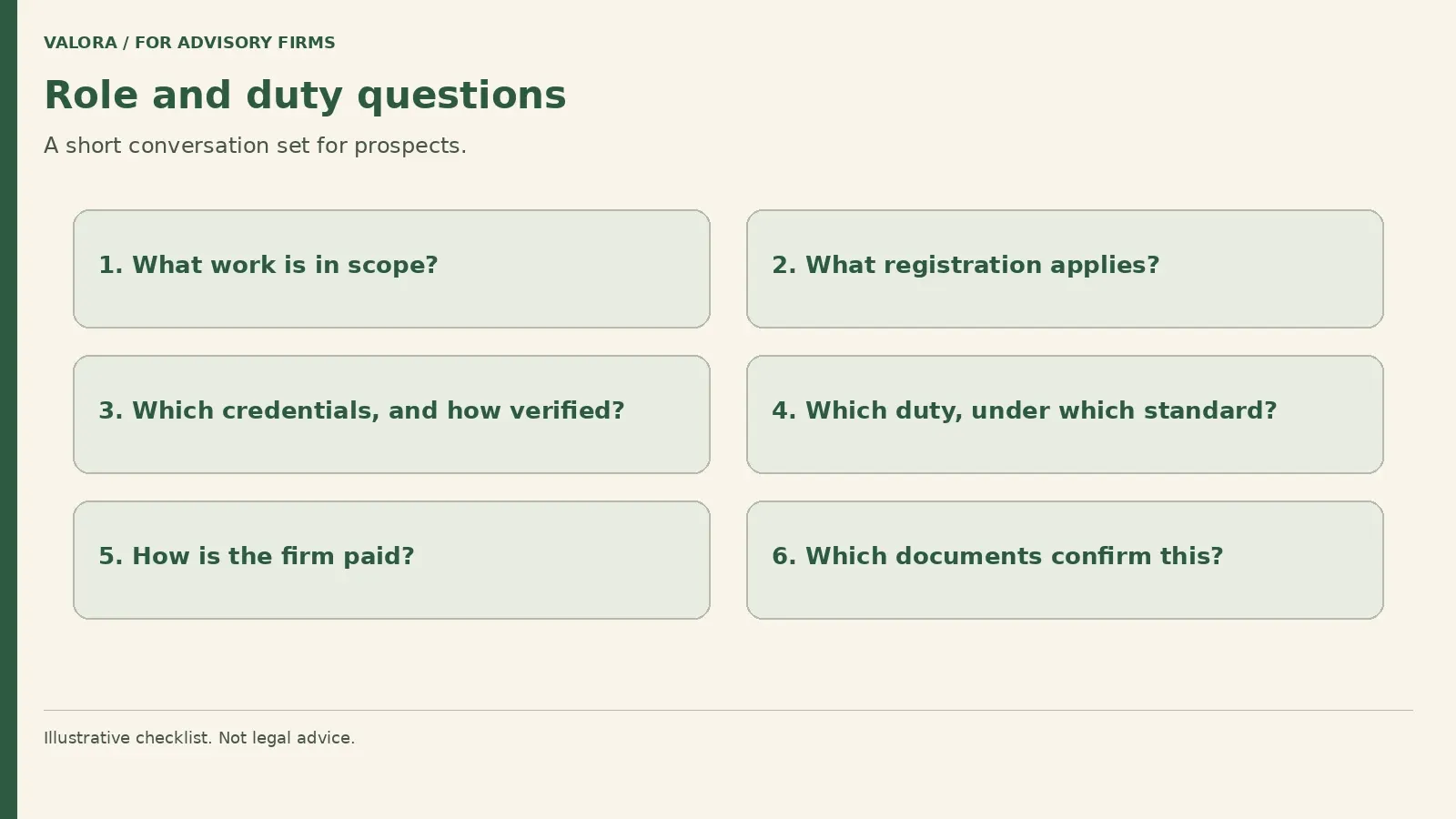
Use a short checklist with prospects:
- What work is in scope, and what is out?
- What license or registration applies to that work?
- Which certifications are claimed, and how can we verify them?
- Which duty applies, under which standard, and when?
- How is the firm paid for this work?
- Which documents and public databases confirm the answers?
Walk the list in order. Write down the capacity answer when the firm is a dual registrant.
Frequently asked questions
Does "wealth manager" mean the client must be rich? No. The title does not set a wealth minimum. Ask about the firm's actual client criteria and services.
Is every financial planner a CFP® professional? No. FINRA notes that planners come from many backgrounds. CFP® is one certification path, not a requirement to use the planner label.
Can a fee-based professional owe fiduciary duties? Yes, when a fiduciary standard applies to the work. Pay method and duty are different questions. See the fee-label guide linked above for compensation wording.
Can I look up "fiduciary" like a credential? Some private designations use the word fiduciary, and FINRA's Professional Designations tool lists several. A designation does not create or replace a legal fiduciary duty. Whether that duty applies depends on the standard and the work, so check the registration and the engagement.
If your firm later wants help making its services easier for suitable prospects to find and understand, you can learn about Valora's work for advisory firms. The current public offer is $250 per booked appointment with a qualified prospect, with a 3-appointment minimum, paid in advance. An appointment is a call booked on your calendar with a prospect who has asked to speak with an advisor. There is no setup fee, retainer, or long-term contract. If a prospect does not attend or does not meet the agreed criteria, the appointment is replaced at no charge. Your firm reviews what goes out under its name. Marketing is a separate decision from how you explain roles and duties.
This article is educational, not legal advice, compliance advice or personalized investment advice. Valora is not a registered investment adviser and does not provide investment advice. Valora provides marketing services to advisory firms.
Sources
- FINRA, Financial Planners. Planner backgrounds, services and regulation.
- FINRA, Professional Designations. Designation lookup, including CFA®, ChFC® and marks that use the word fiduciary.
- CFP Board, Code of Ethics and Standards of Conduct. Fiduciary Duty (A.1) when providing Financial Advice. Certification standards for CFP® professionals.
- SEC Investor.gov, Form CRS. Relationship summary topics for retail investors.
- SEC Investor.gov, Opening an Investment Advisory Account (updated June 24, 2020). Staff bulletin on services, fees, contracts and conflicts.
- SEC, Commission Interpretation Regarding Standard of Conduct for Investment Advisers, Release IA-5248 (2019). Primary PDF. Care, loyalty, scope, disclosure, monitoring and the separate Reg BI citation.
- SEC, Investment Adviser Marketing: A Small Entity Compliance Guide. Marketing Rule small entity guide. Scope: advisers registered or required to be registered with the SEC.
- FINRA, Check Registration / BrokerCheck. Registration check tools and BrokerCheck.
- SEC, Investment Adviser Public Disclosure (IAPD). AdviserInfo search.
- NASAA, About Us. State, provincial and territorial securities administrators association.
- CFP Board, Verify a CFP® Professional. Issuer verification.
- Valora, For Advisors (live read 2026-11-10). $250 per booked appointment; offer terms.
- Valora, How to explain fee-only vs fee-based pay to prospects. Sibling compensation guide.