
What are the best lead sources for RIAs (and how to compare them)?
Compare RIA lead sources—referrals, COIs, inbound search, content, paid matching, and booked appointments—on the same quality, cost, and consent tests.


There is no single best lead source for an RIA. The firms that grow steadily usually run a small portfolio: one high-trust source (client referrals or centers of influence), one intent source (search, directories, or AI answers that reach people already looking), and, if capacity allows, an optional paid or appointment-based fill. The right mix is the one that produces the most suitable conversations for your firm per dollar and per hour, judged on the same written tests for every source.
This guide defines what a “lead” actually is, summarizes what Cerulli and Schwab research says about where RIA clients come from, gives you a fair comparison frame, and walks through each source category. It does not rank vendors or promise that any channel will produce clients for your firm.
Key takeaways
- “Lead” covers very different products: a name, a warm introduction, a marketplace match, prospect data, or a booked appointment. Compare like with like.
- Referrals still dominate RIA new-client acquisition in Cerulli’s research, yet many firms are passive about asking.
- Judge every source on the same eight dimensions: fit, consent, exclusivity, advisor time, cash cost and term, measurability, speed to conversation, and compliance load.
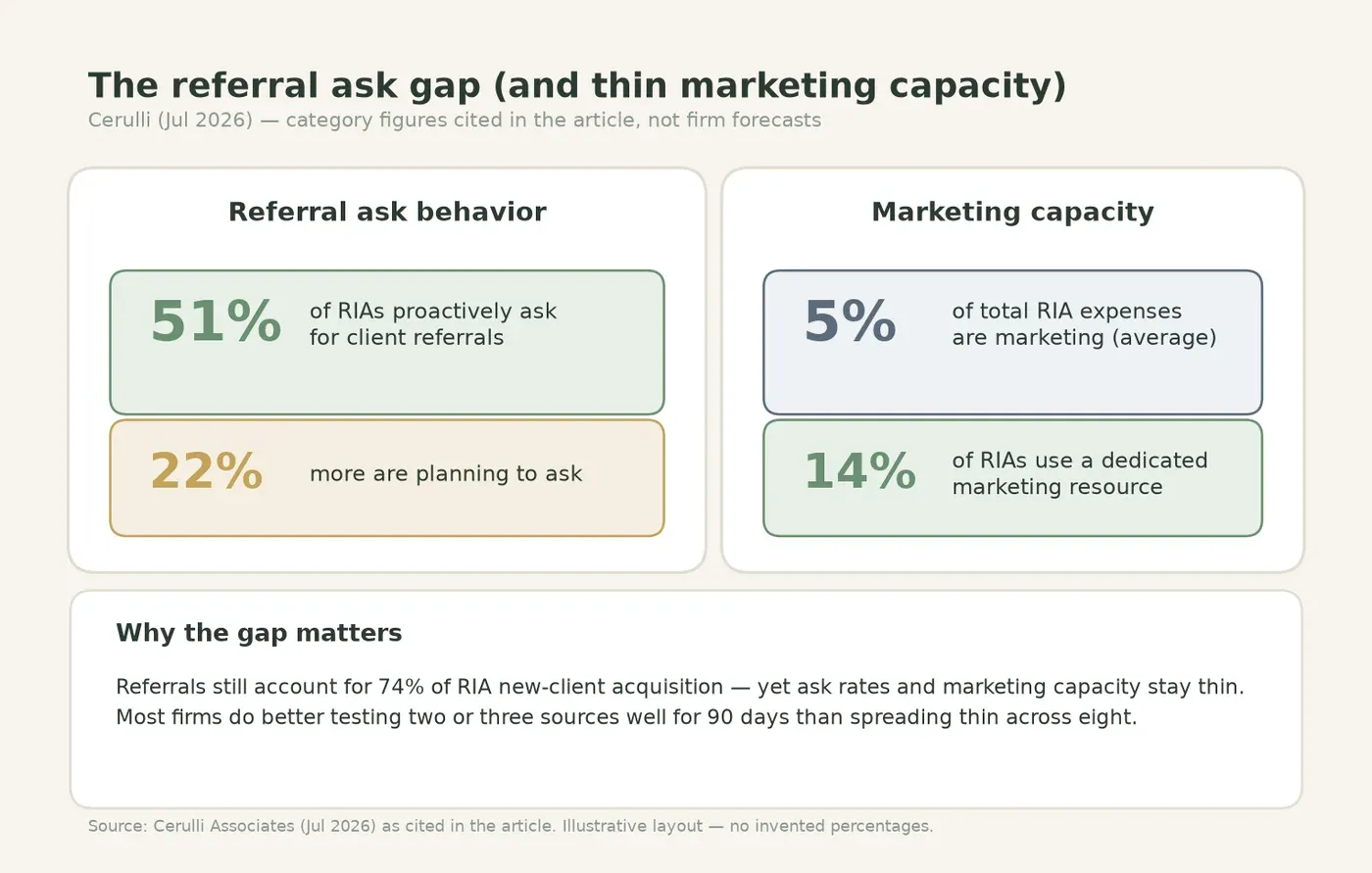
- Most firms do better testing two or three sources well for 90 days than spreading thin across eight.
- Measure suitable conversations, not lead counts.
What counts as a “lead”?
Before you rank anything, write down which unit you are buying or building. The same word hides five different products.
| Unit | What you get | What is still your job |
|---|---|---|
| Name or contact | A person who may need advice | Qualification, consent check, outreach, conversion |
| Warm introduction | A client or professional vouches for you | Prompt follow-up and a good first meeting |
| Marketplace match | A consumer who asked to be matched with one or more advisors | Speed to contact, fit check, close |
| Prospect data | Wealth or life-event signals | All outreach — you bought information, not interest |
| Booked appointment | A calendar meeting with someone who asked to speak with an advisor | The meeting and everything after — it is not a signed client |
A source that produces 100 names and a source that produces ten meetings are not comparable on “lead count.” The common unit is the suitable conversation: someone who fits your ideal client profile, agreed to talk, and showed up.
What does the research say about where RIA clients come from?
Two Cerulli press releases give useful category context:
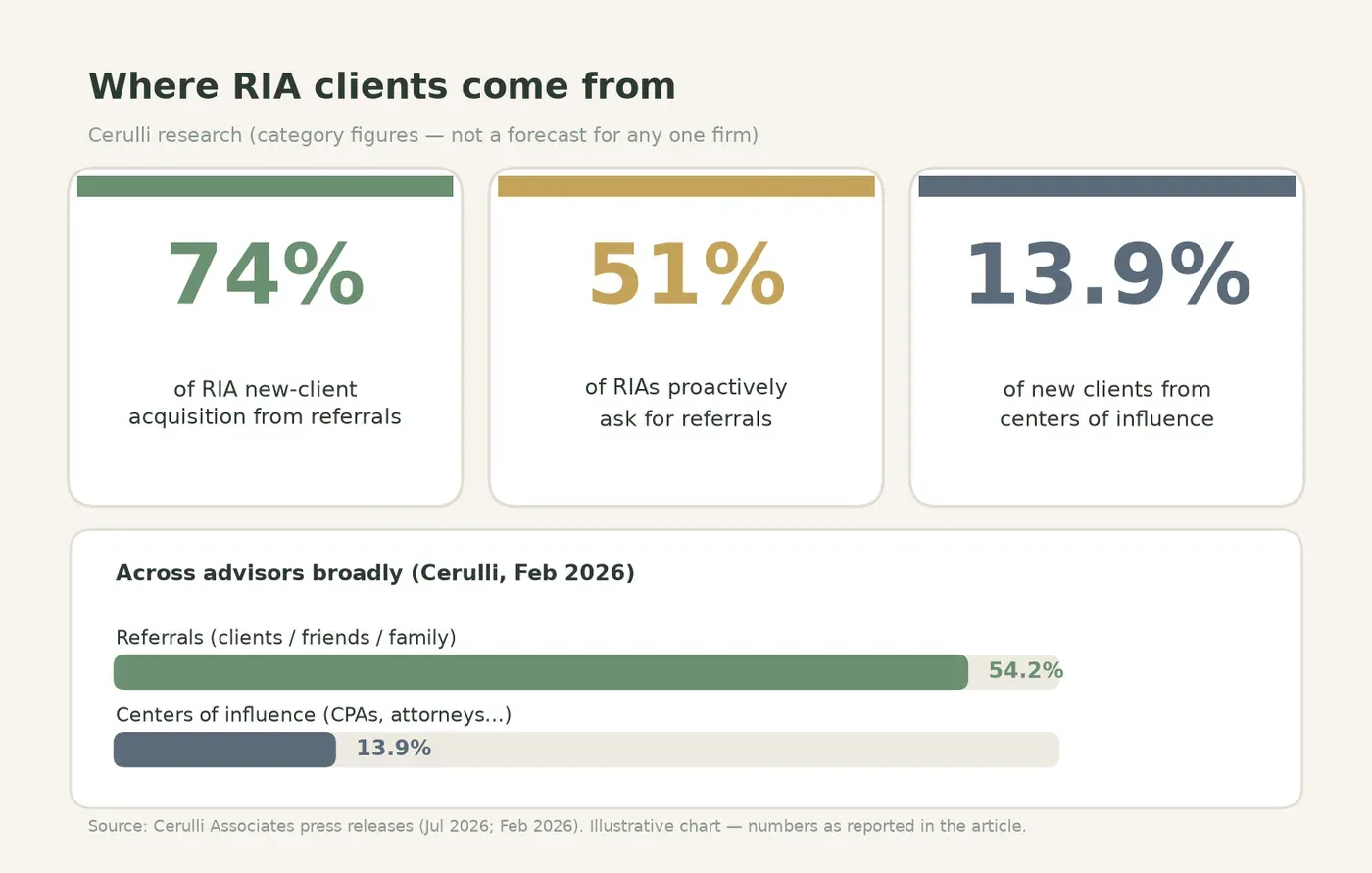
- Referrals account for 74% of RIA new-client acquisition, yet just 51% of RIAs proactively ask for client referrals, with another 22% planning to. Marketing averages about 5% of total RIA expenses, and only 14% of RIAs use a dedicated marketing resource (Cerulli, July 2026).
- Across advisors broadly, referrals from clients, friends, or family account for 54.2% of new clients, and centers of influence such as CPAs and attorneys are the second most common source at 13.9% (Cerulli, February 2026).
Schwab’s 2026 RIA Benchmarking Study (1,236 Schwab-custodied firms, self-reported) finds that Top Performing Firms are more likely to have a documented ideal client persona, value proposition, and marketing plan, and more likely to track the source of prospect inquiries (Schwab). That is an association, not proof that documenting a plan causes growth.
The practical reading: referrals are the backbone for most firms, marketing capacity is thin, and the firms that grow tend to know where inquiries come from.
How should you compare lead sources?
Use one table for every option — including the ones you already run. If a vendor or partner cannot answer a row in writing, that is information.
| Dimension | Question to answer |
|---|---|
| Quality / fit | What share matches your written ideal client profile? |
| Provenance / consent | How did this person enter the funnel, and did they agree to hear from an advisor? |
| Exclusivity | Does the same person go to one firm or several? |
| Advisor time | Who calls, books, nurtures, and follows up — and for how many hours a week? |
| Cash cost and term | All-in cost, commitment length, exit rules, and any ongoing asset-based fees |
| Measurability | Can you trace a signed client back to this source? |
| Speed to conversation | Weeks or months before a first meeting? |
| Compliance load | How much review do the ads, testimonials, or referral arrangements need? |
Then divide the all-in cost (cash plus a fair value for advisor hours) by expected suitable conversations. That number, not the sticker price, is what you compare.
Referrals and centers of influence
Client referrals
Client referrals remain the core source for most firms, but Cerulli’s data suggests many advisors still wait for them to happen. A specific ask is usually easier for a client to act on than a general one: name the kind of person you help (“a colleague going through the same equity-comp decision”), make the ask after a meaningful result, and make the introduction easy. Track who referred whom so you can see which relationships actually send fit.
Centers of influence
CPAs, estate attorneys, business brokers, and similar professionals are the second most common source in Cerulli’s research. Cerulli’s press release reports that practice management professionals rate joint meetings with clients or prospects, connecting over shared personal interests, and referring clients to the other professional first as the most effective ways to build these alliances. The pattern is relationship design: you bring value and introductions first, rather than asking a CPA to “send me clients.” COI work is slow to start and hard to scale, but it scores well on fit, consent, and exclusivity.
Inbound search, local presence, and directories
Inbound intent sources reach people who are already looking. Three practical rules:
- Problem pages beat generic copy. A page that answers a specific situation (for example, “what to do with a 401(k) after selling a dental practice”) is more useful to a searcher than another “comprehensive wealth management” page.
- Keep your local presence accurate. Name, address, services, and fees should match across your website, Google Business Profile, regulator records, and listings. That is profile hygiene, not a pile of city landing pages; thin city doorway pages are not a strategy we recommend.
- Directories are a supporting channel. They can add visibility and proof for smaller firms. Ask how listings are ranked and whether contacts are shared.
These sources take months to compound, cost mostly time, and are exclusive by construction: the prospect contacted you.
Content and AI-search visibility
More prospects now ask AI tools and search engines who to talk to. Being described accurately there depends on the same basics: consistent public facts, clear answer-first pages, and accurate listings. Nobody can guarantee that ChatGPT or Google’s AI features will cite or recommend your firm on a given day, so treat AI answers as dated snapshots you observe, not a ranking you buy.
For the AI side, start with Valora’s live readiness post, Can ChatGPT find your firm?, the companion How can an RIA get clients from ChatGPT and AI search?, and the 12-month referrals and AI-search review.
Paid matching, lead platforms, and booked appointments
Matching marketplaces and lead subscriptions
Matching marketplaces and lead subscriptions can add volume quickly. They also vary widely on the rows that matter: how the consumer was recruited, how many advisors receive the same person, commitment length, and whether fees continue as an asset share. Published prices and trade-press figures are starting questions, not your rate card — ask each vendor for current written terms and model the result with your own show and close rates.
For a dated vendor-by-vendor price and exclusivity table, see Valora’s live SmartAsset alternatives: what advisor lead generation actually costs. Note: that page still describes an earlier founding-advisor program that is not Valora's current offer. Valora's current public offer is $250 per booked appointment (for-advisors).
Appointment-based outreach
A booked-appointment model shifts what you pay for: instead of names or matches, you pay for a meeting on your calendar with someone who asked to speak with an advisor. That moves qualification and booking work off your desk, but a meeting is still not a client. Compare it on the same table: define “qualified” in writing, ask what happens when a prospect does not show or does not fit, confirm exclusivity and term, and review any outreach that goes out under your firm’s name.
How to pick two or three sources for the next 90 days
- Pick one high-trust source. Usually a structured referral ask or one COI relationship you will actually tend.
- Pick one intent source. One or two niche problem pages plus an accurate profile, or a directory you can measure.
- Optionally add one fill source — paid matching or booked appointments — only if you have the follow-up capacity and written terms.
- Write the success metric first: suitable conversations per month, by source.
- Set a stop rule. If a source cannot show suitable conversations at an acceptable all-in cost by day 90, cut it or change one variable.
Brand-new solo firms have a different problem — the first handful of clients — covered in Valora’s live Your first ten clients as a solo RIA.
Where Valora fits
Valora helps independent advisory firms get booked appointments with qualified prospects — people who asked to speak with an advisor — rather than selling lead lists. The public offer is $250 per booked appointment. Firms start with a 3-appointment minimum, paid in advance; there is no setup fee, retainer, or long-term contract, and appointments where the prospect does not attend or does not meet the agreed criteria are replaced at no charge (for-advisors). Your firm reviews what goes out under its name. Valora does not guarantee clients, rankings, AI citations, or lead volume, and it is one option to compare on the table above, not a replacement for referrals.
Related reading
- Can ChatGPT find your firm? — readiness of your public facts
- How can an RIA get clients from ChatGPT and AI search? — AI-search companion
- AI search and referrals: the next 12 months — calendar plan
- Your first ten clients as a solo RIA — new-firm plan
- SmartAsset alternatives — dated vendor table
Frequently asked questions
What is the best lead source for a solo advisor versus a team?
Solo advisors usually lack hours more than cash, so referrals, one COI, and one niche page tend to come first. Teams with a dedicated person for follow-up can absorb a paid or appointment-based source more easily. Either way, compare on suitable conversations.
Why do searches for “financial advisor leads” mostly show vendors?
Because that phrase is mostly used by companies selling lead products. Useful answers about how clients actually find advisors are more often framed as referral, COI, or niche-visibility questions.
Are seminars and events still worth it?
They can be when the audience shares a specific situation and the event is co-hosted with a trusted partner. Score them on the same table: cost, advisor time, consent, and suitable conversations.
Does cold outbound work?
Cold outreach to people who never asked to hear from you scores poorly on consent and usually on fit. Outreach to people who have raised a hand is a different product. Review either against your compliance policies.
What compliance rules apply?
Advertising, testimonials, endorsements, and paid referral arrangements fall under the SEC Marketing Rule for SEC-registered advisers, and states have their own rules. This page is educational; run any program past your compliance review.
Scope of this guide
This is educational marketing content for independent advisory firms, not investment, tax, legal, or compliance advice. Valora is not a registered investment adviser. Nothing here guarantees clients, rankings, AI citations, or lead volume from any source. Cerulli figures are press-release summaries; Schwab findings are associations from a self-reported sample, not causation. Ask any vendor for current written terms before you buy.
Sources
- SEC Division of Investment Management: Marketing Compliance — Frequently Asked Questions. https://www.sec.gov/rules-regulations/staff-guidance/division-investment-management-frequently-asked-questions/marketing-compliance-frequently-asked-questions
- Cerulli Associates (July 2026 press release): RIAs Must Offset Asset Churn with Dedicated Growth Efforts — referral share of new-client acquisition, proactive-ask gap, marketing spend and staffing. Accessed 7 Nov 2026. https://www.cerulli.com/press-releases/rias-must-offset-asset-churn-with-dedicated-growth-efforts
- Cerulli Associates (February 2026 press release): Financial Advisors Increasingly Leverage COIs to Capture New Client Growth — client/friends/family and COI shares; alliance-building practices. Accessed 7 Nov 2026. https://www.cerulli.com/press-releases/financial-advisors-increasingly-leverage-cois-to-capture-new-client-growth
- Schwab Advisor Services: 2026 RIA Benchmarking Study — Top Performing Firm habits including inquiry-source tracking (self-reported; association, not causation). Accessed 7 Nov 2026. https://advisorservices.schwab.com/insights-hub/perspectives/ria-benchmarking-study-2026
- Valora: for-advisors — $250 per booked appointment; offer terms. https://www.valorahq.com/for-advisors/
- Valora: SmartAsset alternatives (dated vendor table). https://www.valorahq.com/insights/smartasset-alternatives/
- Valora: Your first ten clients as a solo RIA. https://www.valorahq.com/insights/your-first-ten-clients-as-a-solo-ria-where-they-actually-come-from/
- Valora: Can ChatGPT find your firm? https://www.valorahq.com/insights/can-chatgpt-find-your-firm/