
How much should a new solo RIA budget for software and marketing in its first year?
Budget first-year software and marketing as running costs, not a one-time setup bill, without copying an industry number that is not first-year data.


A new solo registered investment adviser (RIA) should budget software and marketing as recurring running costs, not as a one-time setup bill. Formation and registration can look inexpensive next to the subscriptions, compliance tools, marketing tests, and founder time that repeat every month. There is no first-year benchmark in the sources cited below for either line. Build the budget from the functions the firm must support, the actual quotes it can get, and the cash it can spend before revenue is steady.
The Kitces AdvisorTech 2025 study reports median technology spend for already-established unsupported solo practices, not for firms in their first year. It is also not a marketing budget (Kitces Report, Volume 1, 2025). Treat those figures as context, not as a target.
This article is for new solo RIA owners planning a first-year cash budget. An RIA is a firm registered to give investment advice for compensation. This is firm-side education, not legal advice or a recommended spend.
How much should a new solo RIA budget for software and marketing?
There is no first-year benchmark in the sources cited below for software or for marketing. The useful budget is the sum of the recurring tools the firm must have, a marketing plan it can actually fund, and a cash reserve for slower months. A percentage of hoped-for revenue is not a budget if that revenue has not arrived.
This page is a year-one cash guide for software and marketing. It is not a hiring guide, a workflow-automation guide, or a vendor review. For operating questions after traction, including capacity, hiring, and founder time, see How to grow a solo RIA into a real firm. That live article starts once an existing client book creates recurring work. It does not set a first-year software or marketing budget.
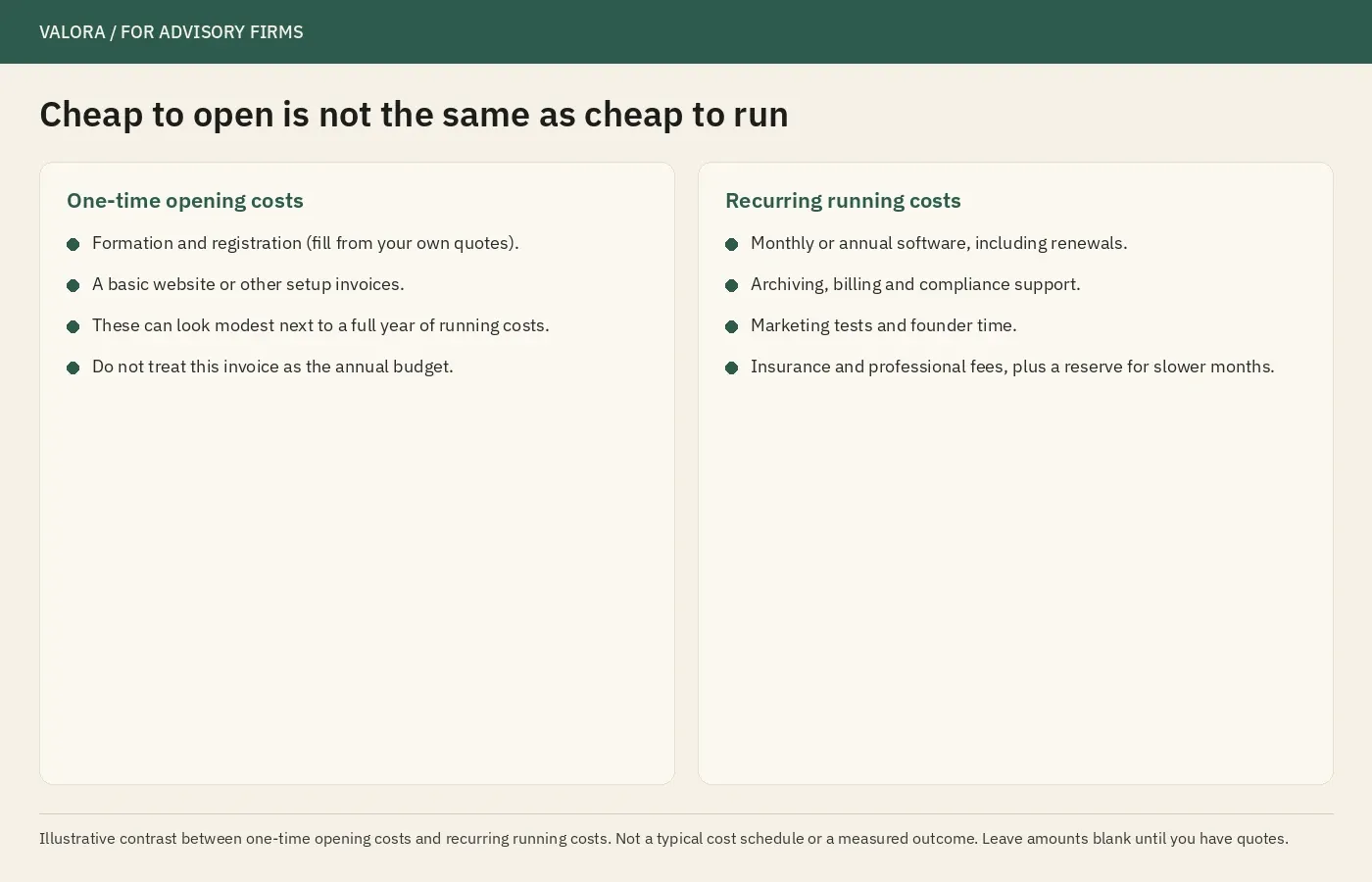
Cheap to open is not the same as cheap to run
Formation, initial registration, and a basic website can look modest next to twelve months of software, archiving, compliance support, insurance, professional fees, and marketing tests. None of the sources cited below itemizes those opening costs, and this article does not invent them. The point is timing and cash flow. A one-time setup invoice is not the annual operating budget.
The costs that repeat are the ones that squeeze a new firm. A promotional first month of software is not the renewal. A domain and a simple site are not a year of reviews, tests, and founder time spent on marketing. Insurance and professional fees often arrive on their own calendar, not on the day you form the firm. If you only budget the opening bill, you can run short once the subscriptions start renewing.
Cheap tools can also make a firm look easy to open. They do not change the running cost of staying in business, or the work of explaining value to a household. For that later conversation, see How to explain what clients pay for when software does the math. This page stays on cash and categories.
Build the budget from quotes and functions, not a copied percentage
Start with the functions the firm must perform. Get current vendor quotes for those functions. Add the founder time it will take to set them up and keep them current. Only then total the year. Fill the numbers from your own quotes. Do not copy a percentage from another firm, and do not treat hoped-for revenue as cash you already have.
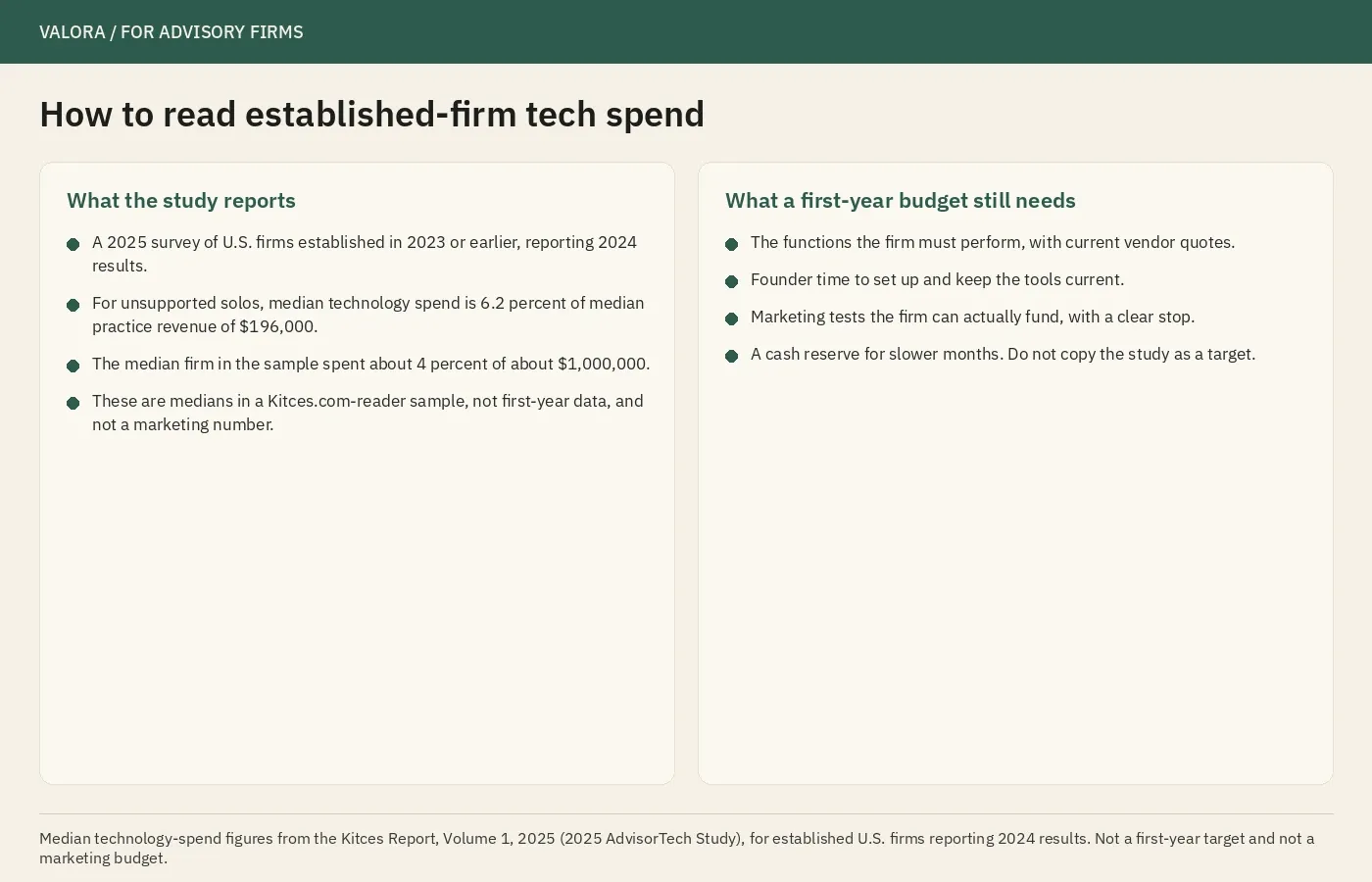
The Kitces AdvisorTech 2025 study can supply context, and it cannot supply a first-year target. It is a 2025 survey of U.S. firms established in 2023 or earlier, reporting 2024 operating results (Kitces Report, Volume 1, 2025). The study was fielded from March 14 to April 28, 2025, on Kitces.com. Eligibility excluded newer firms so respondents would have a full year of 2024 revenue and expenses. Nearly 1,400 people at least partly completed the survey, and 703 responses were usable. Most results were reported within a plus or minus 3 percent margin of error. The sample is Kitces.com readers, described as more advice- and planning-centric than the broader industry. In that sample, 59 percent of respondents were affiliated exclusively with an RIA.
For unsupported solo advisors, meaning an advisor with no other advisors or W-2 employees, the study says technology spend amounts to 6.2 percent of annual practice revenue of $196,000. The figure notes say those figures are medians. That is context for established unsupported solos in a Kitces.com-reader sample. It is not a first-year target, and it is not a marketing number. Do not treat the product of those two medians as a recommended software budget.
The study also reports that the median firm in the sample, with five members and about $1,000,000 in revenue, spent about 4 percent of revenue on technology. That is a different group. A new solo firm may need fewer tools than a larger firm and still pay a higher share of early revenue, because many subscriptions are fixed costs.
Software: pay for functions the firm must perform
Budget the work the firm has to do, not a "best stack." Vendor-neutral categories a new solo firm often has to pay for include planning, a customer relationship management (CRM) system, document and message archiving, billing, compliance support, and a website and related tools. This list is a starting inventory, not a ranking and not an endorsement of any product.
A firm can spend less by buying fewer tools. It cannot spend nothing on functions it is required to perform. Archiving, billing, and a way to keep client records are not optional extras once the firm is open. If you are choosing which workflow to automate first, and what controls to put around it, see What should a solo RIA automate first?. This page does not repeat that workflow guide.
Budget the renewal, not only the promotional first month. Count implementation and training time as part of the cost, because founder hours are cash you cannot spend twice. Before you change a CRM or another system of record, treat export and reconstruction work as a real cost. For the testing that should happen before a switch, see What should an advisory firm test in a CRM export before switching tools?. Do not skip that work to make this year's budget look smaller.
Marketing: time, tests, and paid acquisition
Marketing is not only ad spend. Include founder time, review of anything published under the firm's name, and a bounded test with a clear stop. There is no typical marketing percentage in the sources cited below, and this article does not invent one.
A useful marketing line has a dollar cap, a time cap, and a way to tell whether the test is worth continuing. It also has a person who reviews what goes out. If the offer or the test appears in an advertisement, the SEC Marketing Rule's general prohibitions apply to advisers registered or required to be registered with the Securities and Exchange Commission. An advertisement may not include an untrue statement of a material fact, or a material claim the adviser cannot substantiate. Benefits need fair and balanced treatment of associated risks and limits (SEC small entity compliance guide, April 28, 2021). Do not promise clients, revenue, or a cost per client from a marketing test. The Marketing Rule does not, by its own terms, apply to advisers that are only state-registered. State-registered advisers should check their state securities regulator's advertising rules.
Video can be one optional line in this budget. It should not become a production plan here. For a pilot, a cost calculation, and the difference between views and inquiries, see How should a small advisory firm budget and test video marketing?.
Paid lead generation and directory programs belong in the same worksheet as other marketing tests. They are budget lines with a stop, not a growth strategy for this page. Staff cost is a later decision. When the firm is ready to check hiring economics, use the live firm-building article rather than turning this budget into a staffing plan.
A first-year cash worksheet
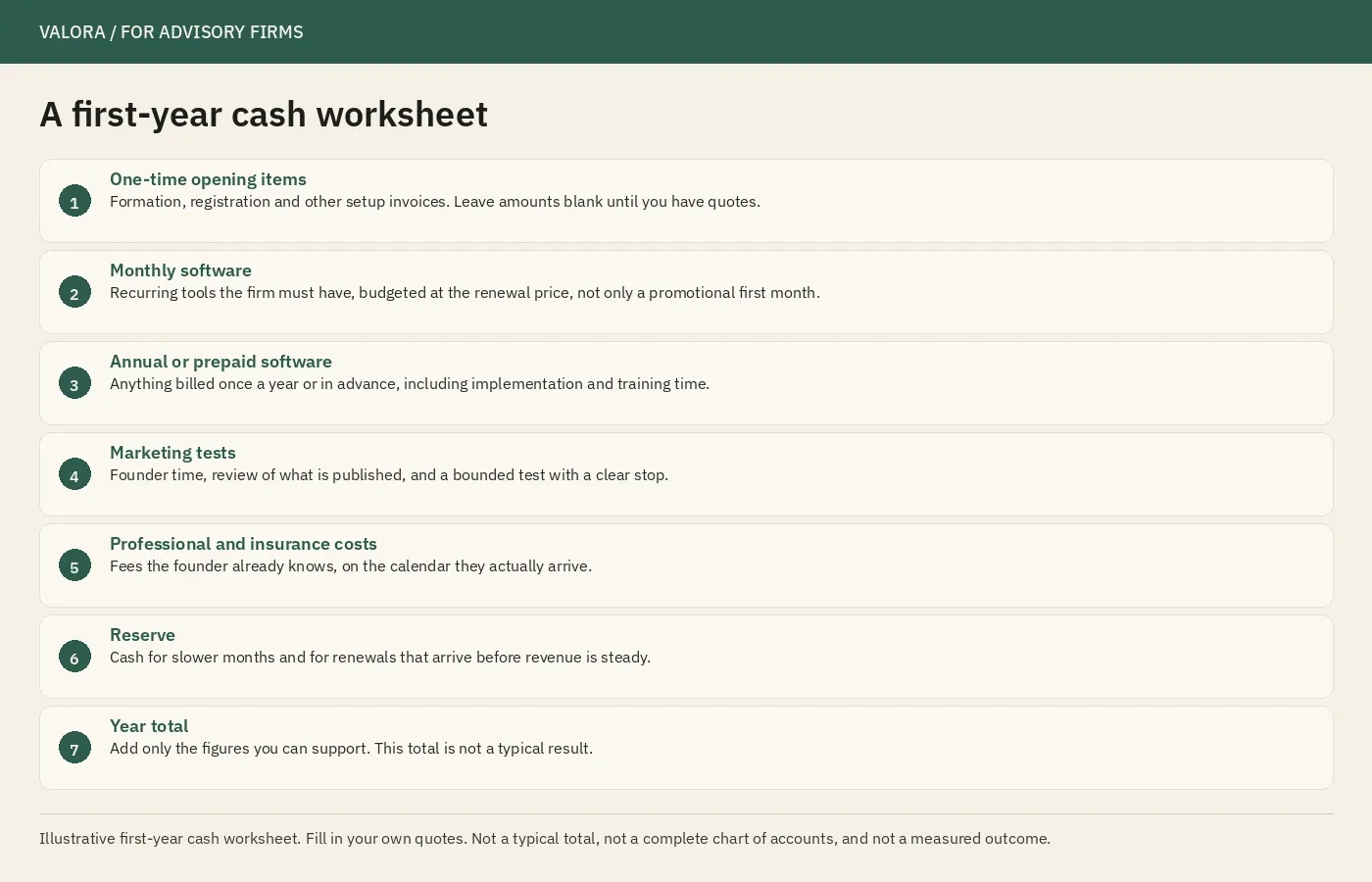
Use a simple worksheet to hold the numbers you can actually quote. Leave amounts blank until you have them. This is an organizing list, not a complete chart of accounts, and not a claim that any total is typical.
Include one-time opening items, without inventing the amounts. Include monthly software and any annual or prepaid software. Include marketing tests, with founder time counted. Include professional and insurance costs the founder already knows. Include a reserve for slower months and for renewals that arrive before revenue is steady.
Fill only what you can support with a quote, an invoice, or a calendar. If a cell is empty, that is a research task, not a reason to copy someone else's percentage.
FAQ
Is there a standard first-year percentage I should copy? No. The AdvisorTech 2025 figures are medians for established unsupported solo practices, and for a different median firm in the same study, not for firms in their first year (Kitces Report, Volume 1, 2025). Newer firms were excluded so respondents would have a full year of 2024 results. No cited source gives a representative first-year software or marketing percentage. Build the budget from functions, quotes, and cash on hand.
Can a firm stay cheap by skipping archiving or a CRM? Skipping a required function does not make the firm cheaper to run. It can shift the cost into cleanup, a later switch, or a gap in records. Budget the functions you must perform, then decide how simply you can buy them. A smaller stack can still be a complete stack.
Does more software spending make the firm more productive? Not in the study cited here. The AdvisorTech executive summary reports no statistically detectable increase in revenue productivity from higher technological sophistication in that comparison (Kitces Report, Volume 1, 2025). It also found no significant difference in tech-stack satisfaction by the percentage of revenue spent on technology. Staff leverage was the larger productivity factor in the study. That is a limit on "buy more tools" claims. It is not hiring advice. Hiring and capacity questions belong in How to grow a solo RIA into a real firm.
Does a software and marketing budget replace a clear fee explanation for clients? No. A budget is an internal cash plan. Investor.gov tells people to understand the fees and services of an advisory account before they open one (Investor.gov, updated June 24, 2020). That bulletin is staff education, not a rule. Budget decisions do not replace those client-facing explanations.
Next step for firms that want help being found
If your firm later wants help making its services easier for suitable prospects to find and understand, you can learn about Valora's work for advisory firms. The current public offer is $250 per booked appointment with a qualified prospect, with a 3-appointment minimum, paid in advance. An appointment is a call booked on your calendar with a prospect who has asked to speak with an advisor. There is no setup fee, retainer, or long-term contract. If a prospect does not attend or does not meet the agreed criteria, the appointment is replaced at no charge. Your firm reviews what goes out under its name. Marketing is a separate decision from the first-year software budget.
This article is educational, not legal advice, tax advice, compliance advice or personalized investment advice. Valora is not a registered investment adviser and does not provide investment advice. Valora provides marketing services to advisory firms.
Sources
- Kitces Report, The Technology That Independent Financial Advisors Actually Use And Like, Volume 1, 2025 (2025 AdvisorTech Study). Study PDF. Survey of U.S. firms established in 2023 or earlier, reporting 2024 results. Median technology-spend figures are context for established firms, not a first-year target and not a marketing budget.
- Investor.gov, Investor Bulletin: Opening an Investment Advisory Account (September 25, 2017, updated June 24, 2020). Investor.gov Bulletin. Staff education, not a rule.
- U.S. Securities and Exchange Commission, Investment Adviser Marketing, a small entity compliance guide (April 28, 2021). SEC Marketing Rule small entity guide. The Marketing Rule applies to advisers registered or required to be registered with the Commission.
- Valora, For advisors, offer terms as of November 11, 2026. Valora for advisors.