
How to make your first hire as a solo advisor
Help solo and small RIA owners plan a first hire: the work, worker classification, IAR registration, privacy rules and pay structure.


A first hire is a work, classification, registration, and privacy decision, not only a payroll decision. There is no official healthy share of revenue to spend on admin or client-service pay. Start with the work the person will do. Then choose a vendor or a direct hire, classify the relationship from the facts, and check whether the role needs investment adviser representative (IAR) registration.
This piece is for solo and small registered investment adviser (RIA) owners. An RIA is a firm registered to give investment advice for compensation. It is firm-side education, not employment law, tax advice, or personalized compliance advice.
In advisor community threads, solo owners often ask how much of revenue to spend on admin or client-service pay. They also ask whether to use a virtual assistant (VA) firm or hire directly. Comments touch pay structure, including surprise at revenue-share pay for admin roles. These are anonymized forum observations, not a study.
Start with the work, not a revenue percentage
No official source sets a healthy percentage of revenue for admin or client-service pay. A ratio copied from a peer thread is not a rule. Budget from your own records and actual quotes instead.
If you are still deciding whether you need help at all, start with How to grow a solo RIA into a real firm. That guide covers workload inventories, bottleneck roles, and the cost of adding help. This piece picks up after that choice, when a first seat is on the table.
Write the recurring tasks you want to hand off. Include review time you will still spend. A role that only works if new clients arrive on schedule is a weak plan.
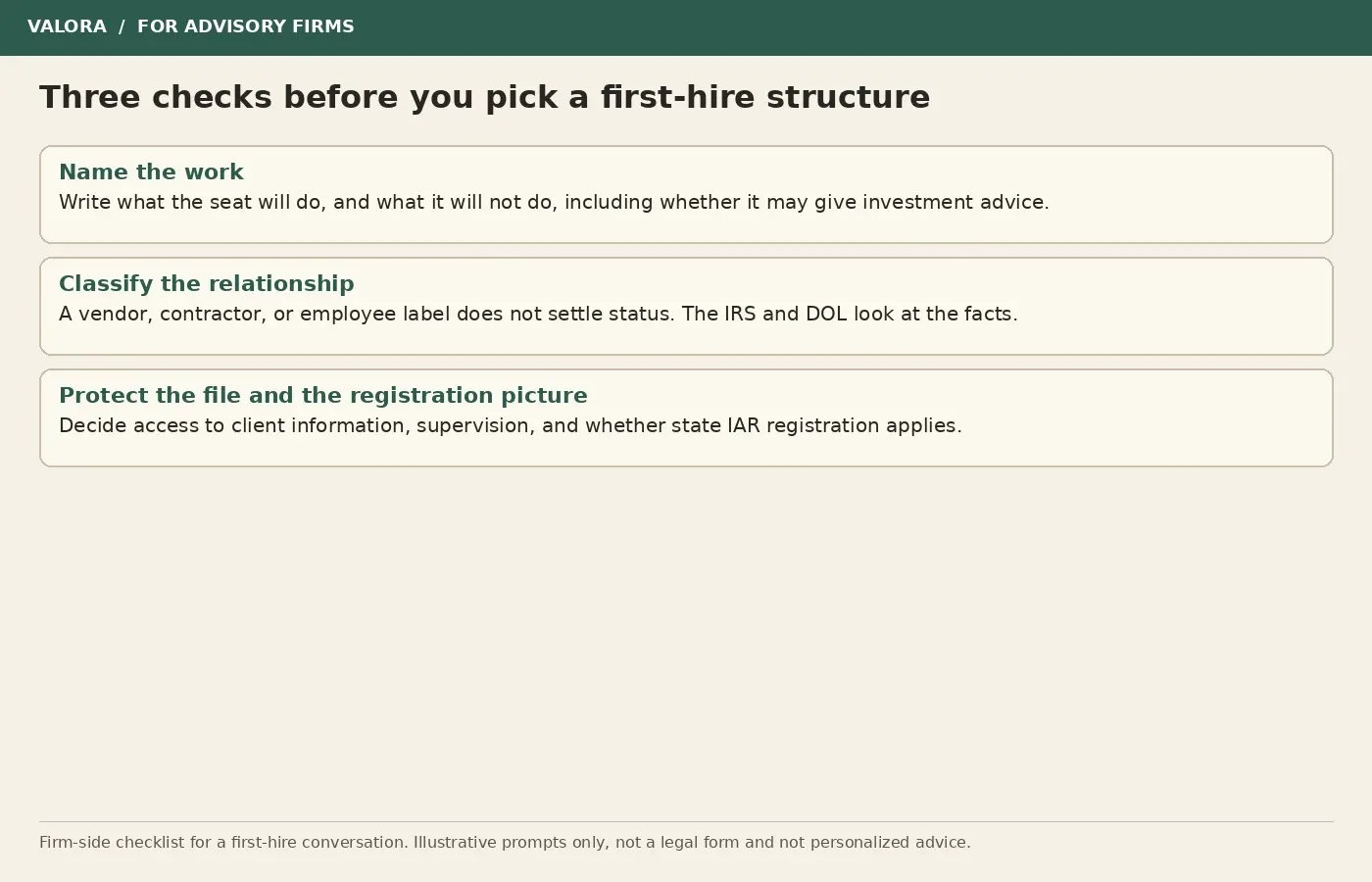
Name what the first seat will and will not do
Separate support work from advice work. Scheduling, document collection, and task tracking are different from recommending investments or presenting a plan. Role titles do not settle what a person may legally do.
State the limits in writing. Say whether the person may speak with clients, open systems that hold household data, or draft advice for your review. Vague instructions such as taking work off your plate leave both sides guessing.
If the later question is how a junior planner seat should change when tools draft the plan, use How to redesign the junior advisor role when AI drafts the plan. That article is for firms that already have a service team. It is not a first-hire guide for a solo practice.
Choose a vendor, a contractor, or an employee
A VA firm, a direct contractor, and an employee can all perform similar tasks on a calendar. They are not the same legal relationship. The label in a contract does not settle the status.
A vendor can be a fit for defined support work if access, confidentiality, and review are clear. Direct hiring can be a fit when you need one person inside your process. Neither path removes the need to classify the relationship correctly and to protect client information.
Ask what happens if the work is steady, directed by you, and uses your tools. Those facts matter more than whether the invoice comes from a company or a person.
How the IRS looks at employee versus contractor status
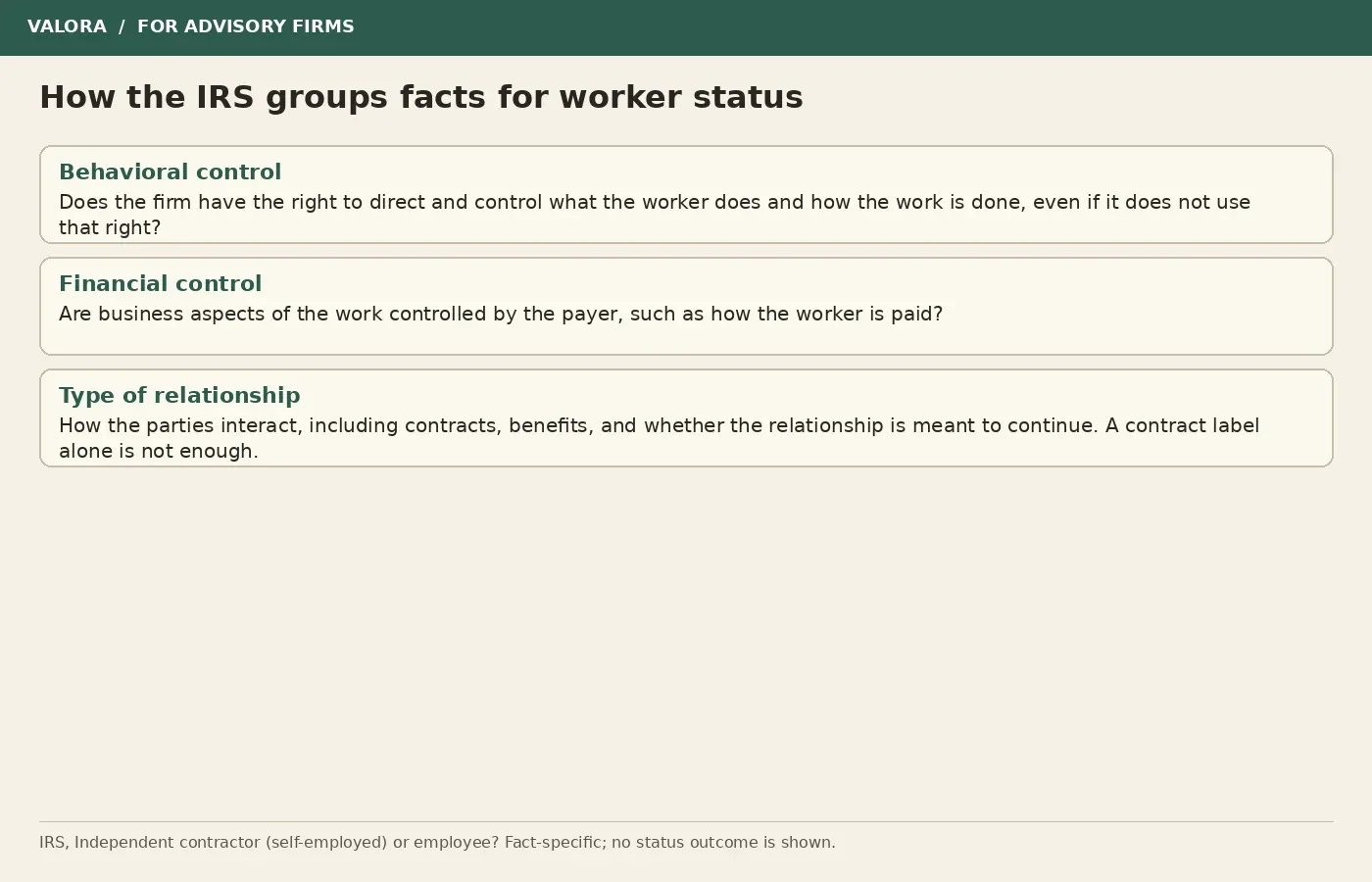
The Internal Revenue Service (IRS) is the U.S. federal tax authority. For federal employment tax, it looks at facts that show control and independence. Those facts fall into three categories: behavioral control, financial control, and type of relationship.
Behavioral control asks whether the firm has the right to direct and control what the worker does and how the work is done, even if that right is not used. The IRS notes that detailed instructions and certain evaluation systems may point toward employee status.
Financial control asks whether the payer controls business aspects of the work, including how the worker is paid. Type of relationship looks at how the parties interact. That can include written contracts, employee-type benefits, and whether the relationship is expected to continue.
A contract that calls someone an independent contractor is not enough, on its own, to set the status. If the facts remain unclear, the IRS provides Form SS-8, Determination of Worker Status for Purposes of Federal Employment Taxes and Income Tax Withholding. Publication 15-A, Employer's Supplemental Tax Guide, is another IRS resource.
Classifying an employee as an independent contractor without a reasonable basis can make the business liable for employment taxes. This is a fact-specific test. Get qualified tax advice before you treat a first seat as settled.
The Department of Labor test is a separate question
The U.S. Department of Labor (DOL) enforces the Fair Labor Standards Act (FLSA), the federal wage and hour law. DOL Fact Sheet 13 describes an economic reality test for whether an employment relationship exists under the FLSA.
Under that framing, a worker who is economically dependent on the employer for work is an employee. A worker who is in business for themself is an independent contractor. The fact sheet lists several factors, including control, permanence, and whether the work is integral to the business.
That test is broader than the common law standard often used under other federal laws, according to the same fact sheet. A person can raise different questions under the IRS rules and under the FLSA. State wage and tax rules can add still more tests.
The Department of Labor's current enforcement position is in Field Assistance Bulletin 2025-1, issued May 1, 2025. Its investigators do not apply the 2024 independent-contractor rule. They rely on Fact Sheet 13 and a 2019 opinion letter (FLSA2019-6) instead. The 2024 rule still applies in private lawsuits. Check current guidance with qualified counsel.
If you hire as an employer, set up the tax basics
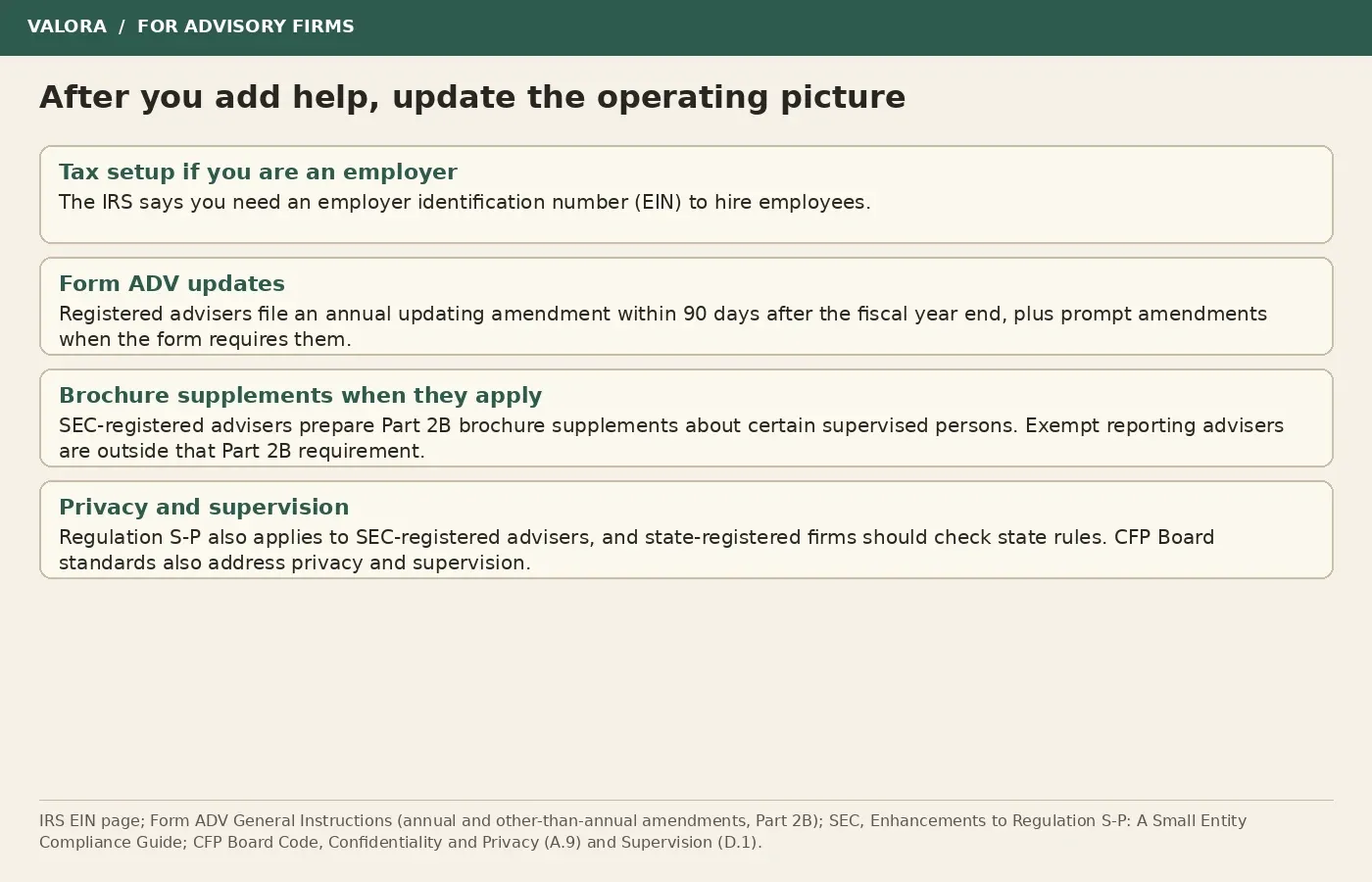
The IRS says you need an employer identification number (EIN) to hire employees. An EIN is a federal tax ID for a business. Having an EIN does not, by itself, make a worker an employee. It is a filing tool for employers.
Employment tax withholding, wage statements, and related filings follow once a worker is an employee. Those steps belong with a tax professional and payroll process, not in a marketing article. If the first hire is an employee, the firm is taking on employer duties, not only a new calendar.
If the person may give investment advice, check IAR registration
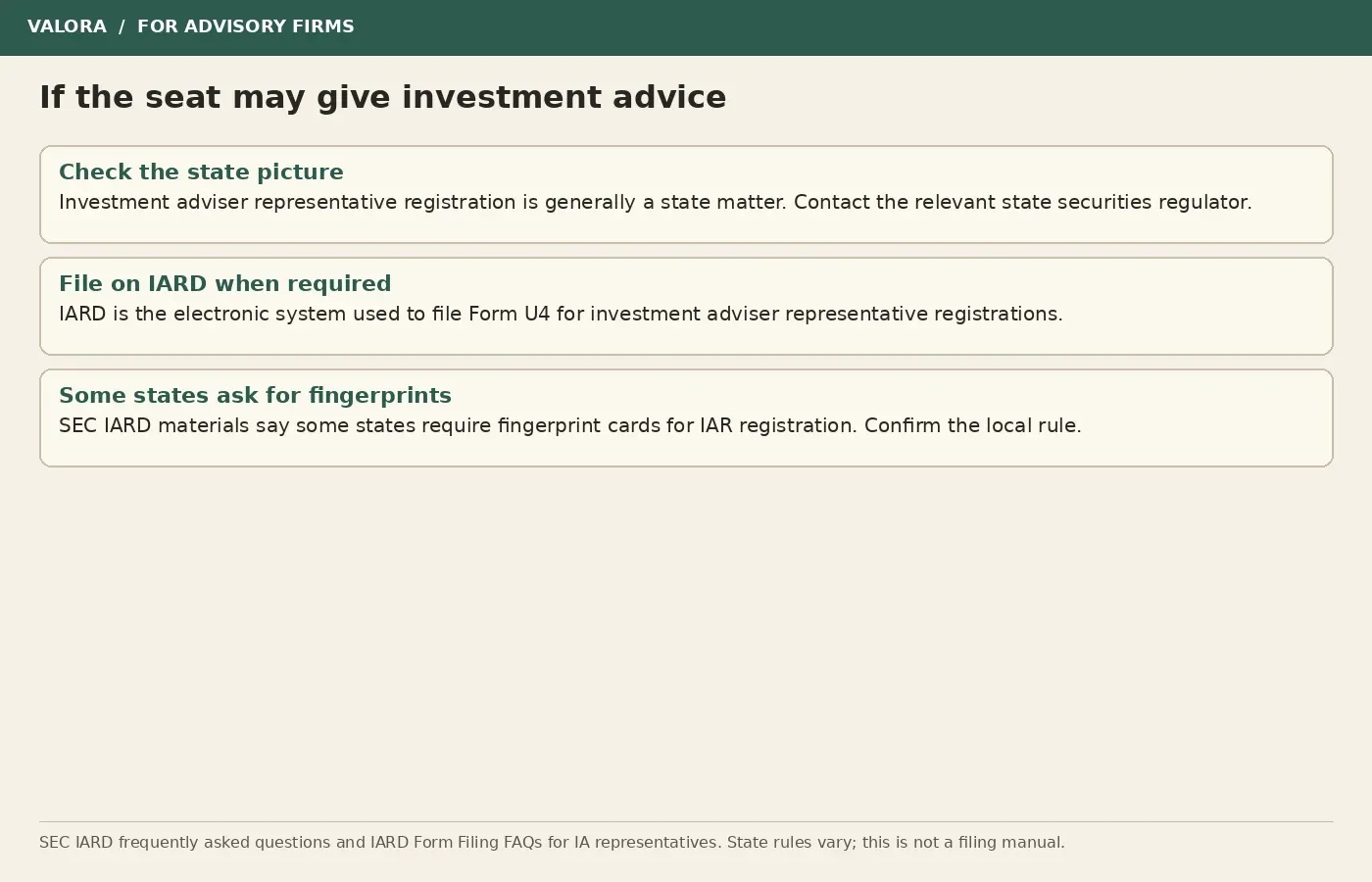
An investment adviser representative (IAR) is an individual who represents an advisory firm in giving investment advice, as defined under applicable state rules. IAR registration is generally handled by state securities regulators, not as a separate U.S. Securities and Exchange Commission (SEC) license for the individual.
The Investment Adviser Registration Depository (IARD) is the electronic system used for adviser filings. IARD Form Filing FAQs explain that firms file Form U4, the uniform form used to register or transfer an individual, for investment adviser representative registrations. Some questions, including state exemptions, require a direct check with the state.
SEC IARD frequently asked questions also note that some states require fingerprint cards for IAR registration. If you have questions about IAR registration or a related fingerprint rule, contact the relevant state securities authority.
IARD lists qualification paths used in the filing system, including certain exams or recognized designations. Those system paths are not a substitute for the state's own rules. Confirm the state's requirements before a new person gives advice.
The SEC's Investment Adviser Public Disclosure (IAPD) site at adviserinfo.sec.gov is the public record for many adviser firms and representatives. FINRA (Financial Industry Regulatory Authority) BrokerCheck is a different public tool, focused on broker-dealer registrations. Use the tool that matches the person's actual registration.
Update Form ADV when the firm's facts change
Form ADV is the uniform registration and disclosure form for investment advisers. Advisers file it electronically through IARD. The Form ADV General Instructions require an annual updating amendment within 90 days after the end of the firm's fiscal year.
The same instructions also require other-than-annual amendments, filed promptly, when specified items become inaccurate. A first hire can change disclosures, supervised-person information, or other answers. Follow the form's instructions rather than waiting for a convenient later date.
Part 2B of Form ADV requires SEC-registered advisers, and applicants for SEC registration, to create brochure supplements about certain supervised persons. That Part 2B requirement does not apply to exempt reporting advisers. A support hire who does not meet the supplement criteria may not need a Part 2B document. Check the instructions for the actual seat.
Protect client information when someone else can see the file
CFP® is a certification mark owned by Certified Financial Planner Board of Standards, Inc. (CFP Board). For CFP® professionals, the Code of Ethics and Standards of Conduct includes confidentiality and privacy duties (section A.9).
A.9 requires reasonable steps to protect the security of a client's non-public personal information, including information stored physically or electronically. The aim is to prevent unauthorized access that could harm or inconvenience the client. A.9 also requires policies on protection, handling, and sharing of that information. Written notice goes to the client at engagement and at least annually, subject to stated exceptions.
Those duties apply when a vendor, contractor, or employee can see household files. Limit access to what the work requires. Record who can enter systems and how you review that access. A shared inbox is not a reason to give unrestricted access to every record.
For advisers registered with the SEC, Regulation S-P also governs the treatment of nonpublic personal information about customers. The 2024 amendments apply to those advisers. For smaller entities, the compliance date was June 3, 2026, and that date has passed. The amendments require a written incident-response program. They also require written policies for oversight of service providers that handle customer information. CFP Board treats compliance with Regulation S-P, or a substantially equivalent federal or state rule, as compliance with standard A.9 when the firm is subject to that rule. State-registered firms should check their state's privacy and safeguarding rules.
CFP Board section A.13 applies when you recommend or engage additional people to provide professional services for a client. It requires a reasonable basis for the recommendation, based on reputation, experience, and qualifications. It also requires disclosure of material economic benefits tied to the engagement.
Supervise the work you hand off
Assigning a task does not, by itself, settle who may decide or who reviews the work. For CFP® professionals, section D.1 requires reasonable care when supervising people acting under the professional's direction. The aim is to help prevent violations of applicable laws, rules, regulations, and the Standards.
That is a scoped certification duty. It is not the complete supervisory rule for every registered adviser. Ask a compliance reviewer to check the firm's actual obligations. State the difference between support, advice, and approval, and give a route for issues outside the person's authority.
Pay structure does not settle classification
Community comments sometimes treat revenue-share pay for admin work as unusual. That reaction is not a legal finding. No official source bans or requires a particular pay method for a first admin or client-service seat.
Pay method and legal status are different questions. A revenue share, hourly rate, or salary does not, on its own, settle whether someone is an employee or a contractor under IRS or DOL tests. Benefits, direction, and permanence still matter.
If a new person will appear in the firm's advertising, SEC-registered advisers should also review the SEC Marketing Rule. The Marketing Rule applies to advisers registered or required to be registered with the SEC. State-registered firms should check their state securities regulator's advertising rules.
FAQ
Is there a healthy percentage of revenue to spend on a first admin hire?
No official source sets that percentage. Community threads discuss the question, but those comments are not a study. Budget from your own costs and quotes.
Does using a VA firm avoid employee classification questions?
No. The IRS looks at the facts of control and independence, not only the vendor's label. Privacy, access, and review still belong to the firm.
Does every first hire need IAR registration?
No. Registration depends on whether the person will act as an IAR under the relevant state's rules. Confirm that with the state securities regulator before the person gives advice.
Is this legal, tax, or employment advice?
No. This article is firm-side education for advisory owners. It is not legal advice, tax advice, compliance advice, or personalized investment advice.
Next step for firms that want help being found
If your firm later wants help making its services easier for suitable prospects to find and understand, you can learn about Valora's work for advisory firms. The current public offer is $250 per booked appointment with a qualified prospect, with a 3-appointment minimum, paid in advance. An appointment is a call booked on your calendar with a prospect who has asked to speak with an advisor. There is no setup fee, retainer, or long-term contract. If a prospect does not attend or does not meet the agreed criteria, the appointment is replaced at no charge. Your firm reviews what goes out under its name. Marketing is a separate decision from how you staff the first seat.
This article is educational, not legal advice, tax advice, compliance advice or personalized investment advice. Valora is not a registered investment adviser and does not provide investment advice. Valora provides marketing services to advisory firms.
Sources
- IRS, Independent contractor (self-employed) or employee? IRS worker status page.
- IRS newsroom, Understanding Employee vs. Contractor Designation (historical content). IRS designation explainer. The current worker-status page is Source 1.
- IRS, Publication 15-A, Employer's Supplemental Tax Guide. Publication 15-A.
- IRS, About Form SS-8, Determination of Worker Status for Purposes of Federal Employment Taxes and Income Tax Withholding. Form SS-8.
- IRS, Apply for an employer identification number (EIN) online. EIN page.
- U.S. Department of Labor, Wage and Hour Division, Fact Sheet 13: Employment Relationship Under the Fair Labor Standards Act (FLSA). DOL Fact Sheet 13. 6a. U.S. Department of Labor, Wage and Hour Division, Field Assistance Bulletin No. 2025-1 (May 1, 2025). FAB 2025-1 PDF.
- CFP Board, Code of Ethics and Standards of Conduct, Confidentiality and Privacy (A.9); Duties When Recommending, Engaging, and Working With Additional Persons (A.13); Use Reasonable Care When Supervising (D.1). Code and Standards.
- SEC, How To Register With the SEC as an Investment Adviser (electronic filing through IARD). SEC IARD registration page.
- SEC, Form ADV General Instructions (annual updating amendment within 90 days after fiscal year end; other-than-annual amendments; Part 2B brochure supplements). Form ADV instructions PDF.
- SEC, IARD Frequently Asked Questions (IAR registration questions and state fingerprint notes). SEC IARD FAQ.
- IARD, System Frequently Asked Questions, Form Filing for IA Representatives (Form U4 filings; contact states on exemptions). IARD IA representative FAQs.
- SEC, Investment Adviser Public Disclosure. IAPD.
- SEC, Investment Adviser Marketing: A Small Entity Compliance Guide. Marketing Rule small entity guide. Scope: advisers registered or required to be registered with the SEC.
- Community observations paraphrased from advisor-forum threads summarized in Valora's Facebook research pack, 2026-11-09 (admin and client-service staffing for solo advisors, including VA firm versus direct hire and pay-structure comments). Not a survey. No member names. No invented quotes.
- U.S. Securities and Exchange Commission, Enhancements to Regulation S-P: A Small Entity Compliance Guide. Regulation S-P small entity guide.