
Can financial advisors text clients?
Yes, if the firm can keep the texts. What the SEC records rule covers, what exam staff saw work, and what to do when a client texts your cell.


Yes, if your firm can keep the texts. Advisers registered, or required to be registered, with the Securities and Exchange Commission (SEC) must keep written communications about advice, money movements, orders, and performance. That includes texts.
In a December 14, 2018 review of advisers' texting and messaging, SEC exam staff noted practices that may help a firm stay within the books-and-records rule. Allow only the messaging tools your firm can retain. Ban apps that automatically destroy messages. Tell staff what to do when a client texts a personal phone. Train people, and check that they follow the policy. Those were staff observations, not requirements.
The SEC has said it is considering a proposal to update the recordkeeping rule for electronic communications. A regulatory agenda is not a rule. Until a new rule is adopted, the current rule still applies.
This is educational, not legal or compliance advice. Confirm how the rule applies to your firm with counsel or your chief compliance officer (CCO). The recordkeeping rule discussed here applies to advisers registered, or required to be registered, with the SEC. State-registered advisers should check their state recordkeeping rules. Dual registrants also follow Financial Industry Regulatory Authority (FINRA) requirements, which this page does not describe.
Short answer: yes, if you can capture and keep it
You can text a client. The condition is that the firm treats those texts like other written business communications. Use only channels the firm can capture and keep. Have a plan for when a message arrives on a personal phone. Do not use disappearing-message apps for business.
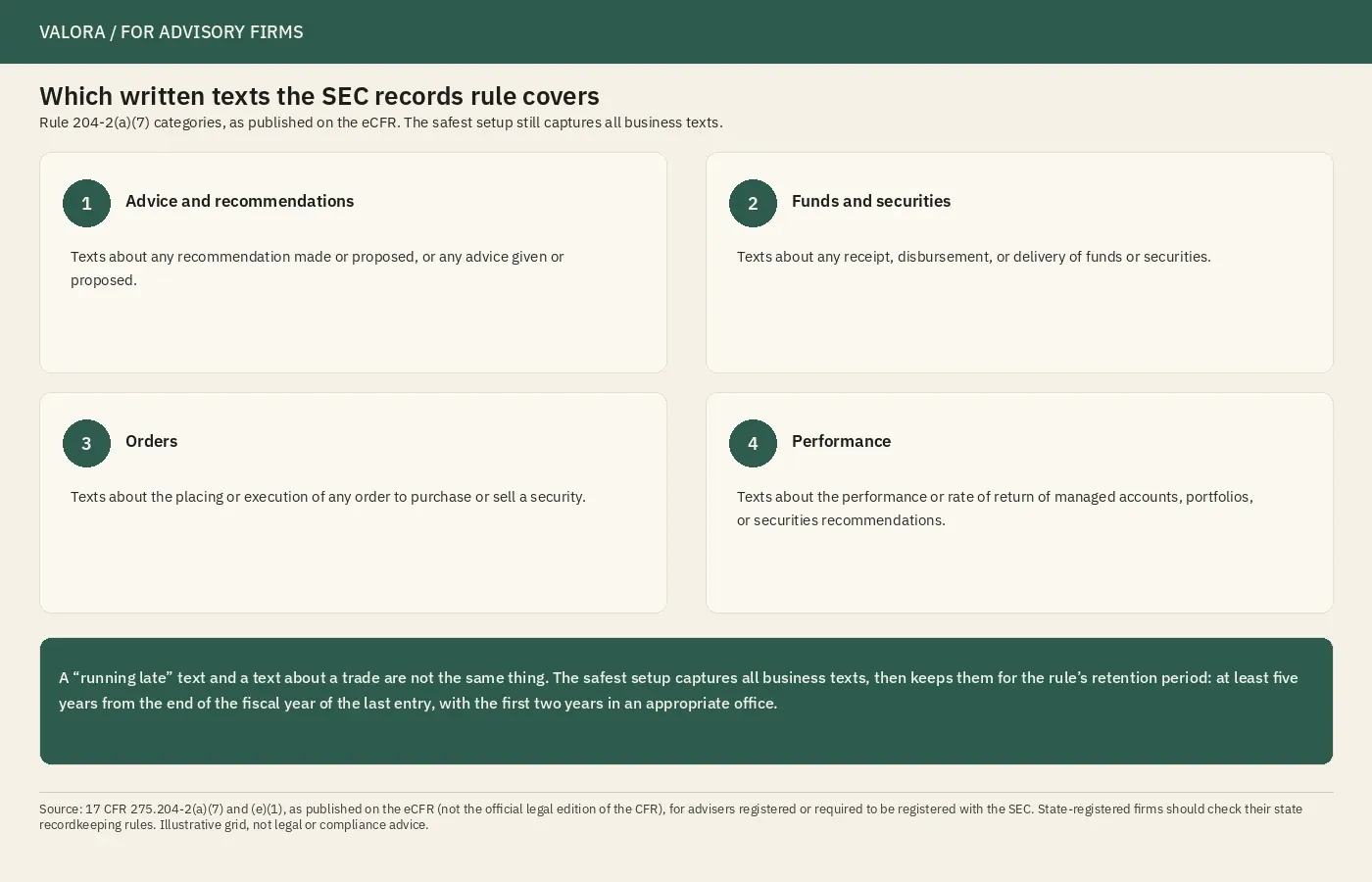
A text that says you are running late, and a text about a trade, are not the same thing. The safest setup still captures all business texts, so you are not sorting them after the fact.
What the rule actually covers
The books-and-records rule for SEC-registered advisers is Rule 204-2 under the Investment Advisers Act of 1940. The text quoted below is from the Electronic Code of Federal Regulations (eCFR), a continuously updated online version of the Code of Federal Regulations. The eCFR is not the official legal edition of the CFR.
Rule 204-2(a)(7) requires you to keep originals of all written communications received, and copies of all written communications sent, relating to certain subjects. Those subjects include any recommendation made or proposed to be made, and any advice given or proposed to be given. They also include any receipt, disbursement, or delivery of funds or securities, and the placing or execution of any order to purchase or sell any security. They also include predecessor performance, and the performance or rate of return of any or all managed accounts, portfolios, or securities recommendations.
In the December 14, 2018 risk alert, SEC exam staff included "text/SMS messaging, instant messaging, personal email, and personal or private messaging." The staff also included messages sent on firm systems or third-party apps, and messages sent from firm devices or "personally owned computers or mobile devices." Those are staff observations about the scope of their review, dated December 14, 2018. They are not a new rule.
Rule 204-2(e)(1) then sets the holding period for those records, with some exceptions set out in the rule. They must be preserved in an easily accessible place for at least five years from the end of the fiscal year during which the last entry was made on the record. The first two years must be in an appropriate office of the investment adviser.
State-registered advisers should check their state recordkeeping rules. Those state rules were not reviewed for this page.
A subscriber's reply to a firm newsletter is also a communication to record, which a separate page already covers. See What should an advisory firm record when a subscriber replies to a newsletter?.
What SEC exam staff saw firms do that worked (2018)
On December 14, 2018, the SEC's Office of Compliance Inspections and Examinations (OCIE) published a risk alert on electronic messaging. The alert shares "the staff's observations" from a limited-scope examination initiative. The staff also said the alert "is not intended to be a comprehensive list of practices for a firm to meet its regulatory obligations." The items below are staff observations, not requirements. They are dated December 14, 2018.
Staff noted practices they believe may assist advisers in meeting the books-and-records rule. One was "Permitting only those forms of electronic communication for business purposes that the adviser determines can be used in compliance with the books and records requirements." Another was specifically prohibiting business use of apps that allow "automatic destruction of messages," or that let someone communicate anonymously.
When an employee receives a message on a channel the firm does not allow for business, staff observed a "move those messages" practice. That practice requires moving the messages to another electronic system the firm can retain, "and including specific instructions to employees on how to do so." Staff also observed training on what is permitted and prohibited, and attestations at the start of employment and regularly thereafter. They also observed "Soliciting feedback from personnel as to what forms of messaging are requested by clients."
Where a firm permits personally owned mobile devices for business, staff observed written policies on that use. Those policies included prior approval before staff use a personal device to access firm systems. Staff also observed loading security apps or other software before a device is used for business communications. This page does not name vendors or tools.
When a client texts your personal phone
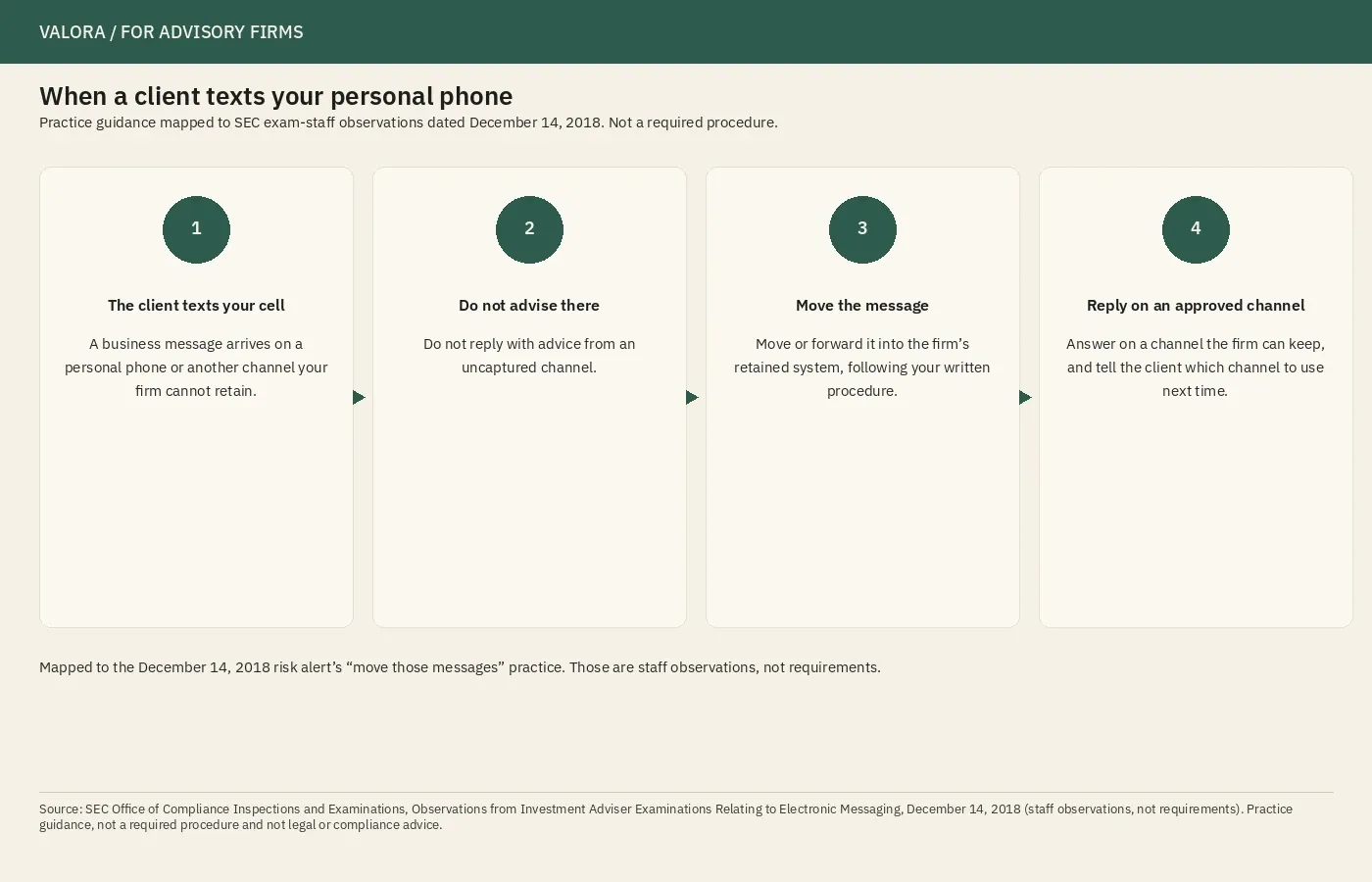
Clients will text the number they already have. If that number is a personal phone, or another channel the firm cannot retain, do not answer with advice on that channel.
The December 14, 2018 staff observations included a "move those messages" practice. Mapped to that practice, do this. Move or forward the message into the firm's retained system, following your written procedure. Reply on an approved channel the firm can keep. Tell the client which channel to use next time. Get prior approval, if your policy requires it, before using a personal device for business.
This is practice guidance, not a required template and not a finding that the December 14, 2018 alert created a new duty. Confirm the steps with your CCO.
Where the SEC is headed (and what hasn't changed)
The current rule is still Rule 204-2. Plan for today's rule.
On the federal Unified Agenda, under regulatory identification number 3235-AN66, the SEC's Division of Investment Management describes a possible project titled "Amendments to Investment Adviser Recordkeeping Rule." The abstract says the Division "is considering recommending that the Commission propose amendments to rule 204-2." The stated aims are "the appropriate scope of and identified compliance burdens related to electronic communications," and "certain technological developments since the rule was adopted." The agenda lists the item in the proposed-rule stage, designates it "Deregulatory," and shows a notice-of-proposed-rulemaking timetable of October 2026.
An agenda entry is not a rule, and it is not a proposal. As of the check for this page, the SEC's public rulemaking activity list did not include an issued proposal to amend Rule 204-2 for electronic communications. Until the Commission adopts a new rule, the current recordkeeping rule still applies.
Texts that need extra care
Some texts need more than a routine save. Do not accept money-movement instructions by text without verification.
If you use texts for marketing, the Marketing Rule can apply. That rule is for advisers registered, or required to be registered, with the SEC. State-registered advisers should check their state securities regulator. This page does not explain the Marketing Rule. See SEC Marketing Rule in plain English for solo RIAs (testimonials, reviews, AI copy).
For the year-round marketing-compliance workflow in a one-person practice, see How can a solo RIA manage marketing compliance without a compliance department?.
If a client complaint arrives by text, record it and route it, even if it reaches the wrong person. See What should an RIA record when a client complaint reaches the wrong person?.
A one-page texting policy for a small firm
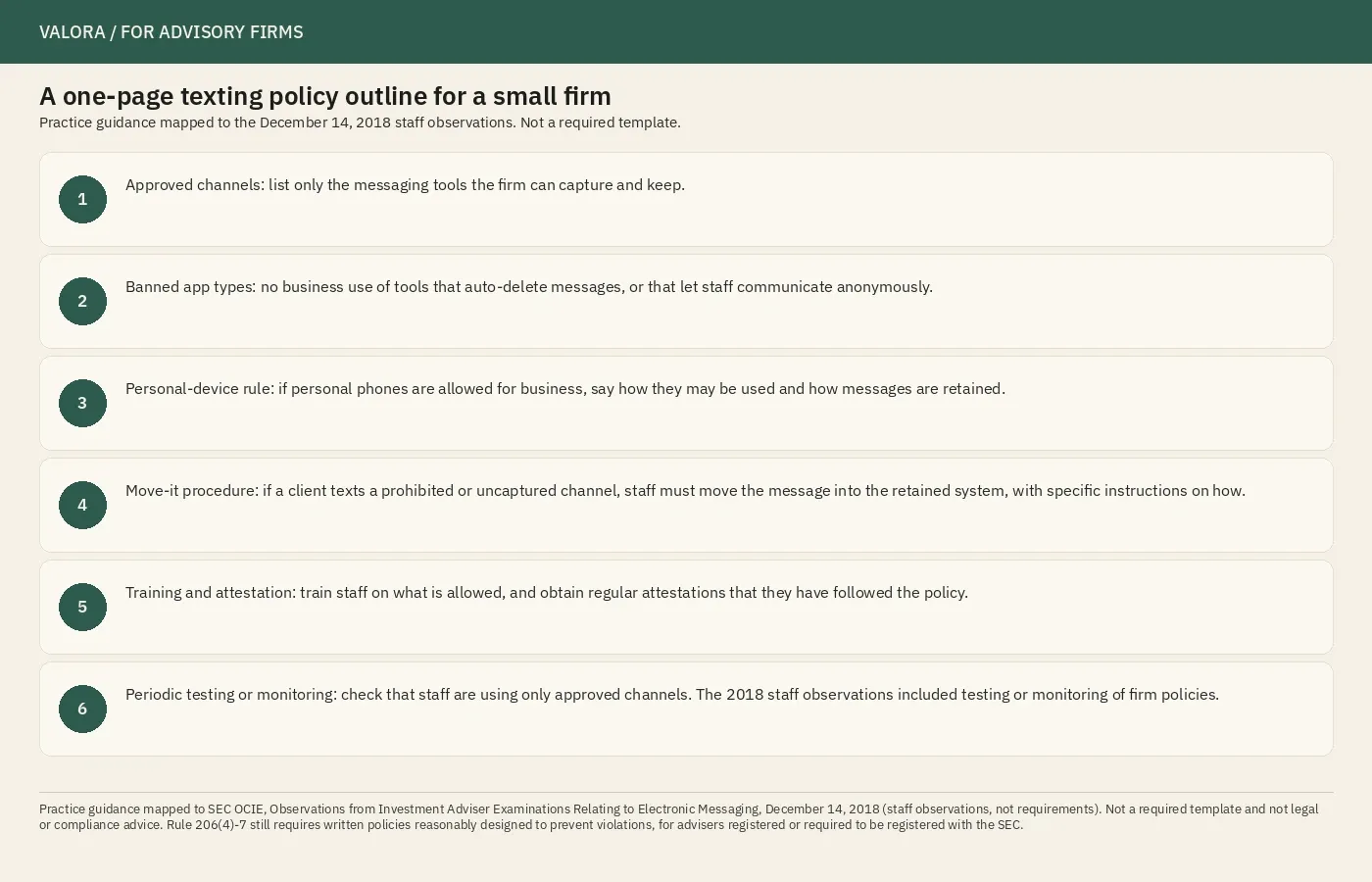
The outline below is practice guidance, mapped to the December 14, 2018 staff observations. It is not a required template.
The Compliance Rule, Rule 206(4)-7, applies to advisers registered, or required to be registered, with the SEC. It requires them to adopt and implement written policies and procedures reasonably designed to prevent violations of the Advisers Act and the rules under it. A short texting policy can be part of that program. This page does not rewrite an annual-review program.
Write down the approved channels, and list only tools the firm can capture and keep. Ban business use of apps that auto-delete messages or that let staff communicate anonymously. If personal devices may be used for business, say how, and how messages are retained. Describe the "move it" steps when a client texts an uncaptured number. Train staff, and obtain regular attestations. Test or monitor, from time to time, that people are staying on approved channels.
The SEC Division of Examinations' Fiscal Year 2026 Examination Priorities are staff views, not a rule. Examinations that look at the effectiveness of advisers' compliance programs typically include an evaluation of core areas, as applicable and appropriate for each examination, including "disclosure and filings" and other core areas. That is not a claim that examiners always ask about texts.
FAQ
Can I text clients from my personal phone? Only if your firm can capture and keep those texts, and only under the firm's written policy. If a client texts an uncaptured number, do not reply with advice there. Move the message into the retained system and reply on an approved channel.
Do I have to keep a text that only says I am running late? A scheduling text and a text about a trade are not the same thing. The rule covers written communications relating to advice, funds or securities, orders, and performance. The safest setup still captures all business texts.
Has the SEC already changed the recordkeeping rule for texts? No. The Unified Agenda says the Division is considering recommending a proposal to amend Rule 204-2 for electronic communications. An agenda entry is not a rule. The current rule still applies until a new rule is adopted.
I am state-registered. Does this page state my rule? No. Rule 204-2, as discussed here, applies to advisers registered, or required to be registered, with the SEC. Check your state recordkeeping rules.
What if the texts are marketing? The Marketing Rule can apply to SEC-registered advisers, or advisers required to register with the SEC. State-registered advisers should check their state securities regulator. See the Marketing Rule page linked above. This page does not explain that rule.
Clear, consistent client communication is part of what makes a firm easy to choose. If you want more good-fit prospects to talk to, you can learn about Valora's work for advisory firms. The current public offer is $250 per booked appointment with a qualified prospect, with a 3-appointment minimum, paid in advance. An appointment is a call booked on your calendar with a prospect who has asked to speak with an advisor. There is no setup fee, retainer, or long-term contract. If a prospect does not attend or does not meet the agreed criteria, the appointment is replaced at no charge. Your firm reviews what goes out under its name.
This article is educational, not legal advice, tax advice, compliance advice or personalized investment advice. Valora is not a registered investment adviser and does not provide investment advice. Valora provides marketing services to advisory firms. Valora is not a recordkeeping, archiving, or texting-compliance service.
Sources
- eCFR, 17 CFR 275.204-2, Books and records to be maintained by investment advisers (the eCFR is not the official legal edition of the CFR): https://www.ecfr.gov/current/title-17/chapter-II/part-275/section-275.204-2
- SEC Office of Compliance Inspections and Examinations, Observations from Investment Adviser Examinations Relating to Electronic Messaging, December 14, 2018 (staff observations, not requirements): https://www.sec.gov/files/OCIE%20Risk%20Alert%20-%20Electronic%20Messaging_0.pdf
- Unified Agenda, SEC RIN 3235-AN66, Amendments to Investment Adviser Recordkeeping Rule (agenda entry, not a rule or an issued proposal): https://www.reginfo.gov/public/do/eAgendaViewRule?RIN=3235-AN66&pubId=202510
- SEC, Rulemaking Activity, checked this turn for an issued Rule 204-2 electronic-communications proposal (none listed among the activity items on the page): https://www.sec.gov/rules-regulations/rulemaking-activity
- eCFR, 17 CFR 275.206(4)-7, Compliance procedures and practices (the eCFR is not the official legal edition of the CFR): https://www.ecfr.gov/current/title-17/chapter-II/part-275/section-275.206(4)-7
- SEC Division of Examinations, Fiscal Year 2026 Examination Priorities (staff views, not a rule): https://www.sec.gov/files/2026-exam-priorities.pdf
- Valora, For Advisors: https://www.valorahq.com/for-advisors/ (offer terms only; not evidence of client results)