
How long to 50 clients — and what actually speeds it up?
There is no universal timeline to 50 clients. Diagnose fit, channels, follow-through, and capacity without borrowing another advisor's growth clock.


There is no honest universal timeline for a new advisor to reach 50 clients. The sources reviewed for this guide do not establish an industry average in months or years. Your starting relationships, service model, time available for business development, acquisition mix, and ability to turn suitable conversations into ongoing relationships all change the answer.
What can help is identifying the stage where your process stalls: finding the right people, establishing fit, holding meetings, reaching decisions, or onboarding without overwhelming your firm. Improving a documented bottleneck is a more useful goal than copying another advisor's calendar. It still does not guarantee a faster result.
Key takeaways
- Define “client” before setting the target: households, accounts, and one-time plans are not interchangeable.
- Fifty is a practice-design milestone, not a required destination for every advisor.
- A transferred book and a business built organically from zero are different starting points.
- Track suitable conversations, decisions, departures, and capacity rather than predicting from borrowed close rates.
- Use a review window to test a process, not to promise a particular number of new clients.
Why an “average time to 50” can mislead
An advisor moving established relationships to a new firm has a different problem from a career changer without a relevant network. Full-time and part-time firms also have different opportunities to meet prospects and different service constraints. An anecdote rarely gives enough context to compare them.
Definitions create another problem. Fifty investment accounts might belong to far fewer households. Fifty completed one-time plans might not create 50 ongoing relationships. A story about reaching a revenue milestone may say nothing about client count, fees, expenses, or retention.
Neither a successful founder's story nor a growth study supplies a universal clock. The evidence cited below describes acquisition practices and category conditions, not a measured average time from launch to 50 ongoing households. That benchmark is not published here. Filling the gap with an attractive estimate would make the answer less useful, not more concrete.
Define the milestone around your service model
Write down what counts as a new client and when you record it. For an ongoing advisory practice, you might count a household after the agreed engagement is accepted and onboarding begins. Apply one definition consistently; record accounts separately.
Then ask why 50 is the target. Does your service calendar support that number of relationships? What fees, complexity, and service commitments come with each? A planning-only practice, a portfolio-led practice, and a firm coordinating complex household needs may require very different workloads at the same count.
Include departures. Net relationship growth equals new relationships minus relationships that end; asset withdrawals and account transfers need their own records. Do not treat routine retirement spending as a lost household. The target should describe a business you can serve well, rather than make every new signature look like progress regardless of fit.
Understand the stages without attaching a clock
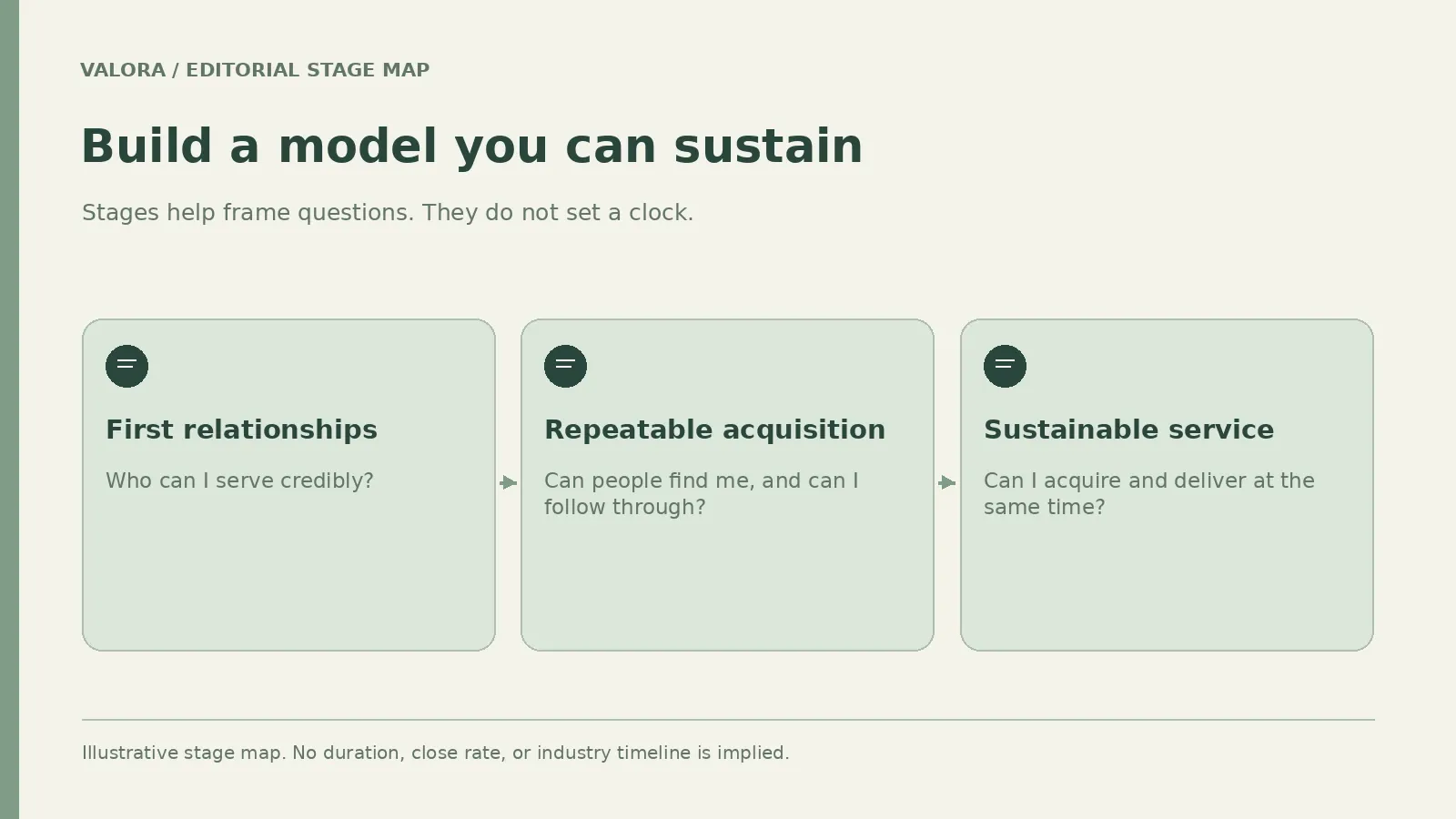
The following is an editorial stage map, not a forecast or an industry classification.
| Stage | Useful question | Evidence of progress |
|---|---|---|
| First relationships | Who can I serve credibly? | Suitable conversations and accepted engagements |
| Early book | Can I repeat how people find me? | Identifiable sources and consistent follow-through |
| Expanding practice | Can I acquire and serve at the same time? | Clear ownership and manageable onboarding |
| Around the chosen milestone | Is this the right business model? | Sustainable service commitments and client fit |
If you are still establishing the first relationships, begin with the first-ten-clients guide. It focuses on defining a group and testing ways to meet it, not promising ten signatures in a month.
As the book grows, delivery can crowd out acquisition. That does not mean the original channel failed. It may mean the founder no longer has the capacity to run it. Diagnose the change before replacing the strategy.
Use growth research as context, not a stopwatch
Cerulli's July 2026 release reports referrals account for 74% of RIA new-client acquisition, while 51% proactively ask for referrals. It also reports only 14% of RIAs use a dedicated marketing resource. These figures describe reliance and capacity, not the pace at which a new firm will grow.
Schwab's 2026 RIA Benchmarking Study associates stronger growth with documented plans and consistent execution. It reports 85% of Top Performing Firms track inquiry sources, versus 71% of other firms. The sample contains self-reported information from 1,236 Schwab-custodied firms and was not independently verified by Schwab.
Top Performing status reflects a composite index, not simply speed of acquisition. Neither the figures nor the associations translate into a deadline for your fiftieth household. The practical lesson is to make your own process visible enough to evaluate.
Make your client profile easy to repeat
Write a short description of whom you serve, the planning problem, the service provided, and relevant limits. Use real expertise, not a niche chosen only because it sounds lucrative. A prospect and an introducer should understand the description without translating industry jargon.
Kitces' September 2026 referral analysis finds associations between having and communicating an ideal client persona and referral-driven growth. It also discusses service calendars as a way to make delivered value visible. Neither observation proves that changing a sentence or adopting a calendar accelerates every firm.
Use the insight diagnostically. If introductions repeatedly fall outside your service scope, check whether people understand whom you help. If prospects misunderstand ongoing fees, explain the work and review cycle more clearly. A larger pipeline of unsuitable people does not move you toward a sustainable milestone.
Develop one channel beyond passive referrals
Kitces reports that practices with standout organic growth receive a smaller share of new clients from referrals than practices without standout growth. Its high-growth definition uses organic new-client revenue growth within revenue levels among actively growing practices; it is not identical to Schwab's definition.
The article argues for learning a non-referral “anchor” tactic rather than relying entirely on clients' networks. That might be a professional community, a focused educational offering, or useful content answering a question your intended households actually ask. Choose based on access, expertise, and time, not a vendor's growth story.
Professional relationships can also broaden the people who understand your work. Cerulli's February 2026 release identifies COIs as the second most common source across advisors and highlights joint work as an alliance-building approach. Build around a real client need and permission to coordinate, not a promise of introductions in return.
Remove avoidable friction after a hand-raise
A person requesting a conversation should know what happens next. Assign an inquiry owner, test the form and calendar route, and establish a response standard your team can actually maintain. Follow contact preferences and applicable policies. Downloading something does not by itself mean a person wants an advisory relationship.
Use discovery to establish the need, service fit, fee expectations, and mutual interest in a next step. Send an agreed summary rather than leaving the prospect to guess what happens after the call. Log no-shows, rescheduling, unsuitable needs, and declined proposals separately.
For ways to reach and recognize people seeking advice now, see the actively-looking prospect guide. These practices reduce ambiguity; they do not establish a universal response-time conversion gain or guarantee that a prospect will choose your firm.
Find the bottleneck before buying more volume
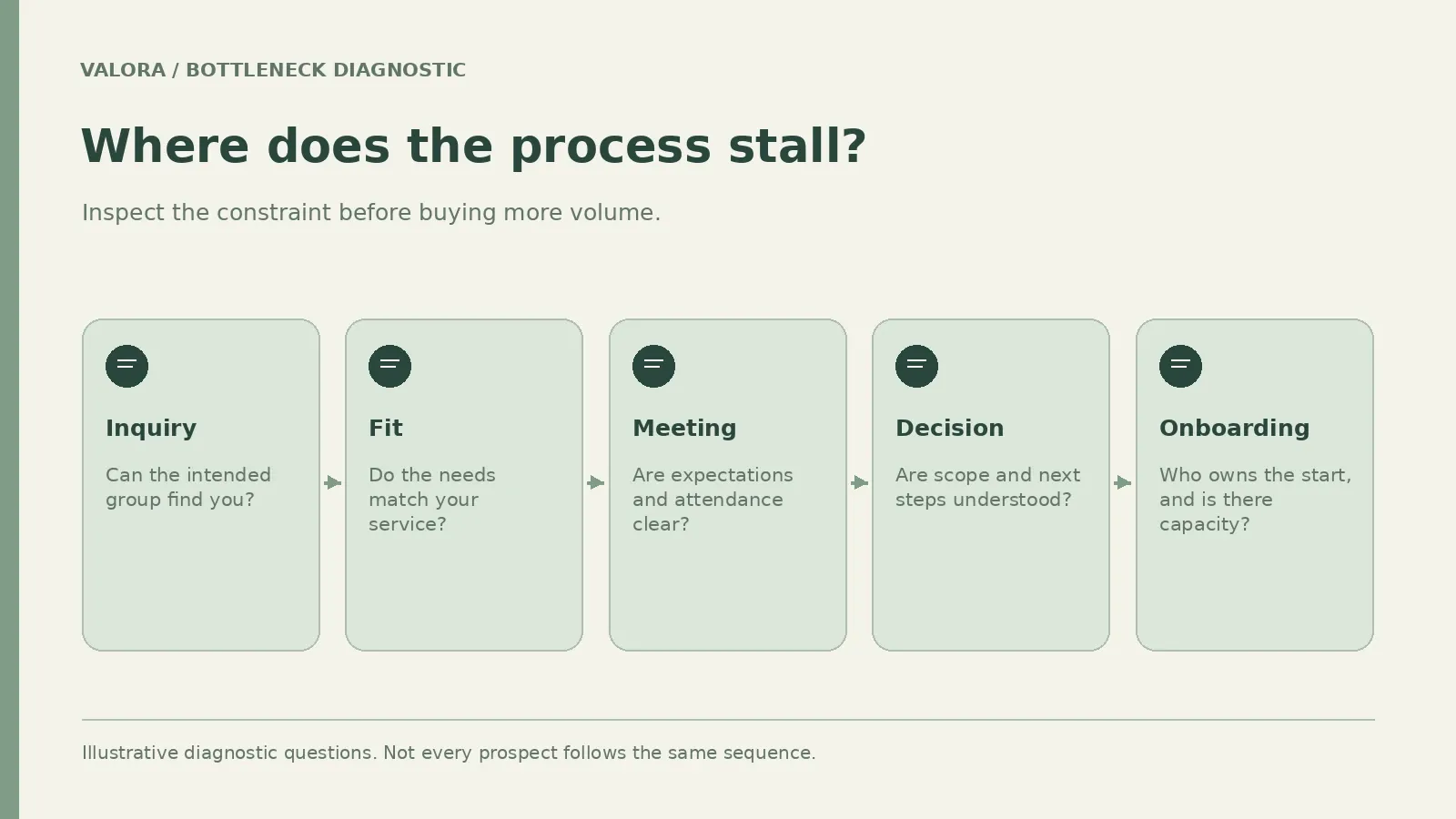
Keep unique-household counts at each stage. Your log should distinguish inquiries, suitable inquiries, booked meetings, attended suitable conversations, proposals where appropriate, accepted engagements, and completed onboarding. Not every prospect will need an identical sequence, but the labels should remain consistent.
| What you observe | What to inspect first |
|---|---|
| Few inquiries | Whether the intended group can find and understand you |
| Many unsuitable inquiries | Positioning, eligibility, and source criteria |
| Bookings without attendance | Scheduling expectations and confirmation process |
| Suitable meetings without decisions | Scope, fees, timing, and agreed next steps |
| Signed clients with delayed starts | Onboarding ownership and service capacity |
Record original and assisting sources without double counting. Compare cash cost and advisor time, not just lead prices. Do not divide the households remaining to 50 by a borrowed monthly win rate and call the answer a forecast. Until your own observations support a useful range, uncertainty is the honest result.
Run a bounded test and protect delivery
A 90-day review window can organize an experiment; it is not a promise of clients within 90 days. Define your profile, choose a small source mix, assign follow-up ownership, and record the process before changing tactics. Use the lead-source comparison guide for fit, consent, cost, and term questions.
Set a firm-specific limit on spending and hours. Review whether suitable conversations occurred, where they stalled, and whether open decisions simply need more time. Stop an unaffordable or unsuitable channel; change one observable weakness rather than rewriting everything after a quiet week.
Check onboarding capacity at the same review. Schwab cautions that adding capabilities does not guarantee growth and brings oversight demands. Do not broaden services merely to accept every inquiry. If delivery is overloaded, reducing acquisition temporarily or improving workflow may be more responsible than racing toward the count.
Where Valora fits
Valora is one optional source of booked conversations, not a shortcut to 50 clients. It works with advisory firms to reach people seeking their services and book appointments with prospects who asked to speak with an advisor.
The public offer is $250 per booked appointment, with a 3-appointment minimum, paid in advance. There is no setup fee, retainer, or long-term contract. If a prospect does not attend or does not meet the agreed criteria, the appointment is replaced at no charge. Your firm reviews what goes out under its name.
Appointments are not signed engagements. Valora does not guarantee time-to-50, client counts, revenue, assets, rankings, AI citations, or appointment volume. If follow-up and service capacity exist, review written terms as you would for any acquisition source. If they do not, additional meetings may increase workload without solving the constraint.
Frequently asked questions
Does an existing book make the comparison different?
Yes. Transferring established relationships, buying a book, and acquiring new households organically are different paths. Keep them separate before comparing progress. Any transition also needs appropriate contractual and compliance review.
Can a part-time advisor reach 50 clients?
This guide cannot predict that outcome or its timing. Available acquisition and service hours constrain the model. Choose commitments and a target compatible with the work you can actually deliver.
Should I lower minimums to move faster?
Not automatically. Lower minimums change eligibility and economics, not visibility or expertise. Check whether the resulting service commitments remain sustainable rather than accepting more households just to increase the count.
Should I buy leads to accelerate the process?
Only consider a source after checking fit, permission, terms, cost, and follow-up capacity. Buying names is different from booking suitable meetings. Neither product guarantees clients or supplies a reliable timeline.
Is asking more often for referrals the answer?
Kitces found no evidence that higher request frequency increased referral-driven growth. That is observational, not a prohibition on asking. Use judgment, avoid pressure, and have claims, testimonials, and referral arrangements reviewed for applicable requirements.
Scope of this guide
This is educational marketing content, not investment, legal, tax, or compliance advice. Valora is not a registered investment adviser. Stage maps and test windows are planning suggestions, not industry timelines or causal research findings. Review communications under applicable SEC or state requirements and firm policies. The SEC staff FAQs are guidance, not a rule or Commission statement. No plan here guarantees the milestone.
Sources
- Schwab Advisor Services, 2026 RIA Benchmarking Study: documentation, source tracking, capabilities, sample limitations, and Top Performing definition. Fetched 7 Nov 2026 (Asia/Makassar). https://advisorservices.schwab.com/insights-hub/perspectives/ria-benchmarking-study-2026
- Cerulli Associates, RIAs Must Offset Asset Churn with Dedicated Growth Efforts, July 22, 2026: referral reliance and marketing capacity. Fetched 7 Nov 2026 (Asia/Makassar). https://www.cerulli.com/press-releases/rias-must-offset-asset-churn-with-dedicated-growth-efforts
- Cerulli Associates, Financial Advisors Increasingly Leverage COIs to Capture New Client Growth, February 4, 2026: advisor acquisition sources and alliance approaches. Fetched 7 Nov 2026 (Asia/Makassar). https://www.cerulli.com/press-releases/financial-advisors-increasingly-leverage-cois-to-capture-new-client-growth
- Kitces.com, Mark Tenenbaum, What Really Drives Client Referrals, September 28, 2026: referral reliance, ideal client personas, service calendars, and asking frequency; associations, not a timeline. Fetched 7 Nov 2026 (Asia/Makassar). https://www.kitces.com/blog/client-referrals-organic-client-growth-advisor-value-growth-network-marketing/
- SEC Division of Investment Management, Marketing Compliance — Frequently Asked Questions: staff marketing guidance. Fetched 7 Nov 2026 (Asia/Makassar). https://www.sec.gov/rules-regulations/staff-guidance/division-investment-management-frequently-asked-questions/marketing-compliance-frequently-asked-questions
- Valora, For Advisors: price, prepaid minimum, replacement terms, and limits. Fetched 7 Nov 2026 (Asia/Makassar). https://www.valorahq.com/for-advisors/
- Valora, Your first ten clients as a solo RIA: early-book companion, not a time-to-50 benchmark. Fetched 7 Nov 2026 (Asia/Makassar). https://www.valorahq.com/insights/your-first-ten-clients-as-a-solo-ria-where-they-actually-come-from/