
How to answer 'Is a 1% fee worth it?' without hype
Help advisory firms answer whether a 1% advisory fee fits a prospect's scope: dollar cost, services, limits and alternatives, without promising returns.


A 1% annual advisory fee is not automatically worth paying. It is also not automatically poor value. The honest answer compares dollar cost and other expenses with the actual services, complexity and alternatives. No advisor should promise to recover the fee through extra returns or guaranteed savings.
This guide is for advisory firms that need a plain way to discuss that question with prospects. It does not replace your brochure (Form ADV Part 2A, the disclosure document an adviser gives clients), your Form CRS relationship summary or your engagement agreement. For fee-page and billing worksheets a registered investment adviser (RIA) can use before a first call, see How should an RIA explain fees before a first call?.
Is an advisor worth a 1% annual fee?
The answer is conditional. It depends on what work is included, how often it happens, what else the client pays and what other arrangements could cover the same scope.
An automatic yes promises more than the firm can show. An automatic no ignores cases where ongoing advice, planning and monitoring are actually delivered. State the work, the limits and the other costs. Let the prospect compare with the documents in hand.
A prospect may press for a yes-or-no answer. Treat the question as a cost-and-service comparison instead. Put the dollar cost, the services and the exclusions side by side. If two firms quote the same percentage, the services behind that percentage can still differ. Ask which tasks are included before you compare the rates.
Translate the percentage into dollars
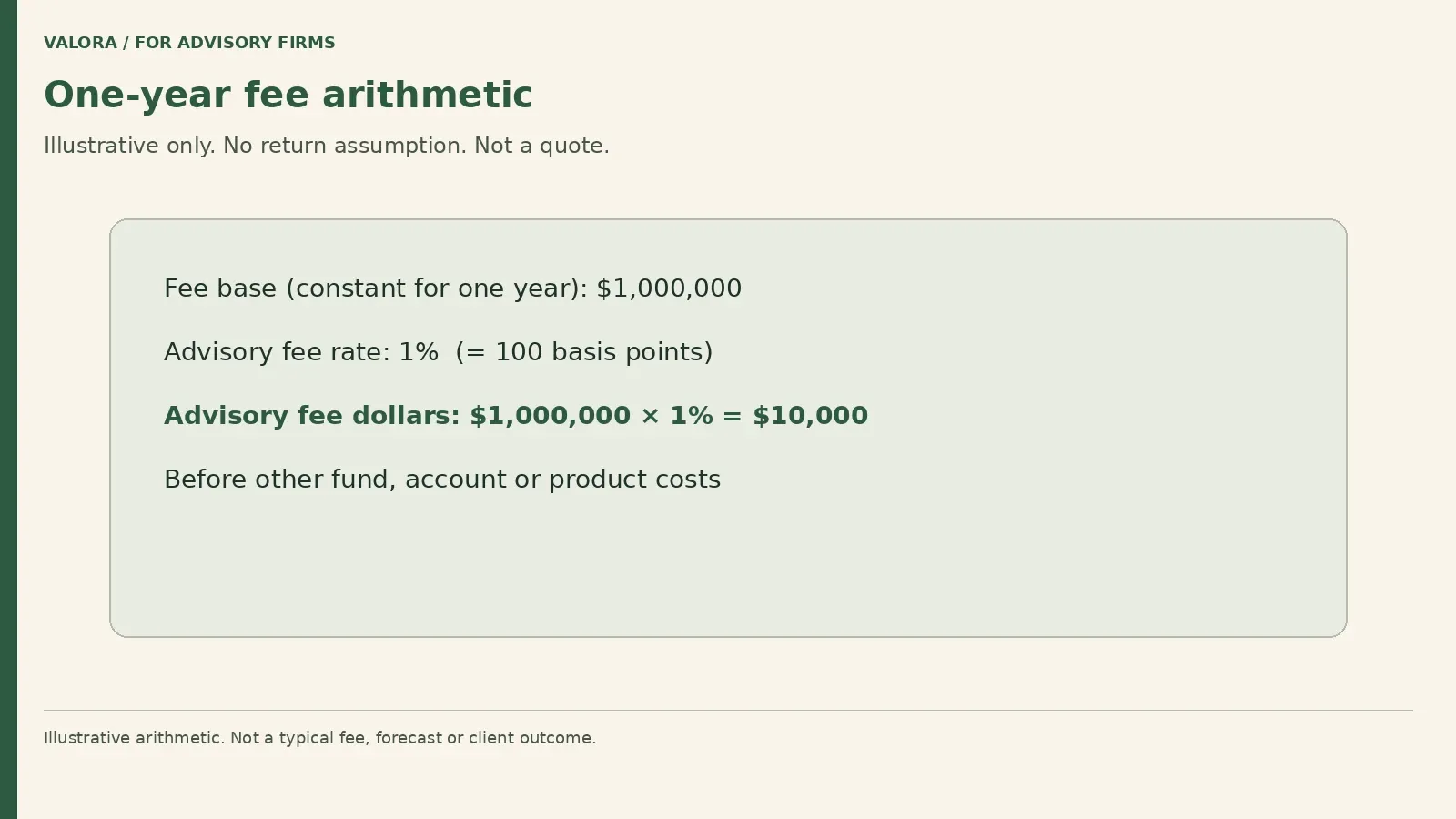
Say the dollar amount out loud. On a constant one-year fee base of $1,000,000, a 1% advisory fee equals $10,000 before other costs. That is simple arithmetic. It assumes no return and no balance change. It is not a quote, a typical market fee or a value score.
Actual balances, tiers, household minimums and billing timing vary. One percent is also 100 basis points. A basis point is one hundredth of one percent. Use the firm's real schedule when you talk to a real prospect.
If billing timing or the fee base is complex, walk through it with the fee explainer worksheet.
Separate the advisory fee from the full cost
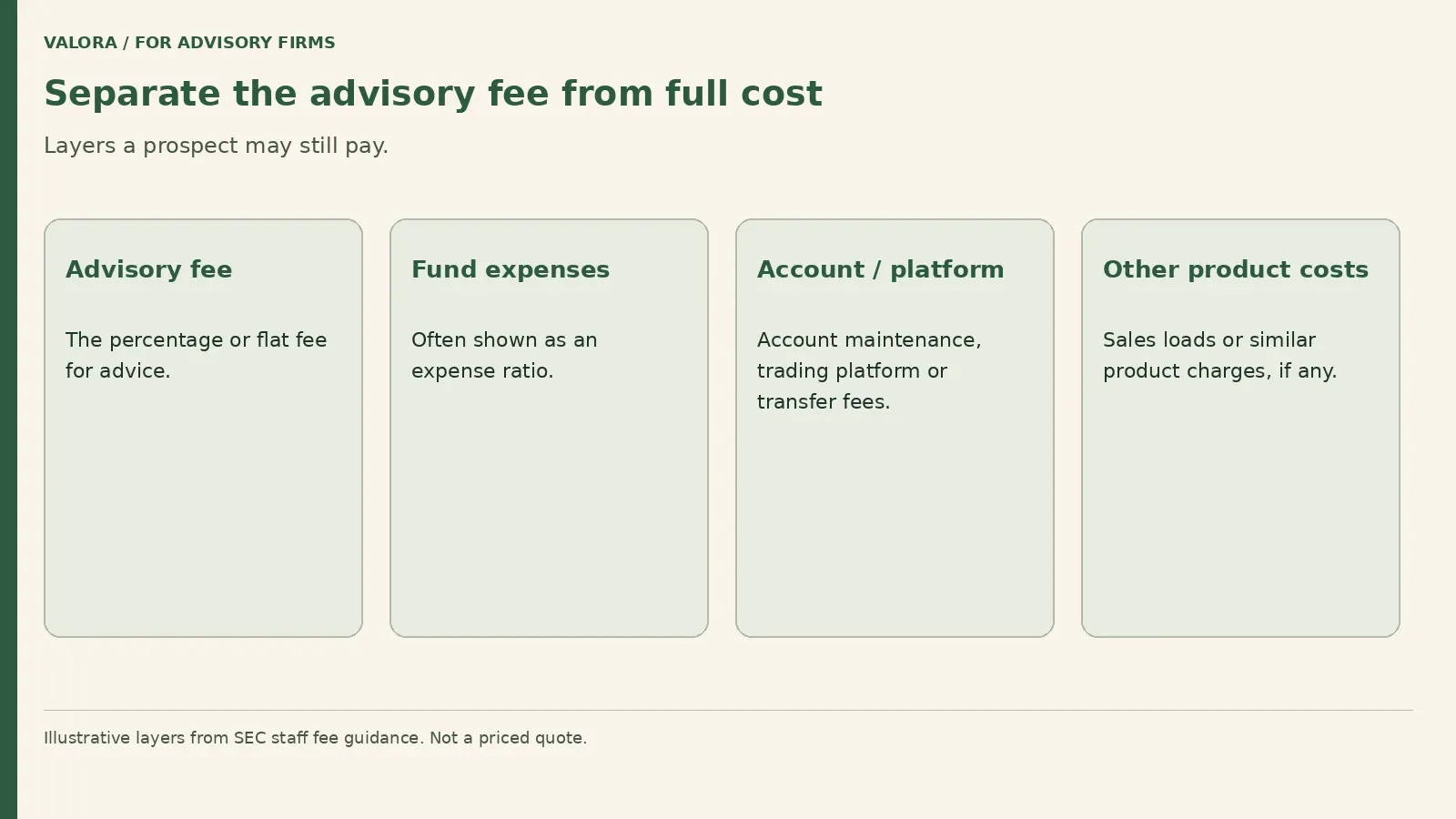
The advisory fee is only one layer. The U.S. Securities and Exchange Commission (SEC) staff fees bulletin explains that ongoing and transaction fees reduce the amount left in a portfolio. Fund operating expenses can sit on top of the advisory fee. Those expenses are often shown as an expense ratio, the annual fund cost as a share of fund assets. Account, platform and product charges may also apply.
Point prospects to disclosure documents and statements. For the fee-page worksheet, use the fee explainer linked above. Name each cost layer once so a percentage fee is not mistaken for the full all-in cost.
What services does the agreement actually include?
List only what the engagement covers. Investment management, financial planning, tax or estate coordination and monitoring count only if they are in the agreement. The Financial Industry Regulatory Authority (FINRA), which oversees brokerage firms, notes that people who call themselves financial planners can come from many backgrounds and offer different service breadth.
Ask, and answer, four practical questions. How often does the work happen? What deliverables does the client receive? What is excluded? Who does each part of the work?
Form CRS is the short relationship summary that SEC-registered broker-dealers and investment advisers must give retail investors. Broker-dealers are firms that buy and sell securities for customers. Form CRS helps compare services, fees and costs, conflicts and standards of conduct. Dual registrants (firms registered as both a broker-dealer and an investment adviser) may act in different capacities. Say which capacity applies to the work.
The SEC staff account-opening bulletin also points to scope, service frequency, contract terms, fees, cancellation and conflicts. Use those headings in the conversation.
Why an ongoing service may be useful
An ongoing relationship can support decisions, reviews and implementation over time. Investor.gov's Form CRS page says a typical adviser gives ongoing advice and ongoing monitoring. The SEC's 2019 adviser interpretation notes that services range from a single financial plan for a one-time fee to ongoing portfolio management.
Frequency matters. A quarterly review is different from an annual check-in or a one-time plan. Spell out who initiates contact and what happens between meetings.
When an ongoing percentage fee may not fit
An ongoing asset-based fee may not fit when needs are narrow, the service is rarely used or a one-time project covers the work.
The account-opening bulletin lists hourly, fixed or flat, and asset-based client fees. It also notes commissions as another way some professionals are paid. Describe the questions a prospect should ask about scope and alternatives. Whether a client should move or close an account is a personal decision for the client and the firm, based on the full facts.
Explain service without promising a financial payoff
Describe the work. Avoid claiming the fee will earn itself back. Avoid inventing extra returns above a benchmark, tax savings or a promised gain from better client behavior. A story about a mistake someone might avoid is not a measured client outcome.
SEC Release IA-5248 is the SEC's 2019 interpretation of the duties an investment adviser owes clients. It says cost is one of many important factors in judging whether advice is in the client's best interest. The duty of care is the adviser's obligation to give advice that serves that best interest, including a reasonable understanding of the client's objectives. Among similar products or strategies, the duty does not necessarily require the lowest-cost option. That point does not justify any particular fee, including 1%. It also does not bar a lower-cost arrangement that still meets the client's objectives.
For SEC-registered advisers, the SEC Marketing Rule bars untrue or misleading statements of material fact. It bars material statements of fact the adviser has no reasonable basis to substantiate. It requires fair and balanced treatment of any material risks or limitations. State-registered firms follow their state's rules.
What does fee research establish, and what does it not?
The SEC fees bulletin includes a hypothetical cost illustration. It starts with a $100,000 portfolio. It assumes 4% annual growth for 20 years. It compares annual fees of 0.25%, 0.50% and 1.00%. After 20 years, the ending values are about $208,000, $198,000 and $179,000. The bulletin labels the example as hypothetical. It shows how fees shrink an ending balance under stated assumptions. It does not measure the net value of advice.
The SEC example shows what fees cost. It does not show that advice adds a fixed return or beats a lower-cost option. Prefer the one-year dollar translation when a long illustration distracts from the service discussion. If you use the long example, keep every assumption visible next to the ending values.
Compare alternatives on the same scope
Compare arrangements that cover the same work. Hourly and project fees can fit defined tasks. A flat or ongoing fee can fit continuous advice. An asset-based fee scales with assets under management (AUM), the assets a firm manages for clients. Commission-based product pay is a different model.
Compare on scope, frequency, exclusions and total cost layers. Keep the comparison to your own documented terms.
For fee-only and fee-based labels under Certified Financial Planner Board of Standards (CFP Board) rules, see How to explain fee-only vs fee-based pay to prospects. CFP® professionals are holders of the Certified Financial Planner certification. For role, credential, registration and fiduciary duty, see Wealth manager vs financial planner vs fiduciary: role, credential and duty.
Review the work delivered, not a made-up ROI score
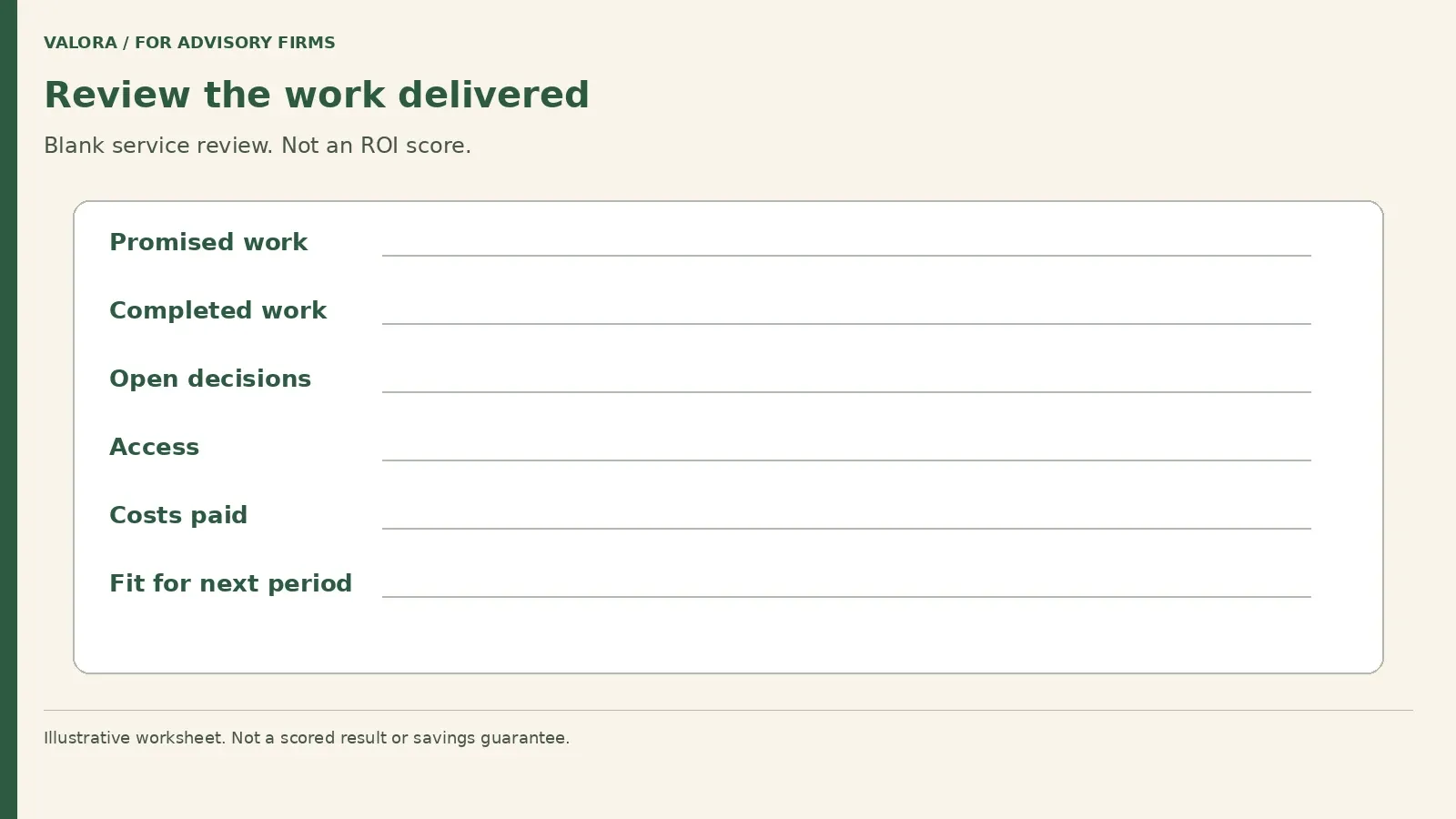
Use a service review, not a fake return-on-fee calculator. Check what was promised, what was completed and what decisions remain open. Check how easy access is, what the client paid and whether the fit still holds. Repeat the review on a set schedule, not only when fees are questioned.
CFP Board Standard A.1 requires CFP® professionals to act as a fiduciary when providing Financial Advice to a Client. A fiduciary, in plain terms, must put the client's interest first under that standard. That duty is about the advice relationship. It is not proof that any percentage fee is worth paying.
How to answer the question in a first conversation
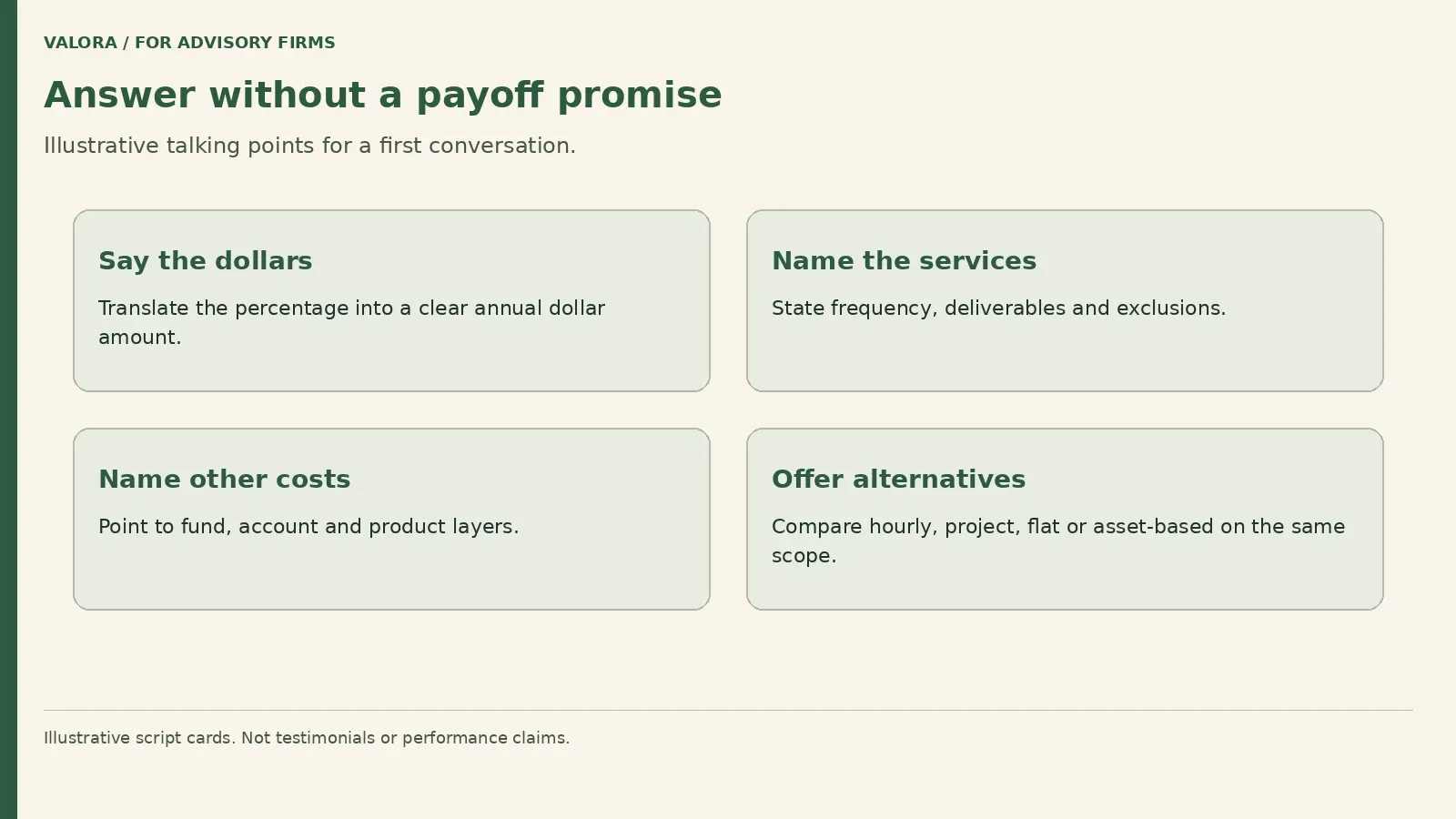
Use a short, honest script. Fill blanks with real facts from your brochure and agreement:
"Our advisory fee on the assets we would manage is [rate]. On [fee base], that is about [dollar amount] per year before other costs. The engagement covers [services and frequency]. It does not cover [exclusions]. Other fund and account costs may still apply. They appear in [disclosures]. Other fee arrangements can fit different scopes. How would you like to compare them?"
Invite questions without pressure. Offer to walk the prospect through Form CRS and the brochure in the same sitting. Leave time for the prospect to read before any engagement decision.
Frequently asked questions
Is a lower fee always the better choice? Not always. Under IA-5248, cost is one of many important factors in judging whether advice is in the client's best interest. Among similar products or strategies, the lowest-cost option is not necessarily required. Compare cost with scope, quality of the work and the full facts of the engagement.
Does fee-only mean cheaper? No. Fee-only describes payment sources under a stated standard. It does not set a price level. See the fee-label guide linked above.
Does higher wealth require a wealth manager? No. Wealth manager is a title a firm chooses for its offering. It does not set a universal wealth minimum. See the roles and duty guide linked above.
What if the prospect needs one-off help? An hourly or project fee may fit a defined task. Compare that scope with an ongoing percentage arrangement before either side assumes a long retainer. Write the deliverable and the end date so both sides know when the work is done.
If your firm later wants help making its services easier for suitable prospects to find and understand, you can learn about Valora's work for advisory firms. The current public offer is $250 per booked appointment with a qualified prospect, with a 3-appointment minimum, paid in advance. An appointment is a call booked on your calendar with a prospect who has asked to speak with an advisor. There is no setup fee, retainer, or long-term contract. If a prospect does not attend or does not meet the agreed criteria, the appointment is replaced at no charge. Your firm reviews what goes out under its name. Marketing is a separate decision from how you explain cost and service.
This article is educational, not legal advice, compliance advice or personalized investment advice. Valora is not a registered investment adviser and does not provide investment advice. Valora provides marketing services to advisory firms.
Sources
- SEC Investor.gov, How Fees and Expenses Affect Your Investment Portfolio (July 23, 2025). Staff bulletin on fee layers and the hypothetical long-term illustration.
- SEC Investor.gov, Opening an Investment Advisory Account (updated June 24, 2020). Staff bulletin on services, fees, contracts and conflicts.
- SEC Investor.gov, Form CRS. Relationship summary topics for retail investors.
- CFP Board, Code of Ethics and Standards of Conduct. Fiduciary Duty (A.1) when providing Financial Advice.
- SEC, Commission Interpretation Regarding Standard of Conduct for Investment Advisers, Release IA-5248 (2019). Primary PDF. Cost as one of many important factors; lowest-cost not required among similar products or strategies.
- SEC, Investment Adviser Marketing: A Small Entity Compliance Guide. Marketing Rule small entity guide. Scope: advisers registered or required to be registered with the SEC.
- FINRA, Financial Planners. Planner backgrounds and services.
- Valora, How should an RIA explain fees before a first call? Fee explainer and worksheet.
- Valora, How to explain fee-only vs fee-based pay to prospects. Sibling compensation guide.
- Valora, Wealth manager vs financial planner vs fiduciary: role, credential and duty. Sibling roles and duty guide.
- Valora, For Advisors (live read 2026-11-10). $250 per booked appointment; offer terms.