
How to redesign the junior advisor role when AI drafts the plan
Redesign the junior advisor seat around reviewing AI output, judgment work and a pay-linked promotion path for mid-size RIAs.


When artificial intelligence (AI) can draft plans, notes and follow-ups faster, redesign the junior advisor seat around review and judgment work, with clear decision limits and a promotion path tied to pay. Do not treat software alone as a substitute for that seat.
This guide is for registered investment adviser (RIA) firms managing roughly $150 million to $1 billion in client assets that already have a service team and are deciding what the next junior hire on the path to becoming a financial planner (a planner-track hire) should own. It is not a first-hire guide for a solo practice. For early team design after traction, see How to grow a solo RIA into a real firm.
This checklist is Valora editorial guidance, inspired by a November 2026 guest post by Daniel M. Yerger on Kitces.com. Several examples below echo tasks Yerger suggests for new planners. Yerger is the founder and president of MY Wealth Planners, an RIA, and writes that he has taken part in a client advisory committee for a financial technology (fintech) company he does not name. Michael Kitces, who publishes Kitces.com, co-founded New Planner Recruiting, a firm that recruits new financial planners, so the publisher has a business interest in entry-level planner hiring. Treat the piece as one founder's view, not research.
What changes when AI absorbs junior production work?
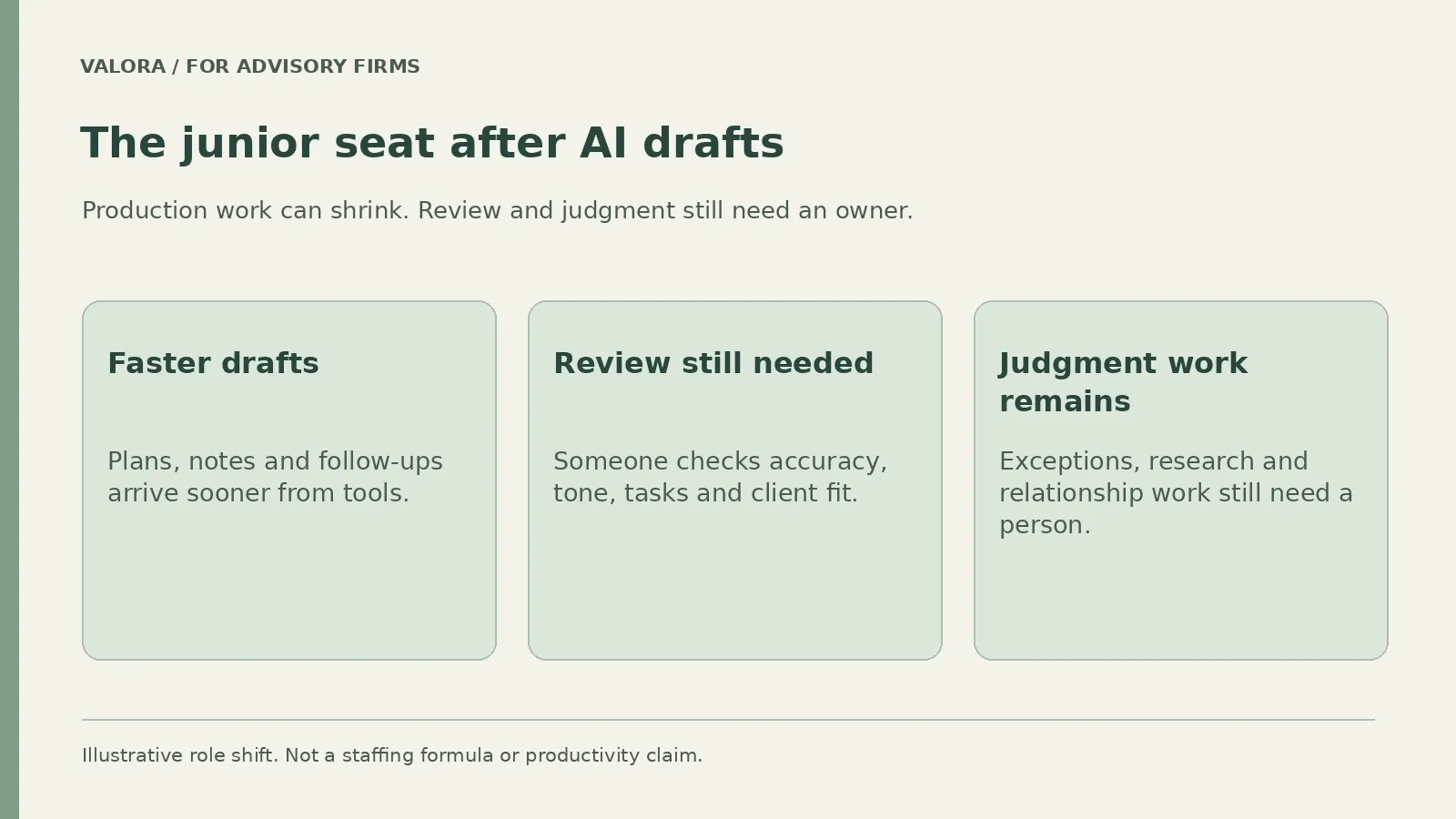
Junior planner seats used to absorb a lot of production: gathering inputs, building first-pass plans and turning meeting notes into follow-ups. Faster drafting tools can shrink that production load. The work that remains is less about typing the first version and more about checking whether the draft is accurate, complete and fit for the client.
That shift does not remove the need for a person. Someone still has to compare the draft with source records, catch tone problems, assign tasks correctly and raise exceptions. Someone still has to handle work that is too sensitive, too unusual or too relationship-heavy for an unchecked tool output.
Describe the change to your team as a shift in the mix of work, not as proof that AI makes the firm more productive. Tools can change the mix of work. They do not automatically create capacity, better margins or better advice.
Separate buying tools from redesigning the seat
Buying a notetaker or a planning assistant is a tooling decision. Redesigning the junior seat is a staffing decision. Mixing the two leads to vague job posts and unfinished handoffs.
Ask two questions in order. First: which recurring drafts now arrive faster than a person used to produce them? Second: who owns the review before those drafts enter the client record or leave the firm?
If you skip the second question, senior advisors often absorb the review quietly. The tool looks efficient. The calendar does not get lighter. The junior seat, if you still hire one, becomes unclear about what success looks like.
Keep tool vendors and role design separate in your notes. A vendor demo is not a role description. A role description is not a compliance approval.
Decide what the junior seat owns after drafts get faster
Start from the work the firm already promises, not from a job title. List recurring outputs that AI now drafts or assists: meeting notes, follow-up emails, task lists, first-pass plan sections and similar items. Mark which ones still need a named human check before they are used.
Then list judgment work that still needs a person even when drafts are fast. Examples include checking source documents against a draft, researching an edge case, preparing educational material for review, supporting smaller or secondary relationships under limits, and raising issues outside the seat's authority.
Yerger's essay argues that firms should keep developing entry-level planners even when tools can build plans quickly, and that the work should still have "real stakes" under senior oversight. Use that idea only as a prompt. Write your own owned-work list from your firm's service model.
This is not a claim that firms are pausing junior hiring because of AI. Redesigning one seat is a choice for your firm, not a sign of an industry trend.
Put AI-output review at the center of the role
Make review an explicit duty, not an afterthought. For each AI-assisted output, state what "checked" means. Accuracy against source data. Correct client identity. Tone that matches the firm's voice. Tasks assigned to the right owner. Open questions flagged instead of guessed.
Give the junior seat a clear place in the workflow: they attend or listen to defined meetings, they receive the draft, they edit or reject it, and they record what changed. Senior review still happens where risk requires it. The point is to stop treating review as unpaid senior overtime with no training value.
Define the evidence of a completed check. A short note that the draft was compared with the meeting recording or source files is more useful than a silent edit. If the junior rejects a draft, record why. That record trains the next person and shows seniors where the tool or the process is weak.
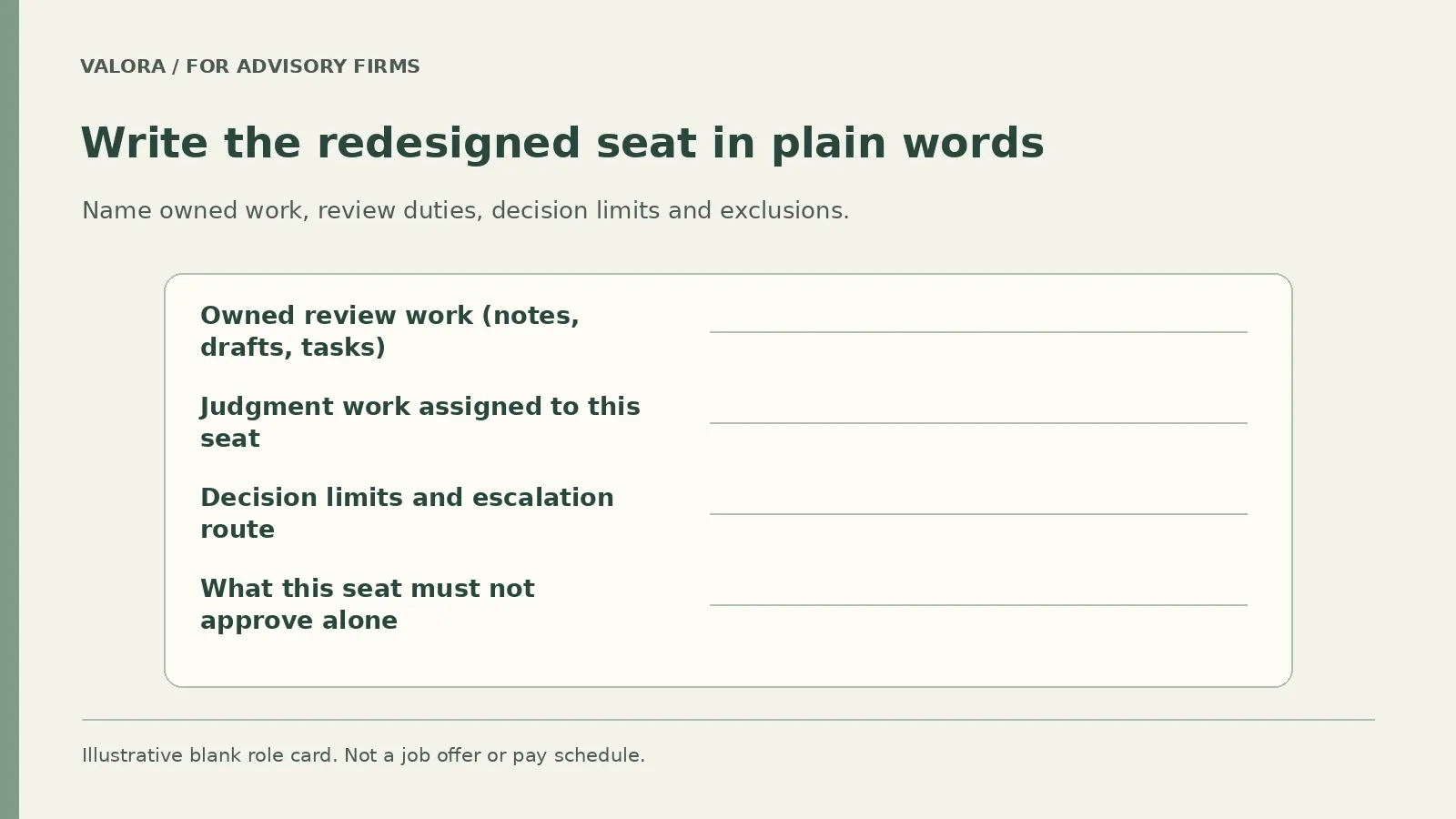
Keep the scope honest. Reviewing notes is not the same as approving advice. Editing a follow-up is not the same as sending unsupervised recommendations. Say which outputs the junior may finalize, which need a second look and which they must never release alone.
If a summary has already reached the client with an error, see how to correct an AI meeting summary.
Keep judgment work that still needs a person
If the seat only cleans up machine drafts, development stalls and the role feels thin. Pair review with judgment work that builds skill and still helps the firm.
Useful categories, several of which Yerger also suggests, include: checking complex research before a senior uses it, preparing educational content for senior review, auditing client touchpoints with fresh eyes, supporting defined secondary relationships under limits, and handling license-required tasks only when the person is properly licensed and supervised.
Weight the mix toward work your service calendar already creates. If seniors are drowning in exceptions after meetings, put sorting and routing exceptions near the center. If smaller relationships get neglected, define a supervised service lane for them. Do not invent projects only to fill a calendar.
These are illustrations. They are not a required curriculum. Choose work that matches your service promises, your supervision capacity and the person's credentials. Get qualified advice before treating a task list as permission to act.
Write decision limits before the first week
A redesigned seat fails when everyone assumes the junior "will just use judgment." Write the limits in plain words before day one.
State what the person can decide alone, what they can draft for approval and what they must escalate. Include information access: which systems, which client segments and which records. Include exclusions: advice they must not give, communications they must not send and approvals they must not grant.
Some professionals hold CFP® certification, a financial-planning credential issued by CFP Board. CFP Board's supervision standard requires CFP® professionals to exercise reasonable care when supervising people under their direction. CFP Board's standards also require CFP® professionals to use reasonable care and judgment when selecting and using technology with clients. That is a scoped certification requirement. It is not the complete supervisory rule for every RIA. Ask your compliance reviewer what your firm actually needs.
Clear limits protect clients, seniors and the junior hire. Vague enthusiasm does not.
Map a promotion path tied to pay, without inventing salaries
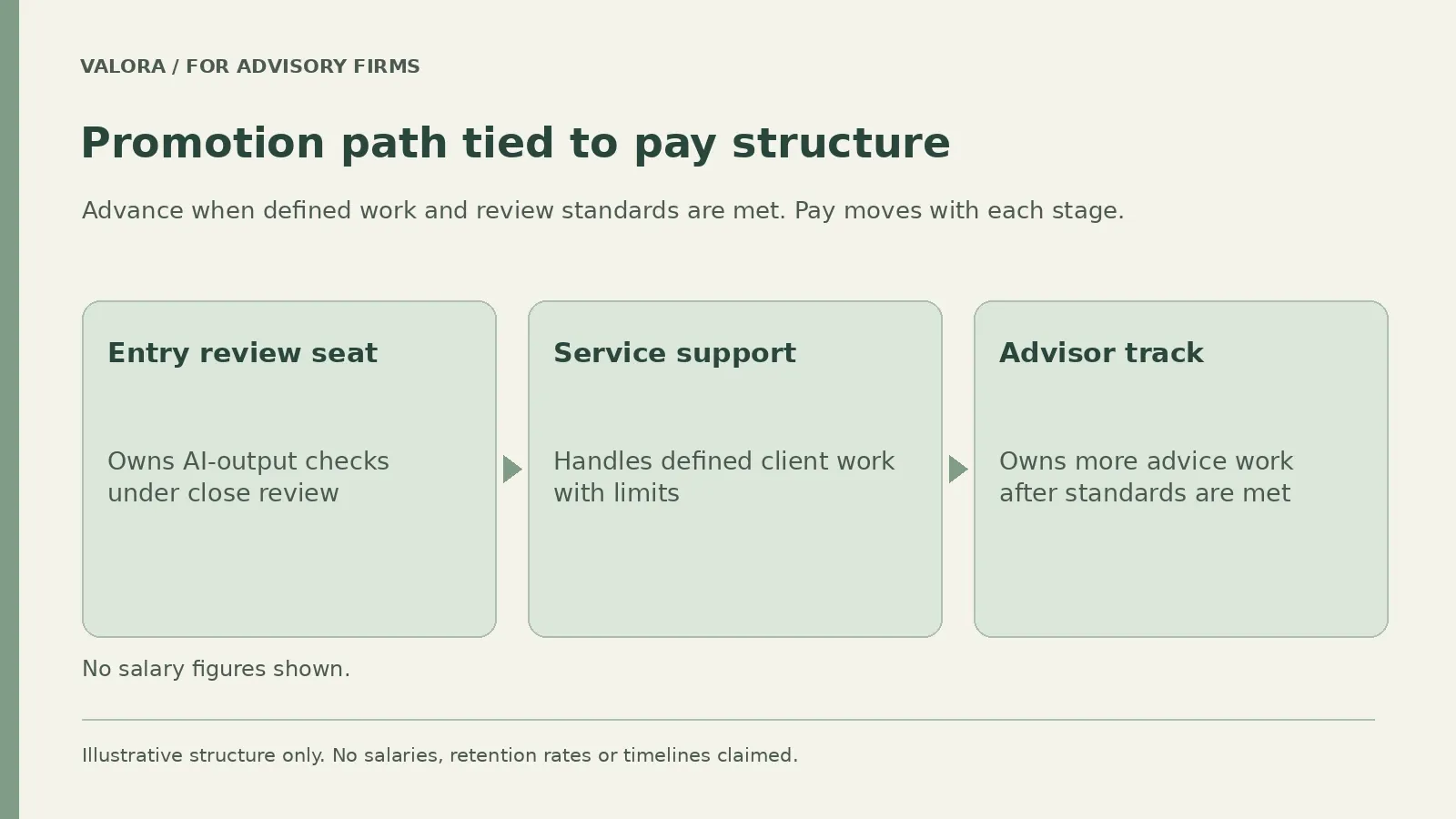
People stay when they can see how good work turns into broader responsibility and higher pay. Write a path in stages your firm can actually support.
Describe each stage by owned work, review standards and decision limits. Tie advancement to meeting those standards, not to time alone. State that pay moves with the stage. Do not publish invented salary bands or borrow another firm's numbers unless you have a verified primary source for them.
Yerger stresses a clear relationship between advancement and compensation so people are less likely to leave for pay alone. Build stages that fit your own firm rather than copying another firm's ladder.
If your firm cannot fund the next stage yet, say so in the plan. An honest pause is better than a fake ladder.
Budget for supervision and rework, not only software
A junior review seat creates training, oversight and correction costs. Put those in the budget beside tool fees.
Include senior time to set standards, spot-check work and handle escalations. Include access setup, licensing questions and the cost of fixing errors found in review. Ask what happens if the tool's output quality drops or the vendor changes pricing. Do not treat today's tool price as permanent fact. Yerger argues that some AI tools are cheap today because investors are subsidizing them, so prices could rise. That is his view, not a proven forecast.
There is no universal margin target here. Build the case from your own recurring revenue, committed costs and supervision capacity. A seat that only works if every draft is perfect is not a durable plan.
Test one redesigned seat before scaling the pattern
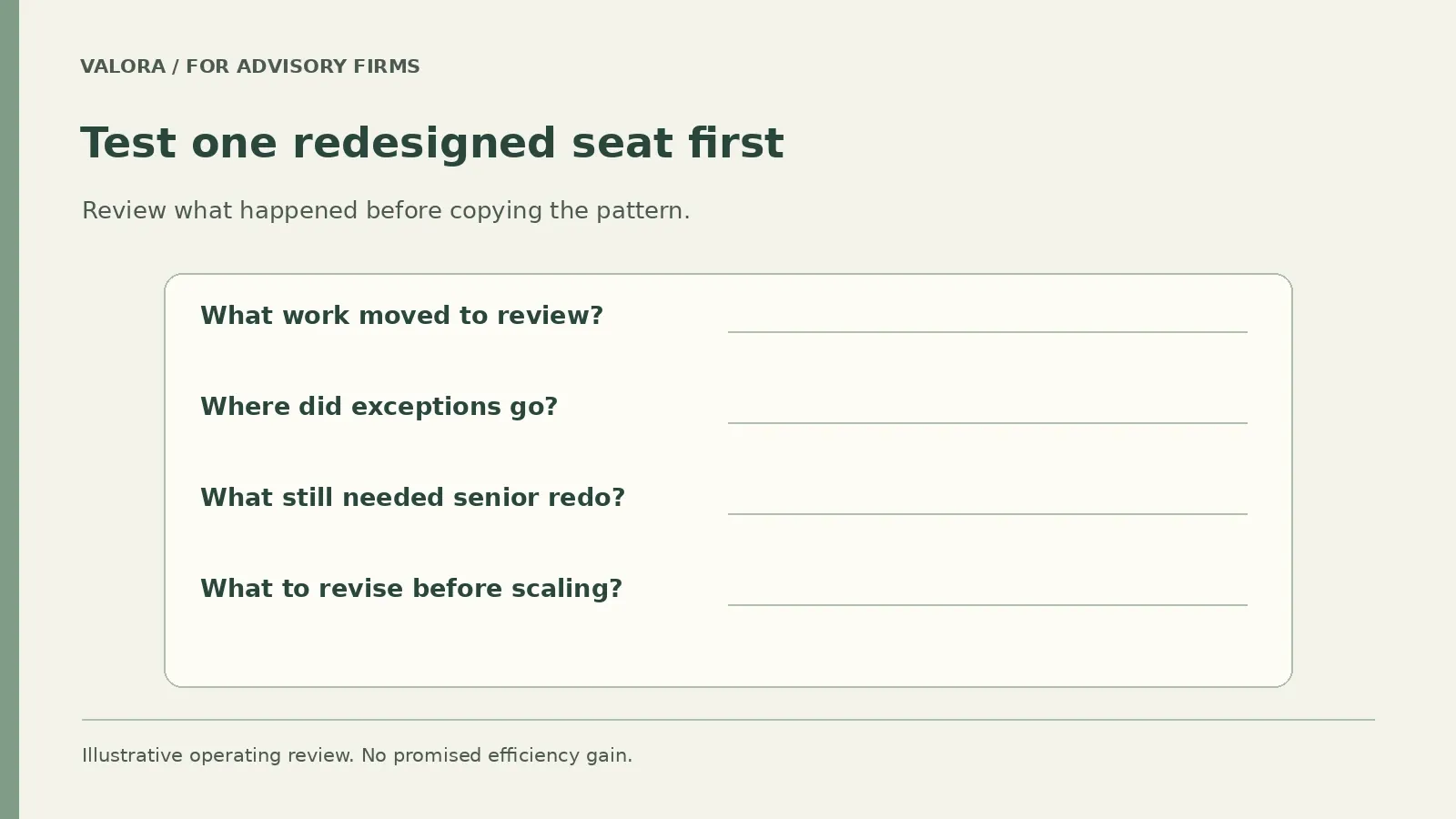
Run a short test on one person and one cluster of work. Record the current problem, the owned review duties, the limits and the review arrangement. After a defined period, ask what moved, what still returned to seniors, where exceptions went and what clients experienced.
Use the result to revise the seat before copying it across the firm. There is no fixed transformation timetable. A slower handoff that protects service may be better than a quick title change with unclear ownership.
Frequently asked questions
Does AI replace the junior hire? Not automatically. It can change what the seat produces. Review and judgment still need an owner.
Is this the same as a first operations hire? No. An early operations (ops) or admin hire solves different bottlenecks. This piece assumes a mid-size firm redesigning a planner-track seat after drafts get faster.
What should change first? Name the review duty and decision limits for one recurring AI-assisted output, then attach judgment work the person can grow into.
How this differs from a first ops or advisor hire
How to grow a solo RIA into a real firm focuses on founder-led practices after traction: whether to stay strong as a solo, how to measure workload, how to choose a bottleneck role and how to keep responsibility when you delegate. That article is about becoming less founder-dependent.
This article assumes the firm already has enough structure to talk about a junior planner-track seat. The question is not "ops versus advisor" as a first hire. The question is how to redesign the junior advisor seat when production drafts arrive faster from tools.
If your firm is still deciding whether the first help should be administrative, planning support or another advisor, start with the solo-firm guide. If you already have a team and AI is changing junior production work, use this checklist.
For a broader growth diagnosis that separates capacity from pipeline, see How to grow an RIA practice: where to start.
Common mistakes when AI changes the junior role
Leaving review unnamed so seniors quietly redo everything. Writing a job post that still centers data entry the tools already draft. Skipping decision limits. Promising a promotion path with no pay link. Treating a vendor roadmap as a staffing plan. Copying another firm's task list without matching your service model. Claiming industry-wide hiring freezes without evidence.
Also keep unverified secondhand figures out of your internal business case. If a claim matters, open the primary source. If you cannot verify it, leave it out.
Keep seat redesign separate from marketing
A clearer junior seat improves delivery. It does not by itself create more suitable inquiries. If capacity is the constraint, finish the role redesign before buying more demand. If demand is the constraint, How to grow an RIA practice: where to start is the better first read.
If your firm later wants help making its services easier for suitable prospects to find and understand, you can learn about Valora's work for advisory firms. The current public offer is $250 per booked appointment with a qualified prospect, with a 3-appointment minimum, paid in advance. An appointment is a call booked on your calendar with a prospect who has asked to speak with an advisor. There is no setup fee, retainer, or long-term contract. If a prospect does not attend or does not meet the agreed criteria, the appointment is replaced at no charge. Your firm reviews what goes out under its name. Marketing is a separate decision from redesigning a junior seat.
This article is educational, not legal advice, employment advice or personalized investment advice. Valora is not a registered investment adviser and does not provide investment advice. Valora provides marketing services to advisory firms.
Sources
- Daniel M. Yerger, Why To Hire An Entry-Level Advisor (Even If AI Can Do Their Job Instead), Kitces.com (Nov 9, 2026). Guest post. One founder's view. Publisher affiliation: Michael Kitces co-founded New Planner Recruiting. Author: founder and president of MY Wealth Planners (RIA); has taken part in an unnamed fintech company's client advisory committee.
- CFP Board, Code of Ethics and Standards of Conduct (current online standards). Supervision and related standards.
- Valora, For Advisors offer page (live read 2026-11-09). $250 per booked appointment; 3-appointment prepaid minimum.
- New Planner Recruiting, About Us (read 2026-11-09). Lists Caleb Brown and Michael Kitces as co-founders.