
What IAR continuing education does an investment adviser representative need each year?
IARs in adopting states need 12 CE credits a year: 6 ethics, 6 products and practice. Deadlines, carryover, CE Inactive status and who reports.


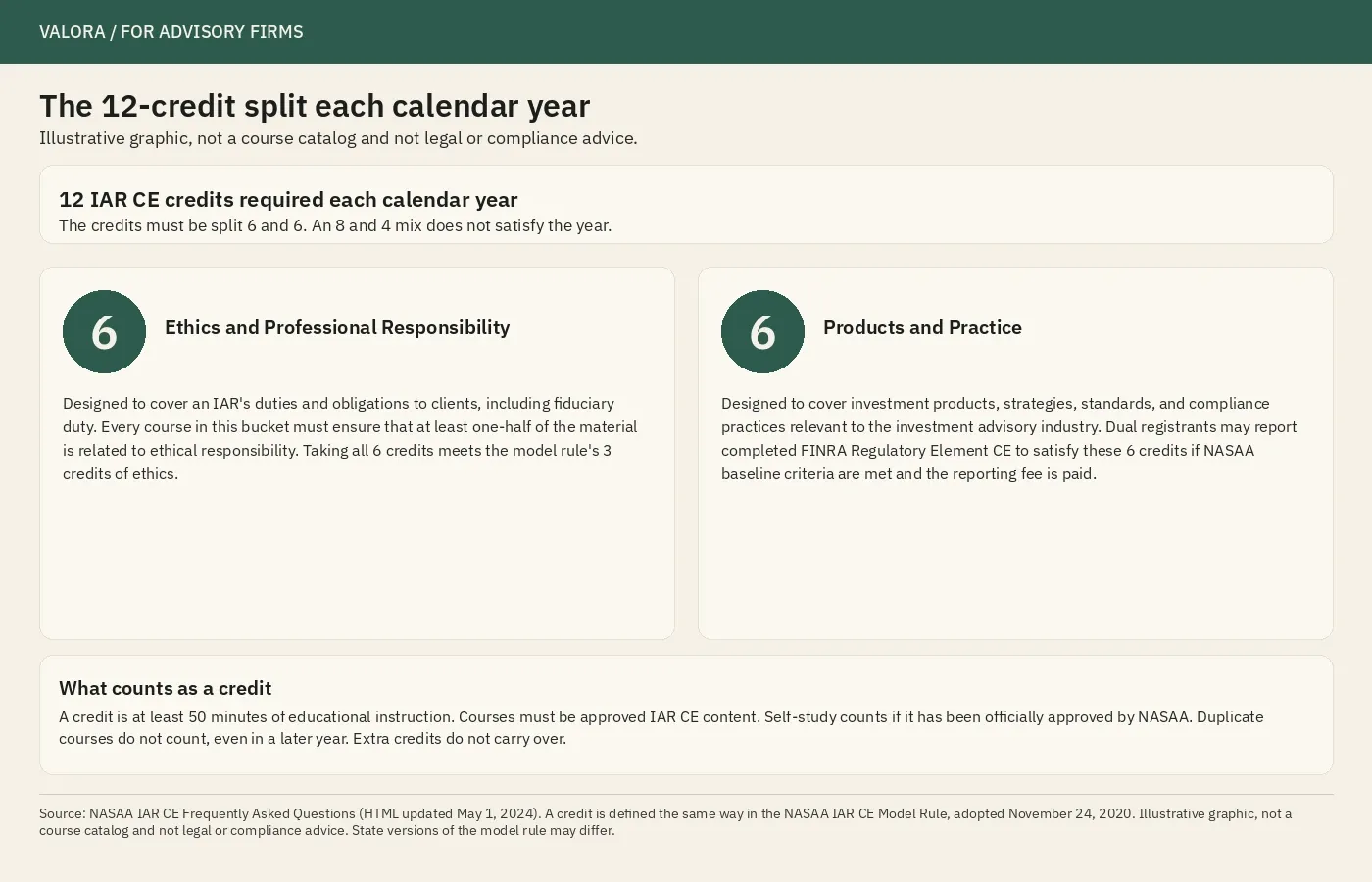
The North American Securities Administrators Association (NASAA) has a model rule on investment adviser representative (IAR) continuing education (CE). If you are registered as an IAR in a state that has adopted that rule, you need 12 credits every calendar year. Six credits must be in Ethics and Professional Responsibility. Six must be in Products and Practice. The split is fixed. Extra credits do not carry over.
Your course provider, not you, reports completions to the Central Registration Depository (CRD) of the Financial Industry Regulatory Authority (FINRA). The requirement follows where you are registered as an IAR, not where your firm is registered. If you miss it, your CE status becomes "CE Inactive," which can stop you from renewing. For 2026, NASAA says its own courses completed by midnight Eastern Time on December 22 will be submitted before the year-end CRD shutdown.
This is educational, not legal or compliance advice. Confirm the current rule with your state securities regulator and with your course provider. This page does not list the states that have adopted the model rule. Check your own record instead.
Short answer: 12 credits, split 6 and 6, every calendar year
NASAA's frequently asked questions state the requirement in plain terms. "IARs need to attain 12 CE credits each year to maintain their IAR registration." A credit is "at least 50 minutes of educational instruction."
The credits must be split 6 and 6. The FAQ gives a direct example. If an IAR takes 8 credits of Products and Practice and 4 credits of Ethics and Professional Responsibility, they will not satisfy that year's requirements, even though they attained 12 total credits.
The underlying text is NASAA's IAR CE Model Rule, adopted November 24, 2020. The model rule uses the heading "IAR Regulatory and Ethics Content" for the ethics bucket, and it requires at least three hours covering ethics. States adopt their own versions, and those versions may differ.
Who the requirement applies to
The FAQ says, "Every investment adviser representative (IAR) registered with a jurisdiction that has adopted the model rule is subject to its CE requirements." The program applies to registered IARs of both state-registered and federal covered investment advisers in that jurisdiction. "Federal covered" here means an investment adviser registered with the Securities and Exchange Commission (SEC).
A common misconception is that the firm's registration controls the outcome. The FAQ is direct on this point. "The requirement is applied based on where the IAR is registered regardless of where the IAR is domiciled or the firm is registered or notice filed."
This page does not list adopting states, and it does not count them. If you are not sure whether you have an IAR CE requirement, NASAA points you to your own record. "You can view your IAR CE transcript and manage your IAR CE requirement through FINRA's Financial Professional Gateway (FinPro) account."
If you are registered in more than one adopting state, you still complete the 12-credit requirement once per year when two FAQ conditions are met. Your home state's CE must be at least as stringent as the model rule, and you must be in compliance with it. "Home State," in the model rule, is the state of the IAR's principal office and place of business. If your home state has not adopted the rule, you must still comply with each other state in which you are registered as an IAR.
Titles and designations are a different question from this CE rule. For how those labels are used with clients, see Wealth manager vs financial planner vs fiduciary: role, credential and duty.
What counts: the two buckets
You choose approved courses. There is no single mandated course, so long as the 6-and-6 split is met and the courses are approved IAR CE content. NASAA publishes a public course and provider catalog. This page does not recommend a provider or a course, and it does not quote course prices.
The Products and Practice component covers investment products, strategies, standards, and compliance practices relevant to the investment advisory industry. You need six credits of it each year. The Ethics and Professional Responsibility component covers an IAR's duties and obligations to clients, including fiduciary duty. Every course in that bucket must devote at least one-half of its material to ethical responsibility. Taking all 6 credits meets the model rule's 3 credits of ethics.
Self-study counts if the course has been officially approved by NASAA. The FAQ sets no maximum for that delivery method. Unapproved self-study does not count.
If you are also a broker-dealer agent, completed FINRA Regulatory Element CE can satisfy the six Products and Practice credits. That works only if the content still meets NASAA's baseline criteria and the reporting fee is paid. FINRA Firm Element training counts only if NASAA has approved that training.
Credits taken to maintain a professional designation can also apply, the FAQ says, "so long as the provider and course have been approved by NASAA for IAR CE purposes." NASAA does not independently verify provider claims about other designations. This page does not map any one designation's hours onto IAR CE.
Duplicate courses do not count, even in a later year. Each course must have a unique identification number for you to receive credit. If you change firms mid-year, credits already completed stay on your CRD transcript and still apply to the annual requirement.
First year and timing
A new IAR in a state that has adopted the rule does not have an annual requirement immediately. The FAQ says those individuals "do not have an annual IAR CE requirement until January 1 of the following year." If an IAR registers in an IAR CE state for the first time in February of 2024, they will not be required to complete IAR CE in 2024. Their requirement begins on January 1, 2025.
Once the requirement applies, you can begin taking courses on January 1. "All CE credits must be reported by the end of the calendar year." The course must also appear on your IAR CE transcript in CRD by year end. That means it is completed, the provider has reported it, and FINRA has accepted and processed the roster.
The FAQ also describes a related but different start date. The requirement begins on January 1 of the calendar year following a jurisdiction's adoption. Do not mix a state's adoption date with your own first registration date. Check FinPro for the year that applies to you.
Who reports and what it costs to report
With the exception of FINRA's Regulatory Element CE, course providers report completions to FINRA, NASAA's vendor for program tracking. "There is no need to directly report the completion of CE to your state securities regulator."
You are still responsible for the file. The model rule says every IAR must ensure that the authorized provider reports the completion. Give the provider your CRD number and your first and last names. You may want documentation for courses you attend. You can watch submissions in FinPro.
There is a reporting fee, sometimes called a roster fee. It is $3 per credit per person. The fee is due when the provider submits the completed course, and the invoice goes to the provider. This is a reporting fee, not a course price.
If you report FINRA Regulatory Element CE for the six Products and Practice credits, you pay $18 through FinPro, unless your firm has opted in to pay that fee for all of its IARs. The FAQ says there will be no refunds. If the payment is not processed or is charged back, you will not receive the corresponding credits. Ask your broker-dealer whether the firm will report this on your behalf.
What happens if you miss it
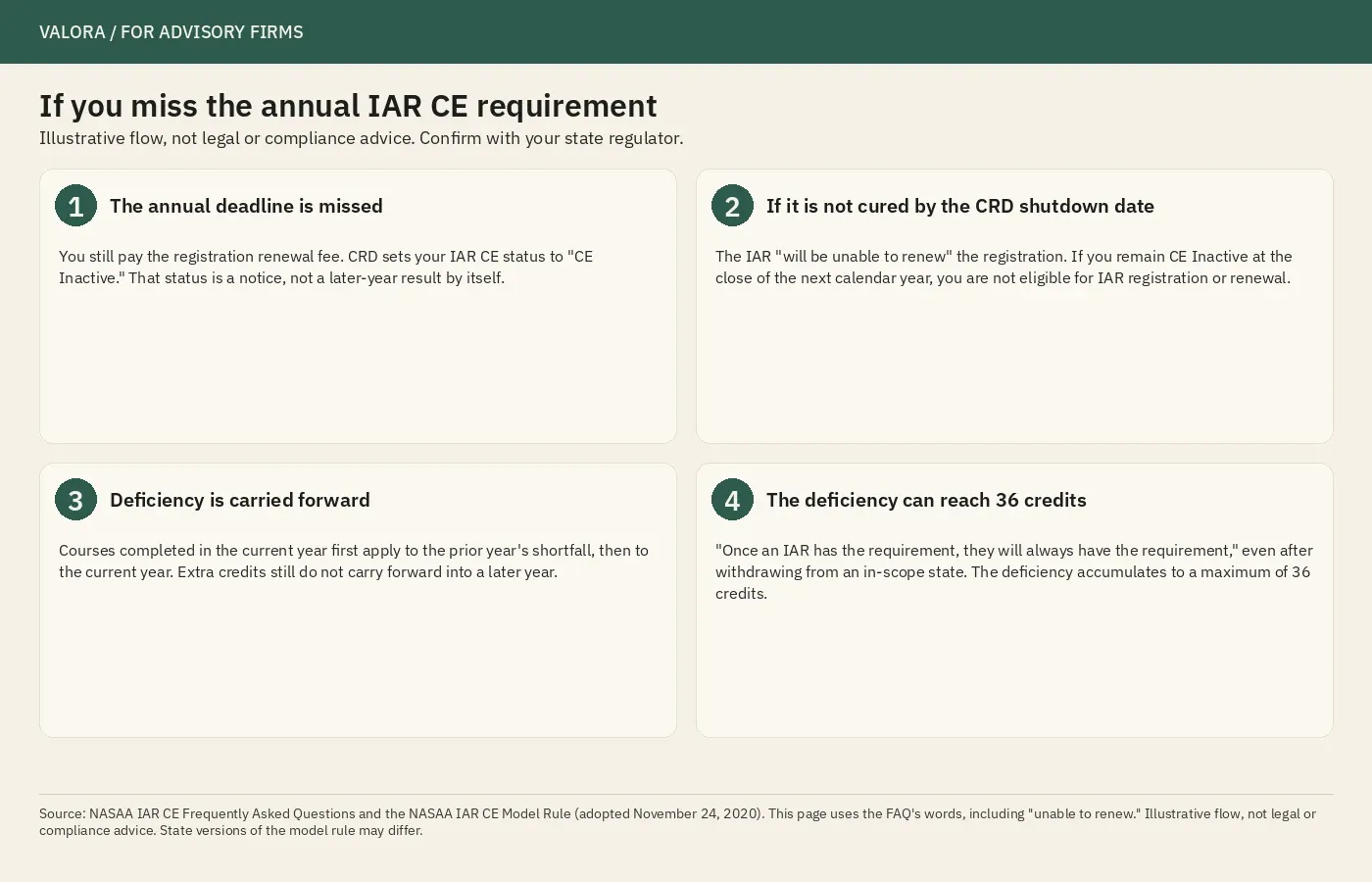
If you do not complete the CE requirement by the annual deadline, you still pay the registration renewal fee. CRD then sets your IAR CE status to "CE Inactive." The FAQ treats that status as a notice. If CE is not completed by the CRD System Shutdown date, the IAR "will be unable to renew" the registration.
An IAR who remains CE Inactive at the close of the next calendar year is not eligible for IAR registration or renewal. The same result follows if the requirements are not completed by the CRD System Shutdown date of that second year.
Missed credits do not disappear. Courses completed in the current year first apply to a prior-year deficiency, then to the current year. The FAQ's example is Joe, who missed 2022. Courses he completes in 2023 first fill that shortfall. Excess credits in 2023 will not be applied to 2024. Once the required credits are in, status updates automatically to "Satisfied."
The deficiency can accumulate to a maximum of 36 credits if it is not maintained annually. The FAQ says, "once an IAR has the requirement, they will always have the requirement," even after withdrawing from an in-scope state. The requirement is maintained if you were registered with a state that requires IAR CE for any part of the year. A deficiency will not affect registration in states that have not adopted the rule. If such a state later adopts it, your registration can be affected on the rule's effective date if you have not stayed current.
You cannot bank extra credits for a later year. The FAQ and the model rule both say excess credits do not carry forward.
2026 year-end dates
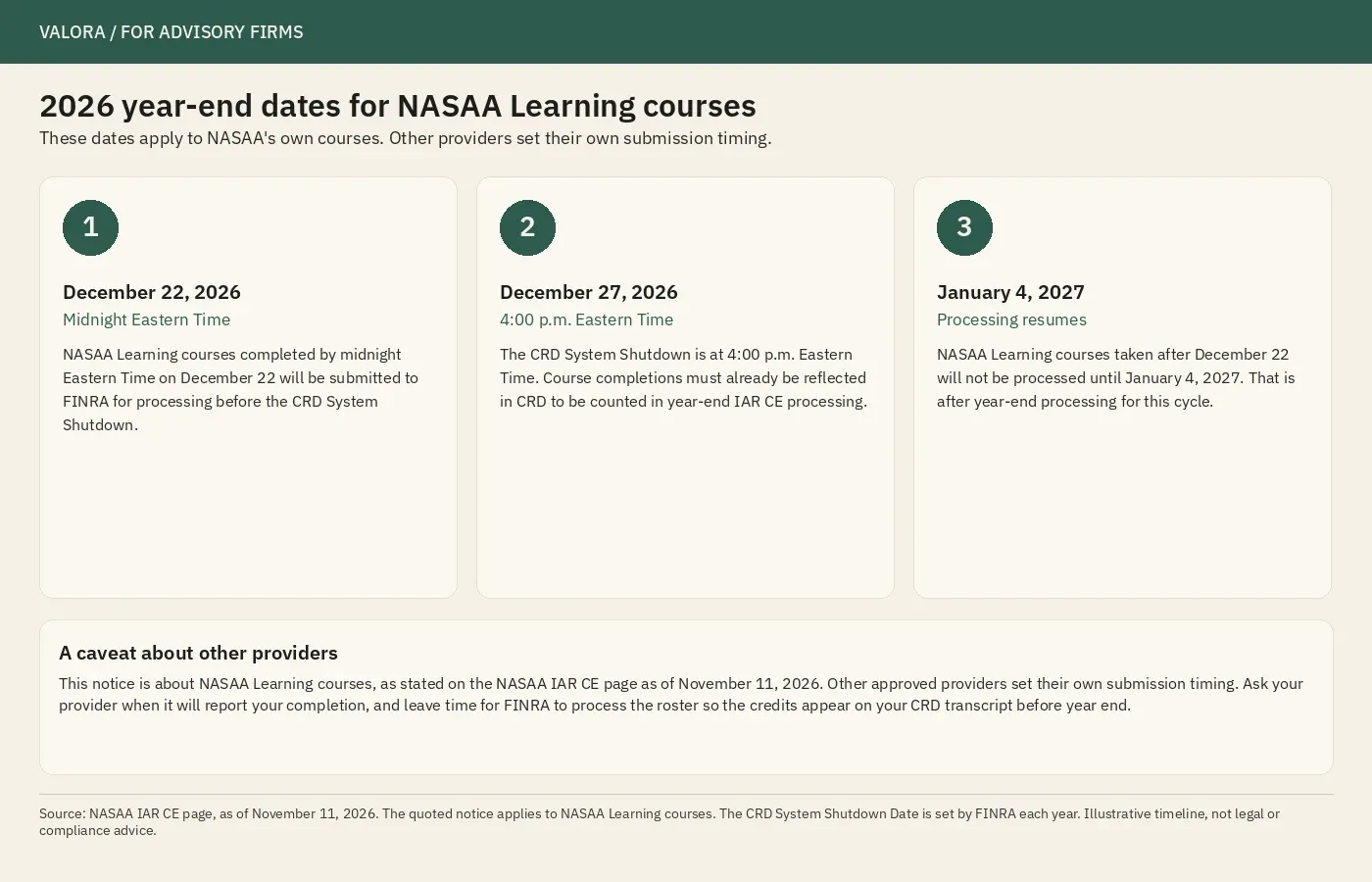
The dates that matter this cycle are on NASAA's IAR CE resources page, as of November 11, 2026. "NASAA Learning courses completed by midnight ET on December 22 will be submitted to FINRA for processing prior to the CRD System Shutdown (December 27 at 4:00 PM ET)." "Courses taken after December 22 will not be processed until January 4, 2027."
ET in that notice means Eastern Time. Those dates apply to NASAA Learning courses in this cycle, not automatically to every approved provider.
Other providers set their own submission timing. Ask your provider when it will report your completion, and leave time for FINRA to process the roster. A course counts only once it is reflected on your CRD transcript. The CRD System Shutdown Date is set by FINRA each year. Do not assume every provider uses December 22.
A simple year-end CE check for a small firm
This section is practice guidance, not a required form and not a substitute for your state regulator or your provider.
First, open FinPro and read your IAR CE transcript and status. The record that matters is the one in CRD.
Second, count credits by bucket, not only by the yearly total. You need 6 and 6.
Third, confirm submission timing with your provider. If you are using NASAA Learning this year, treat midnight Eastern Time on December 22, 2026, as NASAA's published cutoff for those courses. If you use another provider, use that provider's date.
Fourth, confirm you have not repeated a course that will be reported but will not count. Keep your certificates. The FAQ says you may want documentation for courses attended.
Fifth, if you use Regulatory Element CE for the Products and Practice bucket, confirm that the FinPro reporting step is done. Confirm that the $18 fee, or your firm's opted-in payment, has been processed.
Year-end CE is one admin task among others. For what a solo registered investment adviser might automate first, see What should a solo RIA automate first?.
FAQ
Can I carry over extra credits? No. An IAR who completes more CE credits than are required for the year may not carry forward excess credits into a subsequent year, according to NASAA's IAR CE FAQ and the model rule.
Do I have to report CE myself? Usually no. With the exception of FINRA's Regulatory Element CE, course providers report completions to FINRA. "There is no need to directly report the completion of CE to your state securities regulator." You are still responsible for ensuring that the provider reports the course, and you can watch the result in FinPro. If you are applying Regulatory Element credit, you or your firm reports that piece through FinPro and pays the $18 reporting fee unless the firm has opted in.
If your firm later wants help making its services easier for suitable prospects to find and understand, you can learn about Valora's work for advisory firms. The current public offer is $250 per booked appointment with a qualified prospect, with a 3-appointment minimum, paid in advance. An appointment is a call booked on your calendar with a prospect who has asked to speak with an advisor. There is no setup fee, retainer, or long-term contract. If a prospect does not attend or does not meet the agreed criteria, the appointment is replaced at no charge. Your firm reviews what goes out under its name.
This article is educational, not legal advice, tax advice, compliance advice or personalized investment advice. Valora is not a registered investment adviser and does not provide investment advice. Valora provides marketing services to advisory firms. Valora is not a continuing-education or compliance service.
Sources
- NASAA, Investment Adviser Representative Continuing Education resources page, including the End-of-Year Notice for NASAA Learning courses, as of November 11, 2026: https://www.nasaa.org/industry-resources/investment-advisers/investment-adviser-representative-continuing-education/
- NASAA, Investment Adviser Representative Continuing Education (IAR CE) Frequently Asked Questions (HTML, updated May 1, 2024): https://www.nasaa.org/industry-resources/investment-advisers/resources/iar-ce-faq/
- NASAA, Investment Adviser Representative Continuing Education (IAR CE) Frequently Asked Questions (PDF, July 2026 uploads path; mechanics match the HTML FAQ): https://www.nasaa.org/wp-content/uploads/2026/07/IAR-CE-FAQs.pdf
- NASAA, Model Rule on Investment Adviser Representative Continuing Education (Model Rule 2002-411(h) or 1956-204(b)(6)-CE), adopted November 24, 2020: https://www.nasaa.org/wp-content/uploads/2020/10/NASAA-IAR-CE-Model-Rule.pdf
- Valora, For Advisors: https://www.valorahq.com/for-advisors/ (offer terms only; not evidence of client results)