
How should independent advisors use AI in prospect and client work?
Use AI to draft and think through advisor work, keep client files out of unapproved tools, and review every output before it is used.


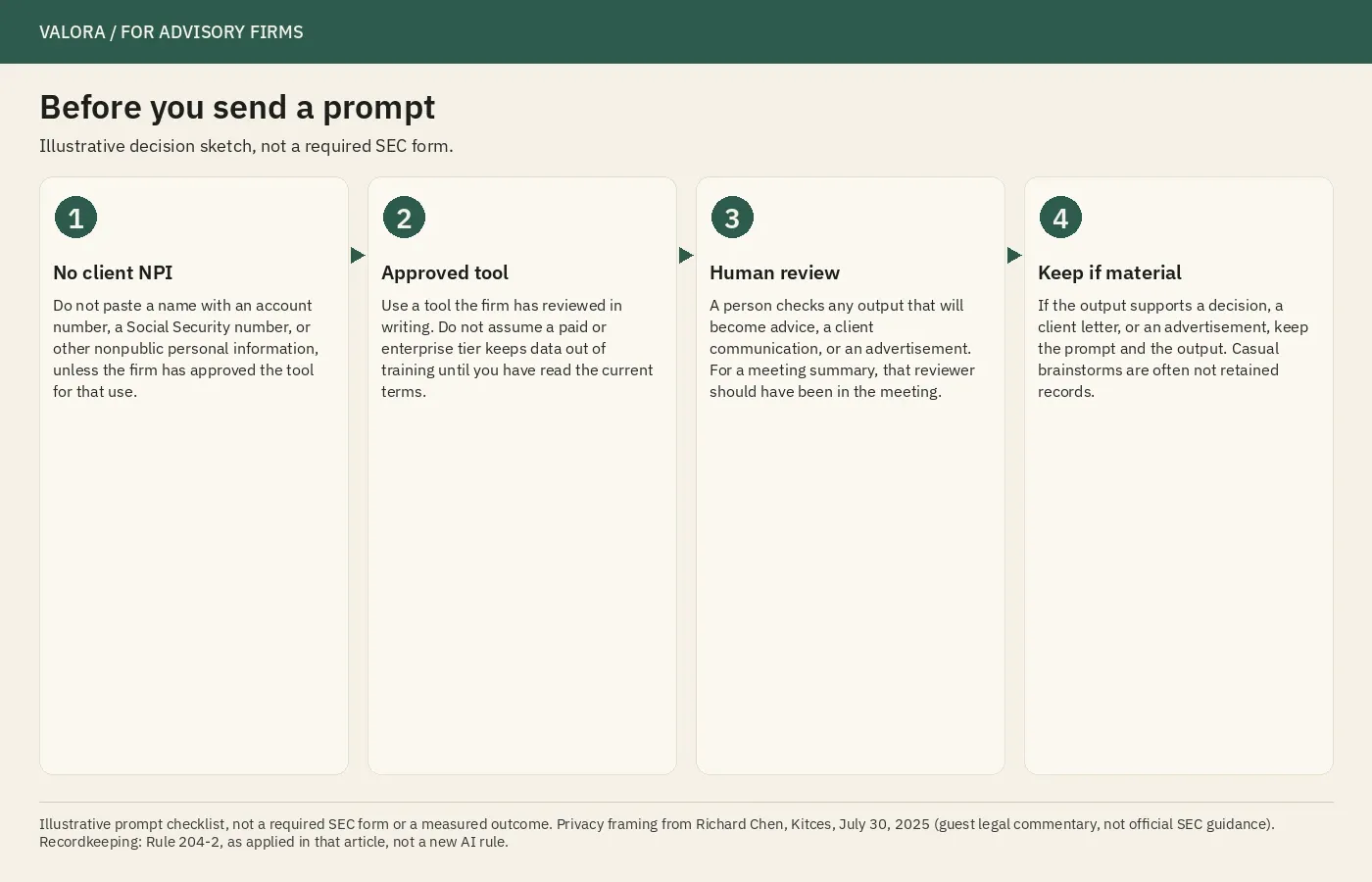
AI tools can help an independent advisor draft, summarize, and think through prospect and client work. They do not replace the adviser's responsibility for what is accurate, suitable, and allowed to leave the firm. A practical starting point is to use AI first on work that does not need a client's file. Keep nonpublic personal information (NPI) out of tools that train on or retain prompts, unless the firm has approved a configuration that fits its privacy program. NPI is nonpublic personal information about a client, such as a name paired with an account number or a Social Security number. Review any output that will become advice, a client communication, or an advertisement. Keep the material prompts and outputs.
This is educational, not legal advice, and not a product review. It does not tell a firm which vendor to buy. Advisers have been asking how to use these tools with client information, which is one reason the question is live. This page does not treat any private discussion as a study.
A registered investment adviser (RIA) is a firm registered to give investment advice. The privacy and marketing rules discussed here apply to advisers registered with the Securities and Exchange Commission (SEC), or required to be registered with it. Advisers that are only state-registered should check the rules of their state securities regulator.
This page is about in-practice workflows and the client-data line. It is not a hiring guide, a fee-value explainer, or a guide to how a firm is described in public AI answers. For marketing drafts, use SEC Marketing Rule in plain English for solo RIAs (testimonials, reviews, AI copy). For an AI meeting summary that has already reached a client, use How should an advisory firm correct an AI meeting summary after it has reached the client?.
How should an independent advisor use AI in prospect and client work?
Use AI as a thinking and drafting partner, then check the output before it leaves the firm. These tools predict language from patterns in their training data. They do not understand a particular client (Richard Chen, Kitces, July 30, 2025). The output can sound fluent and still be inaccurate, incomplete, or biased. The adviser remains responsible for advice, client communications, and advertisements.
This article is educational. It is not a ranking of vendors, and it does not promise time saved or a typical result. If a firm later adds a junior person to review AI drafts, that later seat is covered in How to redesign the junior advisor role when AI drafts the plan. This page stays on the adviser who is using the tools. Questions about what a household is paying for when software does the math live on a separate page. This article does not cover that conversation.
Start with work that does not need a client file
A safer place to start is work that does not require a client's file. In a January 23, 2025 practitioner conversation, not a survey, Michael Kitces and Carl Richards discussed low-data uses of a chatbot as a thinking partner (Kitces and Carl, Episode 156). The examples include brainstorming a first-meeting agenda, tightening a reply after identifiers are removed, asking for a critique of an educational handout, and summarizing a public transcript. Richards also flags taking identifying information out of an email before pasting it.
Those examples are illustrations, not a promise of time saved, and not a measured result for a typical firm. The same conversation notes that useful prompting is often iterative. You may need more than one pass, and you still have to read what comes back. This is practice commentary, not official guidance.
Draw a hard line around client nonpublic information
Client NPI does not belong in a tool the firm has not approved for that use. In a July 30, 2025 Kitces article, Richard Chen, a lawyer who represents investment advisers, frames Regulation S-P as the primary federal privacy framework for SEC-registered advisers. That article is guest legal commentary, not official SEC guidance, and not Valora legal advice.
As Chen states the rule, Regulation S-P has two core obligations. Firms must provide privacy notices and an opportunity to opt out of certain sharing. They must also adopt written policies reasonably designed to protect client NPI from unauthorized access or use. Chen says the most effective method is to use tools that do not train on user data and do not retain it longer than necessary. If a tool does train on inputs, he says personnel should be trained not to enter client NPI, with redaction as an added control.
This page does not say that any particular consumer tool, paid tier, or enterprise product is or is not permitted. A firm has to read the current written terms and match them to its privacy program.
Fiscal year 2026 examination priorities from the SEC Division of Examinations are staff views, not a rule. They discuss Regulation S-P amendments, including incident-response programs and customer-information safeguards, as an examination topic after the applicable compliance dates. They also mention cybersecurity training and controls related to AI (SEC Division of Examinations, Fiscal Year 2026 Examination Priorities). This article does not invent those compliance dates.
State-registered and unregistered firms may face different privacy rules. Chen notes Federal Trade Commission or state privacy regimes in those cases. That is a limit of this page, not a map of those regimes. Advisers that are only state-registered should check their state securities regulator.
Ask vendors how they store, train on, and log your inputs
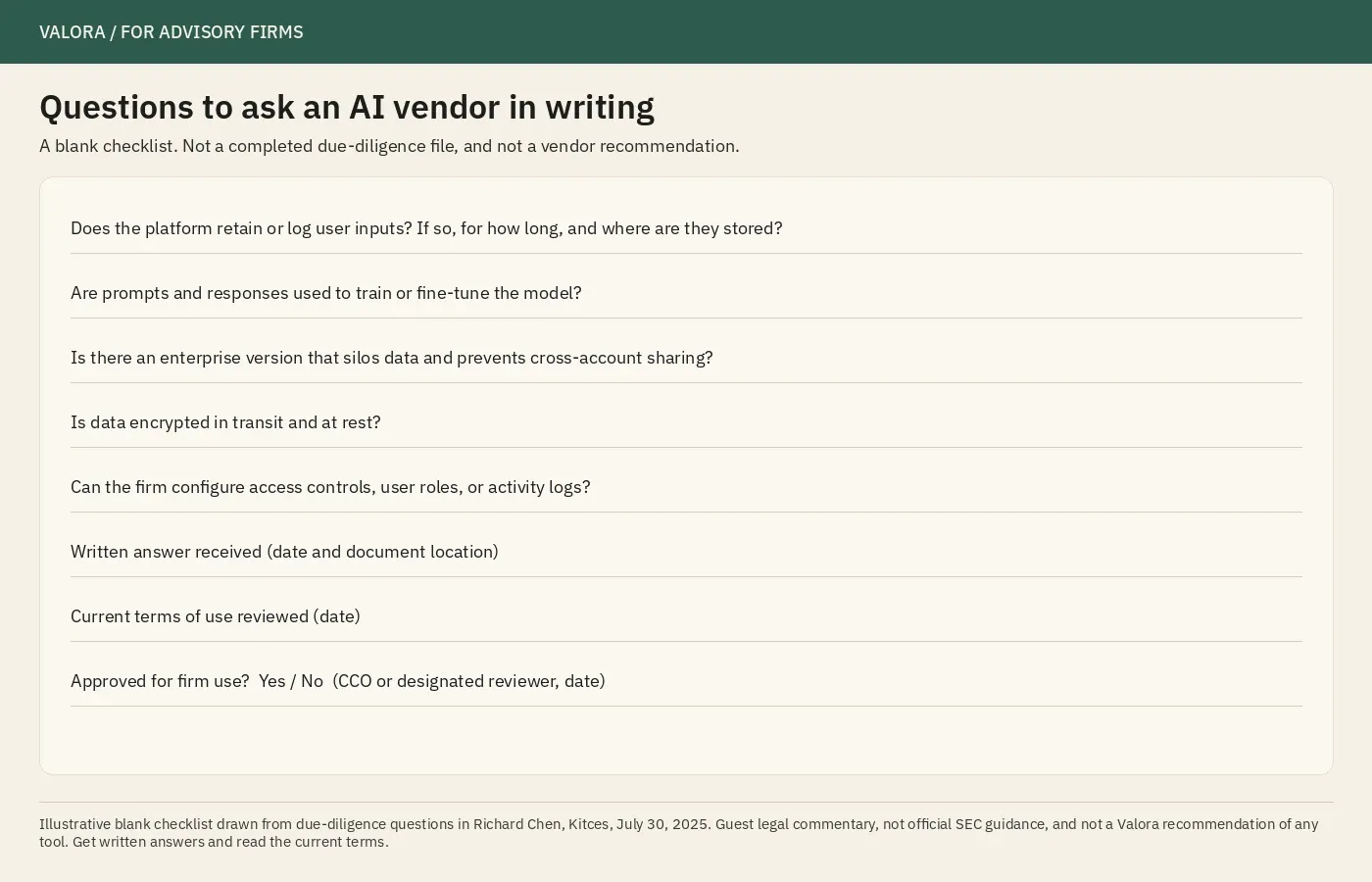
Before a tool touches firm work, ask how it handles your inputs, and get the answers in writing. Chen's due-diligence list is a useful checklist, not a required SEC form. Ask whether inputs are retained or logged, and for how long and where. Ask whether prompts and responses are used to train or fine-tune a model. Ask whether an enterprise version silos data. Ask whether data is encrypted in transit and at rest. Ask whether the firm can set access controls, roles, or activity logs (Richard Chen, Kitces, July 30, 2025).
Prefer written answers, and read the current terms yourself. Do not assume that a paid or enterprise tier always keeps data out of training. Mentions of particular products in the Kitces article are the author's examples, not a Valora recommendation. This page does not name a best tool.
Chen also advises firms not to use personal accounts for business AI work, because the firm may not be able to retrieve those records. That is the author's practice point, not a new AI-specific SEC rule. If a vendor relationship later ends, a short companion on disconnecting a former vendor's access to client data covers offboarding. This page stays on the questions to ask up front.
A person still has to check the output before it becomes advice or an advertisement
A fluent draft is not a finished work product. Chen notes that AI output can be inaccurate, incomplete, or biased, and that firms should have a review process, especially when the output is used in marketing, research, or planning advice. Citations supplied by a tool still need to be opened and checked, because tools can invent sources (Richard Chen, Kitces, July 30, 2025).
If the draft is an advertisement, use the review already described on the live Marketing Rule page. The Marketing Rule applies to advisers registered with the SEC, or required to be registered with it. This page does not reprint that checklist.
If the output is a meeting summary, a person who was in the meeting should review it before it is used. Keep the transcript with the summary. If an inaccurate summary has already reached a client, follow How should an advisory firm correct an AI meeting summary after it has reached the client?. This page does not write that correction workflow.
Chen discusses Advisers Act anti-fraud provisions and a possible negligence theory. He also says that theory has yet to be tested in a live case involving the use of an AI tool. This article does not treat that theory as a decided case.
Keep the prompts and outputs that support a decision or a client communication
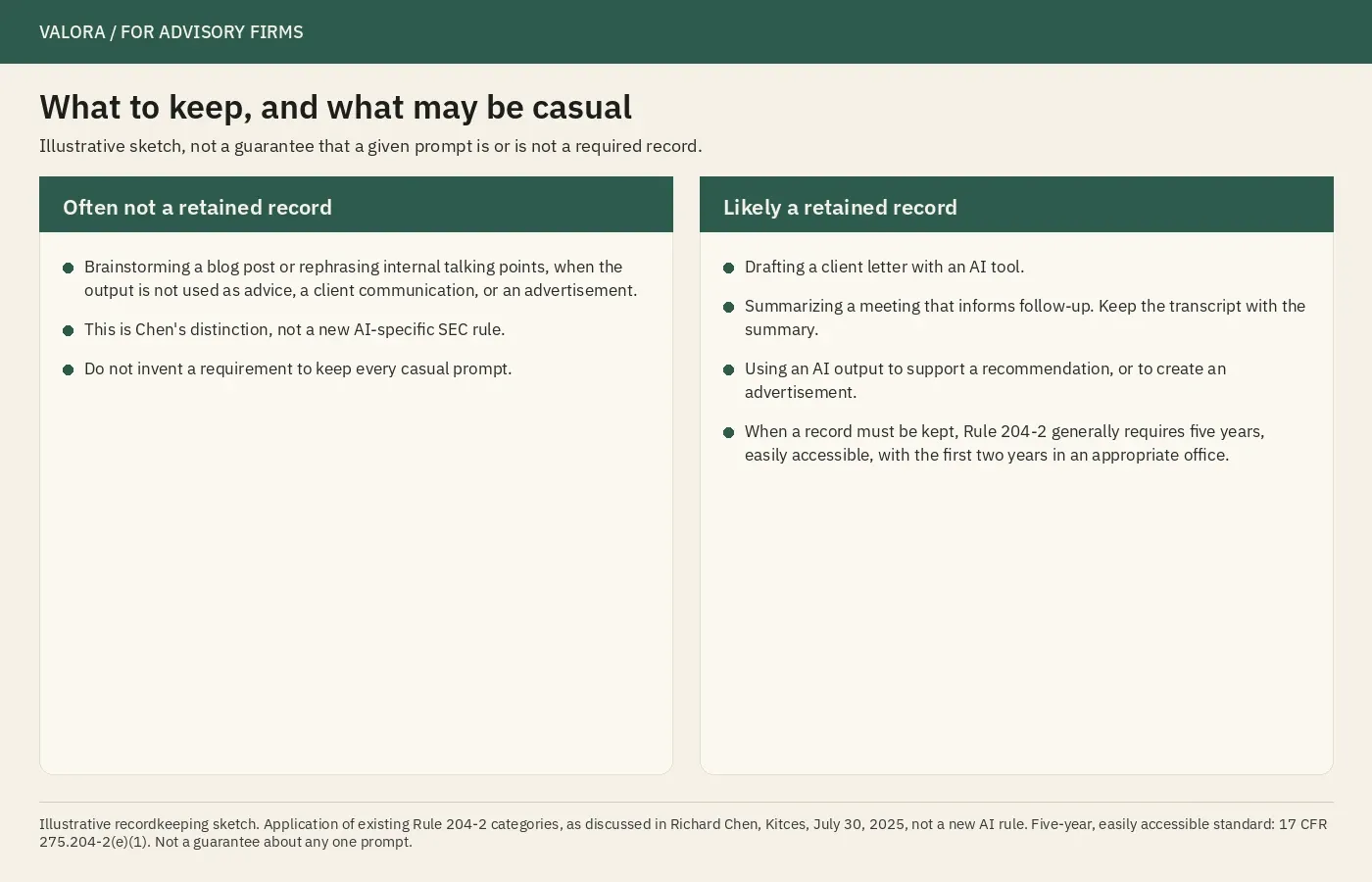
There is no SEC rule titled as an "AI rule" for advisers in the sources cited below. Recordkeeping still comes from existing categories in Rule 204-2, the books and records rule. Chen reads that rule to cover AI-generated meeting notes, marketing content, and investment analyses when they are used to support client advice, client communications, or advertisements (Richard Chen, Kitces, July 30, 2025).
He distinguishes a casual use, such as brainstorming a blog post, which often is not a retained record, from a material use. Material uses include drafting a client letter, summarizing a meeting that informs follow-up, or supporting a recommendation, which are likely to be retained. This page does not invent a requirement to keep every casual prompt.
When a record must be kept, Rule 204-2 generally requires it to be kept in an easily accessible place for at least five years from the end of the fiscal year of the last entry. The first two years must be in an appropriate office of the adviser (17 CFR 275.204-2(e)(1)). That standard is not a new AI rule, and the rule text does not name any particular chatbot.
Say only what is true about how your firm uses AI
Do not claim the firm uses AI in a way it does not. Do not imply that the SEC has approved a tool. Fiscal year 2026 examination priorities say the Division of Examinations will review the accuracy of registrant representations regarding their AI capabilities or AI. The same document says the Division will assess whether firms have policies and procedures to monitor or supervise their use of AI technologies (SEC Division of Examinations, Fiscal Year 2026 Examination Priorities). Those statements are staff views, not a new rule, and not a prediction that any particular firm will be examined.
If a marketing claim about AI is also an advertisement, the Marketing Rule analysis is already on the live Marketing Rule page, including its note on 2024 marketing settlements over AI claims. This page does not reprint that section.
FAQ
Can I paste a client's email into a public chatbot? Not with identifiers or other NPI, unless the firm has approved a tool and configuration that fit its privacy program. Take identifying information out first if you are only asking for help with the wording. When in doubt, do not paste the client's file.
Does AI replace a meeting with the client? No. These tools can help you prepare or summarize. They do not understand the client, and they do not replace the conversation or the adviser's judgment.
Do I need an AI committee? The sources cited below describe written policies, training, and review. They do not require a committee for a solo firm.
Is this legal advice? No. This article is educational firm-side material. It is not legal advice, cybersecurity advice, compliance advice, or personalized investment advice. It does not recommend a vendor or promise a result.
If your firm later wants help making its services easier for suitable prospects to find and understand, you can learn about Valora's work for advisory firms. The current public offer is $250 per booked appointment with a qualified prospect, with a 3-appointment minimum, paid in advance. An appointment is a call booked on your calendar with a prospect who has asked to speak with an advisor. There is no setup fee, retainer, or long-term contract. If a prospect does not attend or does not meet the agreed criteria, the appointment is replaced at no charge. Your firm reviews what goes out under its name.
This article is educational, not legal advice, tax advice, compliance advice or personalized investment advice. Valora is not a registered investment adviser and does not provide investment advice. Valora provides marketing services to advisory firms. Valora is not an AI-tools vendor or a compliance service.
Sources
- Richard Chen, Major Compliance Risks When Using AI Tools (And Best Practices To Mitigate Them), Kitces, July 30, 2025: https://www.kitces.com/blog/artificial-intelligence-ai-tools-regulation-compliance-regulatory-ria-chatgpt-records-client-data-risk/
- Kitces and Carl, Episode 156, How Are You Getting Value Out Of ChatGPT As A Financial Advisor?, January 23, 2025: https://www.kitces.com/blog/156-michael-kitces-carl-richards-chat-gpt-financial-advisor-ai-technology-tools/
- SEC Division of Examinations, Fiscal Year 2026 Examination Priorities (staff views only): https://www.sec.gov/files/2026-exam-priorities.pdf
- 17 CFR 275.204-2, Books and records to be maintained by investment advisers: https://www.ecfr.gov/current/title-17/chapter-II/part-275/section-275.204-2
- Valora, For Advisors: https://www.valorahq.com/for-advisors/ (offer terms only; not evidence of client results)