
What do the fastest-growing RIAs do differently to get clients?
What research associates with stronger RIA organic growth: clear plans, tracked inquiry sources, and acquisition beyond passive referrals.


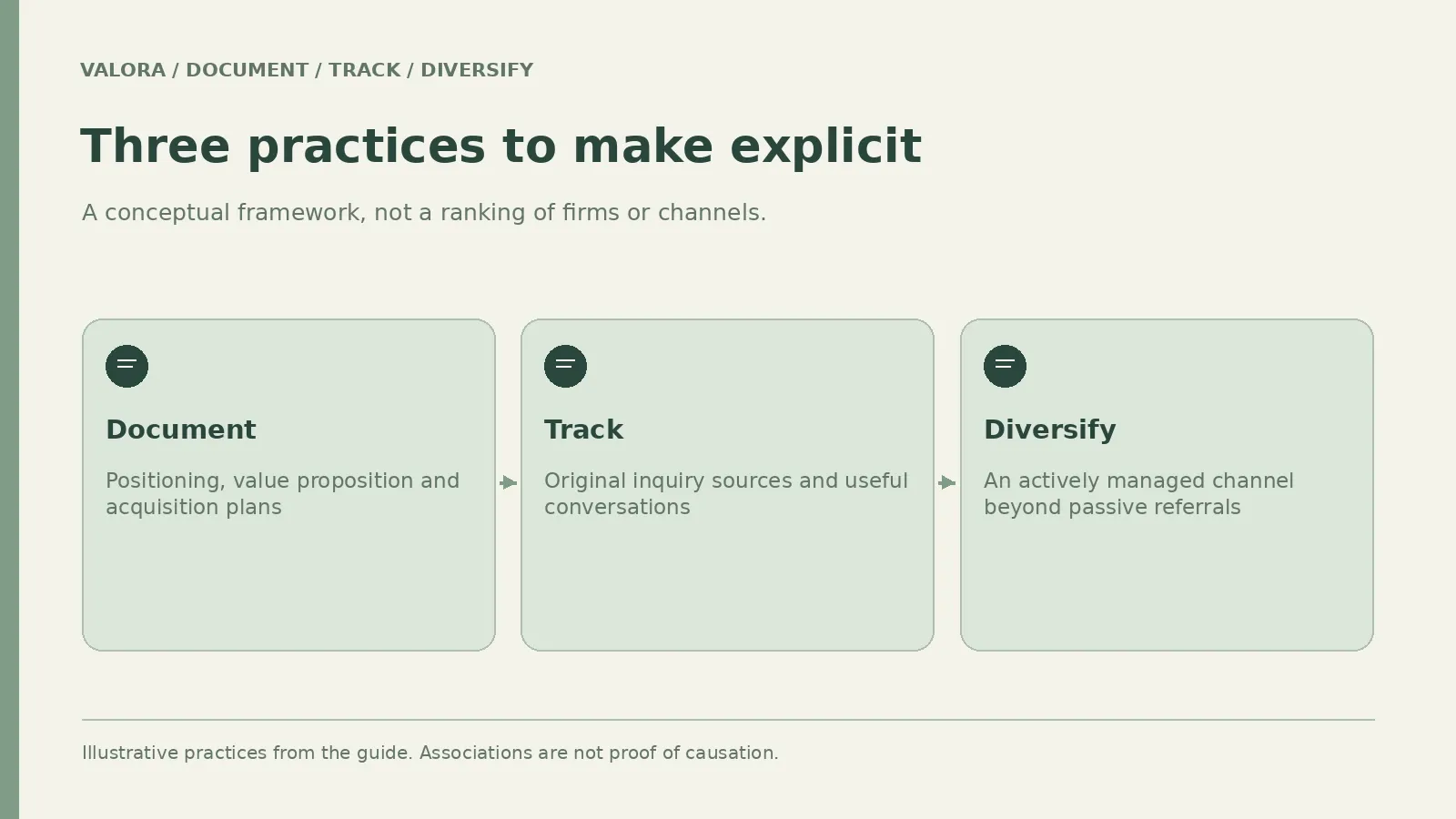
The useful difference is not a secret lead source. Research associates stronger organic growth with clear positioning, documented marketing and referral processes, inquiry-source tracking, and acquisition beyond passive referrals. These practices give a firm ways to learn which conversations fit its services and where follow-through breaks down. They do not establish a formula that makes any firm one of the fastest-growing RIAs.
Start by separating growth in assets from growth in client relationships. Markets, existing-client deposits, acquisitions, and new households can all change a firm's size. This guide focuses on earning suitable new relationships through organic business development, not buying another book or predicting investment returns.
Key takeaways
- Define growth before copying tactics: AUM, net flows, and new households measure different things.
- Schwab's Top Performing Firms are a composite-performance group, not simply the fastest client gatherers.
- Kitces' high-growth practices use a different definition and are less dependent on referrals as a share of acquisition.
- Copy the discipline of documenting, measuring, and following through, not another firm's growth rate.
- Protect service capacity: more inquiries do not help if you cannot serve the resulting households well.
What does “fastest-growing” actually mean?
Schwab's 2026 RIA Benchmarking Study says stronger organic growth is associated with clear processes and consistent execution. Top Performing Firms are more likely to document an ideal client persona, value proposition, marketing plan, and referral plans for clients and business partners.
Schwab defines this group as the top 20% of its Firm Performance Index, combining 15 metrics across growth, retention, operations, and planning. Planning-related metrics (for example ideal client persona and client value proposition) are among the Firm Performance Index inputs. It is not a clean experiment proving that a marketing plan causes acquisition.
The study uses self-reported information from 1,236 Schwab-custodied firms, not independently verified by Schwab. Kitces' referral analysis instead defines high-growth practices as the top third of organic new-client revenue growth for their revenue level among actively growing practices. Do not collapse these populations into one universal ranking.
Why deliberate growth matters even when markets rise
A rising asset balance can hide a weak acquisition process. Conversely, a firm serving retirees may add relationships while distributions limit net asset growth. Cerulli's July 2026 release reports that regular income withdrawals and one-time distributions accounted for 56% of RIA outflows in 2025. Withdrawals are not automatically evidence of failed service.
Choose the measure that answers your business question:
| Measure | What it helps you see | What it cannot establish alone |
|---|---|---|
| New households | Relationships accepted | Their profitability or service burden |
| Net household change | Additions less departures | Why people joined or left |
| New-client assets | Assets from new relationships | Overall service quality |
| Net organic flows | Contributions and withdrawals excluding market moves | A channel's conversion quality |
| AUM growth | Change in managed assets | How much came from marketing |
Keep acquisitions separate from organic wins. Decide whether a couple is one household or two clients and maintain that definition. A change in counting is not a growth improvement.
Make your ideal client recognizable
A written profile should help someone decide, not decorate a slide. Describe the problem you handle, the services you actually provide, relevant eligibility or minimums, and circumstances that make a prospect unsuitable.
For example, an advisor with genuine retirement-transition experience might focus on households moving from salary to portfolio income. That gives an introducer a situation to recognize and gives your team questions to ask. “Successful people who value advice” does neither.
Check the profile against existing relationships. Which needs recur? Which work fits your expertise? Which requests require another professional? Make exceptions deliberately. A campaign attracting work you cannot serve is not progress simply because inquiries rise. Use the same profile in website copy, professional conversations, discovery, and service planning so those parts of the business are not attracting different people.
Understand the referral paradox
Cerulli reports that referrals account for 74% of RIA new-client acquisition, while 51% proactively ask for them. That describes category reliance and activity; it does not establish that asking more produces more referrals.
Kitces' September 2026 analysis adds an important counterpoint. Its executive summary reports that standout-growth practices obtain roughly 25%–35% of new clients from referrals, versus 60% or more for practices without standout growth. Those are shares of acquisition, not proof that high-growth practices receive fewer referrals in absolute numbers. The samples and definitions also differ from Cerulli's.
Kitces finds no evidence that more frequent referral requests increased referral-driven growth. A useful application is to make clients aware that introductions are welcome, explain whom you help, and communicate the service value you actually deliver. Do not turn every review into a request. Thank introducers while protecting privacy; review gifts, compensation, and reciprocal arrangements before adopting them.
Add a channel you can actively manage
Referrals depend on another person's willingness and network. Kitces argues that practices seeking standout growth need at least one non-referral “anchor” tactic they can execute. More control over activity does not mean control over outcomes.
Choose a channel where you can state what you will do, what it costs, and how a suitable person reaches you. That might be participation in a relevant professional community, a focused educational event, or useful search content. A paid source is another possible test, not a required next step.
Do not adopt everything at once. A solo firm may lack the hours to sustain an established team's mix. For source definitions and comparison dimensions, use the RIA lead-source guide. Here the lesson is ownership and measurement, not a preferred vendor or universal channel ranking.
Build professional relationships around useful work
Centers of influence are professionals whose work intersects with your clients' needs, not a list of accountants to email once. Cerulli's February 2026 release identifies COIs as the second most common new-client source across advisors, at 13.9%. This population differs from its RIA-specific July release.
The release highlights joint meetings, shared interests, and referring clients to another professional as alliance-building approaches rated effective by practice management professionals. That is not evidence that every reciprocal referral program is appropriate or compliant.
Choose a professional because their expertise serves a genuine need. Discuss the situations each party handles, permission for sharing information, and who communicates next. A joint planning conversation can clarify roles without promising business in return. For complex-household considerations, see how advisors approach high-net-worth acquisition.
Give interested prospects something clear to check
Referrals and visibility are not competing philosophies. A person introduced by a professional may still need to understand your services, fees, credentials, and next step. Make those facts easy to find and consistent with your actual practice.
Use an answer page to explain a decision your intended clients face. Say what it covers, where general education stops, and when individual advice is needed. Describe your experience accurately rather than claiming to be the “best” advisor for a group.
Test the contact route. A useful page cannot repair a broken form or unclear booking instructions. Keep service-area information honest; do not manufacture near-identical city pages. Search and AI visibility may support discovery, but rankings and AI citations are not guaranteed. The guide to people already looking for advice explains the intent distinction.
Track handoffs and protect capacity
Schwab reports that 85% of Top Performing Firms track inquiry sources, compared with 71% of other firms. This is an association, not evidence that installing a CRM creates clients.
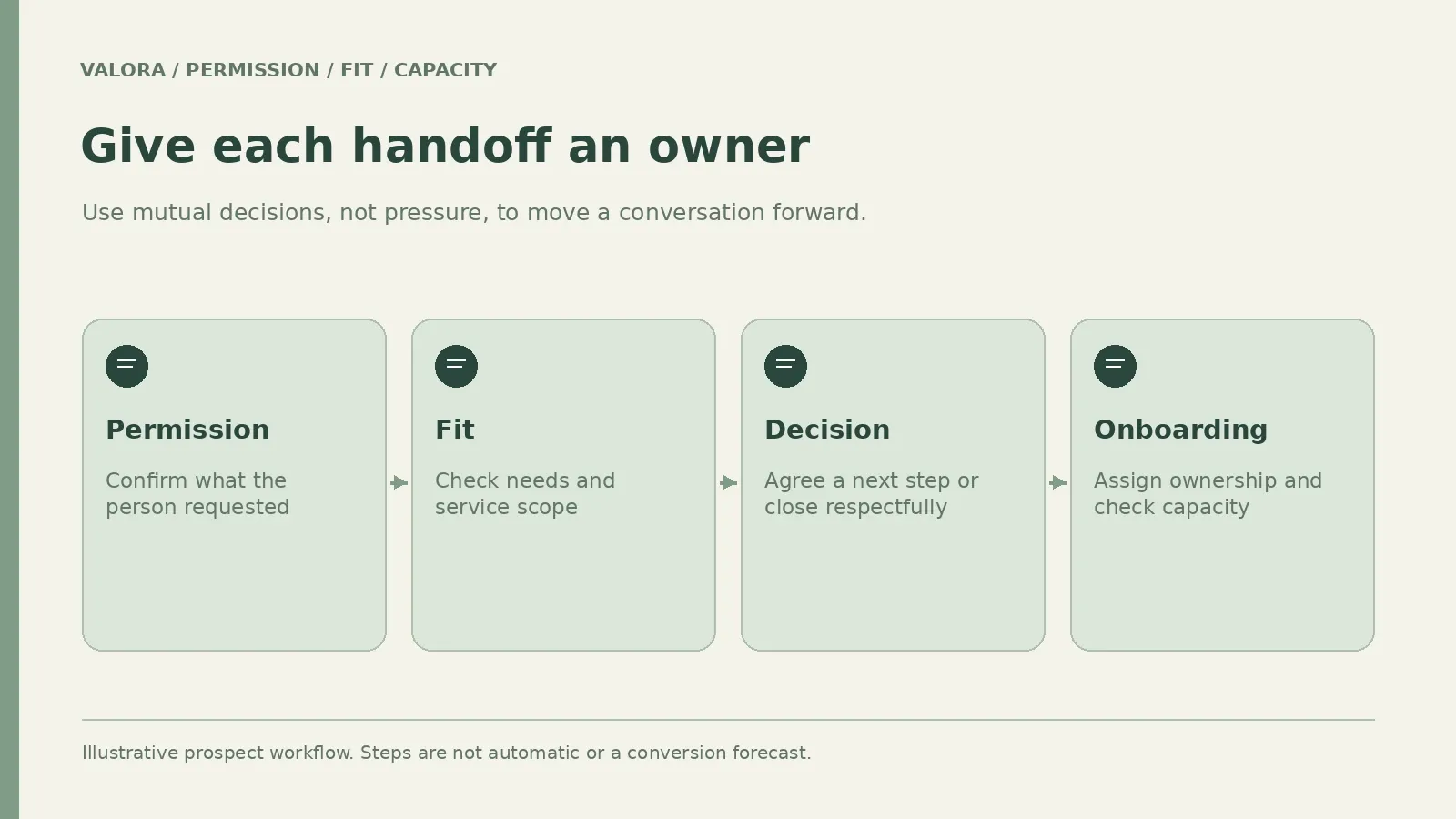
Connect each unique household to its original source, assisting sources, meeting outcome, decision, and onboarding status. Track cash spending and advisor hours alongside suitable attended conversations. Do not count someone again because they read an article after a referral.
Assign an owner to new inquiries and explain the first conversation. Record why prospects decline or stall: timing, fees, unsuitable needs, or unclear scope. These are diagnostic categories, not objections to overcome at any cost.
Capacity belongs on the same dashboard. Cerulli reports that only 14% of RIAs use a dedicated marketing resource, illustrating why business development competes with client work. Standardize scheduling and document collection before increasing volume. Schwab cautions that additional services bring oversight demands and do not guarantee growth. More complex offers are not automatically a better acquisition engine.
What should you copy this quarter?
Use a quarter as a review window, not a promised time to results. Write down your client profile, value proposition, and available acquisition capacity. Choose one high-trust relationship activity and one actively managed channel. Name an owner and record inquiry sources each week.
Then match the experiment to the observed constraint:
- Too few suitable inquiries: test a clear source aimed at your client group.
- Inquiries but poor fit: inspect positioning before increasing spending.
- Suitable meetings but unclear decisions: review discovery, fee explanation, and next steps.
- New clients but overloaded service: repair onboarding before accelerating acquisition.
Set an affordable time and spending limit. At review, separate completed conversations from still-open decisions. Continue, change one variable, or stop for a documented reason. New firms can begin with the first-ten-clients guide rather than copying a mature firm's operating model.
Where Valora fits
Valora is an optional marketing service to compare with other sources, not an explanation for the research findings above. It helps advisory firms reach people seeking their services and book conversations with prospects who asked to speak with an advisor.
The current public offer is $250 per booked appointment, with a 3-appointment minimum, paid in advance. There is no setup fee, retainer, or long-term contract. If a prospect does not attend or does not meet the agreed criteria, the appointment is replaced at no charge. Your firm reviews what goes out under its name.
A booked appointment is not a client. Valora does not guarantee clients, revenue, asset growth, rankings, AI citations, appointment volume, or Top Performing status. Review written criteria and available capacity before deciding whether an appointment-based test suits your firm.
Frequently asked questions
Are the fastest-growing RIAs always the biggest?
No. Size, percentage growth, and new-household counts are different measures. A percentage gain from a small base is not directly comparable with a larger firm's absolute additions. Define the comparison first.
Is a niche enough to create growth?
No. It clarifies fit, but the firm still needs appropriate services, credible communication, suitable conversations, and capacity. No cited source establishes that selecting a niche guarantees clients.
Should I copy the industry's marketing budget?
Cerulli reports marketing averages about 5% of RIA expenses. That is descriptive, not a recommended budget. Your economics, available time, and capacity should determine what you can responsibly test.
Do these tactics need compliance review?
Public claims, client stories, testimonials, endorsements, and referral arrangements need review under the rules and policies applicable to your firm. Research is not permission to make unsupported marketing claims.
Scope of this guide
This is educational marketing content, not investment, tax, legal, or compliance advice. Valora is not a registered investment adviser. Observational research is not a causal finding or forecast. SEC and state requirements depend on your registration and communications. The SEC staff FAQs are guidance, not a rule or Commission statement. No tactic described here guarantees business results.
Sources
- Schwab Advisor Services, 2026 RIA Benchmarking Study: planning, tracking, sample limitations, and Top Performing Firm definition. Fetched 7 Nov 2026 (Asia/Makassar). https://advisorservices.schwab.com/insights-hub/perspectives/ria-benchmarking-study-2026
- Kitces.com, Mark Tenenbaum, What Really Drives Client Referrals, September 28, 2026: growth definitions, referral reliance, asking frequency, and non-referral anchor tactics. Fetched 7 Nov 2026 (Asia/Makassar). https://www.kitces.com/blog/client-referrals-organic-client-growth-advisor-value-growth-network-marketing/
- Cerulli Associates, RIAs Must Offset Asset Churn with Dedicated Growth Efforts, July 22, 2026: outflows, referrals, marketing resources and spending. Fetched 7 Nov 2026 (Asia/Makassar). https://www.cerulli.com/press-releases/rias-must-offset-asset-churn-with-dedicated-growth-efforts
- Cerulli Associates, Financial Advisors Increasingly Leverage COIs to Capture New Client Growth, February 4, 2026: advisor-wide COI share and alliance practices. Fetched 7 Nov 2026 (Asia/Makassar). https://www.cerulli.com/press-releases/financial-advisors-increasingly-leverage-cois-to-capture-new-client-growth
- SEC Division of Investment Management, Marketing Compliance — Frequently Asked Questions: staff guidance relevant to marketing review. Fetched 7 Nov 2026 (Asia/Makassar). https://www.sec.gov/rules-regulations/staff-guidance/division-investment-management-frequently-asked-questions/marketing-compliance-frequently-asked-questions
- Valora, For Advisors: appointment definition, price, prepaid minimum, replacement terms, and limitations. Fetched 7 Nov 2026 (Asia/Makassar). https://www.valorahq.com/for-advisors/