
What should advisors do every week to keep clients coming in?
A weekly advisor business-development loop: tend relationships, improve one intent surface, clear follow-ups, and track suitable conversations by source.


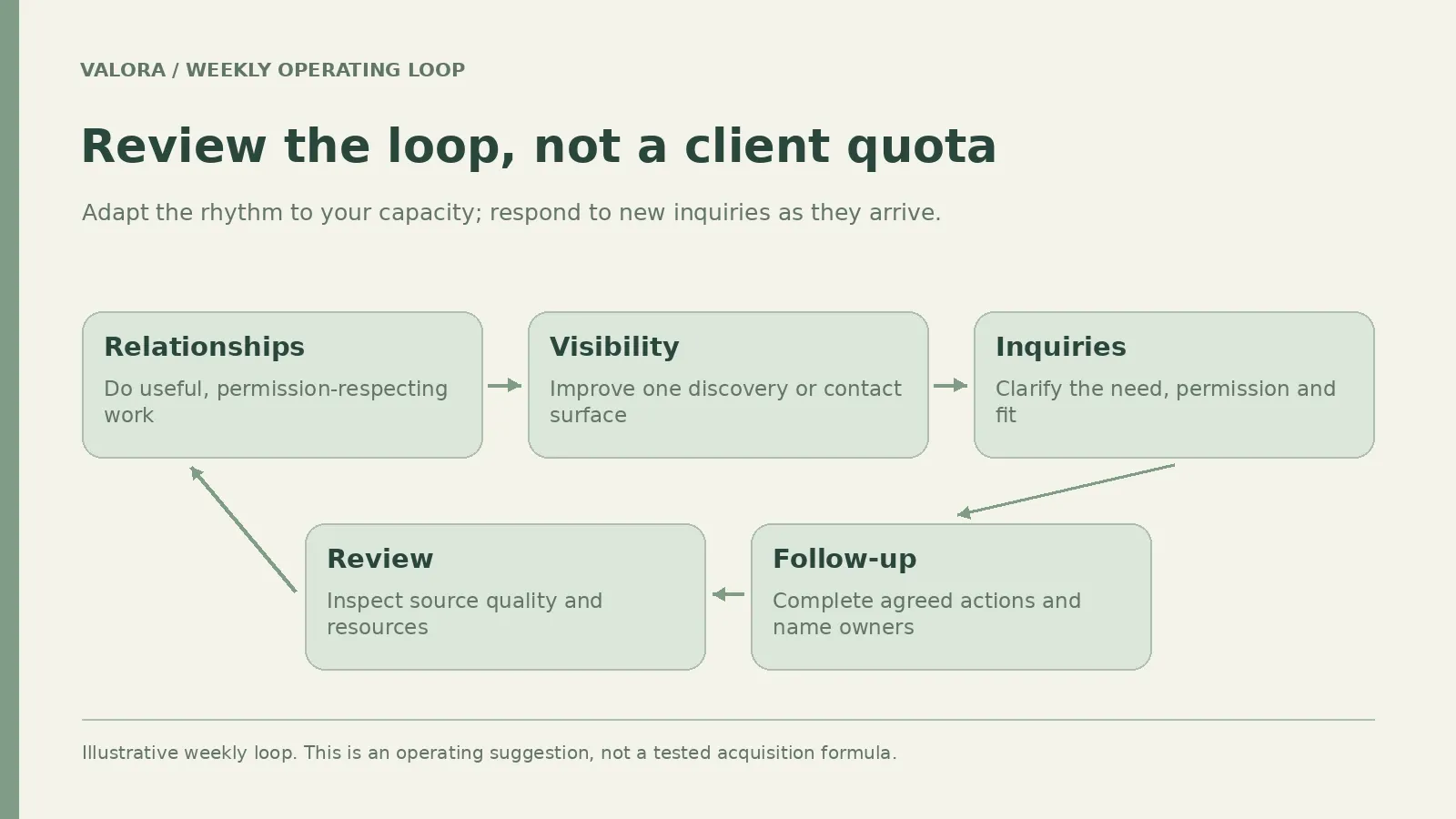
Run a short, repeatable business-development loop: protect time for acquisition, make a useful relationship move, improve one way suitable people can find you, clear inquiry and meeting follow-ups, and record sources and outcomes. Review the loop each week so work does not disappear whenever client delivery gets busy.
That is an operating rhythm, not a promise that clients arrive weekly. The right amount of work depends on your capacity, service model, and starting relationships. There is no industry-standard number of business-development hours established by the sources reviewed here. Choose a minimum you can sustain and adjust it using your own evidence.
Key takeaways
- Maintain a weekly process, not a quota of signed clients you cannot control.
- Prioritize suitable conversations: people who fit your service, agreed to talk, and attended.
- Tend referrals without repeatedly putting clients on the spot; build professional relationships around useful work.
- Improve one discovery or contact surface rather than publishing for its own sake.
- Assign an owner and next action to every live inquiry, then review time, cash, fit, and outcomes by source.
Why give business development a weekly rhythm?
Cerulli's July 2026 release reports that referrals account for 74% of RIA new-client acquisition, but only 14% of RIAs use a dedicated marketing resource. Business development therefore competes with advisor time and client needs. The same release highlights asset outflows, including routine distributions, as pressure on organic growth.
Schwab's 2026 RIA Benchmarking Study associates stronger organic growth with clear processes and consistent execution. Top Performing Firms are more likely to document marketing and referral plans and track inquiry sources. That does not prove a weekly checklist causes growth.
The proposed cadence translates those observations into manageable work. Its purpose is to expose missed handoffs and sustain a chosen experiment. A completed task list is evidence of activity; only your actual conversations and decisions show whether the activity is useful.
Protect a realistic block and name its owner
Choose time for business development before committing the rest of the week to delivery. Do not borrow an arbitrary hours target from another firm. Start with what your service obligations allow and write down what must be finished inside it.
A solo advisor may own the whole loop. A team can divide scheduling, drafting, professional relationships, and review, but one person should know whether the process actually happened. Responsibility should survive an absence or a busy client week.
Protecting time is not permission to delay client needs. Define what constitutes a genuine interruption and what can wait. If the block is repeatedly cancelled, revisit workload or the scope of the acquisition test. Do not keep an ambitious plan on paper while relying on spare evenings to execute it. A smaller repeatable commitment is easier to inspect honestly.
Make one respectful referral-related move
Review whether clients understand whom you help and what ongoing work you deliver. A useful action might be clarifying your client description, acknowledging an introduction, or making your willingness to meet suitable referrals visible in reviewed communications. It need not be a fresh request for names.
Kitces' September 2026 analysis finds no evidence that asking more frequently increased referral-driven growth. It also reports associations between communicating an ideal client persona, making value visible, and referral outcomes. These observations are not a ban on asking or proof that a script works universally.
Explain a situation you genuinely help with, rather than asking a client to identify wealthy friends. Let them decline freely. Someone supplying another person's name has not established that person's permission to receive outreach. Thank introducers without sharing private details, and review gifts, public testimonials, or compensated arrangements before use.
Advance a useful professional relationship
Choose one meaningful next action with a center of influence: clarify a shared planning issue, prepare a permissioned joint meeting, send an appropriate resource, or follow through on a promise. Avoid generic “send me clients” messages disguised as relationship building.
Cerulli's February 2026 release says COIs such as CPAs and attorneys account for 13.9% of new clients across advisors, the second most common source in that research. It identifies joint meetings, mutual interests, and referring clients to professionals as approaches rated effective for developing alliances.
Choose contacts for expertise and service fit, not a weekly networking quota. Keep client consent and professional boundaries clear. Referring a client to another professional should serve the client, not obligate a return introduction. For deeper complex-household context, see the high-net-worth acquisition guide.
Improve one surface for people already looking
Pick one useful visibility action. Update an answer to a recurring client question, clarify service and fee information, correct an eligible directory profile, or check that a booking route works. Publishing an entirely new article every week is not required.
Write for a person with a real decision, not an imagined keyword count. Explain whom the material helps, what it can establish, and where individual advice is needed. A clear next step should let someone ask about fit without suggesting that reading the page makes them a client.
Keep public facts consistent across your website and relevant profiles. Accurate local information is profile hygiene, not a reason to build city doorway pages. AI visibility is not a placement entitlement; no one can guarantee a citation. The actively-looking prospect guide distinguishes discovery from an actual request to speak.
Clear inquiries, meetings, and agreed follow-ups
New hand-raises require attention throughout the week, not only during a Friday review. Choose a response standard, such as the same or next business day, that your firm can staff. That is an example service commitment, not a researched conversion benchmark.
For each inquiry, establish the service need, fit, permission to continue, and next step. Send booking instructions, make meeting expectations clear, and log rescheduling and no-shows. Follow the contact preferences the person expressed rather than enrolling every inquiry in indefinite pursuit.
After a meeting, record what both sides agreed: another discussion, information to provide, an engagement decision, or no further action. A polite decline is an outcome, not an unfinished task to chase forever. Keep a reason where appropriate, such as timing or service mismatch. A pipeline full of stale names hides capacity and makes acquisition look healthier than it is.
Keep a small source-and-outcome scorecard
Schwab reports inquiry-source tracking at 85% of Top Performing Firms versus 71% of other firms. Its study uses self-reported information from 1,236 Schwab-custodied firms, not independently verified by Schwab. Top Performing status comes from a composite index, not just acquisition speed. Treat the comparison as association, not a CRM sales pitch.
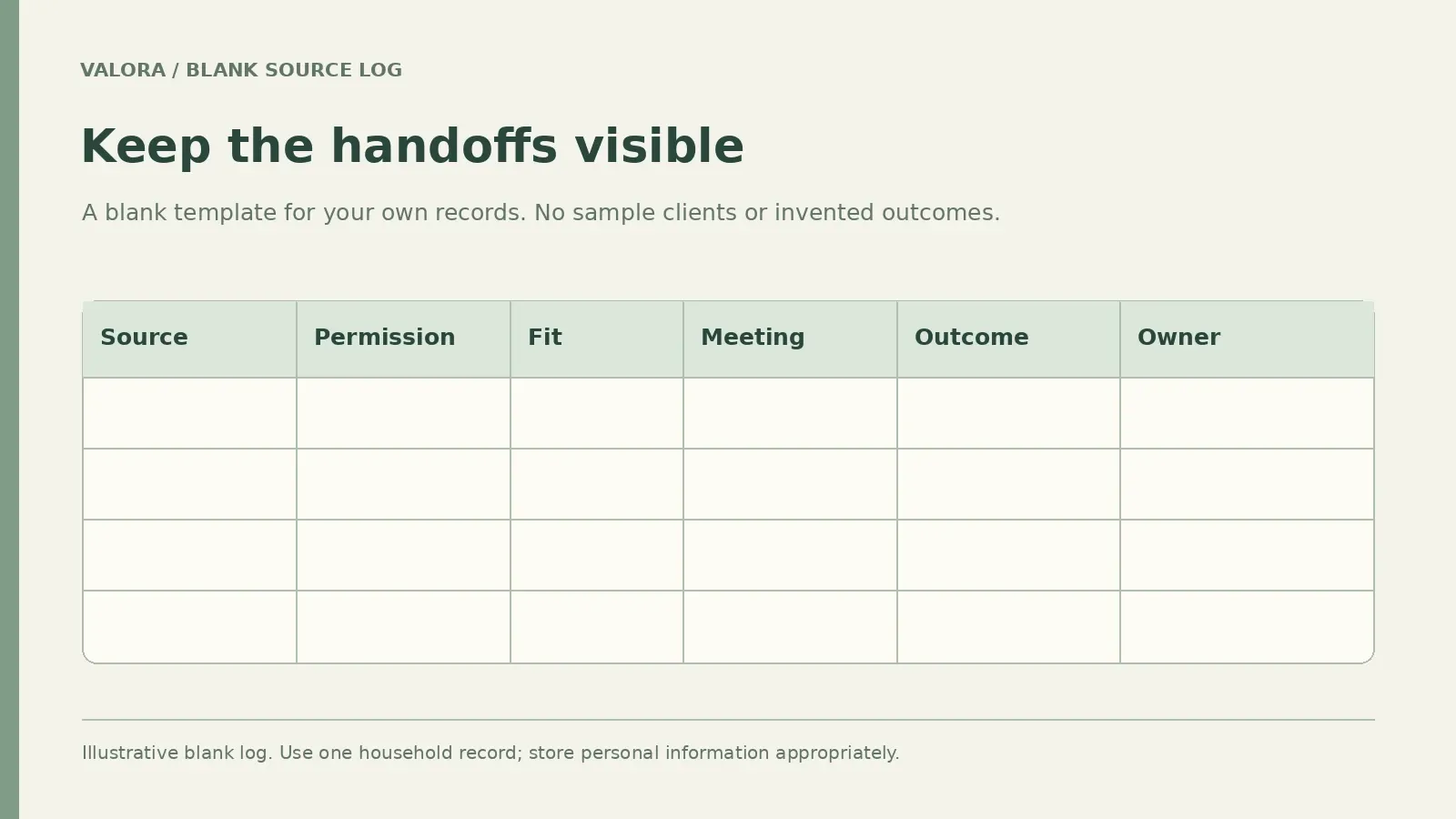
Your own weekly record can be modest:
| Field | What to record |
|---|---|
| Unique household | One record even when several channels helped |
| Source | Original source and any assisting touchpoint |
| Permission and fit | What the person requested and whether you can help |
| Meeting | Booked, attended, rescheduled, or not attended |
| Outcome | Open decision, accepted engagement, declined, or unsuitable |
| Owner and next action | Who does what next, consistent with permission |
| Resources | Cash spending and advisor or staff time |
Separate names, inquiries, suitable attended conversations, and clients. Compare sources using the same definitions. For a fuller comparison framework, use the RIA lead-source guide. Impressions and page views can help explain activity, but they are not acquisition outcomes.
Adapt this illustrative sample week
This is an example allocation of tasks, not a mandatory calendar or an evidence-based posting frequency. Move the days to suit your client commitments; respond to new inquiries as they arrive.
| Day | Example focus | Completed output |
|---|---|---|
| Monday | Review live conversations and capacity | Every active inquiry has an owner and next step |
| Tuesday | Tend a referral or professional relationship | One useful, permission-respecting action completed |
| Wednesday | Improve an intent surface | A reviewed correction, answer, or contact-path improvement |
| Thursday | Complete agreed follow-ups | Meeting summaries and promised information delivered |
| Friday | Review source quality and resources | One documented keep, change, or investigate decision |
The week may produce no signed clients. It can still reveal useful evidence: prospects consistently misunderstand fees, a form fails, or professional introductions reach the wrong service. Do not inflate output by counting routine reminders as new relationships. The purpose is to improve the loop, not manufacture a busy dashboard.
Change one weak link and protect service capacity
At review, ask where the process is constrained. If suitable inquiries are scarce, inspect audience access and positioning. If meetings are plentiful but unsuitable, review criteria before adding spend. If suitable prospects do not reach decisions, inspect scope, fees, timing, and the next-step explanation.
Keep open decisions separate from completed outcomes. A quiet week does not prove a channel failed, and one signature does not establish a repeatable acquisition rate. Use an affordable test window and a reasoned stop rule rather than reacting to each weekly result.
Check delivery too. Can the firm onboard the relationships it is pursuing while meeting existing obligations? Schwab cautions that additional services bring complexity and do not guarantee growth. If capacity is tight, improve ownership or reduce the experiment's scope. For an advisor still forming the early book, the first-ten-clients guide provides a simpler starting point.
Where Valora fits
Valora is an optional source of booked conversations alongside this operating rhythm, not a replacement for it. It helps advisory firms reach people seeking their services and book appointments with prospects who asked to speak with an advisor.
The current public offer is $250 per booked appointment, with a 3-appointment minimum, paid in advance. There is no setup fee, retainer, or long-term contract. If a prospect does not attend or does not meet the agreed criteria, the appointment is replaced at no charge. Your firm reviews what goes out under its name.
Valora does not guarantee clients, weekly appointment volume, revenue, asset growth, rankings, or AI citations. A meeting still needs discovery, a mutual decision, and service delivery. Consider an appointment-based test only if your firm can follow through and the written criteria fit the households it can serve.
Frequently asked questions
How many hours should a solo advisor spend each week?
The reviewed sources do not establish a universal standard. Set a firm-specific minimum that fits service commitments, then track what you accomplish and the time consumed. Revise scope if the plan repeatedly cannot be completed.
Is content creation the same as business development?
No. Content can support discovery and understanding, but the weekly loop also includes relationships, response, meetings, follow-up, and measurement. A posting streak is not a substitute for suitable conversations.
Does LinkedIn need a place every week?
Only if it serves a defined audience and purpose you can evaluate. A useful, reviewed response or resource may be appropriate; indiscriminate messages and a compulsory posting quota are not the objective.
What if I dislike selling?
Focus on explaining your service, establishing fit, and offering a clear next step without pressure. Prospects are allowed to decline. The operating process should help both sides decide, not turn every interaction into a pitch.
What should compliance review?
Review public claims, client stories, testimonials, endorsements, referral arrangements, and outreach under applicable rules and firm policies. A private message is not automatically exempt from every requirement. Build review into the workflow before material is used.
Scope of this guide
This is educational marketing content, not legal, compliance, tax, or investment advice. Valora is not a registered investment adviser. The weekly template is an editorial suggestion, not a tested acquisition formula. Research findings are observational and use different populations. SEC and state obligations depend on your firm and communications. SEC staff FAQs are guidance, not a rule or Commission statement. No weekly routine guarantees clients.
Sources
- Cerulli Associates, RIAs Must Offset Asset Churn with Dedicated Growth Efforts, July 22, 2026: referral reliance, marketing-resource constraints, and outflows. Fetched 7 Nov 2026 (Asia/Makassar). https://www.cerulli.com/press-releases/rias-must-offset-asset-churn-with-dedicated-growth-efforts
- Cerulli Associates, Financial Advisors Increasingly Leverage COIs to Capture New Client Growth, February 4, 2026: advisor-wide COI share and alliance approaches. Fetched 7 Nov 2026 (Asia/Makassar). https://www.cerulli.com/press-releases/financial-advisors-increasingly-leverage-cois-to-capture-new-client-growth
- Schwab Advisor Services, 2026 RIA Benchmarking Study: documentation and tracking associations, sample limitations, and service complexity. Fetched 7 Nov 2026 (Asia/Makassar). https://advisorservices.schwab.com/insights-hub/perspectives/ria-benchmarking-study-2026
- Kitces.com, Mark Tenenbaum, What Really Drives Client Referrals, September 28, 2026: asking frequency, client profile, visible value, and referral practices. Fetched 7 Nov 2026 (Asia/Makassar). https://www.kitces.com/blog/client-referrals-organic-client-growth-advisor-value-growth-network-marketing/
- SEC Division of Investment Management, Marketing Compliance — Frequently Asked Questions: staff marketing guidance. Fetched 7 Nov 2026 (Asia/Makassar). https://www.sec.gov/rules-regulations/staff-guidance/division-investment-management-frequently-asked-questions/marketing-compliance-frequently-asked-questions
- Valora, For Advisors: appointment definition, price, prepaid minimum, replacements, and limitations. Fetched 7 Nov 2026 (Asia/Makassar). https://www.valorahq.com/for-advisors/