
What should an advisor do when a client leaves at retirement?
A retirement departure is not automatically a failure. Check the expectations you set, then talk with the client about what changed.


A client who ends an ongoing relationship at retirement is not automatically proof that the advice failed. Needs change when work income stops. A firm that was a good fit during the working years may not be the right fit for the next stage. Or the firm may have failed to name what ongoing planning still does after the "are we ready?" question has been answered.
Before you try to keep the business, look at the expectations you set before the transition. Ask whether this is a one-off or a pattern. Then open a conversation aimed at understanding what changed. Sometimes the gap is communication and can be repaired. Sometimes the honest next step is to help the person leave well.
This page is about that diagnosis for an existing ongoing relationship. It is not a guide to designing an entry offer, and it is not a tutorial on writing a service calendar. Advisers have been asking what to do when a client leaves at retirement, which is one reason the question is live. This page does not treat any private discussion as a study.
This is educational, not legal advice, and not a promise that a conversation will keep the client.
What should you do first when a client leaves at retirement?
Start by seeking to understand what happened, not by asking how to keep the account. In a September 2021 conversation on the Kitces and Carl podcast, Michael Kitces and Carl Richards discussed clients who transfer out without notice. They argued that not every household benefits from a lifelong relationship with the same firm. Needs and circumstances change. The same adviser may no longer be the best fit.
That framing still helps when the departure comes at retirement. The podcast did not study retirement-stage exits as a separate data set, and this page does not treat it as one. Richards suggested opening the call with a request for professional courtesy: walk through what happened. Kitces later contrasted that with starting from "is there anything I can do to keep your business." He said that opening made his own first attempt feel confrontational.
After you understand the gap, three paths are open. You can try to repair a service or communication failure. You can help the person find a better fit. Or you can close the relationship cleanly and civilly. Do not open the call as a campaign to retain revenue.
If you are designing an entry offer rather than responding to an existing-client exit, start with Should a new advisor offer one-time financial plans?. That is a different decision than the one this page covers.
A departure at retirement is not automatically a failure
Advisers often treat a long relationship that ends as a personal or professional failure. The 2021 conversation pushed back on that default. Kitces and Richards noted that people have changing needs, and that a departure is not always a verdict on the quality of the work.
Two common reasons still help as a first sort, according to Richards. Either the firm was not delivering on what it promised, or the household had a different set of expectations than the firm can or should meet. Those are practitioner categories, not measured shares of retirement exits. This page does not claim a typical mix. It also does not cite a rate for how often ongoing clients leave at retirement. The absence of that figure is not a claim that no study exists.
If the reason is an undelivered promise, own it and decide whether you can repair it. If the reason is a mismatch the firm cannot honestly meet, helping the person leave well can be the professional response. Neither path requires you to treat the departure as proof that retirement planning has no value.
Look back at the expectations you set before the transition
Before you diagnose the person, look at what you told them the relationship would look like after work income stopped. Did you name a meeting cadence? Did you say what would be reviewed each year? Did you say what would change at retirement? Did you explain how the fee relates to that ongoing work?
If those points were never said out loud, that is a communication failure, not proof that advice after retirement has no value. It is also not proof that the person was wrong to leave. It is a prompt to be clearer with the households still on your roster who are approaching the same transition.
A recurring question in adviser communities is whether a planner should stay involved after the "are we ready to retire?" work is done. That theme is context for why this question is live. It is not a finding about any one firm, and this page does not quote private groups.
Fees belong in this review only as a communication question. Was the ongoing service after retirement explained before the transition? This page does not argue the value of a fee. Readers who want that conversation can start with How to answer 'Is a 1% fee worth it?' without hype.
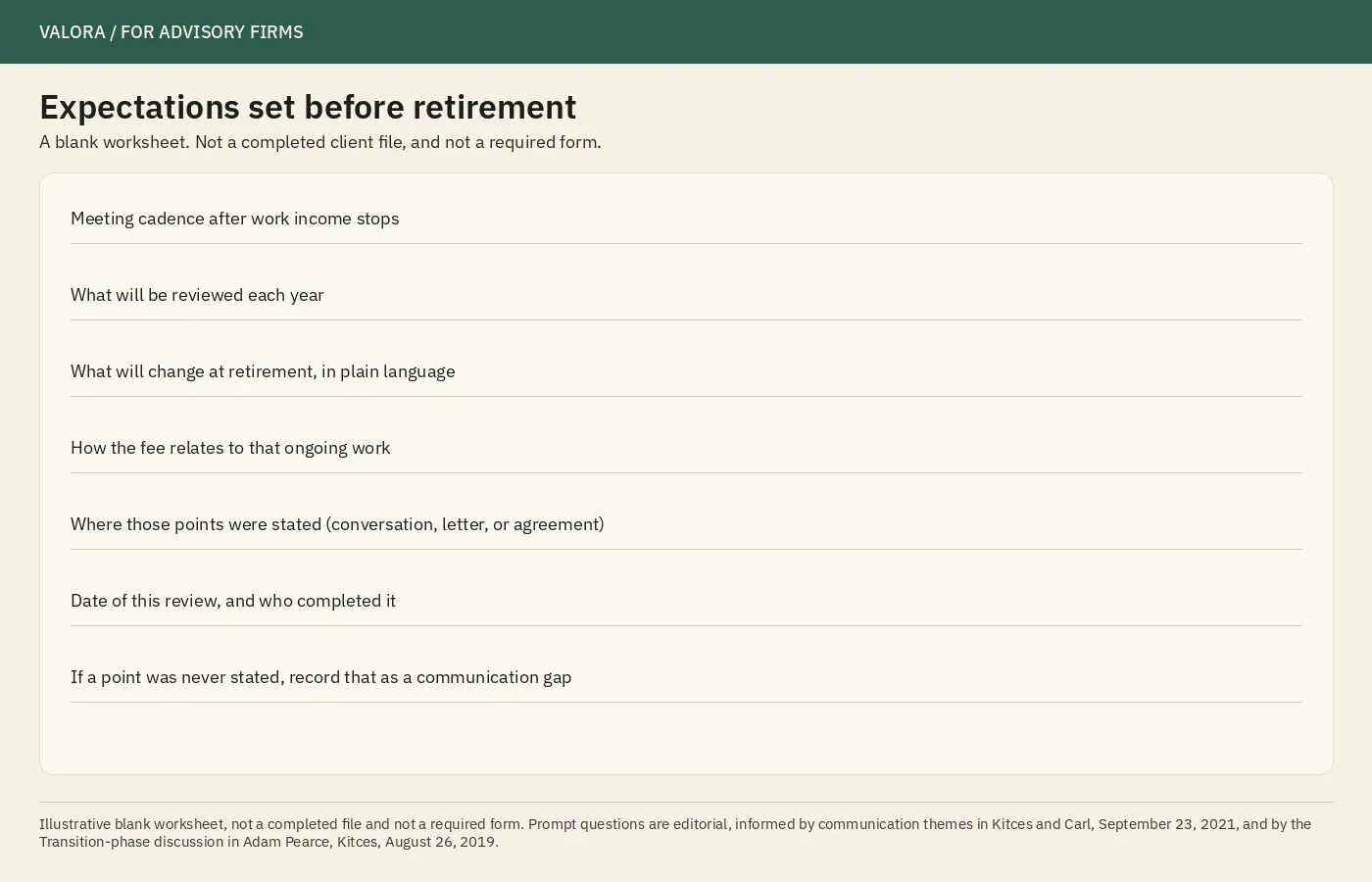
Retirement changes the work. Name that change early.
Retirement is not only a date on a plan. In an August 2019 Kitces guest post, adviser Adam Pearce described a Transition phase in the adviser-client relationship. He listed retirement alongside career changes, health issues, and divorce as a period that can put new strain on the relationship.
Pearce also described a perception problem, especially in employer-plan niches. A household may view the adviser as the person who helped during the working years, and not as the person who can help them retire. His practice response was to treat a retiring household more like a modified onboarding. Raise attention, and do not stay on cruise control. That is one adviser's method, not a required model and not a measured retention result.
A later Kitces and Carl conversation, published in March 2026, made a related qualitative point. Clients often arrive with a concrete technical problem. Over time, and especially through life transitions including retirement, the work can expand beyond that first question. Use that only as a reason to name the change early. Do not treat a later description of the relationship as proof that every household should stay for life.
Name the change while the person is still approaching retirement, not after a transfer notice arrives. Say what the next stage of planning will involve, how often you will meet, and what will be reviewed. If you cannot describe that work in plain language, the household has little reason to keep paying for it after the original question has been answered.
Is this a one-off, or is it a pattern?
A single retirement departure is a case to understand. A pattern is a practice issue. There is no published threshold on this page for how many exits count as a pattern. Use your own records.
Ask three diagnostic questions. Was this mainly a communication gap: work that happened, but was never made visible? Was this a fit mismatch: a household whose needs after retirement are not what the firm actually offers? Or is this a person who simply wants to leave, with or without a reason they will share?
If similar exits keep appearing, look at capacity, meeting load, and whether retirement-year work is being named early enough. If the pattern looks like a capacity problem, the next question is not how to plead for one household to stay. It is whether the firm needs a first hire or a clearer service design. For that path, start with How to make your first hire as a solo advisor.
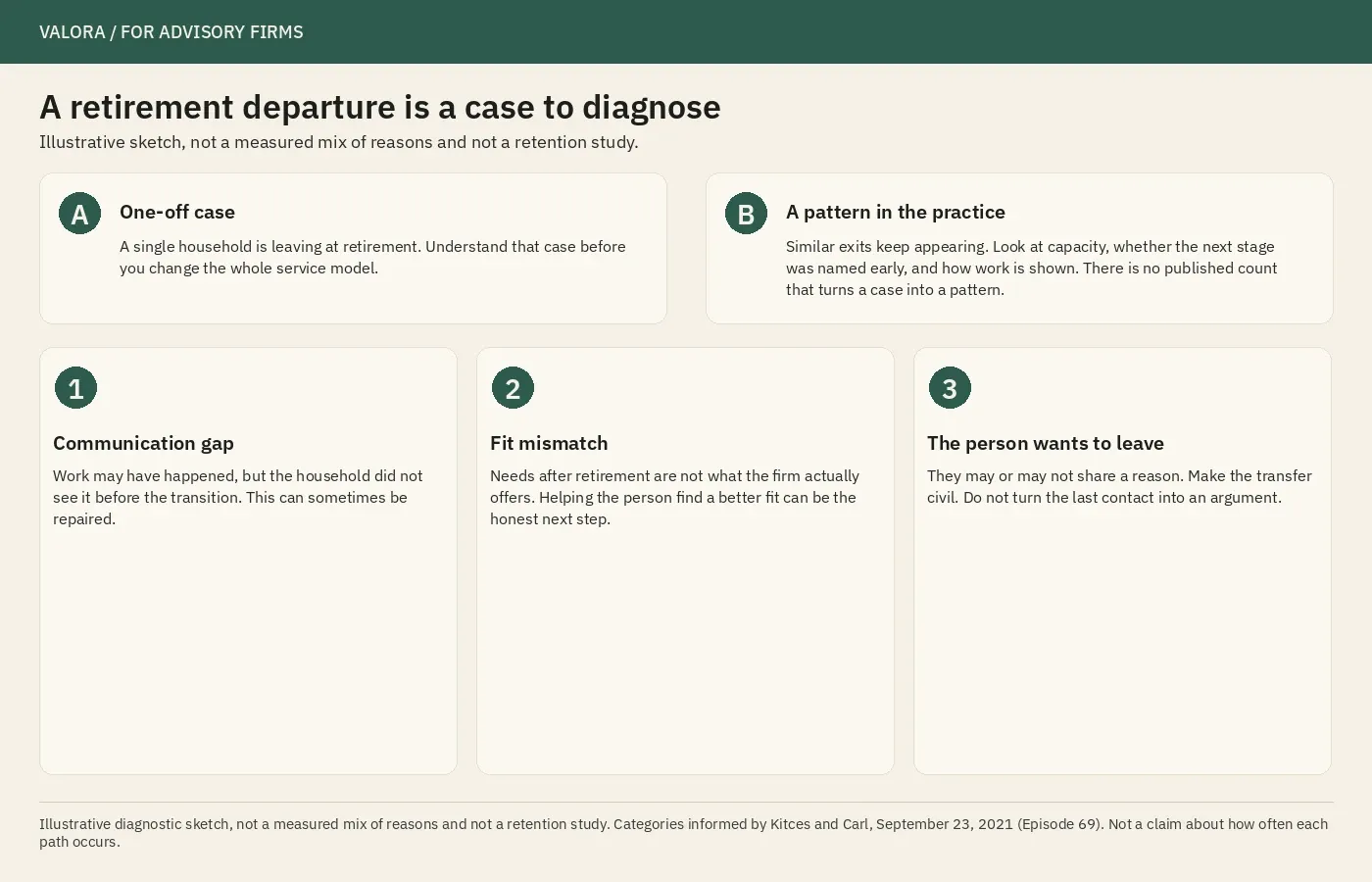
How to open the conversation, and when to help someone leave well
Once you have looked at expectations and at whether this is a one-off, pick up the phone. The 2021 conversation advised against relying on email, because a written note is easy to dismiss and does not give enough context.
Richards's suggested frame was a request for professional courtesy: walk through what happened, with the goal of understanding. Kitces agreed that starting from "how do I keep your business" puts the client on the defensive. The goal of the call is to understand the gap. It is not a script that wins the person back. This page does not claim a success rate for that conversation, because no measured rate is used here.
Three honest outcomes follow from that call. You may find a repairable communication or service failure and agree on a clearer plan for the next stage. You may agree that the person's needs have changed beyond what the firm offers, and you may help them find a better-fit adviser. Or the person may want to leave and may not want to share much. In that case, make the transfer civil. Offer to speak with the new adviser, and do not turn the last contact into an argument.
Helping someone leave well is not a failure of professionalism. It can be the cleanest way to honor a relationship that no longer fits. Do not treat a single story of a client who stayed after a call as a typical result. Anecdotes can illustrate a method. They do not measure how often the method works.
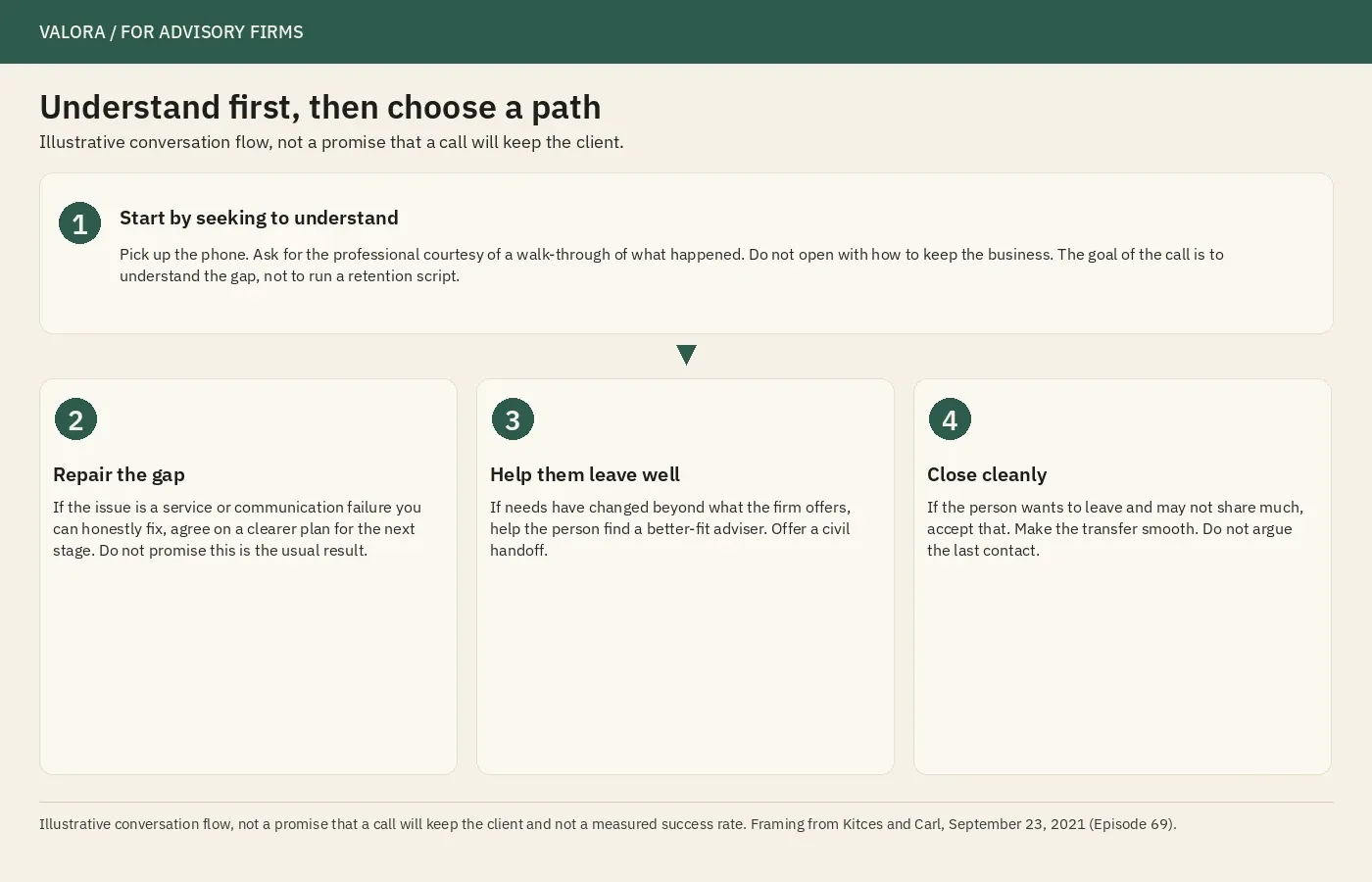
What to show about ongoing planning, without rewriting your calendar
If retirement-year work is happening, the client has to see it before the transition, not after a departure notice. That is a communication point, not a proven rule about how often to contact people. This page does not treat unnamed comments about communication frequency as a verified finding.
The job here is to make the next stage visible. Name the reviews, the decisions, and the support that will still matter after work income stops. Put that in writing in language the household can check against the fee. Then stop. This page does not include a calendar template.
For the mechanics of turning a service model into a written calendar at a registered investment adviser (RIA), see How should an RIA turn a client service model into a written service calendar?.
FAQ
Does a client leaving at retirement mean the advice failed? Not automatically. The 2021 Kitces and Carl conversation argued that not every household benefits from a lifelong relationship with the same firm. Look first at the expectations you set and at whether the departure is a one-off or a pattern.
Should I try to keep every client who transfers at retirement? No. After you understand what happened, you may repair a gap, help the person find a better fit, or close the relationship civilly. Starting from "how do I keep the business" is the wrong opening, according to that same conversation.
What should I review before I call? Review the expectations you set before the transition: meeting cadence, what would be reviewed, what would change at retirement, and how the fee relates to that work. If those points were never stated, treat that as a communication issue.
How is this different from writing a service calendar? This page is about diagnosing an exit and opening a conversation. A written service calendar is a separate tool for making ongoing work visible. Use the service-calendar page for that drafting work, not this one.
If your firm later wants help making its services easier for suitable prospects to find and understand, you can learn about Valora's work for advisory firms. The current public offer is $250 per booked appointment with a qualified prospect, with a 3-appointment minimum, paid in advance. An appointment is a call booked on your calendar with a prospect who has asked to speak with an advisor. There is no setup fee, retainer, or long-term contract. If a prospect does not attend or does not meet the agreed criteria, the appointment is replaced at no charge. Your firm reviews what goes out under its name.
Valora is not a client-retention program. This article is educational, not legal advice, tax advice, compliance advice or personalized investment advice. Valora is not a registered investment adviser and does not provide investment advice. Valora provides marketing services to advisory firms.
Sources
- Kitces and Carl, Episode 69, Retaining The Client Who Transfers Out Without Notice, September 23, 2021: https://www.kitces.com/blog/client-attrition-sudden-departure-service-model-retention/
- Adam Pearce, Managing And Nurturing Clients Through The Lifecycle Of The Advisor-Client Relationship, Kitces, August 26, 2019: https://www.kitces.com/blog/nurture-lifecyle-client-relationship-financial-advisor-onboarding-feeling-out-maturity-transition/
- Kitces and Carl, Episode 185, The Financial Planning Value Disconnect: When Clients Don't Appreciate The Long-Term Benefits, March 5, 2026: https://www.kitces.com/blog/185-michael-kitces-carl-richards-financial-planning-values-long-term-benefits-transformation/
- Valora, For Advisors: https://www.valorahq.com/for-advisors/ (offer terms only; not evidence of client results)