
What is GEO vs SEO for an RIA website?
GEO (and AEO) vs SEO for RIAs: classic rankings versus AI answers. Shared foundations, different goals, and no citation guarantees.


SEO (search engine optimization) is the work of helping your pages show up and get clicked in classic search results. GEO (generative engine optimization) is the work of helping AI tools such as ChatGPT, Perplexity, and Google's AI features find, understand, and cite your content when they write an answer. AEO (answer engine optimization) is a close cousin, and many people use the two terms for the same idea.
For an RIA website (a registered investment adviser's site), the two overlap far more than they differ. Both depend on pages that can be crawled, clear facts about who you are, and useful answers to real client questions. The main differences are the goal and the scoreboard. SEO aims for a ranked link and a click. GEO aims for a mention or citation inside an answer, which you cannot control or guarantee.
Key takeaways
- SEO targets ranked links and clicks. GEO and AEO target being understood and cited in AI-written answers.
- The foundations are shared: crawlable pages, clear firm facts, and helpful answers.
- Google says there are no extra requirements or special files to appear in its AI features. Normal SEO basics apply.
- Clear "who, what, where" facts help both people and machines match your firm to the right question.
- "Citation" means two things: the sources you cite, and whether an AI answer cites you. You control only the first.
- Measure each differently, and keep mentions, inquiries, and clients in separate columns.
SEO, AEO, and GEO in plain words
SEO is the older practice. You make pages that search engines can crawl and index (store and retrieve), that match what people search for, and that earn a click from a results page.
GEO is a newer term. The term comes from a 2024 research paper presented at KDD, a computer science conference. It describes ways for content creators to make their content more visible in AI-written answers. The GEO paper calls these systems "generative engines" because they gather information from several sources and summarize it.
AEO is often used for the same goal: being the answer an AI assistant gives. Valora's For Advisors page describes AEO and GEO together as making a firm's expertise easy for AI assistants and AI-powered search to find, read, and cite.
No standards body defines these terms. Do not let a vendor sell you on the label. Ask what work they will do and how they will measure it.
What stays the same, and what changes
Much stays the same. Google's guide to AI features and your website says SEO best practices remain relevant for AI Overviews and AI Mode. It says there are no additional requirements and no special optimizations needed. To appear as a supporting link, a page must be indexed and eligible to show with a snippet. Even then, Google says indexing and serving are not guaranteed.
A Kitces guest post on AI search by Brent Carnduff, an SEO consultant, makes a similar case. In his view, AI tools often draw on pages that already rank well, so weak SEO hurts you in both places. He also says many broad questions now get answered in the AI tool itself, often without a cited source. That is why generic pages lose value and specific, expert answers gain it.
What changes is the reader's path. In classic search, a person scans links and clicks. With an AI answer, they may read a summary and never visit your site. Google describes a "query fan-out" technique, in which its AI features run several related searches to build one response. Different AI products use different systems, so results vary from tool to tool and day to day.
Be clear about who, what, and where
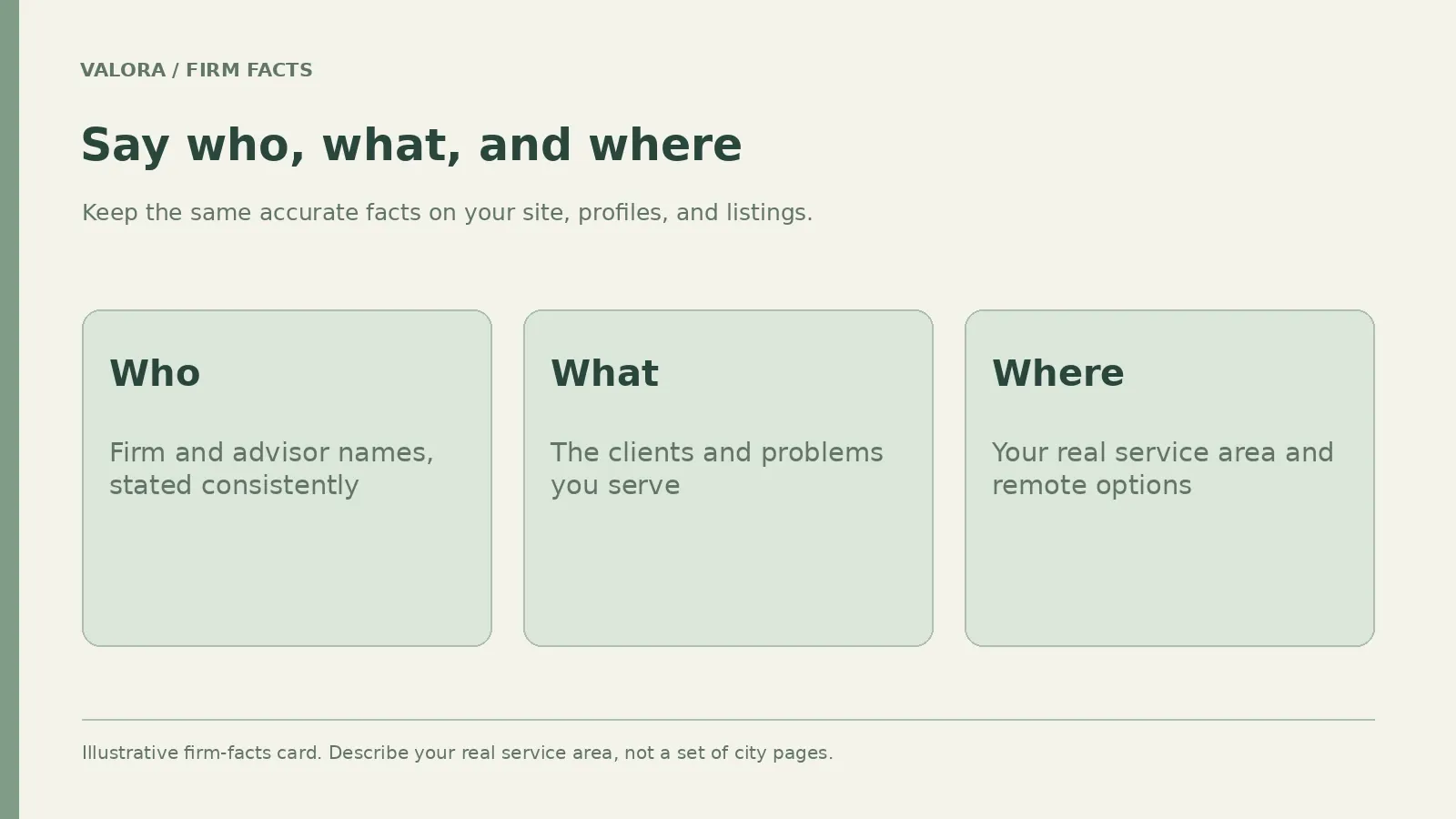
AI tools and search engines both need to connect your content to your firm. Carnduff calls this your "Who-What-Where": your name and firm, your specialty, and where you serve clients. He recommends stating it the same way across your site, directories, and profiles, because these systems rely on repeated patterns.
In practice, write down:
- Your firm name and the advisors' names, exactly as registered.
- The clients and problems you serve best, in plain words.
- What you do not do.
- Your service area and whether you work remotely.
- Your fee approach and how to contact you.
Then check that your website, profiles, and directory listings say the same thing. Marketers sometimes call this "entity clarity." The entity is your firm, and clarity means every source describes it the same way. Fix your own pages first. A model repeating a wrong fact usually found it somewhere.
Organize by topics, not single keywords
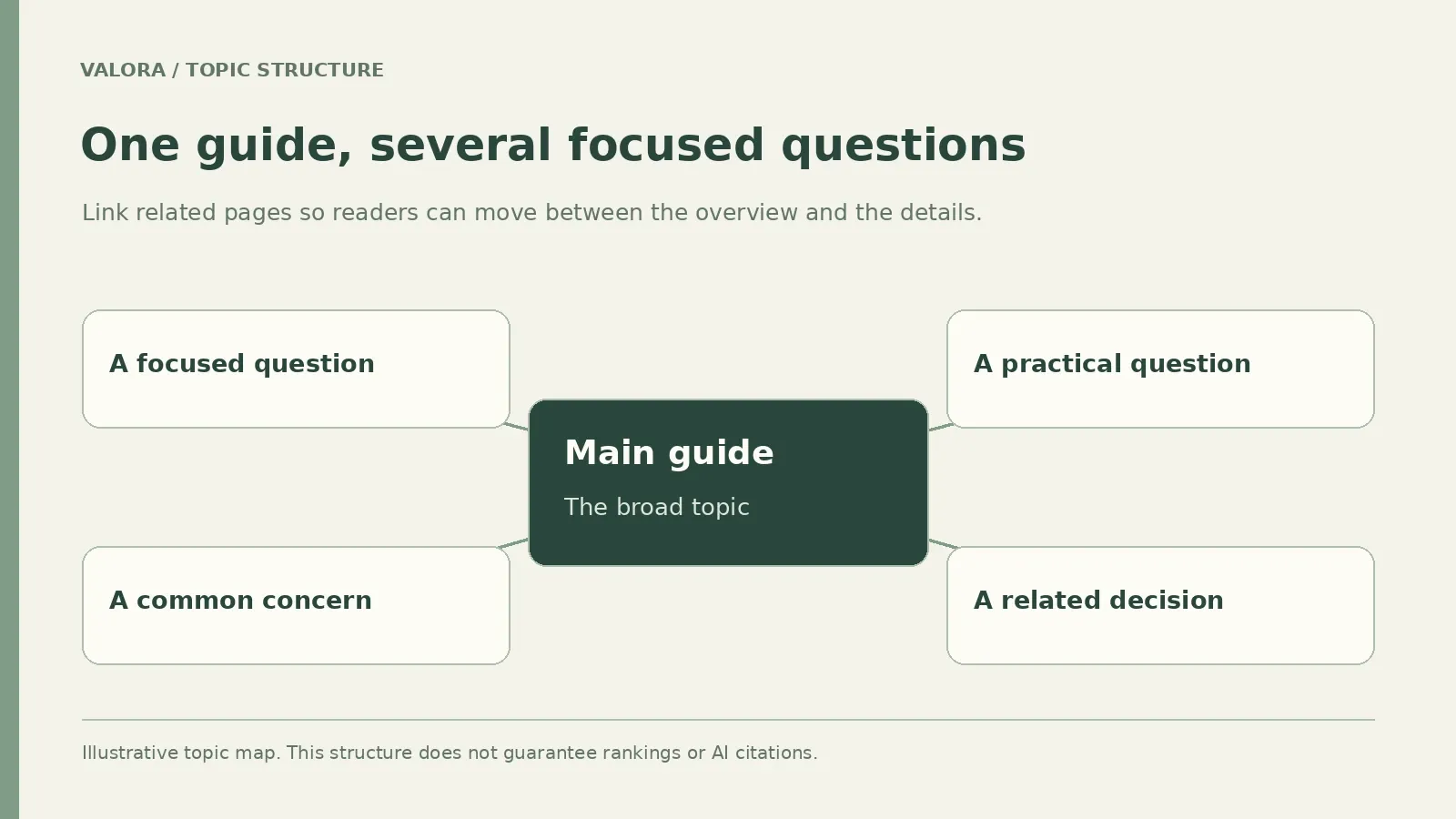
Old-style SEO often meant one page per keyword. Carnduff suggests a "pillar-cluster" model instead. One main guide (the pillar) covers a broad topic. Several shorter pages (the clusters) answer specific questions and link back to it.
For an RIA, the pillar might be the core planning problem you solve. The clusters are the exact questions clients ask about it. Internal links between them help readers move around and help search systems see how your expertise fits together. Google's AI features guide lists internal links among the SEO basics that still matter.
Length is not the goal. Carnduff argues that AI tools favor content that gets to the point. A short page that answers one clear question can work well. A long page that wanders does not.
Write so an answer can be quoted
"Citations" can mean two things on a GEO page, and it helps to keep them apart.
The sources you cite. Link to primary sources for facts, give dates, and say who wrote the page. Google's helpful content guidance asks "Who, How, and Why" about every page. It encourages accurate bylines and warns that made-up author profiles are deceptive. It says the "why" should be helping people, not chasing search visits.
Whether an AI answer cites you. This is an outcome you can influence but not control. The GEO paper reported visibility gains of up to 40% on its own benchmark of test queries, with results that varied by domain. That is a lab result, not evidence about advisory firms or about how any commercial AI product chooses sources.
To make a passage easy to quote, start each section with a direct answer. Keep paragraphs short and self-contained. Define terms once. State limits honestly. These habits help human readers just as much.
Signals AI tools may use
No one outside these companies knows exactly how each AI tool picks which firms to mention. Be wary of anyone who claims a formula. Based on the sources here, the broad categories worth tending are:
- Your own pages: clear, crawlable, and consistent facts.
- Other places that describe you: directories, associations, and publications your clients actually use. Carnduff points to LinkedIn, directories, and other platforms as places AI tools draw from.
- Reviews and ratings: possibly useful, but regulated. See the local section below.
- Structured data: code that labels page content for machines. Google says it must match the visible text on the page, and that no special schema is needed for its AI features.
- Authorship: a real named expert tied to the content.
Treat these as hygiene, not levers. Improving them makes your firm easier to check, whether or not a model ever names you.
What pages should an RIA website have?
A simple checklist covers most of what both SEO and GEO need:
| Page | What it should make clear |
|---|---|
| Home | Who you serve and the main problem you solve |
| About | Advisors, credentials, registration, and how the firm works |
| Services | What is included and what is not |
| Fees | Your fee approach, in plain terms |
| Specialty pages | One page per real client group you serve, not per city |
| Answers or FAQ | Direct answers to questions clients actually ask |
| Contact | A working way to book or ask |
What about llms.txt files and AI-specific markup? For Google, the answer is clear. Its AI features guide says you do not need new machine-readable files, AI text files, or special markup. For other AI tools, we have not seen primary evidence that such files help, so treat them as optional experiments. Have your compliance reviewer check every page before it goes live, since your website is advertising.
For how advertising rules apply to website content, see SEC Marketing Rule in plain English for solo RIAs.
Local visibility without city pages
Local search still matters for many firms. Carnduff cites a figure that about 42% of local searches lead to clicks on the Google Maps results. Treat that as a secondary figure he reports. He suggests keeping your Google Business Profile complete and accurate.
Two cautions. First, do not build a page for every nearby city to catch searches. Google's helpful content guidance warns against content made mainly for search traffic, and thin location pages fit that description. Describe your real service area once, clearly.
Second, reviews are regulated. Showing client reviews on your site or in ads can bring in testimonial rules for advisers. Check with your compliance reviewer before you display, link to, or reward reviews.
How to measure each, and what to do first
Measure SEO and GEO with different tools, and keep the results separate.
- SEO: use Google Search Console for impressions, clicks, and indexing. Google says visits from its AI features are counted in the same "Web" search report, so that view does not separate AI clicks on its own.
- GEO: keep a fixed list of client-style questions. Run them on a schedule in the AI tools you care about. Save the date, tool, full answer, and cited sources. Carnduff also suggests simply asking new clients how they found you.
- Business results: track inquiries, suitable meetings, and clients by source.
For a solo RIA, a sensible order is: fix firm facts and contact paths, check that key pages are crawlable and indexed, write a few strong answers to real questions, then start a quarterly AI-answer check. The live guides Can ChatGPT find your firm?, How can an RIA get clients from ChatGPT and AI search?, and the 12-month AI search plan go deeper on the client side. Website visibility is one lead source among several. The lead-source guide and the actively-looking prospect guide show where it fits.
For the longer operational AI-clients guide, see How RIAs get clients from ChatGPT and AI search. For content used as prospecting rather than closing, see How do I market myself as a financial advisor if I hate selling?.
Where Valora fits
Valora's work for advisory firms includes AEO and GEO, along with direct outreach and YouTube. The aim is to make your firm easier to find for people already looking for the advice you give. Your firm reviews anything published or sent under its name.
The current public offer is $250 per booked appointment, starting with 3 appointments paid in advance. There is no setup fee, retainer, or long-term contract. If a prospect does not attend or does not meet the agreed criteria, the appointment is replaced at no charge.
Valora does not guarantee clients, search rankings, AI citations, or video views. Visibility builds over time, and an AI mention is not a client.
Frequently asked questions
Is GEO the same as AEO?
Mostly. Both aim to make your content easy for AI tools to use in answers. People use the terms loosely. Focus on the work, not the label.
Do I need both SEO and GEO?
The foundations are the same, so in practice you do both at once. Clear facts, crawlable pages, and useful answers serve classic search and AI answers.
Does an AI citation mean a new client?
No. A citation is one observation in one answer. It becomes a lead only if a person acts on it and your site makes the next step easy.
Should I pay for an "AEO" or "GEO" service?
Maybe, if they explain the exact work, report honestly, and promise no placement. Anyone who guarantees that ChatGPT will name you is promising something they cannot control.
Does schema markup get me into AI answers?
Not on its own. Google says no special schema is needed for its AI features, and structured data must match what is visible on the page.
Scope of this guide
This is educational marketing content, not legal, compliance, or investment advice. Valora is not a registered investment adviser. Google's documentation covers Google Search only. It does not explain how ChatGPT, Perplexity, or other tools choose sources. Research and practitioner views cited here are not guarantees. Advisory firm websites are subject to advertising rules; review content with your compliance reviewer.
Sources
- Google Search Central, AI features and your website: no extra requirements, indexing and snippet eligibility, no special files or schema, Search Console reporting. Fetched 7 Nov 2026 (Asia/Makassar). https://developers.google.com/search/docs/appearance/ai-features
- Google Search Central, Creating helpful, reliable, people-first content: Who, How, and Why; authorship; search-engine-first content. Fetched 7 Nov 2026 (Asia/Makassar). https://developers.google.com/search/docs/fundamentals/creating-helpful-content
- Google Search Central, Introduction to structured data markup in Google Search: markup must describe visible content. Fetched 7 Nov 2026 (Asia/Makassar). https://developers.google.com/search/docs/appearance/structured-data/intro-structured-data
- Aggarwal et al., GEO: Generative Engine Optimization (KDD 2024), arXiv 2311.09735: definition and benchmark results. Fetched 7 Nov 2026 (Asia/Makassar). https://arxiv.org/abs/2311.09735
- Kitces.com, Brent Carnduff (guest post), AI search and SEO for financial advisors, November 17, 2025: Who-What-Where, pillar-cluster, local search, measurement. Fetched 7 Nov 2026 (Asia/Makassar). https://www.kitces.com/blog/artificial-intelligence-ai-search-engine-optimization-seo-financial-advisor-marketing-content-strategy/
- Valora, For Advisors: AEO and GEO description, price, prepaid minimum, replacements, and limits. Fetched 7 Nov 2026 (Asia/Makassar). https://www.valorahq.com/for-advisors/