
How do I market myself as a financial advisor if I hate selling?
Market without hard selling: name the problems you solve, make referrals easy, use content to prospect, and add controlled inbound when you need it.


You do not need a salesperson's personality. You need three things: a clear statement of the problems you solve, a referral habit that does not depend on awkward asks, and at least one channel you control, such as useful content, professional relationships, or booked appointments. Then treat every first meeting as a chance for both sides to decide on fit. Nobody has to be pushed.
This is still work. But it is the work of explaining, answering, and following through, not persuading people who never asked to hear from you. It will not guarantee clients.
Key takeaways
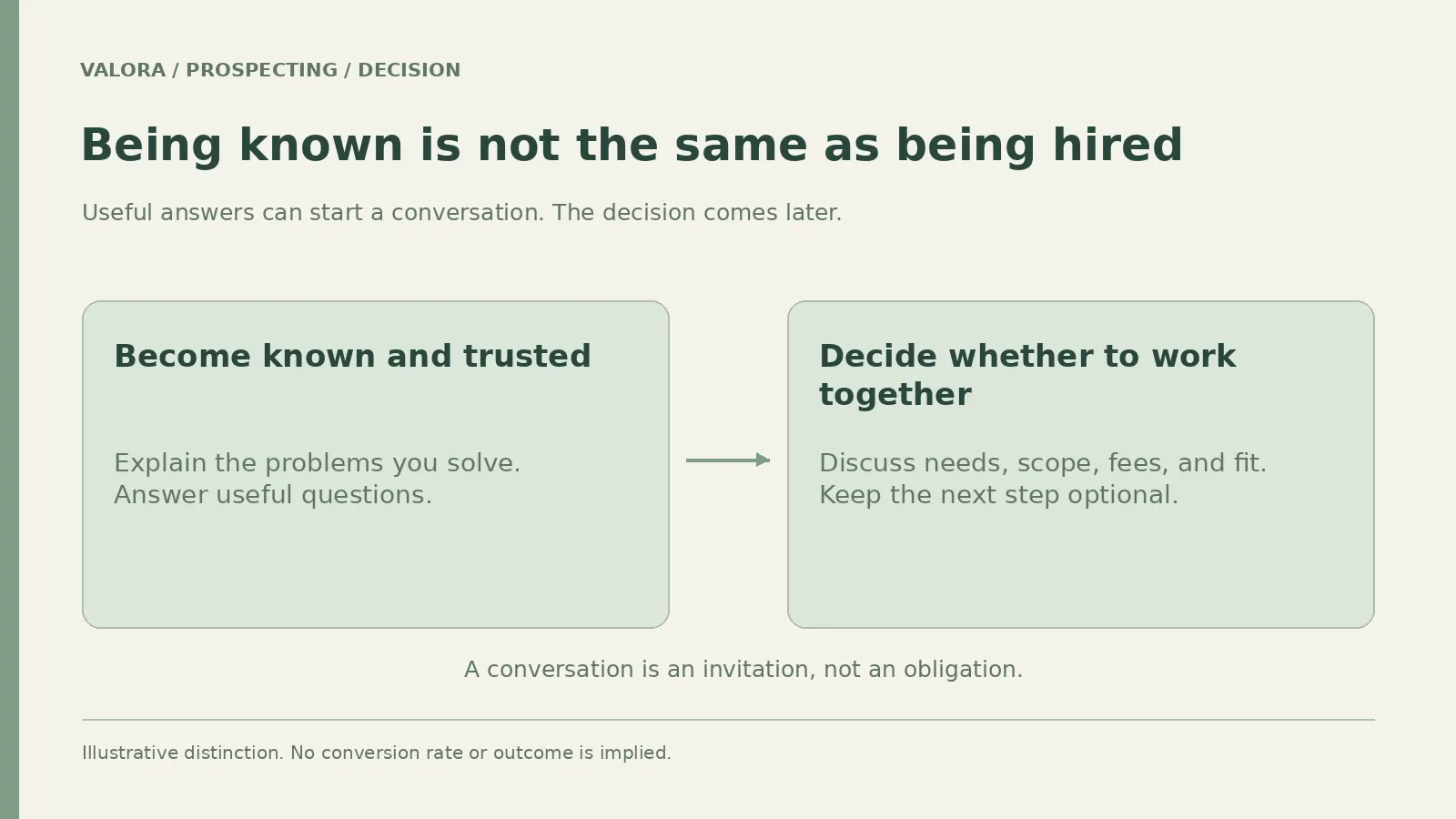
- Marketing and selling are different steps. Marketing helps people know what you do. The decision to hire comes later.
- Be specific about the problems you solve. Clients, professionals, and search tools can then match you to the right people.
- Kitces data links asking for referrals more often with lower, not higher, referral growth. Letting clients know referrals are welcome is a gentler option.
- Content and social posts work as prospecting. They build trust over time. They rarely close anyone.
- Consent-based marketing means talking to people who asked, opted in, or agreed to an introduction, and making "no" easy.
- Outreach, reviews, gifts, and referral rewards still need review under the rules that apply to your firm.
Marketing is not the same as selling
Many advisors picture marketing as cold calls and closing scripts. That picture clashes with why most people do advice work. If marketing means talking people into things, it makes sense to dislike it.
A better picture: marketing is how strangers learn what you do, so that some of them come to you already interested. Michael Kitces makes this point about social media in a Kitces essay on prospecting. Nobody hands over their savings because of one post. The goal is to become known, liked, and trusted, so that a later conversation can happen.
Can you skip marketing and just do great work? In a Kitces & Carl episode on good work and self-promotion, Kitces and Carl Richards argue that great work helps most when people know exactly which problems you solve. Being clear about your expertise is still marketing. It just does not feel like selling.
What consent-based marketing looks like
Consent-based marketing is a working rule, not a legal term. You talk to people who asked to hear from you, opted in, or agreed to an introduction. Every next step stays optional.
| Question | Consent-based | Pressure-based |
|---|---|---|
| Who starts it? | The prospect, or an introducer with permission | The advisor, unprompted |
| What is said? | An answer, a resource, or an honest note on fit | A pitch for a meeting |
| How does it end? | With an easy way to say no | With follow-ups until someone replies |
| What is counted? | Suitable conversations that happened | Number of contacts sent |
Cold outreach is not banned, and some firms use it well. It works best when it is relevant, honest, and easy to decline. Commercial email also has rules. The FTC's CAN-SPAM guide says the law covers business-to-business email too. It requires accurate sender details, honest subject lines, a postal address, and a clear opt-out that you honor within 10 business days. You stay responsible when someone sends on your behalf.
Outreach that offers advisory services may also count as advertising under securities rules. Have your compliance reviewer check templates before use.
For a plain-English overview of outreach and the Marketing Rule, see SEC Marketing Rule in plain English for solo RIAs.
Get specific about the problems you solve
The least salesy thing you can do is make fit obvious. Write one or two sentences that say who you serve best, which decisions you help with, what you do not do, and how you charge. Use the same words on your website, your profiles, and in conversation.
"Comprehensive wealth management" tells a reader very little. A named problem tells them whether to keep reading, and tells clients whom to send you.
Clarity also helps people who search alone. A Kitces guest post on AI search recommends a consistent "Who-What-Where" (your name and firm, your specialty, your service area) across platforms. Treat that as practitioner advice, not a promise of placement. Accurate service-area facts are basic profile hygiene. They are not a reason to build city doorway pages.
For website clarity and how GEO relates to SEO, see What is GEO vs SEO for an RIA website?.
Make referrals welcome without asking over and over
Referrals are still the main source of new clients for many firms. Cerulli's July 2026 release reports that referrals make up 74% of RIA new-client acquisition. (An RIA is a registered investment adviser.) Only 51% of RIAs proactively ask clients for referrals.
If you hate asking, the data is on your side. Kitces' September 2026 referral research reports referral-driven growth of 5.4% for practices that never ask and 3.0% for practices that ask more than once a year. Kitces found no evidence that asking more often increased referrals at any practice age. These are associations, not proof that not asking causes growth.
What does Kitces link with more referrals?
- Let people know referrals are welcome. A line on your website, in an email signature, or in normal conversation.
- Say who you help. Advisors who verbally describe their ideal client report 5.0% referral-driven growth, versus 4.3% for those who do not.
- Make your work visible. Clients refer more easily when they can see the value you deliver.
- Say thank you. A personal thank-you is linked with higher referral growth, and more so when paired with a small gift.
Be careful with gifts and rewards. The SEC's December 2025 risk alert noted firms running "refer-a-friend" programs and giving gift cards for reviews. Some did not realize this created a testimonial or endorsement under the Marketing Rule. Check any reward with your reviewer first.
Build professional relationships around real work
Accountants, attorneys, and other professionals suit advisors who dislike selling, because the relationship rests on shared client work. Cerulli's February 2026 release reports that these centers of influence (COIs) account for 13.9% of new clients across advisors. It names joint meetings, shared interests, and referring your own clients to them as approaches rated effective.
Pick a few professionals whose clients overlap with yours. Learn what problems they see. Explain where you help. When you work on a shared client, do it with that client's permission and follow through. Skip "send me clients" scripts. For more depth, see the high-net-worth client guide.
Use content to be known, not to close
Writing suits advisors who would rather explain than persuade. Take a question clients ask you often, remove any identifying details, and answer it plainly. Say what changes the answer and when someone needs advice about their own situation. End with a quiet next step.
Kitces' prospecting essay notes that the effort to produce content stays about the same while an audience can grow over time. That is an observation from his own experience, not a typical advisor result. Do not expect followers to turn into clients at any set rate.
Google's guidance on helpful content asks a useful question: why does this content exist? "To help the person who asked" is the right answer. Google flags content made mainly to attract search visits as a poor fit for what its systems reward. You do not need a posting quota. A few reviewed, accurate answers beat a stream of generic posts. For a weekly rhythm, see the weekly advisor habits guide.
Be easy to find for people already looking
Some people are searching for an advisor right now. They want to check you before they talk. Make the basics easy to find: who you serve, services, fees or fee approach, credentials, service area, and how to book a call. Keep these facts the same everywhere you control them.
Then test your own contact path: fill in your form, open your booking link, and check that confirmations arrive.
The actively-looking prospect guide covers this intent window in more depth. If AI tools are part of how people find you, Can ChatGPT find your firm? and How can an RIA get clients from ChatGPT and AI search? explain what you can check and what no one can promise.
Treat the first meeting as a fit conversation
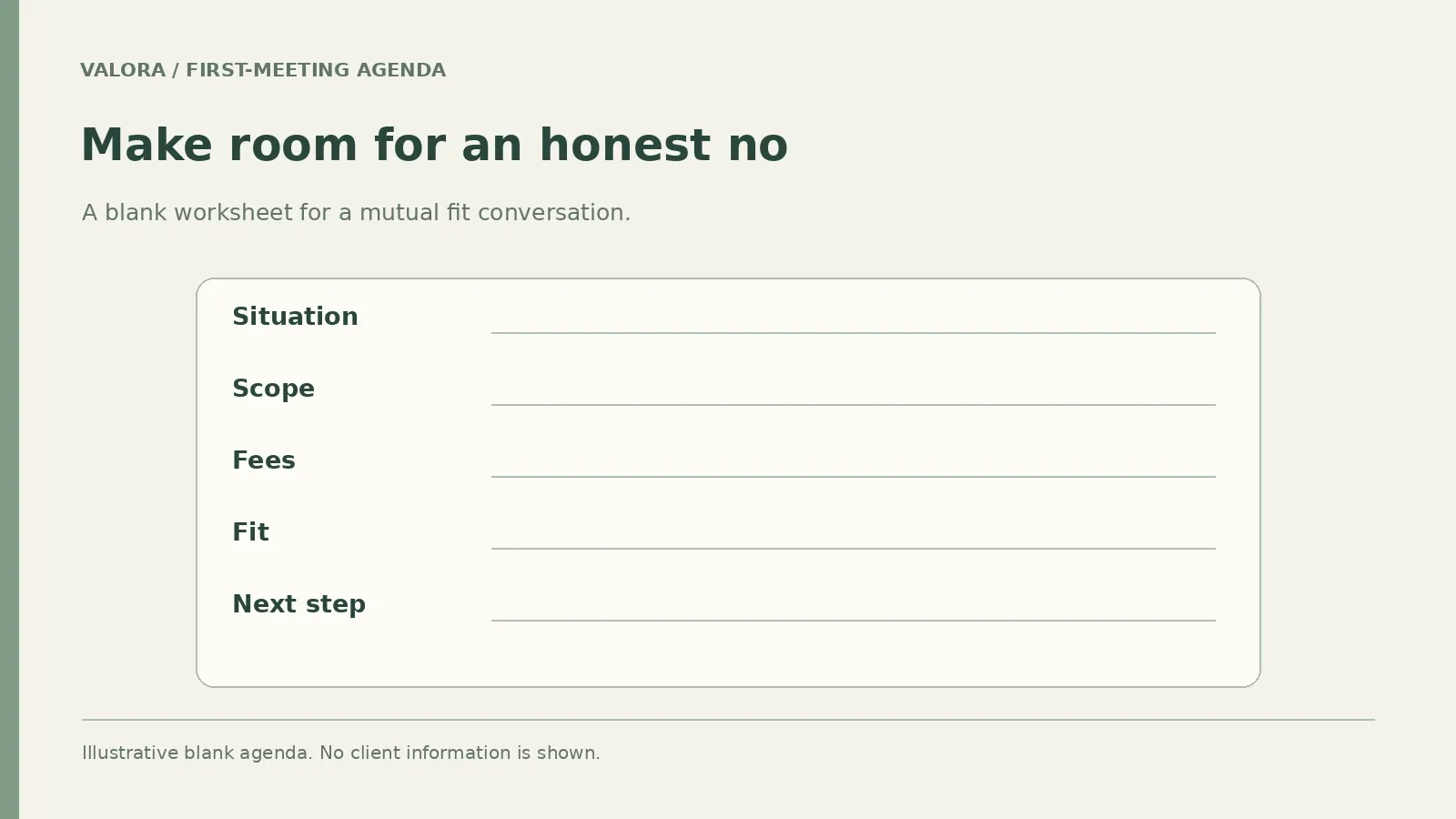
State the purpose up front: understand the person's situation, explain how you work and what you charge, and decide together whether a next step makes sense. Saying this out loud lowers the pressure for both of you.
A simple agenda:
- What made them look for help now.
- What they want from an advisor, and what they do not.
- How you work, what is included, and your fees.
- Whether you fit, and if not, who might.
- An agreed next step, which can be "nothing further."
"This may not be the right fit, and that's fine" is not weak selling. It is honest. Afterward, send what you promised and follow the person's timing. One check-in after an agreed date is service. A long chain of nudges after silence is pressure. When a decision is made either way, close the loop and record the reason.
Spend limited time where it counts
Cerulli reports that RIAs spend an average of 5% of total expenses on marketing, and only 14% use a dedicated marketing resource. For most solo advisors, you are the marketing department. So choose.
Pick two or three things you can repeat: a referral habit, one or two professional relationships, and one way to be found, such as reviewed answers or an accurate profile. Kitces reports that practices with standout organic growth get only 25% to 35% of new clients from referrals, versus 60% or more for practices without standout growth. Referral-only growth also tends to slow as a practice ages. That is a reason to build one more channel before you need it. The fastest-growing RIAs guide covers how strong growers spread their effort, and the lead-source guide compares channels.
Measure conversations, not effort. For each inquiry, note the source, what the person asked for, whether they fit, whether you met, and the outcome. The sources here do not set a standard time to results. The how-long-to-50-clients guide explains why, and the first-ten-clients guide covers the very first stage.
If you need a starting-point growth plan, see How to grow an RIA practice: where to start. For the economics of buying leads, see Is buying leads worth it for financial advisors?.
Where Valora fits
If you would rather spend time in conversations than chasing them, Valora is one optional way to add booked appointments when you have room to follow up. It does not replace your referral habit or professional relationships. Valora helps advisory firms reach people seeking their services and books calls with prospects who have asked to speak with an advisor.
The current public offer is $250 per booked appointment, starting with 3 appointments paid in advance. There is no setup fee, retainer, or long-term contract. If a prospect does not attend or does not meet the agreed criteria, the appointment is replaced at no charge. Your firm reviews anything sent under its name.
Valora does not guarantee clients, revenue, rankings, or AI citations. An appointment is the start of a fit conversation, and you still lead it.
Frequently asked questions
I'm an introvert. Can I still grow a practice?
Many advisors rely mostly on referrals, professional relationships, and inbound inquiries, which suit quieter styles. Whether that is enough depends on your network, capacity, and goals. No source here sets a guaranteed path or timeline.
Can I grow without cold calling?
Often, yes, by using the consent-based channels above. Whether they produce enough suitable conversations is something to test with your own records.
I hate LinkedIn. Do I need it?
No. Use a platform only if your clients are there and you can post useful, reviewed answers. A good website answer can do the same job.
Does low-key marketing still need compliance review?
Yes. Website copy, outreach, reviews, testimonials, and referral rewards can fall under SEC or state advertising rules, depending on how your firm is registered. Review before you use them.
Scope of this guide
This is educational marketing content, not legal, compliance, tax, or investment advice. Valora is not a registered investment adviser. The research cited is observational and uses different samples and definitions. FTC and SEC materials are summarized for context; read the originals and ask your compliance reviewer. No marketing approach guarantees clients.
Sources
- Kitces.com, Mark Tenenbaum, What Really Drives Client Referrals, September 28, 2026: asking frequency, ideal client persona, visible value, thanking clients, and referral share. Fetched 7 Nov 2026 (Asia/Makassar). https://www.kitces.com/blog/client-referrals-organic-client-growth-advisor-value-growth-network-marketing/
- Kitces.com, Michael Kitces, Successful Social Media And Blogging For Financial Advisors Is About Scalable Prospecting, Not Selling, September 28, 2015. Fetched 7 Nov 2026 (Asia/Makassar). https://www.kitces.com/blog/successful-social-media-and-blogging-for-financial-advisors-is-about-scalable-prospecting-not-selling/
- Kitces.com, Kitces & Carl episode 121, good work and self-promotion, September 21, 2023. Fetched 7 Nov 2026 (Asia/Makassar). https://www.kitces.com/blog/financial-advisor-doing-good-work-promotion-marketing-strategy-referrals/
- Kitces.com, Brent Carnduff (guest post), AI search and SEO for financial advisors, November 17, 2025: Who-What-Where consistency. Fetched 7 Nov 2026 (Asia/Makassar). https://www.kitces.com/blog/artificial-intelligence-ai-search-engine-optimization-seo-financial-advisor-marketing-content-strategy/
- Cerulli Associates, RIAs Must Offset Asset Churn with Dedicated Growth Efforts, July 22, 2026. Fetched 7 Nov 2026 (Asia/Makassar). https://www.cerulli.com/press-releases/rias-must-offset-asset-churn-with-dedicated-growth-efforts
- Cerulli Associates, Financial Advisors Increasingly Leverage COIs to Capture New Client Growth, February 4, 2026. Fetched 7 Nov 2026 (Asia/Makassar). https://www.cerulli.com/press-releases/financial-advisors-increasingly-leverage-cois-to-capture-new-client-growth
- Federal Trade Commission, CAN-SPAM Act: A Compliance Guide for Business. Fetched 7 Nov 2026 (Asia/Makassar). https://www.ftc.gov/business-guidance/resources/can-spam-act-compliance-guide-business
- SEC Division of Examinations, Additional Observations Regarding Advisers' Compliance with the Advisers Act Marketing Rule, December 16, 2025. Fetched 7 Nov 2026 (Asia/Makassar). https://www.sec.gov/files/exams-riskalert-mrkt-rule-2512-508.pdf
- SEC Division of Investment Management, Marketing Compliance: Frequently Asked Questions (staff views, not a rule). Fetched 7 Nov 2026 (Asia/Makassar). https://www.sec.gov/rules-regulations/staff-guidance/division-investment-management-frequently-asked-questions/marketing-compliance-frequently-asked-questions
- Google Search Central, Creating helpful, reliable, people-first content. Fetched 7 Nov 2026 (Asia/Makassar). https://developers.google.com/search/docs/fundamentals/creating-helpful-content
- Valora, For Advisors: appointment definition, price, prepaid minimum, replacements, and limits. Fetched 7 Nov 2026 (Asia/Makassar). https://www.valorahq.com/for-advisors/